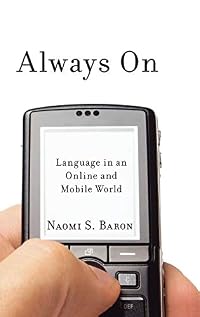
Always On: Language in an Online and Mobile World
by Naomi S. Baron
On This Page
Description
Baron reveals that online and mobile technologies--including instant messaging, cell phones, multitasking, Facebook, blogs, and wikis--are profoundly influencing how we read and write, speak and listen, but not in the ways we might suppose. She reveals that email, IM, and text messaging have had surprisingly little impact on student writing. More troubling is the myriad ways in which we block incoming IMs and screen incoming calls. Our ability to decide who to talk to, she argues, is likely show more to be have a lasting influence on the way we communicate with one another. Also, what kind of people will we become if the relationships we form must increasingly compete for our attention with digital media?. show lessTags
Recommendations








Member Reviews
Baron, Naomi S. Always On: Language in an Online and Mobile World. Oxford University Press, 2008.
Will the English language survive our text and tweet linguistic innovations? Naomi Baron says, yes, mostly. Always On reports on an intriguing experiment. Baron collected months of online posts by a group of college students and analyzed them for acronyms and other linguistic features. She may have expected more nonstandard language than she found. She concludes that the English sentence will survive our new short-form communication. That is refreshing to hear. Is the book especially well written? Not really. The research was already four-years old when the book was published. It would be fun to see a second edition with fresh data, but I show more doubt that will happen. 4 stars, and still worth a look. show less
Will the English language survive our text and tweet linguistic innovations? Naomi Baron says, yes, mostly. Always On reports on an intriguing experiment. Baron collected months of online posts by a group of college students and analyzed them for acronyms and other linguistic features. She may have expected more nonstandard language than she found. She concludes that the English sentence will survive our new short-form communication. That is refreshing to hear. Is the book especially well written? Not really. The research was already four-years old when the book was published. It would be fun to see a second edition with fresh data, but I show more doubt that will happen. 4 stars, and still worth a look. show less
An excellent study on the impact of our constant connection via communications technology. Though a linguist by trade, Baron presents a comprehensive study of the issue. It would be difficult to read this book and not be convinced that new media technology is fundamentally changing the way we relate to one another in the world today.
Ratings
Members
- Recently Added By
Published Reviews
ThingScore 75
Speed, ultimately, is Baron's deep concern. If you pick up the pace at which it's possible to write and read—and at which it's considered normal to write and read—do you inherently damage the processes? Has hastening the rate at which writers create text undermined the attributes of written culture, especially the cognitive depth that writing and reading can bestow? She fears so.
added by Shortride
Author Information
13+ Works 375 Members
Naomi S. Baron is Professor of Linguistics and Executive Director of the Center for Teaching, Research, and Learning at American University in Washington, DC. She is the author of seven earlier books on language. Her book Always On: Language in an Online and Mobile World received the 2008 English-Speaking Union Duke of Edinburgh English Language show more Book Award. show less
Common Knowledge
- Dedication
- To the American University Library
(the heart of the university) - Blurbers
- Tannen, Deborah; Herring, Susan C.; Wellman, Barry; Ling, Rich
Classifications
- Genres
- Nonfiction, Technology, General Nonfiction
- DDC/MDS
- 401.4 — Language Language Philosophy and theory; international languages Communication; semantics, pragmatics, languages for special purposes
- LCC
- P107 .B37 — Language and Literature Philology. Linguistics Language. Linguistic theory. Comparative grammar
- BISAC
Statistics
- Members
- 86
- Popularity
- 370,389
- Reviews
- 2
- Rating
- (4.38)
- Languages
- English
- Media
- Paper, Ebook
- ISBNs
- 6
- ASINs
- 1