660 Curries
by Raghavan Iyer
On This Page
Description
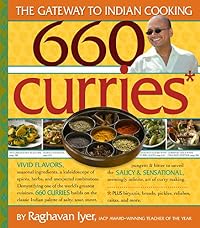
Curry is Salmon with Garlic and Turmeric. Curry is Grilled Chicken with Cashew-Tomato Sauce. Curry is Asparagus with Tomato and Crumbled Paneer. Curry is Lamb with Yellow Split Peas, Chunky Potatoes with Spinach, Tamarind Shrimp with Coconut Milk, Baby Back Ribs with a Sweet-Sour Glaze and Vinegar Sauce, Basmati Rice with Fragrant Curry Leaves. Curry is vivid flavors, seasonal ingredients, a kaleidoscope of spices and unexpected combinations. And "660 Curries" is the gateway to the world of show more Indian cooking, demystifying one of the world's great cuisines. Presented by the IACP award-winning Cooking Teacher of the Year (2004), Raghavan Iyer, "660 Curries" is a joyous food-lover's extravaganza. Mr. Iyer first grounds us in the building blocks of Indian flavors-the interplay of sour (like tomatoes or yogurt), salty, sweet, pungent (peppercorns, chiles), bitter, and the quality of unami (seeds, coconuts, and the like). Then, from this basic palette, he unveils an infinite art. There are appetizers-Spinach Fritters, Lentil Dumplings in a Buttermilk Coconut Sauce-and main courses-Chicken with Lemongrass and Kaffir-Lime Leaves, Lamb Loin Chops with an Apricot Sauce. Cheese dishes-Pan-Fried Cheese with Cauliflower and Cilantro; bean dishes-Lentil Stew with Cumin and Cayenne. And hundreds of vegetable dishes-Sweet Corn with Cumin and Chiles, Chunky Potatoes with Golden Raisins, Baby Eggplant Stuffed with Cashew Nuts and Spices. There are traditional, regional curries from around the subcontinent and contemporary curries. Plus, all the extras: biryanis, breads, rice dishes, raitas, spice pastes and blends, and rubs. show lessTags
Recommendations






Member Reviews
This is rapidly becoming one of my favorite cookbooks -- after owning it for two weeks I've already made three dishes. The variety of dishes is astonishing both in region and in complexity, and Iyer's personality and the tone of the book makes it a joy to flip through. The book is not just curries; the final chapter, "curry cohorts", includes breads, rice dishes, and other accompaniments to make a complete meal. Ingredients that are likely to be unfamiliar are all described in a glossary in the back, which is not uncommon; what sets this book apart for me is the simple fact that Iyer references the glossary each time the ingredients are mentioned, for ease of flipping.
If you love Indian food and love to cook, you will love this cookbook. If you are someone looking for easy recipes, or someone who does not like to spend a lot of time in the kitchen - this is probably not the cookbook for you.
I find this cookbook absolutely amazing, though. There are enough recipes here to try something new every night if you want! The recipes give very clear, specific instructions for working with types of ingredients you may not be familiar with. Iyer tells you the history of the recipes, describes unusual ingredients, and tells you where to find them and what will work as a substitute (or in some cases, what won't).
Many of the spice blends you'll use, you will have to make yourself. Although the spice blends are show more always delicious and pungent, be prepared that some are time-consuming to make. Don't try to make them without a spice blender - we didn't have one at first, but hand-grinding these spices in a mortar is NOT a good use of your time. You can get a decent spice grinder at most kitchen stores for $15-$20. You also generally won't need to make the whole spice blend recipe - he often gives recipes for creating 1-2 cups of a spice blend, when most recipes call for 1-2 tbsps at most. Obviously you can save the blend and use it later, so how much you make should be determined in part by just how much Indian food you plan to cook. On the other hand, it's worth making plenty of ghee and garlic paste from the outset, as both can be saved (in the fridge or your freezer) for use later, and they are time-consuming to make.
We've also found that Iyer goes pretty heavy on the salt. After the first few overly-salty meals, we've adopted the habit of always using between 1/2 and 2/3 the amount of salt he calls for. This seems to work great, making the dishes less obviously salty, and a good bit more heart-healthy. He also calls for fresh coconut frequently. We've found that the effort in using fresh coconut is not worth the pay-off. Substitute dried coconut (from the baking aisle) or for sauces, unsweetened canned coconut milk, and the recipes still come out great.
The book is broken down by the primary ingredient in each recipe (poultry vs. beef vs. vegetables vs. legumes). With a vegetarian in our house, we've so far found that most of the meat recipes are amenable to substitution with veggies or else meat replacement products (i.e. Quorn, Morningstar, seitan) and come out just as yummy. Many of the chicken recipes call for a whole bird, but I've also found that pre-packaged skinless, boneless chicken breast will work well in most cases - just reduce the cooking time appropriately.
Although we've enjoyed every recipe we've made out of this book, some are more worth the time than others. Most of the recipes are fairly time consuming, so an otherwise tasty meal can disappoint if you've spent an hour or two in the kitchen. Some of our favorites are the Bolly Colly, the Garlic Infused Split Black Lentils, and the Coconut Chicken with Potatoes. On the other hand, we found the Stuffed Anaheim Peppers and the Spicy Banana Peppers to be tasty, but not worth the time and effort we had to put in. On average, you can expect each recipe here to take ~45 minutes combined prep/cook time. With two cooks in our kitchen, we can generally make two recipes from this book simultaneously in about an hour or so. show less
I find this cookbook absolutely amazing, though. There are enough recipes here to try something new every night if you want! The recipes give very clear, specific instructions for working with types of ingredients you may not be familiar with. Iyer tells you the history of the recipes, describes unusual ingredients, and tells you where to find them and what will work as a substitute (or in some cases, what won't).
Many of the spice blends you'll use, you will have to make yourself. Although the spice blends are show more always delicious and pungent, be prepared that some are time-consuming to make. Don't try to make them without a spice blender - we didn't have one at first, but hand-grinding these spices in a mortar is NOT a good use of your time. You can get a decent spice grinder at most kitchen stores for $15-$20. You also generally won't need to make the whole spice blend recipe - he often gives recipes for creating 1-2 cups of a spice blend, when most recipes call for 1-2 tbsps at most. Obviously you can save the blend and use it later, so how much you make should be determined in part by just how much Indian food you plan to cook. On the other hand, it's worth making plenty of ghee and garlic paste from the outset, as both can be saved (in the fridge or your freezer) for use later, and they are time-consuming to make.
We've also found that Iyer goes pretty heavy on the salt. After the first few overly-salty meals, we've adopted the habit of always using between 1/2 and 2/3 the amount of salt he calls for. This seems to work great, making the dishes less obviously salty, and a good bit more heart-healthy. He also calls for fresh coconut frequently. We've found that the effort in using fresh coconut is not worth the pay-off. Substitute dried coconut (from the baking aisle) or for sauces, unsweetened canned coconut milk, and the recipes still come out great.
The book is broken down by the primary ingredient in each recipe (poultry vs. beef vs. vegetables vs. legumes). With a vegetarian in our house, we've so far found that most of the meat recipes are amenable to substitution with veggies or else meat replacement products (i.e. Quorn, Morningstar, seitan) and come out just as yummy. Many of the chicken recipes call for a whole bird, but I've also found that pre-packaged skinless, boneless chicken breast will work well in most cases - just reduce the cooking time appropriately.
Although we've enjoyed every recipe we've made out of this book, some are more worth the time than others. Most of the recipes are fairly time consuming, so an otherwise tasty meal can disappoint if you've spent an hour or two in the kitchen. Some of our favorites are the Bolly Colly, the Garlic Infused Split Black Lentils, and the Coconut Chicken with Potatoes. On the other hand, we found the Stuffed Anaheim Peppers and the Spicy Banana Peppers to be tasty, but not worth the time and effort we had to put in. On average, you can expect each recipe here to take ~45 minutes combined prep/cook time. With two cooks in our kitchen, we can generally make two recipes from this book simultaneously in about an hour or so. show less
If you can follow directions, you can make good, flavorful food using this cookbook. That's really all there is to say.
While some of the recipes require a lot of ingredients, many of which you may not already own, the directions are all clear and largely unambiguous: you may not need to read the author's advice on how to clean lentils every time you cook with them, but they're in each of the dozens of recipes that uses them, so no cross-referencing is needed and you can easily skip over the redundant parts in future readings. Since buying this book and starting to make some of the recipes in it, the guy at the Indian grocery shop around the corner has started to recognize me: there is always another recipe that I want to try and some show more new spice that I need to have to put in it.
The only flaw I've found is that in some of the recipes the timing is a bit off: I managed to burn some onions by paying too much attention to the timer and not enough attention to the onions themselves. Also, the book emphasizes making things from scratch, which is nice, but you might want to cheat a bit and use prepackaged spice blends or whatever in some circumstances.
I'm a vegetarian, so I've ignored the sections in the book dealing with meat and fish. The book is comprehensive enough that even ignoring a large portion of the book leaves a ton of things that I want to make. And I guess that's sufficiently high praise that I might as well stop at that. show less
While some of the recipes require a lot of ingredients, many of which you may not already own, the directions are all clear and largely unambiguous: you may not need to read the author's advice on how to clean lentils every time you cook with them, but they're in each of the dozens of recipes that uses them, so no cross-referencing is needed and you can easily skip over the redundant parts in future readings. Since buying this book and starting to make some of the recipes in it, the guy at the Indian grocery shop around the corner has started to recognize me: there is always another recipe that I want to try and some show more new spice that I need to have to put in it.
The only flaw I've found is that in some of the recipes the timing is a bit off: I managed to burn some onions by paying too much attention to the timer and not enough attention to the onions themselves. Also, the book emphasizes making things from scratch, which is nice, but you might want to cheat a bit and use prepackaged spice blends or whatever in some circumstances.
I'm a vegetarian, so I've ignored the sections in the book dealing with meat and fish. The book is comprehensive enough that even ignoring a large portion of the book leaves a ton of things that I want to make. And I guess that's sufficiently high praise that I might as well stop at that. show less
For a cookbook, a great read. I found an Indian grocery store, bought a bunch of interesting looking ingredients (fenugreek anyone?) and made my first curry. I scaled the chili waaaayyyy back, and had a marvelous dinner. All of the recipes I've tried so far have been marvelous!
In the front cover of the book it gives a definition of curry -"any dish that consisits of either meat, fish, poultry, legumes, vegetables or fruits, simmered in or covered with a sauce, gravy or other liquid that is redolent with any number of freshly ground and very fragrant spices and/or herbs."
I bought this book because it was recommended on one of the blogs that I read, and was one of the books that was on the top of our very long wish list, so when I saw it at the book store I had to get it. All I can way is WOW.
It is nicely organized with a paragragh before each recipe with a bit of background on the recipe. The begining of the book is devoted to spice blends and pastes which are the foundations of many of the curries. There are show more 24 curries for paneer (a type of homemade cheese), there are almost 150 pages of legume curries and almost 200 pages of vegetable curries, and this is not counting the recipes that can be found in the appetizer or other sections. There is a section called "curry cohorts" which has recipes for rices dishes, noodles, breads, and other things to make to accompany your curries, including a recipe for Mango Cadamom Cheesecake which I can't wait to try. There is glossary of ingredients at the back of the book, including a very helpful 'shopping Cheat Sheet' which gives the English name and then the Hindi name which is helpful when shopping at the ethnic grocery. There is a small bibliography and what looks to be a very thorough index which I like a lot in a cookbook since often am looking in the index for a recipe with a certain ingredient.
Oh, yeah and the receipes that I have tried were really good and there are about 40 more recipes that ijust HAVE to try. show less
I bought this book because it was recommended on one of the blogs that I read, and was one of the books that was on the top of our very long wish list, so when I saw it at the book store I had to get it. All I can way is WOW.
It is nicely organized with a paragragh before each recipe with a bit of background on the recipe. The begining of the book is devoted to spice blends and pastes which are the foundations of many of the curries. There are show more 24 curries for paneer (a type of homemade cheese), there are almost 150 pages of legume curries and almost 200 pages of vegetable curries, and this is not counting the recipes that can be found in the appetizer or other sections. There is a section called "curry cohorts" which has recipes for rices dishes, noodles, breads, and other things to make to accompany your curries, including a recipe for Mango Cadamom Cheesecake which I can't wait to try. There is glossary of ingredients at the back of the book, including a very helpful 'shopping Cheat Sheet' which gives the English name and then the Hindi name which is helpful when shopping at the ethnic grocery. There is a small bibliography and what looks to be a very thorough index which I like a lot in a cookbook since often am looking in the index for a recipe with a certain ingredient.
Oh, yeah and the receipes that I have tried were really good and there are about 40 more recipes that ijust HAVE to try. show less
One of the great things about having so many recipes is that you can look through the book to see what new and interesting things you can do with whatever ingredients you happen to have on hand at home. Some of the supplies can be hard to find, and the store that he recommends in the book has gone out of business. Maybe there is a good mail-order supplier that someone could share?
Ratings
Members
- Recently Added By
Author Information
6+ Works 736 Members
Raghavan Iyer came to the United States in 1982, at the age of twenty-one. A chef, caterer, and cooking instructor based in Minneapolis, He is the owner of The Essence of Thyme, and also the cofounder of the Asian Culinary Arts Institutes.
Awards and Honors
Distinctions
Common Knowledge
- Original publication date
- 2008
- Important places
- India
- Dedication
- My mother's death, before she could see the finished book, deeply saddens me. I take solace in her memory, kept alive through some of her saucy offerings which you'll find in these pages.
What fulfills me is my almost-... (show all)nine-year-old son, Robert, who is unconditionally the best thing that has happened to me in my 46 years of living. He tasted all of the recipes in this book (extraordinarily commendable when I tell you all the testing happened during the fourth, fifth, and sixth years of his life.)
So I dedicate this book to a generation that slipped away, and one that continues to spice up my life every step of the way. And to my partner of twenty-five years, Terry Erickson, who has supported me through all my ups and downs. - First words
- As a naïve twenty-one-year-old, I found myself enrolled in a program in hotel, restaurant, and institutional management in my newly adopted country, the United States.
- Blurbers
- Kasper, Lynne Rossetto; Jaffrey, Madhur
Classifications
Statistics
- Members
- 351
- Popularity
- 88,991
- Reviews
- 6
- Rating
- (4.46)
- Languages
- English
- Media
- Paper, Ebook
- ISBNs
- 3
- UPCs
- 2
- ASINs
- 3