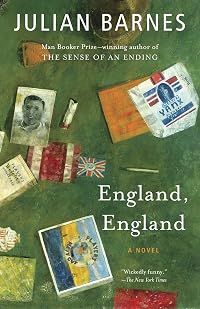
England, England
by Julian Barnes
On This Page
Description
What would happen if a tycoon decided to turn England into a theme park? Before anyone could say "Windsor Castle, " replicas of all of the kingdom's great landmarks from the Tower of London and Westminster Abbey to the National Gallery and everything in between all turn up in one place. And what if credit-worthy tourist could escape to this island that permits vast expense accounts and prohibits paparazzi? This hilarious notion is the premise of acclaimed novelist Julian Barnes's (Flaubert's show more Parrot) simultaneously funny and moving comic romp, England, England. The Sunday Times (London) raved: "There is no more intelligent writer on the literary scene, " and this witty, wistful, thoroughly wonderful book is ample proof.. show less
Tags
Recommendations













Member Recommendations


Member Reviews
I really enjoyed this satirical look at tourism, capitalism and our desire for instant gratification. The story revolves around a millionaire who buys the Isle of Wight and turns it into a theme park with all of England's attractions close at hand so that tourists don't have to "waste time" travelling long distances. Along the way, amidst a lot of humourous scenes, Mr. Barnes manages to raise serious issues of identity and community. So well done.
Like others, I was a bit unsettled by the way the book ends...it's gone from satire to more of a character-based story (it also started that way)...but after I'd finished the book, I appreciated the way the ending put the fantastic goings-on of the Island into a broader context. Recommended.
Like others, I was a bit unsettled by the way the book ends...it's gone from satire to more of a character-based story (it also started that way)...but after I'd finished the book, I appreciated the way the ending put the fantastic goings-on of the Island into a broader context. Recommended.
The theme park envisioned in Barnes’ story is Disneyesque with building replicas and hordes of park staff kitted out in costume, role-playing for the paying public. This story is a satirical swing at all things English, with Barnes exhibiting a mischievousness I never expected from him. This one has all of Barnes’ sharp observation, filled with greedy developers, pompous intellectuals and conniving business tycoons. If that is enough to capture your attention, Barnes embarks, through the satire, on a cutting attack on everything from England’s heritage industry, its politics and its role on the world stage to… you guessed it, he even takes a few swings at the monarchy. Wrapped up as a satirical search for authenticity in a world show more too willing to accept replicas over the real thing, it was easy for this reader to enjoy the story for the fictional romp it is, and fob off any underlying messaging for other readers to angst over. At least, I was able to do exactly that until Barnes decides in the last section when Barnes took away my cartoonish satirical read and landed me – via the ruminations of a considerably older Martha - squarely into frump and ponderous territory. Darn it all, Barnes was determined to make his readers sit up and pay attention to his underlying messaging after all, which is that searching for authenticity in an increasingly unauthentic world is worth pursuing. Point taken, Julian. Now how about giving us more of the madcap satire I enjoyed so much? show less
This was a Booker Prize finalist for 1998. It is a fairly clever satire, taking on memory, and what is real and what is not. In our world, where entertainment is everywhere, do we appreciate the reproduction more than the real thing? In the first part, Martha is a precocious child trying to define her first memory, and trying to come to terms with the disappearance of her father who has left her mother. In the second part, the now 39 year old Martha is hired to become the Special Consultant / Cynic for the wealthy egomaniacal Sir Jack Pitman. (I kept thinking about Donald Trump, because of a review I had read before starting the book). Jack wants to have one last "great idea", and decides to take over the Isle of Wight and turn it into show more a replica of England. England, England would have all of England's history complete with half sized replicas of all things England including Harrod's conveniently located in the Tower of London, Big Ben, Stonehenge, Robin Hood, The Battle of Britain and many other things British. His idea was that tourists could experience everything in a few days without actually having to go to all of the real places. His researchers determine that tourists would enjoy faux England more than the real thing because their memory of the real thing is flawed anyway, and any differences will go unnoticed. His idea works, that is until it doesn't. Some of the characters begin taking their roles too seriously, and Martha takes the blame for the mayhem that ensues. As England, England grows in popularity, "old" England declines and reverts back to a simpler way of life, without the trappings of a commercialized tourist driven economy. At the end of the book, Martha is back in "old" England and once again thinking about memory, happiness, and contentment.
Just a quick comment, I am not a prude when it comes to sexual scenes in books, but there was one particularly perverted sexual fantasy played out that I could have done without. I can say that I enjoyed the book, but I can't say that I loved it. The writing is very good and there are some very humorous scenes, but as a whole, it left me feeling a little flat. show less
Just a quick comment, I am not a prude when it comes to sexual scenes in books, but there was one particularly perverted sexual fantasy played out that I could have done without. I can say that I enjoyed the book, but I can't say that I loved it. The writing is very good and there are some very humorous scenes, but as a whole, it left me feeling a little flat. show less
Funnier the first time I read it, over 15 years ago, in an pre-Trump era; now it's a bit less funny and a bit more sad. A smart Everywoman, disillusioned in love at an early age when her father leaves, takes control of a corporate world that is a nation-state unto itself, an England more English than England, on the Isle of Wight: a theme park that celebrates history as photo collage with fun captions. It continues the theme of historical fiction presented in Flaubert's Parrot: how all history is fictionalized to various extents, and all our fictions have a history. Also continued are themes of lovers ennui, despair as way of life, and what makes truth truthful in the larger context. Some easy shots, a bit snarky in places, but redeemed show more by the main character, who is really the only character with development. show less
Simulacrums, satire, and Sir Jack Pitman. Excellent. 2 for 2 with Mr. Barnes now (also read Arthur and George recently and really liked it). Well fleshed out characters, a wonderfully absurd premise, and one of the most finely crafted relationships I've read in a long time.
Written in 1998, Julian Barnes’ Booker Prize finalist, England, England, presages much of what is going on today culturally given our affinity for facsimile over authenticity (see Friends, Facebook). In this satirically written novel, the Isle of Wight has been liberated from England and all of that country's major attractions (Stonehenge, Harrod’s, quaint pubs, et al.) have been recreated on the apolitical Island at half scale and concentrated for maximum visitor experience at premium expense (see Casinos, Las Vegas). Depleted of its tourist income, jolly ol' England is stripped of its grandeur but in time returns to a bucolic state where humans and nature co-exist in balance. This harmony is a stark contrast to the "new" England's show more superficiality and consumerism. Clearly, the reader is presented with a lifestyle choice (see Virtual or Reality). Full of farce, England, England is a tour de force. show less
What: A megalomaniac billionaire decides to recreate an idealized England, and its history, on the Isle of Wight as a one-stop tourist destination.
Why: For the January TIOLI Challenge to read a book with a duplicate word in its title. Also highly recommended by my best friend several years ago.
How: I had difficulty settling into this satirical look at identity, authenticity and nationalism. None of the characters were particularly engaging; the “heroine,” Martha Cochrane, is a rather morose and cynical figure, though she is introduced in the first chapter in an engaging and touching look at her childhood. The parts of the book dealing with the conceptualization and opening of the faux England had some wonderful, funny moments but show more as a whole, the book was inconsistent. There were times where I felt Barnes was trying too hard to go over the top and get his point across where I would have preferred a more subtle approach. The end of the novel provides a seeming antidote to the rest of the book but one is left to question the actual authenticity of the pastoral world to which Martha ultimately retreats. It is easy to imagine another megalomaniac billionaire coming along and marketing Anglia as the next big thing. England, England is a study of the inherent paradox of trying to construct an authentic existence, especially in a post-modern society more concerned with personal comfort and convenience than genuine interaction with the world around it.
Because I think I might have enjoyed this book more at a different time, and because it was laugh out loud funny in (too few) parts, I am giving it a hopeful 3 stars and keeping it on my shelves for a possible re-read. show less
Why: For the January TIOLI Challenge to read a book with a duplicate word in its title. Also highly recommended by my best friend several years ago.
How: I had difficulty settling into this satirical look at identity, authenticity and nationalism. None of the characters were particularly engaging; the “heroine,” Martha Cochrane, is a rather morose and cynical figure, though she is introduced in the first chapter in an engaging and touching look at her childhood. The parts of the book dealing with the conceptualization and opening of the faux England had some wonderful, funny moments but show more as a whole, the book was inconsistent. There were times where I felt Barnes was trying too hard to go over the top and get his point across where I would have preferred a more subtle approach. The end of the novel provides a seeming antidote to the rest of the book but one is left to question the actual authenticity of the pastoral world to which Martha ultimately retreats. It is easy to imagine another megalomaniac billionaire coming along and marketing Anglia as the next big thing. England, England is a study of the inherent paradox of trying to construct an authentic existence, especially in a post-modern society more concerned with personal comfort and convenience than genuine interaction with the world around it.
Because I think I might have enjoyed this book more at a different time, and because it was laugh out loud funny in (too few) parts, I am giving it a hopeful 3 stars and keeping it on my shelves for a possible re-read. show less
Members
- Recently Added By
Published Reviews
ThingScore 67
Mit liebevoll zynischem Blick stellt Barnes in "England, England" einen ganzen Strauß von philosophischen, politischen und gesellschaftlichen Zeitphänomenen zusammen. Beispielsweise gehören die wenig familienverträglichen Reflexionen des angestellten Historikers Dr. Max über den Mythos des Freiheitskämpfers Robin Hood - über den jede und jeder Bescheid zu wissen glaubt - sicher zu den show more humorigen Glanzlichtern des Romans. Gelungen ist Barnes so eine komisch-absurde Satire auf die Ferienpark-Industrie und das allseits propagierte Primat der Ökonomie unter neoliberalen Vorzeichen. show less
added by Indy133
Barnes uses his copious talents as a writer -- his lapidary prose, his eye for the askew detail, his ear for the circumlocutions of contemporary speech -- to turn the saga of England, England into an uproarious farce that mocks both our postmodernist suspicion of the authentic and our Disney-like willingness to turn that embrace of the ersatz into a money-making machine. He examines the show more arbitrary nature of history writing and the cyclical nature of history, and he satirizes the ideas that the English hold about themselves. show less
added by Nickelini
A mischievous satire on the marketing of illusion and a trenchant analysis of a rootless woman’s interrupted pursuit of authenticity are joined in a highly original way in this consummately entertaining novel, the eighth by the dependably clever British author.
added by Nickelini
Lists

Booker Prize
491 works; 62 members

Books Set in Great Britain
191 works; 13 members

Best Satire
188 works; 29 members
Booker Prize Shortlist: Titles Read
103 works; 10 members

Man Booker Prize Longlist 1998
6 works; 2 members

United Kingdom
82 works; 5 members

Novels that you shouldn't waste your time on
94 works; 52 members

Books With Place Names in the Title
257 works; 11 members

Stories Set at Carnivals, Circuses, and Theme Parks
39 works; 6 members

Books Read in 2026
2,083 works; 69 members
Author Information

89+ Works 43,141 Members
Julian Barnes was born in Leicester, England, on January 19, 1946. He received a degree in modern languages from Magdalen College, Oxford University in 1968. He has held jobs as a lexicographer for the Oxford English Dictionary, a reviewer and literary editor for the New Statesmen and the New Review, and a television critic. He has written show more numerous works of fiction including Arthur and George, Pulse: Stories, The Noise of Time, and England, England. He received the Somerset Maugham Award in 1980 for Metroland, the Geoffrey Faber Memorial Prize in 1985 and a Prix Medicis in 1986 for Flaubert's Parrot, and the Man Booker Prize in 2011 for The Sense of an Ending. He also writes non-fiction works including Letters from London, The Pedant in the Kitchen, and Nothing to Be Frightened Of. He received the Shakespeare Prize by the FVS Foundation in 1993, the Austrian State Prize for European Literature in 2004, and the David Cohen Prize for Literature in 2011. He writes detective novels under the pseudonym Dan Kavanaugh. His works under this name include Duffy, Fiddle City, Putting the Boot In, and Going to the Dogs. (Bowker Author Biography) show less
Some Editions
Awards and Honors
Series
Belongs to Publisher Series
A tot vent (379)
Gallimard, Folio (3604)
Common Knowledge
- Canonical title
- England, England
- Original title
- England, England
- Original publication date
- 1998
- People/Characters
- Jack Pitman; Martha Cochrane; Paul Harrison
- Important places
- Isle of Wight, England, UK; England, UK
- Epigraph
- [None]
- Dedication
- To Pat
- First words
- 'What's your first memory?' someone would ask.
- Quotations
- [The sleaze journalist's victim] felt initially calmed both by Gary's manner and by his lies.... Instead of suggestive pencil-licking, he made slow notes with a gold-nibbed fountain-pen, the sort of semi-antique that could be... (show all)come a talking-point ... And the tape-recorder would turn and turn - the likeable fountain-pen having long been put away ... By this time you had already signed the contract and seen the air-tickets.
- Last words
- (Click to show. Warning: May contain spoilers.)Martha Cochrane watched it for a few seconds, then got to her feet and began to descend the hill.
- Blurbers
- Carey, John; Cumming, Laura; Cunningham, Valentine; Fuentes, Carlos; Gordimer, Nadine; Lanchester, John (show all 8); Marr, Andrew; Rushdie, Salman
- Original language
- English
Classifications
Statistics
- Members
- 2,028
- Popularity
- 10,351
- Reviews
- 38
- Rating
- (3.27)
- Languages
- 14 — Catalan, Danish, Dutch, English, French, German, Hungarian, Italian, Portuguese, Romanian, Croatian, Spanish, Swedish, Turkish
- Media
- Paper, Audiobook, Ebook
- ISBNs
- 46
- UPCs
- 1
- ASINs
- 9