On This Page
Description
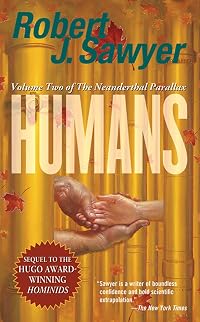
Robert J. Sawyer, the award-winning and bestselling writer, hits the peak of his powers in Humans, the second book of The Neanderthal ParallaxThe trilogy tells of our world and a parallel one in which it was the Homo sapiens who died out and the Neanderthals who became the dominant intelligent species. This powerful idea allows Sawyer to examine some of the deeply rooted assumptions of contemporary human civilization dramatically, by confronting us with another civilization, just as morally show more valid, that has made other choices. In Humans, Neanderthal physicist Ponter Boddit, a character you will never forget, returns to our world and to his relationship with geneticist Mary Vaughan, as cultural exchanges between the two Earths begin.
As we see daily life in another present-day world, radically different from ours, in the course of Sawyer's fast-moving story, we experience the bursts of wonder and enlightenment that are the finest pleasures of science fiction. Humans is one of the best SF novels of the year, and The Neanderthal Parallax is an SF classic in the making.
Humans is a 2004 Hugo Award Nominee for Best Novel.
At the Publisher's request, this title is being sold without Digital Rights Management Software (DRM) applied.
. show less
Tags
Recommendations





Member Reviews
Humans, the second novel in Robert J. Sawyer’s The Neanderthal Parallax series is more romance than science fiction complete with the mandatory steamy sex scene. Unfortunately the female lead in this romance story, Mary (Homo sapiens), provokes little interest. I personally found nothing especially admirable about her and actually found her somewhat annoying. The male lead, Ponter (Homo neanderthalensis), is more interesting, but even he seems to fluctuate from being scientifically objective, as one would expect for a prominent theoretical physicist, to emotionally unstable, which one would not. Romance isn’t a genre I read and maybe this kind of soap opera contrast is common in them but these are not the kind of personalities I show more look for in science fiction.
Personally, I didn’t find the social commentary in this book overly preachy, as did many other reviewers. Sawyer contrasts a low population, hunter-gatherer culture with ours, which has a high population and extensive farming. Each has good points and bad points and I don’t think he came down too hard on Western society. There are other problems with the premise though.
The one that perhaps most bothers me is that all the major characters seem to accept the hypothesis that “consciousness” somehow suddenly appeared 40,000 years ago. Such an astounding and counterintuitive assertion in science fiction is not uncommon but must have at least enough techno-babble to make it possible to suspend disbelief long enough to entertain the idea for the sake of the story. This book does not provide that. It’s stated as if this is a well-known and accepted scientific theory.
The other thing I find hard to accept is that a hunter-gatherer society can achieve the population density required for the individual specialization needed to achieve a high-tech society, which the Neanderthals in this book obviously have. In areas of artificial intelligence, their tech is well beyond ours, in fact, although their achievements in other areas are not. There is some techno-babble to explain this but it seems weak.
The prose is competent and the book is readable, but in the areas of plot and characters, I think it fails. Will I read the next in the series? Yes. The first book, Hominids, was interesting enough and I have hopes that the third is more like it. show less
Personally, I didn’t find the social commentary in this book overly preachy, as did many other reviewers. Sawyer contrasts a low population, hunter-gatherer culture with ours, which has a high population and extensive farming. Each has good points and bad points and I don’t think he came down too hard on Western society. There are other problems with the premise though.
The one that perhaps most bothers me is that all the major characters seem to accept the hypothesis that “consciousness” somehow suddenly appeared 40,000 years ago. Such an astounding and counterintuitive assertion in science fiction is not uncommon but must have at least enough techno-babble to make it possible to suspend disbelief long enough to entertain the idea for the sake of the story. This book does not provide that. It’s stated as if this is a well-known and accepted scientific theory.
The other thing I find hard to accept is that a hunter-gatherer society can achieve the population density required for the individual specialization needed to achieve a high-tech society, which the Neanderthals in this book obviously have. In areas of artificial intelligence, their tech is well beyond ours, in fact, although their achievements in other areas are not. There is some techno-babble to explain this but it seems weak.
The prose is competent and the book is readable, but in the areas of plot and characters, I think it fails. Will I read the next in the series? Yes. The first book, Hominids, was interesting enough and I have hopes that the third is more like it. show less
Robert J. Sawyer’s tenth novel, Hugo award-winning “Hominids” jump-starts a thoughtful and imaginative trilogy, “The Neanderthal Parallax”, which explores an alternate evolutionary stream where Neanderthals became the dominant intelligent species on the planet. Sawyer makes up for his somewhat lackluster prose with well-researched paleoanthropological information and theoretical physics played out by charming untraditional characters from two parallel universes. I recommend Sawyer’s trilogy for readers well-read in SF who seek challenging ideas that push the boundaries of cutting-edge science and alternate social practices. The trilogy explores the lives and cultures of two unique species of people, Homo sapiens and Homo show more neanderthalis, through the premise of existing parallel universes and what might happen if they “collided”. During a quantum-computing experiment, Ponter Boddit, a Neanderthal physicist, accidently pierces the barrier separating his universe from ours, plunging him into a land both familiar and strange. Having left behind his family, a mystery, and his colleague -- now accused of murder -- Ponter’s search for home forces him to navigate his way among the curious and suspicious “Gliksins” who have in his world been extinct for 40,000 years. In our universe it is his kind who have been extinct for so long.
All three books move at a ponderous pace before finally accelerating into high gear. In “Humans” this only happens by chapter 17 (about a hundred pages into the book).
Certainly Sawyer’s characters radiate warmth and evoke our sympathy, but they remain avatars to the main driver of the trilogy, Sawyer’s imaginative ideas in science and social paradigms. While there is nothing new about the idea of parallel universes, Sawyer uses it ingeniously to launch his premise, of an alternate evolution where Neanderthals inherited the “big leap forward” into higher-consciousness, in order to explore an alternate zeitgiest and to comment on our own. The world of the Neanderthals unfurls before us through the counterpoint intrigue of their universe and our own. Sawyer’s alternative societal choices, illustrated through Neanderthal culture show us by example the foolishness of some of our own paradigms, social taboos and prejudices as he explores concepts of morality, gender, faith and love. Author David Brin says: “The biggest job of science fiction is to portray the Other. To help us imagine the strange and see the familiar in eerie new ways. Nobody explores this territory more boldly than Robert Sawyer.” One of Sawyer’s most ingenius concepts is a society wherein females live together with their same-sex mate apart from males who live with their same-sex mate and then get together with their opposite-sex mate only part of each month at the right time to conceive (or not). Of course this is feasible because when women live together for any length of time, it has been shown that they develop synchronus menstral cycles. I found Sawyer’s treatment of this bisexual life-style sensitively and insightfully portrayed.
With respect to language, there is no special magic or brilliance to Sawyer’s writing, particularly in how he constructs his sentences or how he chooses to illustrate his worlds. The writing in Neanderthal Parallax runs lackluster with copious mundane detail, such as the colour of someone’s phone or the brand of potato chips. For instance, do I need to know that Mary had “become quite taken with Upstate Dairy’s Extreme Chocolate Milk, which, like the Fabulous Heluva Good French Onion Dip, wasn’t available in Toronto”? Do I care? There were also too many corny references for my taste to vernacular of our subculture, including “Star Trek” scenes. There are much more effective ways to illustrate a character’s predelictions than with clutter of this sort. In the second book, “Humans”, Sawyer’s passing reference to the demise of New York’s Trade towers appears dropped in gratuitously and, I found, trivialized the tragedy as a result. While this detail was no doubt intended to enrich his created world with a sense of concrete reality (not unlike many mainstream literery works) it also threw me, the reader, out of his “fictive dream” many a time. It detracted from the story’s compelling potential and slowed the pace considerably. There is a place and a method for adding this sort of detail. If simply dropped in, with an inkling of “self-cleverness”, such detail becomes trite and the reader’s involvement with the story is compromised. The reader becomes less participant and more observer. There is nothing wrong with reader as observer. Many classics, written in the “omniscient” voice (as opposed to limited third person) offset the inevitable distancing from the characters by seducing the reader with something else: vivid narrative rich in subtle, lyrical metaphor, evokative imagery or depth of theme. Sawyer provides none of these, so we are left with a need, a yearning for connection in some other way.
There are also times, many times, when Sawyer’s research overwhelms the story with a littany of expository information. For instance, when one of his characters is brutally attacked, permanently changing their physiology and consequently their mental behavior, instead of letting us witness the transformation in the character, we are presented with copious data from the character’s own research, as if Sawyer just had to include all the research he’d conducted on the subject. This, coupled with Sawyer’s mundane detail, reads more like a travelogue, a topography of life without its depth. Those few times when he seamlessly infuses information in story stand out as a result. Two examples include the utterly fascinationg discourse between Louise Benoit and Jock Krieger about CEMI theory and the conversation between neuroscientist Veronica Shannon and Ponter and Mary about the relationship of religious experience with brain chemistry, both in the third book, “Hybrids.” Sawyer seems to do best with dialogue, and some of it is clever. One example comes to mind in a scene between Mary and her Neanderthal friend, Bandra, where Mary defends Homo sapien’s right to breed: “I guess we believe that superseding the brutality of natural selection is the hallmark of civilization.”
To his credit, Sawyer’s “home-spun” style has its charm, providing us with some of that connection we yearn for through his characters. Sawyer’s main characters unfold with a realism that evokes strong empathy in the reader. I like his characters, pimples and all. I particularly like how he has tapped into his geographic heritage to give us full-bodied characters with uniquely Canadian backgrounds, like Louise Benoit, the statuesque French Canadian post-doc in quantum physics.
Sawyer’s greatest skill as a fiction writer lies in how he marries his ordinary people in an ordinary world to extraordinary ideas and circumstance. And it is for this reason, I think, that he time and again arouses wide public readership and continues to be nominated and to win Hugos and Nebulas. The Neanderthal Parallax is no different. I recommend this trilogy for not only Sawyer’s interesting thoughts on paleoantrhopology and quantum theory but for the questions he raises about how we define our humanity. This is good classic SF. Sawyer’s “Neanderthal Parallax” incites intellectual thought and lingers like a rich flavourful coffee. show less
All three books move at a ponderous pace before finally accelerating into high gear. In “Humans” this only happens by chapter 17 (about a hundred pages into the book).
Certainly Sawyer’s characters radiate warmth and evoke our sympathy, but they remain avatars to the main driver of the trilogy, Sawyer’s imaginative ideas in science and social paradigms. While there is nothing new about the idea of parallel universes, Sawyer uses it ingeniously to launch his premise, of an alternate evolution where Neanderthals inherited the “big leap forward” into higher-consciousness, in order to explore an alternate zeitgiest and to comment on our own. The world of the Neanderthals unfurls before us through the counterpoint intrigue of their universe and our own. Sawyer’s alternative societal choices, illustrated through Neanderthal culture show us by example the foolishness of some of our own paradigms, social taboos and prejudices as he explores concepts of morality, gender, faith and love. Author David Brin says: “The biggest job of science fiction is to portray the Other. To help us imagine the strange and see the familiar in eerie new ways. Nobody explores this territory more boldly than Robert Sawyer.” One of Sawyer’s most ingenius concepts is a society wherein females live together with their same-sex mate apart from males who live with their same-sex mate and then get together with their opposite-sex mate only part of each month at the right time to conceive (or not). Of course this is feasible because when women live together for any length of time, it has been shown that they develop synchronus menstral cycles. I found Sawyer’s treatment of this bisexual life-style sensitively and insightfully portrayed.
With respect to language, there is no special magic or brilliance to Sawyer’s writing, particularly in how he constructs his sentences or how he chooses to illustrate his worlds. The writing in Neanderthal Parallax runs lackluster with copious mundane detail, such as the colour of someone’s phone or the brand of potato chips. For instance, do I need to know that Mary had “become quite taken with Upstate Dairy’s Extreme Chocolate Milk, which, like the Fabulous Heluva Good French Onion Dip, wasn’t available in Toronto”? Do I care? There were also too many corny references for my taste to vernacular of our subculture, including “Star Trek” scenes. There are much more effective ways to illustrate a character’s predelictions than with clutter of this sort. In the second book, “Humans”, Sawyer’s passing reference to the demise of New York’s Trade towers appears dropped in gratuitously and, I found, trivialized the tragedy as a result. While this detail was no doubt intended to enrich his created world with a sense of concrete reality (not unlike many mainstream literery works) it also threw me, the reader, out of his “fictive dream” many a time. It detracted from the story’s compelling potential and slowed the pace considerably. There is a place and a method for adding this sort of detail. If simply dropped in, with an inkling of “self-cleverness”, such detail becomes trite and the reader’s involvement with the story is compromised. The reader becomes less participant and more observer. There is nothing wrong with reader as observer. Many classics, written in the “omniscient” voice (as opposed to limited third person) offset the inevitable distancing from the characters by seducing the reader with something else: vivid narrative rich in subtle, lyrical metaphor, evokative imagery or depth of theme. Sawyer provides none of these, so we are left with a need, a yearning for connection in some other way.
There are also times, many times, when Sawyer’s research overwhelms the story with a littany of expository information. For instance, when one of his characters is brutally attacked, permanently changing their physiology and consequently their mental behavior, instead of letting us witness the transformation in the character, we are presented with copious data from the character’s own research, as if Sawyer just had to include all the research he’d conducted on the subject. This, coupled with Sawyer’s mundane detail, reads more like a travelogue, a topography of life without its depth. Those few times when he seamlessly infuses information in story stand out as a result. Two examples include the utterly fascinationg discourse between Louise Benoit and Jock Krieger about CEMI theory and the conversation between neuroscientist Veronica Shannon and Ponter and Mary about the relationship of religious experience with brain chemistry, both in the third book, “Hybrids.” Sawyer seems to do best with dialogue, and some of it is clever. One example comes to mind in a scene between Mary and her Neanderthal friend, Bandra, where Mary defends Homo sapien’s right to breed: “I guess we believe that superseding the brutality of natural selection is the hallmark of civilization.”
To his credit, Sawyer’s “home-spun” style has its charm, providing us with some of that connection we yearn for through his characters. Sawyer’s main characters unfold with a realism that evokes strong empathy in the reader. I like his characters, pimples and all. I particularly like how he has tapped into his geographic heritage to give us full-bodied characters with uniquely Canadian backgrounds, like Louise Benoit, the statuesque French Canadian post-doc in quantum physics.
Sawyer’s greatest skill as a fiction writer lies in how he marries his ordinary people in an ordinary world to extraordinary ideas and circumstance. And it is for this reason, I think, that he time and again arouses wide public readership and continues to be nominated and to win Hugos and Nebulas. The Neanderthal Parallax is no different. I recommend this trilogy for not only Sawyer’s interesting thoughts on paleoantrhopology and quantum theory but for the questions he raises about how we define our humanity. This is good classic SF. Sawyer’s “Neanderthal Parallax” incites intellectual thought and lingers like a rich flavourful coffee. show less
Note: This review is from several years ago, I'm guessing 2005 or 2006. Clearly I had a very different reaction to Humans[bc:Humans|337008|Humans (Neanderthal Parallax, #2)|Robert J. Sawyer|https://d202m5krfqbpi5.cloudfront.net/books/1388561714s/337008.jpg|327441] than to Hominids[bc:Hominids|264946|Hominids (Neanderthal Parallax, #1)|Robert J. Sawyer|https://d202m5krfqbpi5.cloudfront.net/books/1389614019s/264946.jpg|1500323]. I have no idea whether the quality of the two books is really that different, or the change is in me, or whether Humans simply doesn't work out of sequence, but would work better if I read them in order.
This is a 2004 Hugo Award nominee for Best Novel. No, really, it is. You can check the website.
It's also the show more second of Sawyer's three novels about our kind of humans and Neanderthals from an alternate timeline. The Neanderthal physicist, Ponter Boddit, having safely returned home to the more civilized Neanderthal dimension, must of course get back, as quickly as possible, to our dimension and Mary Vaughn, geneticist and One True Love of Neanderthal physicists from alternate dimensions. And, also, incredibly naïve and stupid in how she tries to preserve DNA evidence of a rape in exactly the place that some of the logical suspects would most readily find it and recognize it.
There's a frame story here about Ponter's guilt-tripping afterwards, but it adds nothing. The first part of the book alternates between Ponter working to get back to our dimension, and Mary Vaughn accepting an extremely well-paid job in the US, both to get away from the scene of the rape, and to help prepare for the possible return of Ponter and many more Neanderthals. Once Ponter and a diplomatic delegation arrive, we get the necessary reminders of how much less civilized we are than the Neanderthals, and the critical events brought about only by Mary Vaughn's lack of common sense in evidence-preservation occur. And then Ponter takes Mary to the Neanderthal dimension, where Mary meets Ponter's children, Ponter's male partner, Ponter's late wife's female partner, etc., with predictable angst all around. The whole wavers between mildly interesting and annoying, and it's not really helped by the threatened end of human intelligence (our kind of humans) due imminent magnetic field reversal. show less
This is a 2004 Hugo Award nominee for Best Novel. No, really, it is. You can check the website.
It's also the show more second of Sawyer's three novels about our kind of humans and Neanderthals from an alternate timeline. The Neanderthal physicist, Ponter Boddit, having safely returned home to the more civilized Neanderthal dimension, must of course get back, as quickly as possible, to our dimension and Mary Vaughn, geneticist and One True Love of Neanderthal physicists from alternate dimensions. And, also, incredibly naïve and stupid in how she tries to preserve DNA evidence of a rape in exactly the place that some of the logical suspects would most readily find it and recognize it.
There's a frame story here about Ponter's guilt-tripping afterwards, but it adds nothing. The first part of the book alternates between Ponter working to get back to our dimension, and Mary Vaughn accepting an extremely well-paid job in the US, both to get away from the scene of the rape, and to help prepare for the possible return of Ponter and many more Neanderthals. Once Ponter and a diplomatic delegation arrive, we get the necessary reminders of how much less civilized we are than the Neanderthals, and the critical events brought about only by Mary Vaughn's lack of common sense in evidence-preservation occur. And then Ponter takes Mary to the Neanderthal dimension, where Mary meets Ponter's children, Ponter's male partner, Ponter's late wife's female partner, etc., with predictable angst all around. The whole wavers between mildly interesting and annoying, and it's not really helped by the threatened end of human intelligence (our kind of humans) due imminent magnetic field reversal. show less
Humans, by Robert Sawyer, is volume 2 in his Neanderthal Parallax trilogy. In volume one, two parallel universes were discovered in which modern humans existed as normal, but in the other, Neanderthal became the dominant humans while we had become extinct. Neanderthal advanced to a very high level and, in a scientific lab accident, created a portal between our two parallel universes inadvertently sending one of their own into our world. The contact between him and us and the efforts made to return to his universe was the story line of volume one.
In this volume, a dozen of Neanderthal’s finest scientists, artists, philosophers, government representatives, etc., pass through a device which they have created which keeps a portal open show more between their universe and our universe so the two worlds can pass between each other. This was in an effort to establish diplomatic contact and create a cultural exchange program of sorts to the mutual benefit of both worlds.
The second volume of any trilogy is frequently not as good as the first volume and this one is no exception. The uniqueness of the story is established in the first volume and the climax comes in the third volume. So, what is left for the second volume? Character development? Not really much here. Plot thickening? I can’t really say so.
There is a lot of human bashing going on in this volume, especially in conversations between Ponter Boddit, the Neanderthal, and Dr. Mary Vaughan, his human love interest. In these conversations everything from our exploitation of the environment to America’s involvement in Vietnam were criticized. One interesting point was discussed regarding humanity’s Agricultural Revolution. As the conversation went, one byproduct on it was overpopulation (in comparison to Neanderthal populations, who remained hunter/gatherers). Forests were chopped down for more farmlands, and animals were domesticated. A byproduct of this was various diseases associated with domesticated animals. Furthermore, a byproduct of agriculture was slavery, to provide the necessary labor force, in its various forms, such as sharecropping, peonage, feudalism, etc. The implication is such that we are destroying our world slowly but surely. This reminded me a lot of Elisabeth Kolbert’s book, The Sixth Extinction, in which she convincingly argues that we are, in fact, experiencing the world’s sixth mass extinction. If so, did our own Agricultural Revolution plant the seeds – sort of speak – of this mass extinction?
I disagree with some of the harsh criticisms from other reviewers of this book, it is still an enjoyable read. show less
In this volume, a dozen of Neanderthal’s finest scientists, artists, philosophers, government representatives, etc., pass through a device which they have created which keeps a portal open show more between their universe and our universe so the two worlds can pass between each other. This was in an effort to establish diplomatic contact and create a cultural exchange program of sorts to the mutual benefit of both worlds.
The second volume of any trilogy is frequently not as good as the first volume and this one is no exception. The uniqueness of the story is established in the first volume and the climax comes in the third volume. So, what is left for the second volume? Character development? Not really much here. Plot thickening? I can’t really say so.
There is a lot of human bashing going on in this volume, especially in conversations between Ponter Boddit, the Neanderthal, and Dr. Mary Vaughan, his human love interest. In these conversations everything from our exploitation of the environment to America’s involvement in Vietnam were criticized. One interesting point was discussed regarding humanity’s Agricultural Revolution. As the conversation went, one byproduct on it was overpopulation (in comparison to Neanderthal populations, who remained hunter/gatherers). Forests were chopped down for more farmlands, and animals were domesticated. A byproduct of this was various diseases associated with domesticated animals. Furthermore, a byproduct of agriculture was slavery, to provide the necessary labor force, in its various forms, such as sharecropping, peonage, feudalism, etc. The implication is such that we are destroying our world slowly but surely. This reminded me a lot of Elisabeth Kolbert’s book, The Sixth Extinction, in which she convincingly argues that we are, in fact, experiencing the world’s sixth mass extinction. If so, did our own Agricultural Revolution plant the seeds – sort of speak – of this mass extinction?
I disagree with some of the harsh criticisms from other reviewers of this book, it is still an enjoyable read. show less
I was a little surprised at how much I enjoyed this follow-up novel to 'Hominids'. What I like are the scientific explanations and discussions that are built into the stories. There is a lot of sociological discussion as well. Big things. The human-neanderthal romance that was begun in 'Hominids' becomes much more of a driver to the story. I see it as the vehicle that gets this story done. It doesn't really interest me. But the stuff around it does. For example I thought the scene at the Washington Mall where the woman explains the Vietnam Memorial was quite well done. To me, this second novel is as good or a little better than the first. The religious discussions are even interesting (mostly). I think the character development of show more several principals is well done. I was rather surprised at a few things as well. There is a mystery that involves a rape that was carried over from the first novel that is resolved by book's end here.
I was bothered by the technological advances of the neanderthals in the first book and it only gets worse in this one. Still, I'm looking forward to the final book of the trilogy, 'Hybrids'. I hope it doesn't let me down. show less
I was bothered by the technological advances of the neanderthals in the first book and it only gets worse in this one. Still, I'm looking forward to the final book of the trilogy, 'Hybrids'. I hope it doesn't let me down. show less
2.5 stars rounded up because I am going to finish the trilogy, and there are some interesting ideas hidden under the mess. Maybe it was better when it was new, and the ideas were ones that most of us hadn't thought enough about yet. But now, well, I agree with most of the negative reaction in this one star review:
https://www.goodreads.com/review/show/3913459027?book_show_action=true&from_...
The big thing that I disagree with is that the reviewer attributes the characters' perspectives to the author. For example, I'm pretty sure that Sawyer does *not* agree with Cornelius that Cornelius deserved the positions that Mary and the other women got.
Sawyer does say that most Christians don't believe in Satan. Mary, a fairly devout Catholic, show more says the concept is ridiculous. Of course Ponter and I think God is ridiculous, too... but anyway I'll have to look that up.
I also agree that if the President wants to declare war they should do so, not in their cozy office, but right in front of the Vietnam Veterans Memorial, the Wall. Take the responsibility for the next long list of names. I've been the the Wall and it is damned powerful... I know none of the names nor even families thereof, but still I cried. show less
https://www.goodreads.com/review/show/3913459027?book_show_action=true&from_...
The big thing that I disagree with is that the reviewer attributes the characters' perspectives to the author. For example, I'm pretty sure that Sawyer does *not* agree with Cornelius that Cornelius deserved the positions that Mary and the other women got.
Sawyer does say that most Christians don't believe in Satan. Mary, a fairly devout Catholic, show more says the concept is ridiculous. Of course Ponter and I think God is ridiculous, too... but anyway I'll have to look that up.
I also agree that if the President wants to declare war they should do so, not in their cozy office, but right in front of the Vietnam Veterans Memorial, the Wall. Take the responsibility for the next long list of names. I've been the the Wall and it is damned powerful... I know none of the names nor even families thereof, but still I cried. show less
Humans turns out to be a somewhat tepid follow-up to the fascinating Hominids. The story picks up where it left off in the previous book and revolves around the growing relationship between the Neanderthal Ponter and the human Mary (technically Neanderthals are also human, but for brevity’s sake I'm using the term to stand for Homo Sapiens). Mary travels with Ponter to her world as the portal between the two alternate Earths is opened up for trade. There we get a closer look at Neanderthal society as Mary tries to adjust to its norms. Ponter also finds that he has to come to term with how his time on our Earth and his love for Mary has changed him.
In terms of plot structure and inventiveness, Humans is inferior to its predecessor. show more Ponter and Mary aside, the other supporting characters don’t develop at all and seem to recede into the background. None of the new characters take on three dimensions. We don’t see much of Neanderthal society that we haven’t already seen before. Even the social and political ramifications of the establishment of links between the two worlds is avoided altogether. The only plot threads with any weight are those of the love between Ponter and Mary and Ponter’s growing ambiguity about religion – a concept he had initially dismissed as illogical and even detrimental to the functioning of a well-adjusted society. These are interesting themes but neither are handled well enough to give the book the kind of depth and pull of Hominids.
This is not to say that Humans is a poor read. Sawyer’s prose is as fluid and easy on the eye as ever, and our interest in this interweaving of the two Earths carries over from the first book. The urge to discover what happens next provides a powerful incentive to keep reading. All in all, it’s a decent read and forms a bridge to the third book that is sufficiently entertaining, for the reader to want to complete the journey. show less
In terms of plot structure and inventiveness, Humans is inferior to its predecessor. show more Ponter and Mary aside, the other supporting characters don’t develop at all and seem to recede into the background. None of the new characters take on three dimensions. We don’t see much of Neanderthal society that we haven’t already seen before. Even the social and political ramifications of the establishment of links between the two worlds is avoided altogether. The only plot threads with any weight are those of the love between Ponter and Mary and Ponter’s growing ambiguity about religion – a concept he had initially dismissed as illogical and even detrimental to the functioning of a well-adjusted society. These are interesting themes but neither are handled well enough to give the book the kind of depth and pull of Hominids.
This is not to say that Humans is a poor read. Sawyer’s prose is as fluid and easy on the eye as ever, and our interest in this interweaving of the two Earths carries over from the first book. The urge to discover what happens next provides a powerful incentive to keep reading. All in all, it’s a decent read and forms a bridge to the third book that is sufficiently entertaining, for the reader to want to complete the journey. show less
Members
- Recently Added By
Lists

Books Read in 2018
4,360 works; 110 members
Author Information

107+ Works 20,048 Members
Robert J. Sawyer was born in Ottawa on April 29, 1960, but raised in Toronto. In 1980, while still in high school, Sawyer submitted a short story to the the Rochester Museum and Science Center, which was running a contest for light show ideas. Sawyer didn't win, but the Museum purchased his story Motive anyway and it ran for 192 performances. show more Sawyer went on to attend Toronto's Ryerson Polytechnical Institute, majoring in Radio and Television Arts. In September 1979, he had his first piece of fiction published at the end of his first year, in Ryerson's literary annual, White Wall Review. Sawyer graduated from Ryerson in 1982. Sawyer was hired back the following semester to teach television studio production techniques to second- and third-year students. In the four months interim, he worked for minimum wage at the local SF bookstore, spending all his earnings on books. From 1984 to 1992, while teaching, Sawyer also coordinated a social group of Toronto-area science-fiction writers founded by SF editor Judith Merril. He established a Canadian region of the Science Fiction and Fantasy Writers of America; and in 1998, served as that organization's president. Sawyer also retained freelance nonfiction writing contracts, writing articles for newspapers and magazines, press releases and brochures for corporations, newsletters for government departments. He churned out vast amounts of promotional materials and over 200 articles for computing and personal-finance magazines in a span of five years. But in that time, his only really significant publication was the novelette Golden Fleece, which appeared as the cover story in the September 1988 edition of Amazing Stories. The novel-length Golden Fleece was sold to Warner Books a year later in 1989. The sales of his first five books were uninspiring and Sawyer faced being dropped by his publisher. Sawyer decided to take the time to write a book, without a contract, take as long as necessary, and produce a blockbuster. He also wanted to tackle a controversial issue and deal with it head on. With that in mind, Sawyer wrote The Terminal Experiment, about abortion and the soul. His publisher rejected it on grounds of controversy. HarperPrism then bought the book and serialization rights were sold to Analog, the number-one best-selling English-language SF magazine. The Terminal Experiment went on to win the Science Fiction and Fantasy Writers of America's Nebula Award for Best Novel of 1995. His novel Frameshift was his first book published in hardcover, and was nominated for the Hugo Award, and won Japan's Seiun Award for best foreign novel of the year. (Bowker Author Biography) show less
Some Editions
Awards and Honors
Awards
Series

Work Relationships
Is contained in
Common Knowledge
- Canonical title
- Humans
- Original title
- Humans
- Original publication date
- 2003-02
- People/Characters
- Ponter Boddit; Mary Vaughan; Louise Benoît; Daklar Bolbay; Jurard Selgan; Jock Krieger (show all 14); Kevin Bilodeau; Tukana Prat; Hélène Gagné; Arnold Moore; Rufus Cole; Lonwis Trob; Henry Running Deer; Cornelius Ruskin
- Important places
- Sudbury Neutrino Observatory, Sudbury, Ontario, Canada; New York, New York, USA
- Epigraph
- If only there were evil people somewhere insidiously committing evil deeds and it were necessary only to separate them from the rest of us and destroy them. But the line dividing good and evil cuts through the heart of every ... (show all)human being. And who is willing to destroy a piece of his own heart? - Aleksandr Solzhentsyn
- Dedication
- For Mark Askwith
Master of Multiple Universes - First words
- I've done a terrible thing, said Ponter Boddit, straddling the saddle-seat in Jurard Selgan's office.
- Last words
- (Click to show. Warning: May contain spoilers.)You should visit the world you are dealing with.
- Blurbers
- McDevitt, Jack; Brin, David; Gear, W. Michael; Gear, Kathleen O'Neal; Busby, F.M.; Levinson, Paul
- Original language
- English
Classifications
Statistics
- Members
- 1,248
- Popularity
- 19,804
- Reviews
- 31
- Rating
- (3.50)
- Languages
- 5 — Czech, English, Polish, Spanish, Turkish
- Media
- Paper, Audiobook, Ebook
- ISBNs
- 17
- UPCs
- 1
- ASINs
- 12