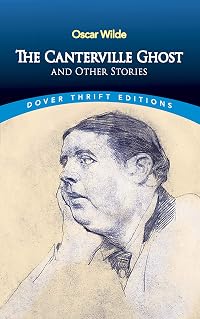
El fantasma de Canterville y otros cuentos
by Oscar Wilde 
On This Page
Description
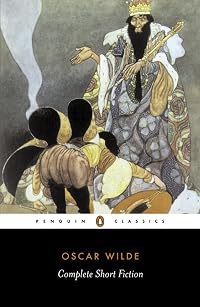
Four of the Irish writer's finest works, among them "The Sphinx Without a Secret," "The Model Millionaire," "Lord Arthur Savile's Crime," and the title story, a delightful tale of a 300-year-old ghost who fails to intimidate the newest occupants of his manor house. Also includes the author's 6 "Poems in Prose."Tags
Recommendations






















Member Reviews
This is a story by one of the greatest humorists of his or any age, so one should not be surprised when it turns out that the titular Ghost is not very scary. At least he is not scary to the American Minister to Great Britain and his family who bought Canterville Chase in spite of severe warnings that it was "haunted".
The ghost who haunts Canterville had died a hundred years ago and ever since had managed to scare the subsequent residents. That all changes when Mr.Hiram B. Otis, his wife, and four children take residence. Hiram is emphatic when he says, "I come from a modern country . . . I reckon that if there were such a thing as a ghost in Europe, we'd have it at home in a very short time in one of our public museums, or on the road show more as a show."
Needless to say, Wilde has fun with his parody of the hicks from America, but also pokes fun at the British lords with their cultural snobbery. What ensues is a topsy-turvy plot with the Ghost being flummoxed by the refusal of the Otis's to believe in him along with the mischievous activities of the youngest children, twins, who pester him on an almost daily basis.
The story is subtitled "A Hylo-Idealistic Romance" and as a romance it does have a sweet ending. Virginia, the only daughter in the family and a kind-hearted girl, becomes friends with the ghost. She gradually learns his background, appropriately sordid, and the story takes the reader on a supernatural journey befitting a "haunted house" tale. The result is one that benefits both the Ghost and Virginia, but you will have to read the story to learn the details. Let me say, however, that it was a delightful and satisfying story from the comic beginning to the romantic ending. It almost left me wanting to believe in ghosts, at least those that are as sympathetic as this creation of Oscar Wilde. show less
The ghost who haunts Canterville had died a hundred years ago and ever since had managed to scare the subsequent residents. That all changes when Mr.Hiram B. Otis, his wife, and four children take residence. Hiram is emphatic when he says, "I come from a modern country . . . I reckon that if there were such a thing as a ghost in Europe, we'd have it at home in a very short time in one of our public museums, or on the road show more as a show."
Needless to say, Wilde has fun with his parody of the hicks from America, but also pokes fun at the British lords with their cultural snobbery. What ensues is a topsy-turvy plot with the Ghost being flummoxed by the refusal of the Otis's to believe in him along with the mischievous activities of the youngest children, twins, who pester him on an almost daily basis.
The story is subtitled "A Hylo-Idealistic Romance" and as a romance it does have a sweet ending. Virginia, the only daughter in the family and a kind-hearted girl, becomes friends with the ghost. She gradually learns his background, appropriately sordid, and the story takes the reader on a supernatural journey befitting a "haunted house" tale. The result is one that benefits both the Ghost and Virginia, but you will have to read the story to learn the details. Let me say, however, that it was a delightful and satisfying story from the comic beginning to the romantic ending. It almost left me wanting to believe in ghosts, at least those that are as sympathetic as this creation of Oscar Wilde. show less
Although first published in 1891, this ghost story remains a classic of Wildean wit and Victorian sentimentality. True, some of the references to melodrama and nineteenth-century Anglo-American attitudes may elude modern readers, but the basic story of a hardheaded American family that buys a haunted British manor house and proceeds to drive the resident ghost nearly crazy with its skepticism is still a delight, as are Wilde's epigrams: "We have really everything in common with America nowadays, except, of course, language." Austrian illustrator Zwerger, a master of the exquisite line, has captured the look of the period and the liveliness of the story in this oversize volume. Michael Cart
the canterville ghost is one of my all time favourite stories. it is so funny. and it shows how silly & out of touch westernised people have become with the spiritual realm.
All I read was the Canterville Ghost. It was alright but after reading Mr. Wilde's plays it was tragically disappointing at the same time. It was good, it wass alright, it passed the time and allowed me to forget that I am at work during the few minutes I would read it daily. Overall, not that exciting.
Very ironic and satirical about both American and English customs and behavior.
One great comedy about "modern" life... It's a laugh.
The Canterville Ghost - 4.5 stars (enchanting)
Lord Arthur Saville's Crime - 4.5 stars (so funny)
The Sphinx without a Secret - 4 stars (clever)
The Model Millionaire - 5 stars (heartwarming)
The Portrait of Mr W H - 1 star (so boring)
The Happy Prince - 5 stars (beautiful)
The Nightingale and the Rose - 3 stars (lovely yet depressing)
The Selfish Giant - 5 stars (moving)
The Devoted Friend - 3 stars (good lesson, but slightly cringe worthy)
Lord Arthur Saville's Crime - 4.5 stars (so funny)
The Sphinx without a Secret - 4 stars (clever)
The Model Millionaire - 5 stars (heartwarming)
The Portrait of Mr W H - 1 star (so boring)
The Happy Prince - 5 stars (beautiful)
The Nightingale and the Rose - 3 stars (lovely yet depressing)
The Selfish Giant - 5 stars (moving)
The Devoted Friend - 3 stars (good lesson, but slightly cringe worthy)
Members
- Recently Added By
Author Information

1,778+ Works 121,101 Members
Flamboyant man-about-town, Oscar Wilde had a reputation that preceded him, especially in his early career. He was born to a middle-class Irish family (his father was a surgeon) and was trained as a scholarship boy at Trinity College, Dublin. He subsequently won a scholarship to Magdalen College, Oxford, where he was heavily influenced by John show more Ruskin and Walter Pater, whose aestheticism was taken to its radical extreme in Wilde's work. By 1879 he was already known as a wit and a dandy; soon after, in fact, he was satirized in Gilbert and Sullivan's Patience. Largely on the strength of his public persona, Wilde undertook a lecture tour to the United States in 1882, where he saw his play Vera open---unsuccessfully---in New York. His first published volume, Poems, which met with some degree of approbation, appeared at this time. In 1884 he married Constance Lloyd, the daughter of an Irish lawyer, and within two years they had two sons. During this period he wrote, among others, The Picture of Dorian Gray (1891), his only novel, which scandalized many readers and was widely denounced as immoral. Wilde simultaneously dismissed and encouraged such criticism with his statement in the preface, "There is no such thing as a moral or an immoral book. Books are well written or badly written. That is all." In 1891 Wilde published A House of Pomegranates, a collection of fantasy tales, and in 1892 gained commercial and critical success with his play, Lady Windermere's Fan He followed this comedy with A Woman of No Importance (1893), An Ideal Husband (1895), and his most famous play, The Importance of Being Earnest (1895). During this period he also wrote Salome, in French, but was unable to obtain a license for it in England. Performed in Paris in 1896, the play was translated and published in England in 1894 by Lord Alfred Douglas and was illustrated by Aubrey Beardsley. Lord Alfred was the son of the Marquess of Queensbury, who objected to his son's spending so much time with Wilde because of Wilde's flamboyant behavior and homosexual relationships. In 1895, after being publicly insulted by the marquess, Wilde brought an unsuccessful slander suit against the peer. The result of his inability to prove slander was his own trial on charges of sodomy, of which he was found guilty and sentenced to two years of hard labor. During his time in prison, he wrote a scathing rebuke to Lord Alfred, published in 1905 as De Profundis. In it he argues that his conduct was a result of his standing "in symbolic relations to the art and culture" of his time. After his release, Wilde left England for Paris, where he wrote what may be his most famous poem, The Ballad of Reading Gaol (1898), drawn from his prison experiences. Among his other notable writing is The Soul of Man under Socialism (1891), which argues for individualism and freedom of artistic expression. There has been a revived interest in Wilde's work; among the best recent volumes are Richard Ellmann's, Oscar Wilde and Regenia Gagnier's Idylls of the Marketplace , two works that vary widely in their critical assumptions and approach to Wilde but that offer rich insights into his complex character. (Bowker Author Biography) show less
Oscar Wilde has a Legacy Library. Legacy libraries are the personal libraries of famous readers, entered by LibraryThing members from the Legacy Libraries group.
Some Editions
Series
Belongs to Publisher Series
Geração Público (19)
Common Knowledge
- Canonical title*
- Il fantasma di Canterville e altri racconti
- Original title
- Lord Arthur Savile's Crime and Other Stories
- Alternate titles*
- Il delitto di lord Arthur Savile - Studio sul dovere; La sfinge senza segreti. Acquaforte; Il fantasma di Canterville. Fantasia ilo-idealistica; Il milionario monello. Attestato di ammirazione
- Original publication date
- 1887 Il fantasma di Canterville; 1891 Il delitto di Lord Arthur Savile; 1888 The Happy Prince and Other Tales; 1891 A House of Pomegranates
- First words
- "The Happy Prince"
High above the city, on a tall column, stood the statue of the Happy Prince. - Last words
- (Click to show. Warning: May contain spoilers.)"The Model Millionaire"
"Millionaire models," remarked Alan, "are rare enough; but, by Jove, model millionaires are rarer still!"
*Some information comes from Common Knowledge in other languages. Click "Edit" for more information.
Classifications
Statistics
- Members
- 533
- Popularity
- 55,956
- Reviews
- 18
- Rating
- (3.70)
- Languages
- 10 — Catalan, Dutch, English, French, German, Hungarian, Italian, Portuguese, Spanish, Swedish
- Media
- Paper, Audiobook, Ebook
- ISBNs
- 89
- ASINs
- 9