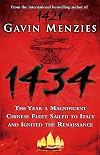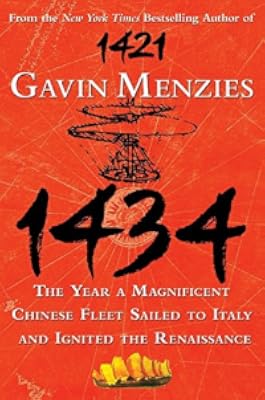
1434: The Year a Magnificent Chinese Fleet Sailed to Italy and Ignited the Renaissance
by Gavin Menzies
On This Page
Description
The brilliance of the Renaissance laid the foundation of the modern world. Textbooks tell us that it came about as a result of a rediscovery of the ideas and ideals of classical Greece and Rome. But now bestselling historian Gavin Menzies makes the startling argument that in the year 1434, China--then the world's most technologically advanced civilization--provided the spark that set the European Renaissance ablaze. From that date onward, Europeans embraced Chinese intellectual ideas, show more discoveries, and inventions, all of which form the basis of western civilization today.--From amazon.com. show lessTags
Recommendations














Member Recommendations
doomjesse It references Gavin Menzies previous work 1421 and gives you an idea of how far China's reach extended.
Member Reviews
https://nwhyte.livejournal.com/2897640.html
This book is total tosh. The contention is that Chinese knowledge was spread to Italy via a treasure fleet which sailed through the Red Sea-Nile canal in 1434. I smelt a rat when reading the chapter on celestial navigation, which is surprisingly poor for an author who claims to be ex-Navy, and started wondering when we would get some actual evidence for his claims. 50 pages in, I started googling and discovered that a lot of people had been there before me; there simply is no evidence whatsoever that Zheng He got as far as Italy in 1434. (He did get as far as the Red Sea, which is surely impressive enough.) Poorly researched, poorly argued and poorly written, and I'm generously going to include show more it in my non-fiction rather than fiction tally. I am hesitating whether even to give it to the charity shop, out of concern that someone might buy it and believe it. show less
This book is total tosh. The contention is that Chinese knowledge was spread to Italy via a treasure fleet which sailed through the Red Sea-Nile canal in 1434. I smelt a rat when reading the chapter on celestial navigation, which is surprisingly poor for an author who claims to be ex-Navy, and started wondering when we would get some actual evidence for his claims. 50 pages in, I started googling and discovered that a lot of people had been there before me; there simply is no evidence whatsoever that Zheng He got as far as Italy in 1434. (He did get as far as the Red Sea, which is surely impressive enough.) Poorly researched, poorly argued and poorly written, and I'm generously going to include show more it in my non-fiction rather than fiction tally. I am hesitating whether even to give it to the charity shop, out of concern that someone might buy it and believe it. show less
One critic wondered why Gavin Menzies, in 1421, had the fleets of Zheng He sail to and explore every nook and cranny of every continent (including Antarctica) except Europe. Well, in 1434, Menzies answers.
And wow!
Do you want a short synopsis of this book? Here's the thesis: everything Europeans have ever done was stolen from the Chinese.
That's it, that's all.
Menzies states that the Renaissance and the Age of the Discovery were sparked by an unrecorded visit by a fleet of Chinese ships that sailed through the Red Sea-Nile canal, about six hundred years after historians say it silted up, and were all the rage in Venice and Florence. In fact, Menzies claims that the canal was in use until 1899 (p. 50), which makes you wonder why the silly show more Europeans spent so much time and treasure digging the Suez Canal. (Even the article on the canal that Menzies' website points to, Carol A. Redmount, "The Wadi Tumilat and the "'Canal of the Pharaohs,'" Journal of Near Eastern Studies 54, no. 2 (April 1995): 127-135, says it was purposely blocked-up in the mid-eighth century!) But, still, Zheng He's fleet, upgraded from hundreds of ships in 1421 to thousands here in 1434, sail through the canal and reach Venice. Proof of the Venice and Florence visit? Nothing really. A tortured reading of Toscanelli's letter to Columbus (pp. 96-97), which turns "men of learning," which could be two travelers or overland merchants from the East, to a panoply of ambassadors from a vast fleet docked at Venice. So let us compare, history teaches us that a letter and handful of Ethiopians show up in Europe and the legend of Prester John echoes and reverberates for centuries; while Menzies would have us believe that a fleet of ships and a troop of people from China show up and... nothing? Nothing but a misinterpreted bit of Toscanelli.
Then there are the maps, the reason I purchased the book, as maps are my trade. The book proves that Mr. Menzies hasn't idea one about cartographic history. In fact, when it comes to maps and their history he is either a dupe or an idiot or both. I hope he tries to sue me for libel here too, so I can make my scholarly name for myself. Let's go through some of Menzies' cartographic sins. First, the "1418/1763" map that serve as bookends, the good folks at http://www.1421exposed.com have blasted this map to smithereens, and I can do so too. First, it is European in shape, not Chinese. It bears no resemblance to either Chinese maps of the 1400s (see the "Kangnido map," which looks nothing like the "1418 map", which Menzies insists on calling it) or Chinese maps of the 1700s. In fact, it gets several portions of the Old World wrong, portions of the world Menzies would have us believe were mapped more precisely by the Chinese than anyone until the 1700s. The map also repeats the strictly European conceit that California was an island! The map in the Doge's Palace in Venice, which mentions Niccolò Da Conti and Marco Polo, Menzies continually insinuates was actually created in the 1400s, which is nowhere near the truth, clearly showing "Nuova Spagna" ("New Spain") as one of the toponyms. He also claims "north at the bottom" was "the practice of Chinese cartographers," but Europeans put the top of the map at almost every cardinal direction well into the 1600s (in fact "orientation" first meant putting east, "orient," at the top of the map). Menzies repeatedly claims that Waldseemüller's globe and map were "accurate" when they are nothing of the sort! They show a strait between North and South America by God! And Menzies makes the claim (p. 130) that this "strait" is in fact the "Raspadura Canal" which still exists during heavy rains! A strait is not a canal, and a quick Google Book Search shows that; to quote Charles L. G. Anderson, Old Panama and Castilla Del Oro; A Narrative History of the Discovery, Conquest, and Settlement by the Spaniards of Panama, Darien, Veragua, Santo Domingo, Santa Marta, Cartagena, Nicaragua, and Peru, (Washington: Press of the Sudwarth Co., 1911), p. 296, with emphasis added:
"Alexander von Humboldt, writing in 1808, gives credence to the story of the Raspadura canal, made, in 1788, by the Cura, or parish priest of Novita, between the headwaters of the Atrato and San Juan rivers. In 1852, the eminent engineer, J. L. Trautwine, proved this so-called canal to be a hill, over which the Indians dragged their canoes in the wet season."
Do some damned research Mr. Menzies! Menzies claims that because the Pacific Ocean, nameless, might be shown on maps before Balboa saw it, this means the information was gleaned from the Chinese. Poppycock! If there is a continent between Asia and Europe, any dunce with a brain can postulate TWO oceans. Menzies claims that the Chinese gave Europe knowledge, and presumably the name, of Brazil (pp. 238-242), seemingly unaware of the mythical "island of Brazil" that may date as far back as the Vikings. (I am assuming that the third volume in the Menzies corpus will not prove that the Northmen were in fact Chinamen.) I could continue for pages on the maps, but I'll finish with this gem: Menzies claims that his evidence is from "maps, which do not lie" (p. 164). What?! Maps lie all the time, they are but tools of their creators. Mr. Menzies, go buy a book entitled How to Lie with Maps which is even in its second edition.
Then there are just the inanities and inaccuracies. Menzies loves to play the DNA game, though I don't think he understands anything about DNA. He confuses mitochondrial-DNA, from mothers, with haplogroups, from fathers. This leads to numerous errors, such as claiming pockets of Asian haplogroups in Eastern Europe came from Chinese slave women from the fleets (instead of the much more plausible marauding, and male, Mongols). He even makes his "Chinese-DNAed Croatians" the founders of Croatoan Island in the Carolinas! Cartographic historians will need to bone up on the chief cartographic formulator of the Greco-Roman world that Europe based its maps on for centuries: "Ptolomy" (pp. 141 passim, though he mentions "Ptolemy" as well). Astronomers will be astonished to find that Galileo discovered Saturn (p. 249). The ancients must be pissed about that one. Menzies basically plagiarizes one of his followers/supporters Gunnar Thompson. Compare his description of the Marco Polo "Map with ship" maps (p. 129) with Thompson's own at http://www.marcopolovoyages.com/Articles/MPoloNewWorldMaps.html - it is almost a cut and paste job. (For a real report on these maps, see Benjamin Olshin, "The Mystery of the 'Marco Polo' Maps: An Introduction to a Privately-Held Collection of Cartographic Materials Relating to the Polo Family," Terrae Incognitae 39 (2007): 1-23.) Then there is the laborious and laughable system of determining longitude (ch. 4) that would be practically useless for sailors, and with no proof whatsoever in Chinese records.
Lastly, to the more physical aspects of the book. It seems as if written by a committee, a committee of dachshunds who dropped out of college. Some sentences don't make sense; the chapters have only a thin string tying them together; some paragraphs contain one sentence, several contain just two; Menzies often makes no sense, moving on from one snippet of info to another with no connection; he repeats himself ad nauseum; and he bores to death. He block-quotes authorities (and "authorities") entirely too much, and often senselessly or out of context. I'm sure that Felipe Fernández-Armesto, a brilliant and fine scholar, would be appalled to know that his work is cited to support Menzies' contention (pp. 104-105) that Columbus had maps of the Americas, obviously from Chinese sources. Menzies says Columbus knew he would discover America! Too bad Columbus thought he was in China and said so multiple times! Which brings us to the "scholarly apparatus," which I am putting into quotes for numerous reasons. They are so muddled and inconsistent they might as well NOT be there. Sometimes he cites something, sometimes he doesn't. Sometimes the citation allows for easy lookup, at other times it is as inscrutable as Chinese characters written by the same group of dropout dachshunds. Items when first mentioned are already in shortened form, quotation marks are out of place, etc. His bibliography, split into groups of chapters is annoying and does not aid lookup of anything. They are often not in alphabetical order, and often repetitive. Sometimes he adds rambling text into his bibliographic entries as if they were a content note! Also, just as the good scholars at http://www.1421exposed.com prophesied, Menzies uses the fact that the Library of Congress hosted a "symposium" on 1421 to boost his "scholarly" credentials. He footnotes one item by stating she "presented her findings at a Library of Congress symposium in May 2005," making it seem as if the Library of Congress gave its imprimatur and seal of approval. His constant referral to http://www.1421.tv for "more information" is annoying and unprofessional, as the website, though neat, offers little scholarly material to reference.
In conclusion, I must say that there is some possibility for true scholarly work in this general field. The Chinese impact on European thought is almost virtually unexplored, and I think that there was much more cultural contact between worlds (i.e. East, West, and Africa) then anyone thinks. Still, this does not mean that because some Chinaman drew a parachute in a book and Leonardo did too, that there must be some concrete link delivering information from point Orient to point Occident. To do this we must all believe that aliens gave Mayans and Egyptians the blueprint for pyramids, because there is no way the two cultures could have independently created pointy buildings. And Leibniz and Newton were in fact the same person, because there is no way they could both independently invent calculus. Wallace was in fact Darwin in disguise. I would also not be surprised if the Chinese may have glanced upon the shores of America pre-1492, just as a Portuguese fisherman or two may have fished off Newfoundland and Bjarni Herjólfsson was blown off course. But the inane theory of Menzies, that EVERYTHING created by or inspired by the Italian Renaissance occurred only because a hitherto unrecorded fleet of Chinese ships sailed through a silted up canal in 1434 (while other Chinese ships sailed all over the world) is just that: inane.
In the end, this book is just poppycock. All you need to know about Gavin Menzies you can find by watching National Geographic's documentary 1421: The Year China Discovered America (which you can find online). It presents his theory and then demolishes it completely. Watch especially at the end when the interviewer confronts Menzies on his misinterpretations, quoting the actual documents Menzies uses as proof and showing they in fact contradict Menzies. His face is priceless. That's all you need to know about Gavin Menzies and his theories.
I give it two stars for nice images and numerous fun tid-bits that are cited. show less
And wow!
Do you want a short synopsis of this book? Here's the thesis: everything Europeans have ever done was stolen from the Chinese.
That's it, that's all.
Menzies states that the Renaissance and the Age of the Discovery were sparked by an unrecorded visit by a fleet of Chinese ships that sailed through the Red Sea-Nile canal, about six hundred years after historians say it silted up, and were all the rage in Venice and Florence. In fact, Menzies claims that the canal was in use until 1899 (p. 50), which makes you wonder why the silly show more Europeans spent so much time and treasure digging the Suez Canal. (Even the article on the canal that Menzies' website points to, Carol A. Redmount, "The Wadi Tumilat and the "'Canal of the Pharaohs,'" Journal of Near Eastern Studies 54, no. 2 (April 1995): 127-135, says it was purposely blocked-up in the mid-eighth century!) But, still, Zheng He's fleet, upgraded from hundreds of ships in 1421 to thousands here in 1434, sail through the canal and reach Venice. Proof of the Venice and Florence visit? Nothing really. A tortured reading of Toscanelli's letter to Columbus (pp. 96-97), which turns "men of learning," which could be two travelers or overland merchants from the East, to a panoply of ambassadors from a vast fleet docked at Venice. So let us compare, history teaches us that a letter and handful of Ethiopians show up in Europe and the legend of Prester John echoes and reverberates for centuries; while Menzies would have us believe that a fleet of ships and a troop of people from China show up and... nothing? Nothing but a misinterpreted bit of Toscanelli.
Then there are the maps, the reason I purchased the book, as maps are my trade. The book proves that Mr. Menzies hasn't idea one about cartographic history. In fact, when it comes to maps and their history he is either a dupe or an idiot or both. I hope he tries to sue me for libel here too, so I can make my scholarly name for myself. Let's go through some of Menzies' cartographic sins. First, the "1418/1763" map that serve as bookends, the good folks at http://www.1421exposed.com have blasted this map to smithereens, and I can do so too. First, it is European in shape, not Chinese. It bears no resemblance to either Chinese maps of the 1400s (see the "Kangnido map," which looks nothing like the "1418 map", which Menzies insists on calling it) or Chinese maps of the 1700s. In fact, it gets several portions of the Old World wrong, portions of the world Menzies would have us believe were mapped more precisely by the Chinese than anyone until the 1700s. The map also repeats the strictly European conceit that California was an island! The map in the Doge's Palace in Venice, which mentions Niccolò Da Conti and Marco Polo, Menzies continually insinuates was actually created in the 1400s, which is nowhere near the truth, clearly showing "Nuova Spagna" ("New Spain") as one of the toponyms. He also claims "north at the bottom" was "the practice of Chinese cartographers," but Europeans put the top of the map at almost every cardinal direction well into the 1600s (in fact "orientation" first meant putting east, "orient," at the top of the map). Menzies repeatedly claims that Waldseemüller's globe and map were "accurate" when they are nothing of the sort! They show a strait between North and South America by God! And Menzies makes the claim (p. 130) that this "strait" is in fact the "Raspadura Canal" which still exists during heavy rains! A strait is not a canal, and a quick Google Book Search shows that; to quote Charles L. G. Anderson, Old Panama and Castilla Del Oro; A Narrative History of the Discovery, Conquest, and Settlement by the Spaniards of Panama, Darien, Veragua, Santo Domingo, Santa Marta, Cartagena, Nicaragua, and Peru, (Washington: Press of the Sudwarth Co., 1911), p. 296, with emphasis added:
"Alexander von Humboldt, writing in 1808, gives credence to the story of the Raspadura canal, made, in 1788, by the Cura, or parish priest of Novita, between the headwaters of the Atrato and San Juan rivers. In 1852, the eminent engineer, J. L. Trautwine, proved this so-called canal to be a hill, over which the Indians dragged their canoes in the wet season."
Do some damned research Mr. Menzies! Menzies claims that because the Pacific Ocean, nameless, might be shown on maps before Balboa saw it, this means the information was gleaned from the Chinese. Poppycock! If there is a continent between Asia and Europe, any dunce with a brain can postulate TWO oceans. Menzies claims that the Chinese gave Europe knowledge, and presumably the name, of Brazil (pp. 238-242), seemingly unaware of the mythical "island of Brazil" that may date as far back as the Vikings. (I am assuming that the third volume in the Menzies corpus will not prove that the Northmen were in fact Chinamen.) I could continue for pages on the maps, but I'll finish with this gem: Menzies claims that his evidence is from "maps, which do not lie" (p. 164). What?! Maps lie all the time, they are but tools of their creators. Mr. Menzies, go buy a book entitled How to Lie with Maps which is even in its second edition.
Then there are just the inanities and inaccuracies. Menzies loves to play the DNA game, though I don't think he understands anything about DNA. He confuses mitochondrial-DNA, from mothers, with haplogroups, from fathers. This leads to numerous errors, such as claiming pockets of Asian haplogroups in Eastern Europe came from Chinese slave women from the fleets (instead of the much more plausible marauding, and male, Mongols). He even makes his "Chinese-DNAed Croatians" the founders of Croatoan Island in the Carolinas! Cartographic historians will need to bone up on the chief cartographic formulator of the Greco-Roman world that Europe based its maps on for centuries: "Ptolomy" (pp. 141 passim, though he mentions "Ptolemy" as well). Astronomers will be astonished to find that Galileo discovered Saturn (p. 249). The ancients must be pissed about that one. Menzies basically plagiarizes one of his followers/supporters Gunnar Thompson. Compare his description of the Marco Polo "Map with ship" maps (p. 129) with Thompson's own at http://www.marcopolovoyages.com/Articles/MPoloNewWorldMaps.html - it is almost a cut and paste job. (For a real report on these maps, see Benjamin Olshin, "The Mystery of the 'Marco Polo' Maps: An Introduction to a Privately-Held Collection of Cartographic Materials Relating to the Polo Family," Terrae Incognitae 39 (2007): 1-23.) Then there is the laborious and laughable system of determining longitude (ch. 4) that would be practically useless for sailors, and with no proof whatsoever in Chinese records.
Lastly, to the more physical aspects of the book. It seems as if written by a committee, a committee of dachshunds who dropped out of college. Some sentences don't make sense; the chapters have only a thin string tying them together; some paragraphs contain one sentence, several contain just two; Menzies often makes no sense, moving on from one snippet of info to another with no connection; he repeats himself ad nauseum; and he bores to death. He block-quotes authorities (and "authorities") entirely too much, and often senselessly or out of context. I'm sure that Felipe Fernández-Armesto, a brilliant and fine scholar, would be appalled to know that his work is cited to support Menzies' contention (pp. 104-105) that Columbus had maps of the Americas, obviously from Chinese sources. Menzies says Columbus knew he would discover America! Too bad Columbus thought he was in China and said so multiple times! Which brings us to the "scholarly apparatus," which I am putting into quotes for numerous reasons. They are so muddled and inconsistent they might as well NOT be there. Sometimes he cites something, sometimes he doesn't. Sometimes the citation allows for easy lookup, at other times it is as inscrutable as Chinese characters written by the same group of dropout dachshunds. Items when first mentioned are already in shortened form, quotation marks are out of place, etc. His bibliography, split into groups of chapters is annoying and does not aid lookup of anything. They are often not in alphabetical order, and often repetitive. Sometimes he adds rambling text into his bibliographic entries as if they were a content note! Also, just as the good scholars at http://www.1421exposed.com prophesied, Menzies uses the fact that the Library of Congress hosted a "symposium" on 1421 to boost his "scholarly" credentials. He footnotes one item by stating she "presented her findings at a Library of Congress symposium in May 2005," making it seem as if the Library of Congress gave its imprimatur and seal of approval. His constant referral to http://www.1421.tv for "more information" is annoying and unprofessional, as the website, though neat, offers little scholarly material to reference.
In conclusion, I must say that there is some possibility for true scholarly work in this general field. The Chinese impact on European thought is almost virtually unexplored, and I think that there was much more cultural contact between worlds (i.e. East, West, and Africa) then anyone thinks. Still, this does not mean that because some Chinaman drew a parachute in a book and Leonardo did too, that there must be some concrete link delivering information from point Orient to point Occident. To do this we must all believe that aliens gave Mayans and Egyptians the blueprint for pyramids, because there is no way the two cultures could have independently created pointy buildings. And Leibniz and Newton were in fact the same person, because there is no way they could both independently invent calculus. Wallace was in fact Darwin in disguise. I would also not be surprised if the Chinese may have glanced upon the shores of America pre-1492, just as a Portuguese fisherman or two may have fished off Newfoundland and Bjarni Herjólfsson was blown off course. But the inane theory of Menzies, that EVERYTHING created by or inspired by the Italian Renaissance occurred only because a hitherto unrecorded fleet of Chinese ships sailed through a silted up canal in 1434 (while other Chinese ships sailed all over the world) is just that: inane.
In the end, this book is just poppycock. All you need to know about Gavin Menzies you can find by watching National Geographic's documentary 1421: The Year China Discovered America (which you can find online). It presents his theory and then demolishes it completely. Watch especially at the end when the interviewer confronts Menzies on his misinterpretations, quoting the actual documents Menzies uses as proof and showing they in fact contradict Menzies. His face is priceless. That's all you need to know about Gavin Menzies and his theories.
I give it two stars for nice images and numerous fun tid-bits that are cited. show less
1434 is the horrible sequel to Gavin Menzies' bestselling 1421, which already went way beyond the facts (aka fibbing) to "support" its thesis. At least, Menzies promoted the achievements of the Chinese medieval fleet and Zheng He around the world. The commercial success of that venture led the author and his publisher HarperCollins to produce this titanic shipwreck. Given the equally flawed sequel Superfreakonimcs, HarperCollins has massive quality control issues bordering on intellectual prostitution.
Gavin Menzies' second book is dishonest, shoddy and lazy beyond repair. The level of ignorance is stunning and hits you machine-gun style: "In the 1430s, Europeans had no unified calendar, for they had not yet agreed how to measure time. show more The Gregorian calendar did not come into use until a century later." Never heard of the Julian calendar, proposed by Gaius Julius Caesar, inventor of the Cesar salad? Obviously, the editors and account managers at HarperCollins haven't either or were blinded by those shiny, shiny coins. This is history's equivalent to Creationism. It is only fitting that HarperCollins is also the publisher of Sarah Palin's Going Rogue, going rogue on facts and reality. Well, there is a sucker born every minute. Fortunately, I did not spend any money on this icky title. show less
Gavin Menzies' second book is dishonest, shoddy and lazy beyond repair. The level of ignorance is stunning and hits you machine-gun style: "In the 1430s, Europeans had no unified calendar, for they had not yet agreed how to measure time. show more The Gregorian calendar did not come into use until a century later." Never heard of the Julian calendar, proposed by Gaius Julius Caesar, inventor of the Cesar salad? Obviously, the editors and account managers at HarperCollins haven't either or were blinded by those shiny, shiny coins. This is history's equivalent to Creationism. It is only fitting that HarperCollins is also the publisher of Sarah Palin's Going Rogue, going rogue on facts and reality. Well, there is a sucker born every minute. Fortunately, I did not spend any money on this icky title. show less
He’s done it again!
Gavin Menzies’s “1434” hits a boundary six (a homerun for Americans who aren’t familiar with cricket) in the game of challenging wisdom delivered by conventional historigraphers. Following in the wake of his controversial “1421 — The Year China Discovered America” Menzies has again assembled the most extraordinary collection of data and given us a new way to connect the dots.
Menzies’s latest look at Chinese influence on western civilization turns conventional scholarship on its head, just like the ancient maps that ‘orient’ the picture of the world with south on the top, north on the bottom.
“1421” pioneered some of the most innovative approaches of yoking the static information of the printed show more page to the fluid evolution of website interplay, generating hundreds of thousands of emails and scores of vitally important new discoveries. “1434” promises to take the medium to the next stage.
The hypothesis is stated boldly. The Italian renaissance seems to spring out of the early 15th century without precedent. Advances in science, mathematics, astronomy, navigation, engineering, painting, sculpture, commerce … they all seem to explode as if the requisite fuel was ignited by a spark plug.
Instead of marveling at the serendipitous admixture of volatile gas and air, Menzies seeks the spark plug.
He finds it in the hitherto little-known or overlooked visit of a Chinese embassy to the Papal Court which had moved in 1434 to Florence. From the Chinese, Menzies argues, flowed the vast treasure of ideas that made possible the unprecedented rise in European civilization, exploration and worldwide domination.
It was a near run thing.
A series of natural disasters, including a recently discovered monstrous tsunami that destroyed the vast ocean-going Chinese treasure fleets, and cataclysmic fire that destroyed the Forbidden City, coupled with domestic introversion took China out of the international sphere. Sophisticated engineering skills and intellectual capital accumulated in the east all but disappeared from the written record. What remained in the west was claimed as its own.
The histories that were written, the histories that were taught, ignored the accomplishments of the “heathen” Chinese. The reports of adventurers like Marco Polo were relegated to myth. No longer. Menzies puts Toscanelli, Alberti, Nicholas of Cusa, Regiomontanus, Fontana, Pisanello, Taccola, Di Giorgi … even Leonardo da Vinci into the post-1434 spectrum of Chinese beneficiaries.
Historians may challenge Menzies’s broad hypothesis, his startling conclusions, his many and bold submissions. But they will have to deal with his uncomfortable facts. His genius lies in his breadth of vision: a new way of seeing facts that previous historians have relegated to “anomalies” that do not fit the model.
Copernicus did not invent the heliocentric view of astronomy, planets revolving around the sun; that laurel must go to Aristarchus who proposed it 1700 years earlier, (without success). What Copernicus did, by compiling thousands of observations (some of which were wrong), was create an alternative to the universally accepted Ptolemaic model of geocentrism, all planets revolving around the earth. As astronomers added to the data, the need for deferents and epicycles to explain “anomalies” fell away. The new model proved itself.
Anyone with a love of science, adventure and good old-fashioned detective work will delight in this new work of this ex-submariner from the Royal Navy. Better yet, there’s promise of a further book in the works: based on evidence suggesting the great Chinese admiral Zheng He ended his days in North Carolina.
Up periscope! show less
Gavin Menzies’s “1434” hits a boundary six (a homerun for Americans who aren’t familiar with cricket) in the game of challenging wisdom delivered by conventional historigraphers. Following in the wake of his controversial “1421 — The Year China Discovered America” Menzies has again assembled the most extraordinary collection of data and given us a new way to connect the dots.
Menzies’s latest look at Chinese influence on western civilization turns conventional scholarship on its head, just like the ancient maps that ‘orient’ the picture of the world with south on the top, north on the bottom.
“1421” pioneered some of the most innovative approaches of yoking the static information of the printed show more page to the fluid evolution of website interplay, generating hundreds of thousands of emails and scores of vitally important new discoveries. “1434” promises to take the medium to the next stage.
The hypothesis is stated boldly. The Italian renaissance seems to spring out of the early 15th century without precedent. Advances in science, mathematics, astronomy, navigation, engineering, painting, sculpture, commerce … they all seem to explode as if the requisite fuel was ignited by a spark plug.
Instead of marveling at the serendipitous admixture of volatile gas and air, Menzies seeks the spark plug.
He finds it in the hitherto little-known or overlooked visit of a Chinese embassy to the Papal Court which had moved in 1434 to Florence. From the Chinese, Menzies argues, flowed the vast treasure of ideas that made possible the unprecedented rise in European civilization, exploration and worldwide domination.
It was a near run thing.
A series of natural disasters, including a recently discovered monstrous tsunami that destroyed the vast ocean-going Chinese treasure fleets, and cataclysmic fire that destroyed the Forbidden City, coupled with domestic introversion took China out of the international sphere. Sophisticated engineering skills and intellectual capital accumulated in the east all but disappeared from the written record. What remained in the west was claimed as its own.
The histories that were written, the histories that were taught, ignored the accomplishments of the “heathen” Chinese. The reports of adventurers like Marco Polo were relegated to myth. No longer. Menzies puts Toscanelli, Alberti, Nicholas of Cusa, Regiomontanus, Fontana, Pisanello, Taccola, Di Giorgi … even Leonardo da Vinci into the post-1434 spectrum of Chinese beneficiaries.
Historians may challenge Menzies’s broad hypothesis, his startling conclusions, his many and bold submissions. But they will have to deal with his uncomfortable facts. His genius lies in his breadth of vision: a new way of seeing facts that previous historians have relegated to “anomalies” that do not fit the model.
Copernicus did not invent the heliocentric view of astronomy, planets revolving around the sun; that laurel must go to Aristarchus who proposed it 1700 years earlier, (without success). What Copernicus did, by compiling thousands of observations (some of which were wrong), was create an alternative to the universally accepted Ptolemaic model of geocentrism, all planets revolving around the earth. As astronomers added to the data, the need for deferents and epicycles to explain “anomalies” fell away. The new model proved itself.
Anyone with a love of science, adventure and good old-fashioned detective work will delight in this new work of this ex-submariner from the Royal Navy. Better yet, there’s promise of a further book in the works: based on evidence suggesting the great Chinese admiral Zheng He ended his days in North Carolina.
Up periscope! show less
Gavin Menzies' newest book 1434, takes up where he left off in his prior book 1421, that was focused on the voyages of the Chinese navigator Admiral Zheng He. Menzies picks up the thread in this outstanding new history book continuing to show new evidence of Zheng He's influence to other European countries, specifically Italy at the time of the Renaissance.
1434 presents startling information, that is more than likely and highly plausible, regarding the fact that Admiral Zheng He did reach America close to 80 years prior to Christopher Columbus. Menzies backs up his evidence and feasible speculations with maps, logbooks, and letters from other explorers who all had copies of maps that more than likely originated from the maps of Zheng show more He. Through these maps, Menzies follows the history of many voyages, traces DNA lineage from various world port civilizations, evaluates artifacts found, and comes up with some very credible ideas that are worth noting.
This book also details many other aspects of the Chinese influence to Europe through Menzies' incredible research. 1434 reveals uncanny knowledge that compares early thoughts on astronomy, mathematics, philosophy, physics and mechanical engineering. Within these pages, the reader can view side by side, many illustrations of mechanical inventions such as siege weapons, parachutes, grinding machines and printing presses, that until now were believed to be created by Leonardo Da Vinci and other brilliant Renaissance men. With these fascinating presentations, it's hard to not realize that the early historians could have been wrong, when in truth; most of all mechanisms shown in the book were initially invented by the Chinese and then introduced to Europe by Zheng He himself. Menzies' new findings that appear to be more than coincidence, offer up a wealth of knowledge, provide serious thought, and are beyond difficult to believe untrue. His in-depth research extends to the belief that these new thoughts stretch to the idea that the works of Leonardo and other inventors were simply enhancements to the diagrams given to them by the Chinese, and not original creations.
I thoroughly enjoyed this book, found Menzies' research to be extensive and thought-provoking. The chapters on cartography, and the voyages of Admiral Zheng He fascinated me. Other newly found shocking tidbits revealed here made me wonder if perhaps the scholars will now be rewriting the history books. I found 1434 intriguing and fun to explore. This book is well written, inspiring, and presented nicely with three sections of color inserts showing illustrations and maps to enhance the book's readability. I can highly recommend this book and give it 4 stars. show less
1434 presents startling information, that is more than likely and highly plausible, regarding the fact that Admiral Zheng He did reach America close to 80 years prior to Christopher Columbus. Menzies backs up his evidence and feasible speculations with maps, logbooks, and letters from other explorers who all had copies of maps that more than likely originated from the maps of Zheng show more He. Through these maps, Menzies follows the history of many voyages, traces DNA lineage from various world port civilizations, evaluates artifacts found, and comes up with some very credible ideas that are worth noting.
This book also details many other aspects of the Chinese influence to Europe through Menzies' incredible research. 1434 reveals uncanny knowledge that compares early thoughts on astronomy, mathematics, philosophy, physics and mechanical engineering. Within these pages, the reader can view side by side, many illustrations of mechanical inventions such as siege weapons, parachutes, grinding machines and printing presses, that until now were believed to be created by Leonardo Da Vinci and other brilliant Renaissance men. With these fascinating presentations, it's hard to not realize that the early historians could have been wrong, when in truth; most of all mechanisms shown in the book were initially invented by the Chinese and then introduced to Europe by Zheng He himself. Menzies' new findings that appear to be more than coincidence, offer up a wealth of knowledge, provide serious thought, and are beyond difficult to believe untrue. His in-depth research extends to the belief that these new thoughts stretch to the idea that the works of Leonardo and other inventors were simply enhancements to the diagrams given to them by the Chinese, and not original creations.
I thoroughly enjoyed this book, found Menzies' research to be extensive and thought-provoking. The chapters on cartography, and the voyages of Admiral Zheng He fascinated me. Other newly found shocking tidbits revealed here made me wonder if perhaps the scholars will now be rewriting the history books. I found 1434 intriguing and fun to explore. This book is well written, inspiring, and presented nicely with three sections of color inserts showing illustrations and maps to enhance the book's readability. I can highly recommend this book and give it 4 stars. show less
Interesting new look at what may have been behind historical events as we learned them. While much may be impossible to prove with certainty, the author's point that before China turned inward in the 15th century, they were well ahead of Europe in both discovery as well as invention seems well researched. The author discusses Chinese advances in many areas, including voyages of discovery, mapping the stars, navigation, etc., as well as intricate inventions later taken and improved upon during the European Renaissance.
Note however that there's considerable controversy over Menzies claims. Some go so far as to call his work fraudulent (see http://www.1421exposed.com/ for more on this).
Note however that there's considerable controversy over Menzies claims. Some go so far as to call his work fraudulent (see http://www.1421exposed.com/ for more on this).
A book that asks the reader to look at history in a whole new way! The author, Gavin Menzies, tells us the story behind his research on the meeting of West and East in the year 1434. To accept this theory, one would have to rewrite the history books. To tell you the truth I don’t know what to think of this book. Do I believe that the people of the Earth have traveled, met and exchanged ideas more than is currently accepted? Sure! Does that mean that a giant fleet of Chinese ships sailed to Italy, taught them everything found in the Renaissance, and then no one recorded it in the history books? That is a long stretch. But there are long breaks in world history that have not been filled in yet. Many mainstream historians do not agree show more with Mr. Menzies’s theory and that does not bother me; breakthroughs by definition go against general accepted theory. What bothers me is that many historians do not believe that Mr. Menzies’s research is reputable, and that is unacceptable. But how do you know if one’s research is reputable or not if you are not a historian? I guess time may be the best answer. If the fleet did sail, and knowledge was exchanged, there should be traces somewhere. Time may tell us if this is truth or fantasy. show less
Members
- Recently Added By
Lists

What A Year: Books titled with a particular year
147 works; 2 members
Author Information

4+ Works 4,817 Members
Gavin Menzies is the bestselling author of 1421: The Year China Discovered America; 1434: The Year a Magnificent Chinese Fleet Sailed to Italy and Ignited the Renaissance; and The Lost Empire of Atlantis: History's Greatest Mystery Revealed. He served in the Royal Navy between 1953 and 1970. His knowledge of seafaring and navigation sparked his show more interest in the epic voyages of Chinese admiral Zheng He. Menzies lives in London. show less
Common Knowledge
Classifications
Statistics
- Members
- 770
- Popularity
- 36,451
- Reviews
- 19
- Rating
- (3.23)
- Languages
- 7 — Chinese, Dutch, English, Korean, Polish, Portuguese, Spanish
- Media
- Paper, Audiobook, Ebook
- ISBNs
- 25
- ASINs
- 7