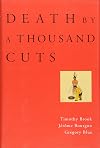
Death by a Thousand Cuts
by Timothy Brook, Gregory Blue, Jérôme Bourgon
On This Page
Description
In a public square in Beijing in 1904, multiple murderer Wang Weiqin was executed before a crowd of onlookers. He was among the last to suffer the extreme punishment known as lingchi. Called by Western observers "death by a thousand cuts" or "death by slicing," this penalty was reserved for the very worst crimes in imperial China. A unique interdisciplinary history, Death by a Thousand Cuts is the first book to explore the history, iconography, and legal contexts of Chinese tortures and show more executions from the tenth century until lingchi's abolition in 1905. The authors then turn their attention to an in-depth investigation of "oriental" tortures in the Western imagination. While early modern Europeans often depicted Chinese institutions as rational, nineteenth- and twentieth-century readers consumed pictures of lingchi executions as titillating curiosities and evidence of moral inferiority. By examining these works in light of European conventions associated with despotic government, Christian martyrdom, and ecstatic suffering, the authors unpack the stereotype of innate Chinese cruelty and explore the mixture of fascination and revulsion that has long characterized the West's encounter with "other" civilizations. Compelling and thought-provoking, Death by a Thousand Cuts questions the logic by which states justify tormenting individuals and the varied ways by which human beings have exploited the symbolism of bodily degradation for political aims. show lessTags
Recommendations



























Member Reviews
If I were to summarize this book in a sentence, it would be "Ling Chi - not as bad as you think". This book contained a detailed and well researched look at the history of judicial torture in China. All in all, for all its perceived brutality, judicial torture in China was much more restrained than its counterparts in Europe. I learned many things from reading this book, which is something I always enjoy.
In Autumn 1904 Wang Weiqin was executed in Beijing. The manner of execution is called in Chinese lingchi chusi, “to put to death by lingchi”. It has been translated as “death by a thousand cuts”, “death by slicing”, and “the lingering death”, none of which are an accurate description of the process described in the first chapter of this book. Even though parts of his flesh were sliced off before he was dead, he was most likely heavily sedated with opium. Lingchi was considered the most severe form of penalty, next was decapitation which was considered worse then strangulation. The order of severity of these methods of execution suggests that is was the separating of the body that was the worst thing that could happen, show more that perhaps one became less human if their head was separated from their body and humanity was totally destroyed if the body was cut in pieces as happened with lingchi. Even burying in an unmarked grave appears to be a part of the penalty and has some significance.
Decided to give up on this book. Not badly written but it reads like a textbook. With this subject matter, that is probably the best way to write but it makes it very difficult for me to read. I may get it again when I don’t have as many books to read. Realistically I probably won’t ever pick it up again. show less
Decided to give up on this book. Not badly written but it reads like a textbook. With this subject matter, that is probably the best way to write but it makes it very difficult for me to read. I may get it again when I don’t have as many books to read. Realistically I probably won’t ever pick it up again. show less
Ratings
Members
- Recently Added By
Author Information

24+ Works 1,550 Members
Timothy Brook is principal of St. John's College at the University of British Columbia, and holds the Shaw Chair in Chinese Studies at Oxford University.

2 Works 31 Members
1 Work 29 Members
Awards and Honors
Common Knowledge
- Canonical title
- Death by a Thousand Cuts
Classifications
- Genres
- Nonfiction, History, Politics and Government, General Nonfiction
- DDC/MDS
- 364.660951 — Society, government, & culture Social problems and social services Crime Punishment Death penalty
- LCC
- HV8699 .C6 .B76 — Social sciences Social pathology. Social and public welfare. Criminology Social pathology. Social and public welfare. Criminal justice administration Penology. Prisons. Corrections
- BISAC
Statistics
- Members
- 27
- Popularity
- 956,766
- Reviews
- 2
- Rating
- (2.75)
- Languages
- English
- Media
- Paper, Ebook
- ISBNs
- 2