
Free Fall
by David Wiesner
On This Page
Description
A young boy dreams of daring adventures in the company of imaginary creatures inspired by the things surrounding his bed.Tags
Recommendations


Member Recommendations
by cmbohn
Member Reviews
A boy falls asleep reading what looks to be an atlas. When a map is torn out of the book he is transported to an imaginary world, or more than one, as he never seems to stay very long before another page floats by and he is off to another world, gathering a cast of imaginary creatures along with him. He wakes to see all is normal, but is it?
Wiesner's illustrations are mesmerizing, each page flowing fluidly into the next and the boy seamlessly changing scenery with a mild curiosity and visible happiness. A great use of perspective, shading and shadow, you know the boy's world is a dream but you wish it weren't.
This could inspire many conversations about where the boy is going, I think it would be enjoyable for any age, including teens.
Wiesner's illustrations are mesmerizing, each page flowing fluidly into the next and the boy seamlessly changing scenery with a mild curiosity and visible happiness. A great use of perspective, shading and shadow, you know the boy's world is a dream but you wish it weren't.
This could inspire many conversations about where the boy is going, I think it would be enjoyable for any age, including teens.
I found this book very unconventionally beautiful for three reasons. The story shows a boy falling asleep with what looks to be a really good book in his arms. First, I loved how a book can exist without a single word and move a reader through the pages solely by what the pictures were telling.The story contains no text, so it relies heavily on the illustrations. Through abstract art and illusions, the scene changes from one adventure to the next and the boy in the middle of it all, all the way until he wakes up the next morning, refreshed from his wild dream. Secondly, I was surprised that although there was no text, the reader can still understand what is, or may be, happening on each page. Reader can even recognize the same show more characters befriending the boy and joining him on his adventure. Third, I was fascinated how the author/illustrator adding in certain details to the end scene, such as toy dragons and chess pieces in his room that were apparent in his dream. It’s relateble how minuscule things in our every day lives can appear in our dreams as something huge. I can also assume that the book he was reading was about castles, dragons, and knights. Overall, the big idea is that a child’s imagination is diverse and unique and can do a lot of things. show less
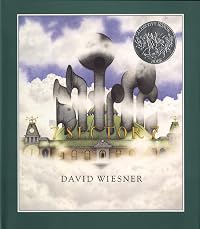
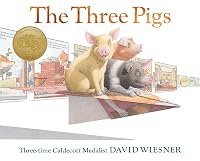
Wiesner's art is always spetacular, but this book didn't do it for me. It felt like an inferior reboot of his "The Three Pigs", or maybe this book came first? The pigs even make an appearance in the book. Love "The Three Pigs"
A boy falls asleep with a book on his chest, then we see a map flying off into the distance-a page from the book-then we see the boy in a bunch of loosely connected dream scenes. At the end all the random pieces from his dream are in his bedroom.
A boy falls asleep with a book on his chest, then we see a map flying off into the distance-a page from the book-then we see the boy in a bunch of loosely connected dream scenes. At the end all the random pieces from his dream are in his bedroom.
This is a book without text. The illustrations begin to tell the tale of a young boy who falls asleep while reading illustrations of Kings and Queens and pawns placed on a chess board.
What began as a wonderful tale, somehow spun out of control and I could not follow what the illustrator attempted portray. It seemed to be a group of wonderful illustrations that were unconnected and the train of thought was confusing. I appreciated the art, I simply didn't know what it was attempting to portray.
What began as a wonderful tale, somehow spun out of control and I could not follow what the illustrator attempted portray. It seemed to be a group of wonderful illustrations that were unconnected and the train of thought was confusing. I appreciated the art, I simply didn't know what it was attempting to portray.
A beautiful pictures only book, taking the "reader" along for a ride with a sleeping city boy. We follow him into the contents of his bedroom; his quilt becomes a series of farmed fields then a chessboard where we meet the kings and queens of the game. When he shakes hands with a knight, the knight flies apart into several doves. The castle becomes a docile dragon and then a forest. We end up riding a goose and back to the quilted bed of our main character.
A lovely dreamworld to show a young reader (or an older one) that ones imagination can take them anywhere.
A lovely dreamworld to show a young reader (or an older one) that ones imagination can take them anywhere.
I thought it was very interesting to look at. I noticed that every page somehow tied into the next page. It almost felt like a fever dream. There was so many illustrations that sometimes didn't make sense unless you took a moment to think and ask questions about the book. There were things that helped guide the little boy through the whole book. I think there is potential for a lot of imagination and thinking. Creative writing might be nice to have alongside of reading the book. Letting students interpret what's happening in their own way. Noticing what are common patterns throughout the book. This book I feel would be good for grades 3 through 5 or 6 depending on what you're teaching and the level of reading your students are on. This show more book is wordless so it's very accessible to students who can't read or have trouble with it. It can help them use critical thinking. show less
This wordless book takes us through the dream journey of a young boy, mixing reality and fantasy into beautifully striking illustrations. This book would be great for 2nd grade-5th when looking at foreshadowing and studying details of the whole picture, although I would also use this book for upper elementary students on a lesson for surrealism, pairing it with a project to be creative and explore their own surrealism art. You could also disassemble the book (if possible) and create almost one long timeline as each picture spills into the next.
Members
- Recently Added By
Lists

Caldecott Honor Books
296 works; 23 members

Wordless Books
157 works; 15 members

Books Read in 2023
5,547 works; 145 members
Author Information

20+ Works 19,628 Members
American children's book author and illustrator David Wiesner was born in Bridgewater, New Jersey on February 5, 1956. He graduated with a BFA in Illustration from Rhode Island School of Design. Known for his imaginative work, Wiesner is particularly celebrated for using wordless storytelling in his picture books. His latest picture book is about show more two artists; it is entitled, Art & Max. "Sector 7" and "Free Fall" are Caldecott Honor Books, while Wiesner won the prestigious Caldecott Medal for "Tuesday" (1992), "The Three Pigs" (2002), and "Flotsam" (2007). Wiesner is only the second person to have won this award three times. (Bowker Author Biography) show less
Awards and Honors
Awards
Common Knowledge
- Original publication date
- 1988
- Epigraph
- [None]
- Dedication
- FOR KIM
Thanks to Matthew and Daniel - First words
- [None]
- Last words
- (Click to show. Warning: May contain spoilers.)[None]
Classifications
- Genres
- Picture Books, Children's Books
- DDC/MDS
- 808.068 — Literature & rhetoric Literature, rhetoric & criticism Rhetoric and collections of literary texts from more than two literatures Rhetoric and anthologies By Type Of Writing Children's literature
- LCC
- PZ7 .W6367 .F — Language and Literature Fiction and juvenile belles lettres Fiction and juvenile belles lettres Juvenile belles lettres
- BISAC
Statistics
- Members
- 1,668
- Popularity
- 13,398
- Reviews
- 56
- Rating
- (3.99)
- Languages
- Chinese, English, French
- Media
- Paper, Audiobook
- ISBNs
- 21
- ASINs
- 3