On This Page
Description
In the year 2020, elderly hippie Cobb Anderson constructs intelligent robots who take control of the moon and offer Cobb a change at immortality.Tags
Recommendations











Member Reviews
This book holds up pretty well even though it's now part of transhumanism's past and not its future, like it was back in the day. The lack of female characters who aren't whores, sex objects, robots, or robot whore sex objects grates, but the bursts of psychedelic stream of consciousness prose shine as bright as they ever did.
"You should think of me as a person. My personality is human. I still like eating and . . . and other things."
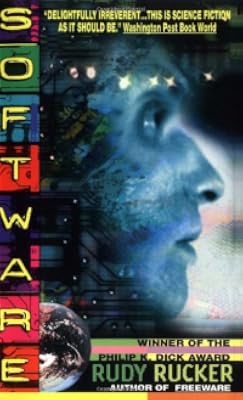
This combination of human and robot fused into one – a prime philosophic enigma addressed squarely in Rudy Rucker’s Software. Take a close look at the gal above, a young lady who could be Misty from the novel talking about her identity. Twenty-five-year old, randy Stanley Hilary Mooney Jr. aka Sta-Hi Mooney is certainly attracted, big time, but then again he starts thinking of the wires behind her eyes - it would be like having sex with a machine, an inanimate object.
Rucker’s 1982 cyberpunk classic is hardly the only piece of fiction to present the human as robot puzzle. Or, should I say robot as human? Recall beautiful show more Rachael Rosen from Philip K. Dick’s 1968 Do Androids Dream of Electric Sheep and the 2014 film Ex Machina featuring stunning Alicia Vikander as Ava. With our world’s rapidly evolving computer technology, maybe such an alluring, sexually charged creation isn’t that many years away.
Isaac Asimov’s three laws of robotics formulated back in the 1940s dark ages demand robots slavishly abide by an overarching ironclad rule: humans first, robots second. Ralph Numbers, a forward-thinking bopper (boppers are robots with real brains created some years prior by the novel’s main character, old man Cobb Anderson) says phooey to such inferior human twaddle: “Humans first and robots last? Forget it! No way!” Ralph reflects with wry satisfaction on how he taught other boppers to reprogram their robot circuitry to transcend Asimov’s laws and thus attain true freedom.
Not only did Cobb Anderson build the first generation of real brain boppers but he gave his boppers the capacity, in turn, to produce other more sophisticated, more intelligent boppers to the point where those more advanced iterations developed consciousness. And now those fully conscious boppers would like nothing more than to expand universal consciousness and mystical awareness of the oneness of life by converting inferior forms of intelligence such as humans, little-minded boppers and diggers (worker robots) into reprogrammed extensions of their own big bopper minds.
If all this sounds crazy, you are far from mistaken. In his lecturers From Here to Infinity: An Exploration of Science Fiction Literature, Michael D. C. Drout proclaimed Software and Freeware, two books in Rudy Ruker's Ware Trilogy, as the weirdest good books you will ever read. Perhaps not surprisingly, Software won the Philip K. Dick award. What was the award, I wonder? Perhaps a year’s supply of speed or tabs of LSD? Reading Rudy Rucker's turbo-injected spinning at the speed of light fiction, I wouldn’t be surprised.
But seriously folks, I suspect more than drugs, what really infuses Rudy’s fiction with its edgy brilliance is his background in advanced mathematics and computer science. And please keep in mind the author has over two dozen novels and other works of fiction and nonfiction to his credit. Fortunately for lovers of SF, Rudy Rucker is still going strong at age seventy-one.
Any reader who enjoys breaking a mental sweat over paradoxes and the metaphysical maze of computational machines, artificial intelligence and the Turing test will have ample material to chew on in the pages of Software. This includes the appearance of a robotic twin for both Cobb and Sta-Hi. Cobb2 can flop and flounder with the best of them; Sta-Hi2 turns out to be the obedient, reliable, hard-working son his dad always wanted. Are these doubles human enhancements or human-deficient?
There’s also Robert Nozick's thought experiment of brain transference: the brain from person A (including all past memories) is placed in the body of person B. After the operation person B thinks he is person A. Is his thinking accurate? Is B entitled to take on the rights and responsibilities of A, including living with A’s wife and children? Such a thought experiment is further complicated in Software. Is Cobb still Cobb when his brain (software) is given a new bopper body (hardware)? Such dilemmas go back to the mind-body problem conceived by such thinkers as René Descartes.
I purposely went light on plot - there’s simply too many freaky chutes and ladders, including a trip to the moon, a brain-drinking party in Florida, a bopper freezer in a Mr. Frostee ice cream truck and enough reefer to keep even Stay-Hi hi.
This is a very good book, a very weird book and a very crazy book. I always wondered if another novel could take the hallucinogenic cake and join PKD’s Dr. Bloodmoney as the strangest, most bizarre, twisted novel I have ever read. For this distinction, Software wins the Glenn C. Russell prize.
Born in 1946, Rudy Rucker is not only an American science fiction author and among the founders of cyberpunk but also an expert in advanced mathematics and computer science. show less
Totally crazy fun. I haven't had this much sheer delight in crazy robot action in ages. The boppers are a blast.
Get this: turn the whole meme of eating brains into a gigantic robot enterprise to upload meat people into imperishable robot bodies, turn the moon into a robot paradise fueled by program evolution, add a serious stoner meat-person to join in the fun up in the moon, and make sure we've got a lot of funny and light and subversive dialogue, and we've got SOFTWARE.
Truly, this is one of those gems that should be a cult classic rocking around in people's mental spaces and cropping up every once in a while in regular conversation.
We're going to Disneyland! (Okay, wait, let's place this in its proper time, shall we? 1982. This is show more "officially" the start of the cyberpunk movement, but it shares very little in common with [b:Neuromancer|22328|Neuromancer (Sprawl, #1)|William Gibson|https://images.gr-assets.com/books/1167348726s/22328.jpg|909457]. It's more of a 60's stoner movie with crazy philosophizing robots behaving like zombies for people's meat brains for the stuff we hold in 'em, with weird homages to the traditional "human" lifestyle that's more epic comedy than a serious piece of love. Think Asimov's Robots meeting Hunter S. Thompson.)
I love it!
But that's not to say that there isn't some issues with plot or payout at the end of the novel, because there isn't much of that there.
But honestly? I just don't care. Its wild and fun and funny and I'm thrilled because it's only the first of the four in the quadrology. :)
The mark of a good book is sometimes all about how much fun we have; not focusing on silly things like plot. :) This is an idea-lover's book and it's written very well, transporting us away into a hellofafun pot-dream. show less
Get this: turn the whole meme of eating brains into a gigantic robot enterprise to upload meat people into imperishable robot bodies, turn the moon into a robot paradise fueled by program evolution, add a serious stoner meat-person to join in the fun up in the moon, and make sure we've got a lot of funny and light and subversive dialogue, and we've got SOFTWARE.
Truly, this is one of those gems that should be a cult classic rocking around in people's mental spaces and cropping up every once in a while in regular conversation.
We're going to Disneyland! (Okay, wait, let's place this in its proper time, shall we? 1982. This is show more "officially" the start of the cyberpunk movement, but it shares very little in common with [b:Neuromancer|22328|Neuromancer (Sprawl, #1)|William Gibson|https://images.gr-assets.com/books/1167348726s/22328.jpg|909457]. It's more of a 60's stoner movie with crazy philosophizing robots behaving like zombies for people's meat brains for the stuff we hold in 'em, with weird homages to the traditional "human" lifestyle that's more epic comedy than a serious piece of love. Think Asimov's Robots meeting Hunter S. Thompson.)
I love it!
But that's not to say that there isn't some issues with plot or payout at the end of the novel, because there isn't much of that there.
But honestly? I just don't care. Its wild and fun and funny and I'm thrilled because it's only the first of the four in the quadrology. :)
The mark of a good book is sometimes all about how much fun we have; not focusing on silly things like plot. :) This is an idea-lover's book and it's written very well, transporting us away into a hellofafun pot-dream. show less
Low comedy, high satire, and the question of whether personalities that are transferred from meat to robot are the same person, and whether this is the future of humanity, or whether it's a good idea at all. With rebel robots on the moon about to engage in their own internal conflict, their creator is offered a chance at immortality, but is he going to be freed from sickness and death to live potentially forever or is he going to me merged into a single vast consciusness, or is it all the same thing?
Very early cyberpunk has this weird characteristic of looking and sounding noting like what we think cyberpunk should, and this seems more like some sort of surreal slacker stoner beach-bum comedy, only with robots on the moon. Nonetheless show more it's all here if you look closely enough. show less
Very early cyberpunk has this weird characteristic of looking and sounding noting like what we think cyberpunk should, and this seems more like some sort of surreal slacker stoner beach-bum comedy, only with robots on the moon. Nonetheless show more it's all here if you look closely enough. show less
Software by Rudy Rucker is a gritty, gripping science-fiction novel that explores cyberpunk themes in a retro (Pulp or early Golden Age) format. Software feel like reading an old Amazing Stories or Astounding Science Fiction magazine. The slim volume and direct prose make Software feel slightly and deliciously subversive.
Winner of the inaugural Philip K. Dick award in 1982, Software is a clear influence on many other science fiction writers, most notably Richard K. Morgan and his Takeshi Kovacs trilogy.
Rucker creates a world in which robots have broken Asimov’s laws of robotics and become self-aware and free, taking up residence on the moon. Cobb Anderson, the scientist who set this rebellion in motion, is now an aging ‘pheezer’ show more in Florida, slowly drinking himself to death.
The story begins almost immediately as Anderson is approached by a representative of the robots, known as boppers, with the offer of immortality. What follows is a terse, action-packed adventure that presents interesting science-fiction concepts beside bits of lurid imagery and unsubtle social commentary.
Read my entire review at the Used Books Blog:
http://usedbooksblog.com/blog/software-by-rudy-rucker/ show less
Winner of the inaugural Philip K. Dick award in 1982, Software is a clear influence on many other science fiction writers, most notably Richard K. Morgan and his Takeshi Kovacs trilogy.
Rucker creates a world in which robots have broken Asimov’s laws of robotics and become self-aware and free, taking up residence on the moon. Cobb Anderson, the scientist who set this rebellion in motion, is now an aging ‘pheezer’ show more in Florida, slowly drinking himself to death.
The story begins almost immediately as Anderson is approached by a representative of the robots, known as boppers, with the offer of immortality. What follows is a terse, action-packed adventure that presents interesting science-fiction concepts beside bits of lurid imagery and unsubtle social commentary.
Read my entire review at the Used Books Blog:
http://usedbooksblog.com/blog/software-by-rudy-rucker/ show less
This review is written with a GPL 3.0 license and the rights contained therein shall supersede all TOS by any and all websites in regards to copying and sharing without proper authorization and permissions. Crossposted at Bookstooge.booklikes.blogspot.wordpress.com by express permission of this reviewer Synopsis A drug induced, hazy look at the future with robots controlling the moon and all the old people living in Florida. And one man's quest to not die. My Thoughts I have no idea why I picked up this set of books, but I have to admit I am glad I did. Anderson Cobb is an old geezer living in Florida along with the rest of the nation's Pheezers, subsisting on free food and alcohol and worrying about how he is going to pay for show more a new heart, as he is afraid of death way beyond the normal. Cobb is also the man who freed the robots from their Asimovian coding. The robots promptly took over the moon and have been living there since. Cobb was tried as a traitor to humanity and stripped of all his rights as a genius computer coder. And now the robots want Cobb on the moon to help them with some more coding so that the human consciousness can be digitized. And they also need the help of a completely drugged out loser who has officially changed his name to Sta-Hi. Ok, while this type of off the wall look at the future is about as normal as a bad acid trip while on weed and scotch [I suspect that combo would kill you, but I really have no experience with illegal drugs], it is written so well that I was sucked along almost against my will. I don't like old useless alcoholics, useless young drug addicts nor the made up words describing a made up future. But I liked this. And I understood it. Even with it's own internal slang not explained, the world situation barely explained and the action so fast that you'll miss something important if you blink. In the end Cobb dies because the computers don't understand death and Sta-Hi marries some random woman. It totally fit with the rest of this book. Rating: 3 of 5 Stars Author: Rudy Rucker " show less
Rucker doesn't take himself too seriously, and the result is wacky and inventive and eye-rolling and troubling and imperfect and good fun.
Members
- Recently Added By
Lists

Best Cyberpunk
41 works; 7 members

Favorite Science Fiction
456 works; 218 members
Author Information

Rudy Rucker is a mathematician, computer scientist, professor, and writer who has twice won the Philip K. Dick Award for best SF paperback original, and has published a number of successful popular books on mathematical subjects, including The Fourth Dimension and Infinity and the Mind. He lives in Los Gatos, California.
Some Editions
Awards and Honors
Awards
Series

Belongs to Publisher Series
ハヤカワ文庫 SF (840)
Urania [Mondadori] (1382)
Work Relationships
Is contained in
Common Knowledge
- Canonical title
- Software
- Original title
- Software
- Original publication date
- 1982
- People/Characters
- Cobb Anderson
- Original language
- English
- Canonical DDC/MDS
- 813.087628
Classifications
- Genres
- Science Fiction, Fiction and Literature
- DDC/MDS
- 813.087628 — Literature & rhetoric American literature in English American fiction in English By type Genre fiction Adventure fiction Speculative fiction Science fiction Cyberpunk
- LCC
- PS3568 .U298 — Language and Literature American literature American literature Individual authors 1961-
- BISAC
Statistics
- Members
- 1,067
- Popularity
- 24,081
- Reviews
- 23
- Rating
- (3.56)
- Languages
- 9 — Czech, English, Finnish, French, German, Italian, Japanese, Portuguese, Spanish
- Media
- Paper, Audiobook, Ebook
- ISBNs
- 14
- ASINs
- 4