On This Page
Description
Captain Kirk, Spock, and the rest of the crew of the Enterprise explore the limits of outer space. Star Trek-Log Two through Star Trek-Log Ten are all in print.Tags
Recommendations


Member Reviews
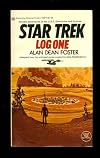
After (finally!) finishing the tenth in James Blish's series of adaptations, we come to June 1974, and the publication of Alan Dean Foster's Star Trek Log One. This volume adapts the first three episodes of Star Trek: The Animated Series, "Beyond the Farthest Star", "Yesteryear", and "One of Our Planets Is Missing".
Like Blish's Star Trek series, Foster's Star Trek Log series adapts television episodes. There, though, the similarities end. Blish adapted hour-long episodes into roughly twenty-five page short stories. Foster adapts half-hour episodes into (in this book) roughly sixty-page short stories. And oh, but the extra pages are well-used.
I hate to be too hard on Blish, but reading his adaptations is very like reading scripts show more re-arranged as prose. Plenty of dialogue, some stage directions, and a bit of description to set the scene. But unless Kirk says it out loud, we have no idea what he's thinking, and twenty-five pages is too short for the narrator to spend any time musing on events, either.
By contrast, Foster adapts much shorter episodes into much longer stories, so he can take time to comment and expand on events, to give things some flavor, and to let us know how the characters are affected. It's interesting and, after reading ten volumes of Blish's spartan prose, refreshing.
Since I reviewed each of the stories in this book, the whole review is very long. I'm cutting to the conclusion, here, for brevity. Read the complete review on my blog.
A digression, here, on the subject of The Animated Series.
In my experience, TAS has not got a very good reputation--which is perhaps a recent development, as it was fairly well received when originally aired. I can understand some reasons why: like TOS, the stories can be far less serious than those told in later Trek, and it suffered from some very subpar animation, from time to time.
For the first point, however, TAS is, after all, intended as a direct followup to TOS--essentially a fourth season. That it has a similar style is no flaw. As to the second: putting aside quality, the use of animation allowed the Enterprise to have regular alien crew members (other than Spock, of course) and to accomplish any desired effects without blowing a whole season's budget. If you ask me, it's better to suffer some low-quality animation than the sameness in a Federation crew.
Back to the book, then.
One thing to note about these adaptations is that Foster ties the stories together chronologically. The first story begins as they are on their way to the Time Planet, the second takes place there, and the third begins two days after they leave. It doesn't really impact the plot--a few minor references to the previous events aside--but it does provide a good sense of continuity. Here, it feels like the Enterprise really is out and about, encountering danger after danger, where in the television series the events felt much more isolated. It's a nice touch.
Star Trek Log One is a worthwhile read, particularly if you find the animation in The Animated Series offputting. No need to miss out on good stories on account of poor presentation! "Yesteryear" is a great character-focused story, bookended by two rather average adventures. All three are quite readable, though, and the book is worth it for "Yesteryear" alone. show less
Like Blish's Star Trek series, Foster's Star Trek Log series adapts television episodes. There, though, the similarities end. Blish adapted hour-long episodes into roughly twenty-five page short stories. Foster adapts half-hour episodes into (in this book) roughly sixty-page short stories. And oh, but the extra pages are well-used.
I hate to be too hard on Blish, but reading his adaptations is very like reading scripts show more re-arranged as prose. Plenty of dialogue, some stage directions, and a bit of description to set the scene. But unless Kirk says it out loud, we have no idea what he's thinking, and twenty-five pages is too short for the narrator to spend any time musing on events, either.
By contrast, Foster adapts much shorter episodes into much longer stories, so he can take time to comment and expand on events, to give things some flavor, and to let us know how the characters are affected. It's interesting and, after reading ten volumes of Blish's spartan prose, refreshing.
Since I reviewed each of the stories in this book, the whole review is very long. I'm cutting to the conclusion, here, for brevity. Read the complete review on my blog.
A digression, here, on the subject of The Animated Series.
In my experience, TAS has not got a very good reputation--which is perhaps a recent development, as it was fairly well received when originally aired. I can understand some reasons why: like TOS, the stories can be far less serious than those told in later Trek, and it suffered from some very subpar animation, from time to time.
For the first point, however, TAS is, after all, intended as a direct followup to TOS--essentially a fourth season. That it has a similar style is no flaw. As to the second: putting aside quality, the use of animation allowed the Enterprise to have regular alien crew members (other than Spock, of course) and to accomplish any desired effects without blowing a whole season's budget. If you ask me, it's better to suffer some low-quality animation than the sameness in a Federation crew.
Back to the book, then.
One thing to note about these adaptations is that Foster ties the stories together chronologically. The first story begins as they are on their way to the Time Planet, the second takes place there, and the third begins two days after they leave. It doesn't really impact the plot--a few minor references to the previous events aside--but it does provide a good sense of continuity. Here, it feels like the Enterprise really is out and about, encountering danger after danger, where in the television series the events felt much more isolated. It's a nice touch.
Star Trek Log One is a worthwhile read, particularly if you find the animation in The Animated Series offputting. No need to miss out on good stories on account of poor presentation! "Yesteryear" is a great character-focused story, bookended by two rather average adventures. All three are quite readable, though, and the book is worth it for "Yesteryear" alone. show less
Star Trek: Log One by Alan Dean Foster features three short stories adapted from "the best episodes" Star Trek: The Animated Series (TAS). The three episodes are in order "Beyond the Farthest Star", "Yesteryear", and "One of Our Planets is Missing" which correspond with the first three episodes of TAS which makes one think they just adapted all the stories of TAS into books to make money, but that is another discussion all together. The three stories are loosing connected as Foster presents them as a sequence of events transcribed from the Captain Logs of James T. Kirk, even though they are connected I feel its best to give a brief review of each story.
"Beyond the Farthest Star"- The longest story of the trio, it is also the slowest to show more develop. The Enterprise gets caught in the pull of an uncharted black hole and barely are able to get into orbit when they encounter an dead alien vessel that has been in orbit for 3 million years. Kirk, Spock, McCoy, and Scotty decide to explore the vessel and realize that it had been taken over by a malevolent energy being that transports over to the Enterprise when the four return then takes over the ship. The standard crew versus creature-taken-over the ship trope then follows. (2.5/5 stars)
"Yesteryear"- Whether all of TAS is considered canon or not, it seems this episode is considered canon. The Enterprise returns to the Time Planet and the Guardian of Forever with several historians. Kirk and Spock accompany one of the historians through the Guardian, but when they return no one recognizes Spock especially the Andorian first officer and Kirk's apparent best friend. After examining the evidence it is deduced that Spock used the Guardian to return to Vulcan when he was seven and saved his younger self, posing as his cousin Selek. A fair amount of the episode takes place on Vulcan following Spock and his younger self, giving insight into Spock's childhood along with Vulcan culture and philosophy. This story is worth the buying the book alone. (5/5 stars)
"One of Our Planets is Missing"- Standard Enterprise encountering large space creature trope. Well-written, but heavy handed with Vulcan telepathy as a deus-ex-machina. (3/5 stars).
While the quality of the stories range from meh to great and some typos that should have been corrected during editing are present, Star Trek: Log One shows the continuing adventures of the original U.S.S. Enterprise and it's crew. If you're new or long-time fan of the original televisions show I would recommend getting your hands on this book, especially for the story "Yesteryear". show less
"Beyond the Farthest Star"- The longest story of the trio, it is also the slowest to show more develop. The Enterprise gets caught in the pull of an uncharted black hole and barely are able to get into orbit when they encounter an dead alien vessel that has been in orbit for 3 million years. Kirk, Spock, McCoy, and Scotty decide to explore the vessel and realize that it had been taken over by a malevolent energy being that transports over to the Enterprise when the four return then takes over the ship. The standard crew versus creature-taken-over the ship trope then follows. (2.5/5 stars)
"Yesteryear"- Whether all of TAS is considered canon or not, it seems this episode is considered canon. The Enterprise returns to the Time Planet and the Guardian of Forever with several historians. Kirk and Spock accompany one of the historians through the Guardian, but when they return no one recognizes Spock especially the Andorian first officer and Kirk's apparent best friend. After examining the evidence it is deduced that Spock used the Guardian to return to Vulcan when he was seven and saved his younger self, posing as his cousin Selek. A fair amount of the episode takes place on Vulcan following Spock and his younger self, giving insight into Spock's childhood along with Vulcan culture and philosophy. This story is worth the buying the book alone. (5/5 stars)
"One of Our Planets is Missing"- Standard Enterprise encountering large space creature trope. Well-written, but heavy handed with Vulcan telepathy as a deus-ex-machina. (3/5 stars).
While the quality of the stories range from meh to great and some typos that should have been corrected during editing are present, Star Trek: Log One shows the continuing adventures of the original U.S.S. Enterprise and it's crew. If you're new or long-time fan of the original televisions show I would recommend getting your hands on this book, especially for the story "Yesteryear". show less
LOG ONE is notably different to James Blish's adaptations of TOS. For one thing, the adaptations make it clear that the adventures are taking place in order (one references another as having just happened previous in time). For another, they are much extended, including more lines and more insight into each character. It's a lot more similar to later novelizations, where the authors take advantage of the written format to give more detail than could be filmed, especially about character feelings.
I am really enjoying the Star Trek Logs. They're short-story novelizations of the animated series, and they're really, really good. The writing is a step up from Blish's novelizations of the original series (though I do love them, too!), and even if you didn't enjoy TAS I would recommend these stories. They're all interconnected, too, and the plots are made to work together despite their obviously episodic nature.
An early collection of Star Trek stories, taken from the animated series that came out a bit earlier. The three stories here comprise two basic straight science-fiction adventures, both fairly interesting, and the gem of the bunch is Yesteryear, a compelling story in which a mishap with the Guardian of Forever forces Spock to journey back to the Vulcan of his childhood to assist his younger self in passing a maturity test. A fascinating early look at Spock's origins and psyche that leaves the reader wishing for more.
Science Fiction: Three short stories adapted from the 1970s animated series. As I have not watched the series, I didn't go into this read with any expectations. The stories are well written and I enjoyed the book.
If you are looking for classic Trek this is just about as classic as it gets. Three stories taken from the 70's animated series just brings back memories of when guys like me were starving for more.
Members
- Recently Added By
Author Information

362+ Works 73,936 Members
Bestselling science fiction writer Alan Dean Foster was born in New York City in 1946, but raised mainly in California. He received a B.A. in Political Science from UCLA in 1968, and a M.F.A. in 1969. Foster enjoys traveling because it gives him opportunities to meet new people and explore new places and cultures. This interest is carried over to show more his writing, but with a twist: the new places encountered in his books are likely to be on another planet, and the people may belong to an alien race. Foster began his career as an author when a letter he sent to Arkham Collection was purchased by the editor and published in the magazine in 1968. His first novel, The Tar-Aiym Krang, introduced the Humanx Commonwealth, a galactic alliance between humans and an insectlike race called Thranx. Several other novels, including the Icerigger trilogy, are also set in the world of the Commonwealth. The Tar-Aiym Krang also marked the first appearance of Flinx, a young man with paranormal abilities, who reappears in other books, including Orphan Star, For Love of Mother-Not, and Flinx in Flux. Foster has also written The Damned series and the Spellsinger series, which includes The Hour of the Gate, The Moment of the Magician, The Paths of the Perambulator, and Son of Spellsinger, among others. Other books include novelizations of science fiction movies and television shows such as Star Trek, The Black Hole, Starman, Star Wars, and the Alien movies. Splinter of the Mind's Eye, a bestselling novel based on the Star Wars movies, received the Galaxy Award in 1979. The book Cyber Way won the Southwest Book Award for Fiction in 1990. His novel Our Lady of the Machine won him the UPC Award (Spain) in 1993. He also won the Ignotus Award (Spain) in 1994 and the Stannik Award (Russia) in 2000. He is the recipient of the Faust, the IAMTW Lifetime achievement award. Alan Dean Foster's Star Wars: The Force Awakens, was a 2015 New York Times bestseller. (Bowker Author Biography) show less
Series

Work Relationships
Common Knowledge
- Canonical title
- Star Trek Log One
- Original title
- Star Trek Log One
- Alternate titles
- Star Trek Log One
- Original publication date
- 1974-06 (eng.) (eng.)
- People/Characters
- Guardian of Forever; Amanda Grayson; James T. Kirk (Captain); Leonard McCoy (Bones); Sarek; Spock (show all 10); Robert Wesley (Commodore); Montgomery Scott; Hikaru Sulu; Nyota Uhura
- Important places
- USS Enterprise NCC-1701; Vulcan
- Related movies
- Star Trek (1973 | IMDb)
- First words
- Beyond the Farthest Star -
Veil of stars. - Last words
- (Click to show. Warning: May contain spoilers.)One of Our Planets is Missing -
Only infinity and a few stars remained.
Classifications
Statistics
- Members
- 685
- Popularity
- 41,922
- Reviews
- 12
- Rating
- (3.46)
- Languages
- English
- Media
- Paper
- ISBNs
- 9
- UPCs
- 1
- ASINs
- 8