On This Page
Description
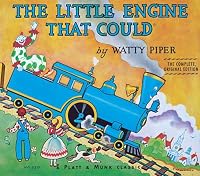
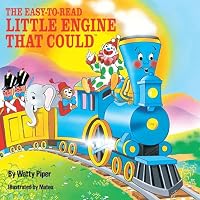
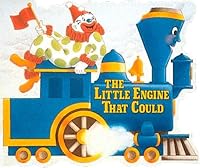
Although she is not very big, the Little Blue Engine agrees to try to pull a stranded train full of toys over the mountain.Tags
Recommendations










Member Recommendations

Member Reviews
The modern illustrations are fun; I haven't read the book with the original illustrations in a long time, so no way to compare particulars.
A couple of notes on the text: The bad (inconsiderate, rude, tired) engines are all male. The kids' train itself is female, as is the little engine that could. It's rare to find inanimate characterizations that center around a heroic female, so one might be tempted to just let discussion pass, and let this one stand as a corrective to all the "male" monster trucks and steamboats and Thomas the Train books. But perhaps that makes talking about this book all the more valuable. Compare this book with one of the other books that characterize inanimate protagonists as male, and one that uses "it" (I'm show more Dirty! by Kate and Jim McMullan), and discuss why? What does it add to the text? Do the trains / trucks have to be written as male or female?
Also I note that the text repeatedly refers to the toys and breakfast for all the little girls and boys, another example of a slightly dated use that unnecessarily inserts gender. (None of the "good little boys and girls" are ever depicted in the story; so why not just talk about children?) show less
A couple of notes on the text: The bad (inconsiderate, rude, tired) engines are all male. The kids' train itself is female, as is the little engine that could. It's rare to find inanimate characterizations that center around a heroic female, so one might be tempted to just let discussion pass, and let this one stand as a corrective to all the "male" monster trucks and steamboats and Thomas the Train books. But perhaps that makes talking about this book all the more valuable. Compare this book with one of the other books that characterize inanimate protagonists as male, and one that uses "it" (I'm show more Dirty! by Kate and Jim McMullan), and discuss why? What does it add to the text? Do the trains / trucks have to be written as male or female?
Also I note that the text repeatedly refers to the toys and breakfast for all the little girls and boys, another example of a slightly dated use that unnecessarily inserts gender. (None of the "good little boys and girls" are ever depicted in the story; so why not just talk about children?) show less
The Little Engine That Could by Watty Piper is a classic children's story whose main theme is determination. This is one of those stories that has a great message for children that no matter how small you may look or feel, you can accomplish big things if you believe in yourself. The little engine repeating “I think I can” reinforces the theme of determination and makes it memorable for young readers. Even though this is a children's book, I have heard adults in life repeat the phrase “I think I can, I think I can” in a funny manner when they are going through something, which is a cute, universal experience that shows how memorable and classic this story is for many generations. The steep mountains are an example of the show more obstacles that life has, but with a positive outlook, it is a great learning experience. Overall, the message of the story is one that encourages young readers to keep trying even when things get hard. show less
Sarah Durkin
Professor Martens
EDUC417
1 March 2016
Reading Log Entry #12: The Little Engine That Could by, Watty Piper
This book does a good job capturing reader’s attentions. First, there are many different emotions that occur throughout this story. Readers are able to relate and predict how the engine will feel next based off of the facial expressions and text in the book. The train was sad when it broke down, but then happy when he was able to deliver all of the toys to the children. Second, this book encourages readers to have positive attitudes by saying “I think I can, I think I can.” This is important because whenever you are having a bad day or a hard time, staying positive can motivate you to reach your goal and do the best show more you can. Others would tell him not to worry about dropping the toys off, but since it was his job and he knew children were waiting, the train persisted to get moving again. Finally, I like how the train took a risk to do what he thought was right. Most people try to avoid risks, but in this story taking a risk could mean happiness for many people. Sometimes it is good to think of others and put others first before yourself. This shows respect and courage, which are good traits to have as a person. The overall message of this book is to never give up. After reading this book, it is clear that anyone who puts in a lot of effort will get a good outcome in return. show less
Professor Martens
EDUC417
1 March 2016
Reading Log Entry #12: The Little Engine That Could by, Watty Piper
This book does a good job capturing reader’s attentions. First, there are many different emotions that occur throughout this story. Readers are able to relate and predict how the engine will feel next based off of the facial expressions and text in the book. The train was sad when it broke down, but then happy when he was able to deliver all of the toys to the children. Second, this book encourages readers to have positive attitudes by saying “I think I can, I think I can.” This is important because whenever you are having a bad day or a hard time, staying positive can motivate you to reach your goal and do the best show more you can. Others would tell him not to worry about dropping the toys off, but since it was his job and he knew children were waiting, the train persisted to get moving again. Finally, I like how the train took a risk to do what he thought was right. Most people try to avoid risks, but in this story taking a risk could mean happiness for many people. Sometimes it is good to think of others and put others first before yourself. This shows respect and courage, which are good traits to have as a person. The overall message of this book is to never give up. After reading this book, it is clear that anyone who puts in a lot of effort will get a good outcome in return. show less
The modern illustrations are fun; I haven't read the book with the original illustrations in a long time, so no way to compare particulars. [return][return]A couple of notes on the text: The bad (inconsiderate, rude, tired) engines are all male. The kids' train itself is female, as is the little engine that could. It's rare to find inanimate characterizations that center around a heroic female, so one might be tempted to just let discussion pass, and let this one stand as a corrective to all the "male" monster trucks and steamboats and Thomas the Train books. But perhaps that makes talking about this book all the more valuable. Compare this book with one of the other books that characterize inanimate protagonists as male, and one that show more uses "it" (I'm Dirty! by Kate and Jim McMullan), and discuss why? What does it add to the text? Do the trains / trucks have to be written as male or female? [return][return]Also I note that the text repeatedly refers to the toys and breakfast for all the little girls and boys, another example of a slightly dated use that unnecessarily inserts gender. (None of the "good little boys and girls" are ever depicted in the story; so why not just talk about children?) show less
The illustrations of the book are beautifully done and really add to the feel of the book. The book tells the story of a group that needs help but can not get any because other engines think that they are too good to help. The Blue engine is an excellent role model that teaches children no matter who you are and what you're capable of you can always help those in need and be a better person.
This picture book is about a train delivering toys to the children in a little town. The train breaks down and the toys wait for an engine that will help them to reach the town. All the engines that go past them deny the task, though, until the little engine agrees.
At first I was a bit put off by the story because I missed some background - why is the train delivering the toys? Some of the toys felt a bit creepy to me. However, once the little engine came along, I rooted for it and I really liked the onomatopoeia (I think I can - I think I can - I think I can...) and the message of the book.
At first I was a bit put off by the story because I missed some background - why is the train delivering the toys? Some of the toys felt a bit creepy to me. However, once the little engine came along, I rooted for it and I really liked the onomatopoeia (I think I can - I think I can - I think I can...) and the message of the book.
This story instills determination and perseverance in the face of adversity, and gives a courage and a voice to littles. A quintessential classic that should be in the home library of all children
Members
- Recently Added By
Lists

Favorite Childhood Books
1,646 works; 513 members

Best children's picture books
377 works; 83 members
1001 Children's Books You Must Read Before You Grow Up
774 works; 100 members

Mensa for Kids Excellence in Reading Award Program (Grades K-3)
64 works; 6 members

Brightly Beaming Curriculum Books
281 works; 8 members
Ambleside Books
459 works; 18 members

Bennett's 30 Great Books Every Preschooler Should Meet
30 works; 3 members

CCE 1000 Good Books List
1,033 works; 12 members

Toy Stories: Living Dolls, Bears and Other Toys
129 works; 7 members

Romalda Spalding's Writing Road To Reading
213 works; 3 members

Reading Rainbow
193 works; 10 members

75 Books for Fall Literacy Block - Dr. Reed
67 works; 2 members

Youth: Personal Values
252 works; 1 member

Books That Defined My Childhood & Early Adulthood
42 works; 5 members

In or About the 1930s
198 works; 27 members

1930s
262 works; 5 members

Before Austen Comes Aesop
318 works; 9 members

scav
54 works; 2 members

Early Picture Books
467 works; 9 members

BitLife
212 works; 4 members

Favorite Picture Books
479 works; 160 members

Books We Loved As Children
603 works; 252 members
Author Information

130+ Works 18,464 Members
All Editions
Some Editions
Awards and Honors
Series

Belongs to Publisher Series
Golden Press (A Little Golden Book 305-2)
Little Golden Book (305-2)
Work Relationships
Is contained in
Has the adaptation
Is abridged in
Common Knowledge
- Original publication date
- 1930
- People/Characters
- The Little Engine That Could
- Dedication
- This book is dedicated to my mother, Elizabeth Long, who knows something of climbing mountains
—L. L - First words
- Chug, chug, chug. Puff, puff, puff. Ding-dong, ding-dong, ding-dong. The little train rumbled over the tracks.
- Quotations
- Then she said, "I think I can. I think I can. I think I can."
- Last words
- (Click to show. Warning: May contain spoilers.)I thought I could.
(Click to show. Warning: May contain spoilers.)And the Little Blue Engine smiled and seemed to say as she puffed steadily down the mountain, "I thought I could. I thought I could. I thought I could. I thought I could. I thought I could. I thought I could." - Original language
- English
- Disambiguation notice
- This is the complete version of the children's classic story and should not be combined with "Easy-to-read", boardbook, or other adaptations.
Classifications
Statistics
- Members
- 14,277
- Popularity
- 514
- Reviews
- 212
- Rating
- (4.08)
- Languages
- 6 — Danish, English, French, German, Spanish, Swedish
- Media
- Paper, Audiobook, Ebook
- ISBNs
- 109
- UPCs
- 12
- ASINs
- 76