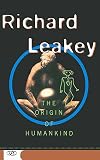
The Origin of Humankind
by Richard Leakey
On This Page
Description
"The name Leakey is synonymous with the study of human origins," wrote The New York Times. The renowned family of paleontologists-Louis Leakey, Mary Leakey, and their son Richard Leakey-has vastly expanded our understanding of human evolution. The Origin of Humankind is Richard Leakey's personal view of the development of Homo Sapiens. At the heart of his new picture of evolution is the introduction of a heretical notion: once the first apes walked upright, the evolution of modern humans show more became possible and perhaps inevitable. From this one evolutionary step comes all the other evolutionary refinements and distinctions that set the human race apart from the apes. In fascinating sections on how and why modern humans developed a social organization, culture, and personal behavior, Leakey has much of interest to say about the development of art, language, and human consciousness. show lessTags
Recommendations




















Member Reviews
Richard Leakey offers here the perfect introduction to human evolution. Paleoanthropologist famous for having discovered 'Turkana Boy' (one of the most ancient hominid we know of, having lived about 1,5 million years ago) he gives us to see our own evolution through a vast panorama stretching from when we became bipeds (about 7 million years ago) to the apparition of culture during the Upper Paleolithic.
Tossing aside the (more often than not) too simplistic views of our origins, he tries to focus on our history from a purely physical perspective (e.g. the discoveries and importance of various fossils). He also tries to define what make us singularly human, distinguishing us from other apes (art, language, self-consciousness...). About, show more the dialogues between paleoanthropologists, biologists and linguists are fascinating; they show how the topics addressed remain highly debated and controversial!
Short, this book is nevertheless so full of instructive information it's enthralling at every page! Here's a highly recommended introduction to a fascinating topic. show less
Tossing aside the (more often than not) too simplistic views of our origins, he tries to focus on our history from a purely physical perspective (e.g. the discoveries and importance of various fossils). He also tries to define what make us singularly human, distinguishing us from other apes (art, language, self-consciousness...). About, show more the dialogues between paleoanthropologists, biologists and linguists are fascinating; they show how the topics addressed remain highly debated and controversial!
Short, this book is nevertheless so full of instructive information it's enthralling at every page! Here's a highly recommended introduction to a fascinating topic. show less
This is a good overview of human evolution, written in such a way that you don’t need to be familiar with technical or scientific terms.
My attention started to waver during the last three chapters, which include analysis of art, plus how and when people first started speaking. I found all this a bit bland and repetitive, but the first three-quarters or so of the book is highly engaging.
My attention started to waver during the last three chapters, which include analysis of art, plus how and when people first started speaking. I found all this a bit bland and repetitive, but the first three-quarters or so of the book is highly engaging.
A very readable basic introduction to the key issues and debates in this field, and pointers to more detailed reading. The author has his own opinions, but sets out the terms of the debate in a fair way. The only specific point I would question is the use of the term "human" to describe all bipedal homin(o)ids, even those living before any use of stone technology or language. The book could also usefully have had some more illustrations, especially in the chapter on art.
A bargain buy in a charity shop - the only thing that stops me giving it 5 stars is the fact that I believe it may be a little dated (simply by advances in the field in the last 15 years).
The author is a great writer, and the name-dropping on the first few pages is quickly forgotten; he deserves to drop some names.
This is an account of some of the key developments in human history, from learning to walk upright to developing language and art. At each stage he reviews the debates in the field (which are many) and usually advances his own view and his reservations. I wish all top scientists and researchers could present their field like this.
However the discussion of timelines for (e.g. language development) may have been superseded by show more subsequent discoveries - while I believe this to be the case, this is not in any way my field so I do not know. If there is an updated version of this book, read it; if there isn't, there should be! show less
The author is a great writer, and the name-dropping on the first few pages is quickly forgotten; he deserves to drop some names.
This is an account of some of the key developments in human history, from learning to walk upright to developing language and art. At each stage he reviews the debates in the field (which are many) and usually advances his own view and his reservations. I wish all top scientists and researchers could present their field like this.
However the discussion of timelines for (e.g. language development) may have been superseded by show more subsequent discoveries - while I believe this to be the case, this is not in any way my field so I do not know. If there is an updated version of this book, read it; if there isn't, there should be! show less
Brief overview of the most pivotal moments in the exploration of human origins, intended as an introductory text for the general public, (as was the overall objective of the Science Masters Series). Quick and entertaining read, which, by it's very nature, aged quite quickly!
Una revelación, Una gran motivación para entrar en el mundo de la paleontología de la mano de uno de los grandes de la disciplina.
Mar 14, 2009Spanish
Indeholder "Forord", "1. De første mennesker", "2. En stor familie", "3. En anden slags menneske", "4. Den ædle jæger?", "5. Nutidige menneskers oprindelse", "6. Kunstens sprog", "7. Sprogets kunst", "8. Åndslivets oprindelse", "Bibliografi og supplerende litteratur", "Register".
DNA analyser af gamle knogler har rokket ved mange af de skråsikre teorier om menneskets udviklingshistorie.
DNA analyser af gamle knogler har rokket ved mange af de skråsikre teorier om menneskets udviklingshistorie.
Nov 12, 2025Danish
Members
- Recently Added By
Author Information

25+ Works 3,724 Members
Some Editions
Awards and Honors
Awards
Series
Belongs to Publisher Series
Work Relationships
Common Knowledge
- Canonical title
- The Origin of Humankind
- Original title
- The Origin of Humankind
- Original publication date
- 1994
Classifications
- Genres
- Anthropology, Science & Nature, Nonfiction, General Nonfiction, History
- DDC/MDS
- 573.2 — Natural sciences & mathematics Biology Specific physiological systems in animals, regional histology and physiology in animals Origin of man
- LCC
- GN281 .L39 — Geography, Anthropology and Recreation Anthropology Anthropology Physical anthropology. Somatology Human evolution
- BISAC
Statistics
- Members
- 958
- Popularity
- 27,769
- Reviews
- 8
- Rating
- (3.74)
- Languages
- 15 — Chinese, traditional, Danish, Dutch, English, Finnish, French, German, Hungarian, Italian, Norwegian (Bokmål), Norwegian, Portuguese, Romanian, Spanish, Swedish
- Media
- Paper, Audiobook, Ebook
- ISBNs
- 35
- ASINs
- 14