In Praise of Darkness
by Jorge Luis Borges
On This Page
Description
La vejez (tal es el nombre que otros le dan) / puede ser el tiempo de nuestra dicha. / El animal ha muerto o casi ha muerto./ Quedan el hombre y el alma.. Con estos versos Jorge Luis Borges inicia el poema Elogio de la sombra que da titulo a este volumen. En su prologo escribe: A los espejos, laberintos y espadas que ya preve mi resignado lector se han agregado dos temas nuevos: la vejez y la etica... Este libro reune las composiciones en prosa y en verso escritas entre 1967 y 1969. Su show more publicacion celebro los 70 anos del autor y tuvo una gran acogida entre el publico y la critica. Elogio de la sombra es la plenitud de Borges, su retorno a las cosas esenciales," escribio Felix Luna. A la edad que tiene Borges, cuando el animal ha muerto o casi ha muerto, queda de el lo mas importante, es decir, el espiritu puro y las raices. Entre estos dos limites extremos, su penumbra; esa sombra que 'se parece a la eternidad. show lessTags
Recommendations


































Member Reviews
The Labyrinth
Zeus, Zeus himself could not undo these nets
of stone encircling me. My mind forgets
the person I have been along the way,
the hated way of monotonous walls,
which is my fate. The galleries seem straight
but curve furtively, forming secret circles
at the terminus of years, and the parapets
have been worn smooth by the passage of days.
Here, in the tepid alabaster of dust,
are tracks that frighten me. The hollow air
of evening sometimes brings a bellowing,
or the echo, desolate, of bellowing,
I know that hidden in the shadows there
lurks another, whose task is to exhaust
the lonliness that braids and weaves this hell,
to crave my blood, and to fatten on my death,
We seek each other, Oh, if only this
were the last day of our antithesis!
[ show more Translated by John Updike] show less
Zeus, Zeus himself could not undo these nets
of stone encircling me. My mind forgets
the person I have been along the way,
the hated way of monotonous walls,
which is my fate. The galleries seem straight
but curve furtively, forming secret circles
at the terminus of years, and the parapets
have been worn smooth by the passage of days.
Here, in the tepid alabaster of dust,
are tracks that frighten me. The hollow air
of evening sometimes brings a bellowing,
or the echo, desolate, of bellowing,
I know that hidden in the shadows there
lurks another, whose task is to exhaust
the lonliness that braids and weaves this hell,
to crave my blood, and to fatten on my death,
We seek each other, Oh, if only this
were the last day of our antithesis!
[ show more Translated by John Updike] show less
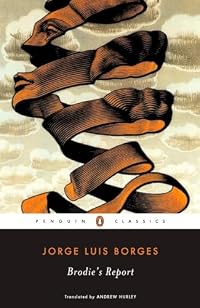
This collection includes poems and short tales from the modern master of the fantastic, Argentina's Jorge Luis Borges (1899-1986) at a time in his life after he completely lost his sight. Below are my comments along with quotes from the tales. I read this book translated by Norman Thomas di Giovanni years ago, however my quotes are from the translation by Andrew Hurley, which is available online via the following link: https://www.google.com/#q=borges brodie's report full text
THE ETHNOGRAPHER
In order to advance the study of anthropology, a student is sent out West to live with a tribe of Native Americans. After undergoing certain proscribed trials and tribulations, he earns the right to receive transmission of the tribe’s secret show more doctrine but when he returns to his professor at university, he refuses to divulge a word about the tribe’s doctrine, explaining the path to the doctrine is a critical first step in understanding.
PEDRO SALVADORES
As a way of hiding himself from a dictator’s torture and execution, Pedro Salvadores remains hidden in total darkness in his cellar for nine years. Borges writes: “I suspect that in the darkness that his eyes learned to fathom, he came not to think of anything – not even his hatred or his anger.” Reflecting on Pedro Salvadores and his years of darkness in that cellar I also think of how this tale was written by a blind Jorge Luis Bores. How would our experience of life be altered if we were forced by circumstances to live years in darkness, either the darkness of a subterranean cavern or due to our loss of sight?
LEGEND
Cain and Able encounter each other after the death of Able. Cain asks Able to forgive him.
Borges writes: “Was it you that killed me; or did I kill you?” Able answered. “I don’t remember anymore; here we are together, like before.”
“Now I know that you have truly forgiven me,” Cain said, “because forgetting is forgiving. I, too, will try to forget.”
“Yes,” said Abel slowly. “So long as remorse lasts, guilt lasts.”
A PRAYER
As part of this tale, we read such a telling statement from Borges as author, a man whose very life revolved around reading books and is now blind, unable to read: “Asking that my eyes not be filled with night would be madness; I know of thousands of people who can see, yet who are not particularly happy, just, or wise."
HIS END AND HIS BEGINNING
Here is the second half of this Borges jewel, a most philosophic tale about a man gone blind and facing death, quoted in full, followed by a number of questions I ask myself after reading:
“That night the nightmares began, he was left without the slightest memory of them – just the fear that they’d return. In time, that fear prevailed; it came between him and the page he was supposed to write, the books he tried to read. Letters would crawl about on the page like ants; faces, familiar faces, gradually blurred and faded, objects and people slowly abandoned him. His mind seized upon those changing shapes in a frenzy of tenacity.
However odd it may seem, he never suspected the truth; it was burst upon him suddenly. He realized that he was unable to remember the shapes, sounds, and colors of his dreams, there were no shapes, colors or sounds, nor were the dreams dreams. They were his reality, a reality beyond silence and sight, and therefore beyond memory. The realization threw him into even greater consternation than the fact that from the hour of his death he had been struggling in a whirlwind of senseless images. The voices he’d heard had been echoes; the faces he’d seen had been masks; the fingers of his hands had been shadows – vague and insubstantial, true, yet also dear to him, and familiar.
Somehow he sensed that it was his duty to leave all these things behind; now he belonged to this new world, removed from past, present, and future. Little by little this new world surrounded him. He suffered many agonies, journeyed through realms of desperation and loneliness – appalling peregrinations, for they transcended all his previous perceptions, memories, and hopes. All horror lay in their newness and their splendor. He had deserved grace – he had earned it; every second since the moment of his death, he had been in heaven.”
• How will memory influence our advanced aging and our own death and dying? Is dealing with our fears the key? Or, stated another way, without fear, do memories lose their grip on us?
• If our familiar boundaries begin to blur and fade, will we be able to let go and face this dissolution with an abiding sense of peace?
• What does it mean to lose memory, particularly in a world without sight, a world gone dark?
• How willing are we to face a completely new world of experience? Are there any aspects of our current earthly life we would like to continue without end? If so, how are those aspects connected with our sense of sight?
• The narrator claims the man in this tale has been in heaven. Since he has been soaked in dread, fear and trepidation all along, is such a statement ridiculous? show less
This collection includes poems and short tales from the modern master of the fantastic, Argentina's Jorge Luis Borges (1899-1986) at a time in his life after he completely lost his sight. Below are my comments along with quotes from the tales. I read this book translated by Norman Thomas di Giovanni years ago, however my quotes are from the translation by Andrew Hurley, which is available online via the following link: https://www.google.com/#q=borges brodie's report full text
THE ETHNOGRAPHER
In order to advance the study of anthropology, a student is sent out West to live with a tribe of Native Americans. After undergoing certain proscribed trials and tribulations, he earns the right to receive transmission of the tribe’s secret show more doctrine but when he returns to his professor at university, he refuses to divulge a word about the tribe’s doctrine, explaining the path to the doctrine is a critical first step in understanding.
PEDRO SALVADORES
As a way of hiding himself from a dictator’s torture and execution, Pedro Salvadores remains hidden in total darkness in his cellar for nine years. Borges writes: “I suspect that in the darkness that his eyes learned to fathom, he came not to think of anything – not even his hatred or his anger.” Reflecting on Pedro Salvadores and his years of darkness in that cellar I also think of how this tale was written by a blind Jorge Luis Bores. How would our experience of life be altered if we were forced by circumstances to live years in darkness, either the darkness of a subterranean cavern or due to our loss of sight?
LEGEND
Cain and Able encounter each other after the death of Able. Cain asks Able to forgive him.
Borges writes: “Was it you that killed me; or did I kill you?” Able answered. “I don’t remember anymore; here we are together, like before.”
“Now I know that you have truly forgiven me,” Cain said, “because forgetting is forgiving. I, too, will try to forget.”
“Yes,” said Abel slowly. “So long as remorse lasts, guilt lasts.”
A PRAYER
As part of this tale, we read such a telling statement from Borges as author, a man whose very life revolved around reading books and is now blind, unable to read: “Asking that my eyes not be filled with night would be madness; I know of thousands of people who can see, yet who are not particularly happy, just, or wise."
HIS END AND HIS BEGINNING
Here is the second half of this Borges jewel, a most philosophic tale about a man gone blind and facing death, quoted in full, followed by a number of questions I ask myself after reading:
“That night the nightmares began, he was left without the slightest memory of them – just the fear that they’d return. In time, that fear prevailed; it came between him and the page he was supposed to write, the books he tried to read. Letters would crawl about on the page like ants; faces, familiar faces, gradually blurred and faded, objects and people slowly abandoned him. His mind seized upon those changing shapes in a frenzy of tenacity.
However odd it may seem, he never suspected the truth; it was burst upon him suddenly. He realized that he was unable to remember the shapes, sounds, and colors of his dreams, there were no shapes, colors or sounds, nor were the dreams dreams. They were his reality, a reality beyond silence and sight, and therefore beyond memory. The realization threw him into even greater consternation than the fact that from the hour of his death he had been struggling in a whirlwind of senseless images. The voices he’d heard had been echoes; the faces he’d seen had been masks; the fingers of his hands had been shadows – vague and insubstantial, true, yet also dear to him, and familiar.
Somehow he sensed that it was his duty to leave all these things behind; now he belonged to this new world, removed from past, present, and future. Little by little this new world surrounded him. He suffered many agonies, journeyed through realms of desperation and loneliness – appalling peregrinations, for they transcended all his previous perceptions, memories, and hopes. All horror lay in their newness and their splendor. He had deserved grace – he had earned it; every second since the moment of his death, he had been in heaven.”
• How will memory influence our advanced aging and our own death and dying? Is dealing with our fears the key? Or, stated another way, without fear, do memories lose their grip on us?
• If our familiar boundaries begin to blur and fade, will we be able to let go and face this dissolution with an abiding sense of peace?
• What does it mean to lose memory, particularly in a world without sight, a world gone dark?
• How willing are we to face a completely new world of experience? Are there any aspects of our current earthly life we would like to continue without end? If so, how are those aspects connected with our sense of sight?
• The narrator claims the man in this tale has been in heaven. Since he has been soaked in dread, fear and trepidation all along, is such a statement ridiculous? show less
`El elogio de la sombra` es un manifiesto sobre la estética japonesa escrito en 1933. En él, se argumenta que en Occidente la belleza siempre ha estado ligada a la luz, a lo brillante y a lo blanco, y que lo oscuro, lo opaco y lo negro siempre ha tenido una connotación negativa. Sin embargo, argumenta, en Japón la sombra no tiene una connotación negativa y es considerada como parte de la belleza.
Jun 23, 2022Spanish
Ratings
Members
- Recently Added By
Author Information

859+ Works 58,704 Members
Born in Buenos Aires, Argentina, in 1899, Jorge Borges was educated by an English governess and later studied in Europe. He returned to Buenos Aires in 1921, where he helped to found several avant-garde literary periodicals. In 1955, after the fall of Juan Peron, whom he vigorously opposed, he was appointed director of the Argentine National show more Library. With Samuel Beckett he was awarded the $10,000 International Publishers Prize in 1961, which helped to establish him as one of the most prominent writers in the world. Borges regularly taught and lectured throughout the United States and Europe. His ideas have been a profound influence on writers throughout the Western world and on the most recent developments in literary and critical theory. A prolific writer of essays, short stories, and plays, Borges's concerns are perhaps clearest in his stories. He regarded people's endeavors to understand an incomprehensible world as fiction; hence, his fiction is metaphysical and based on what he called an esthetics of the intellect. Some critics have called him a mystic of the intellect. Dreamtigers (1960) is considered a masterpiece. A central image in Borges's work is the labyrinth, a mental and poetic construct, that he considered a universe in miniature, which human beings build and therefore believe they control but which nevertheless traps them. In spite of Borges's belief that people cannot understand the chaotic world, he continually attempted to do so in his writing. Much of his work deals with people's efforts to find the center of the labyrinth, symbolic of achieving understanding of their place in a mysterious universe. In such later works as The Gold of the Tigers, Borges wrote of his lifelong descent into blindness and how it affected his perceptions of the world and himself as a writer. Borges died in Geneva in 1986. (Bowker Author Biography) show less
Some Editions
Series
Belongs to Publisher Series
Nuovi Coralli [Einaudi] (187)
Work Relationships
Is contained in
Common Knowledge
- Canonical title
- In Praise of Darkness
- Original title
- Elogio de la sombra
- Original publication date
- 1969
- Original language
- Spanish
Classifications
Statistics
- Members
- 251
- Popularity
- 128,774
- Reviews
- 4
- Rating
- (4.21)
- Languages
- 8 — Dutch, English, Hungarian, Italian, Japanese, Portuguese, Spanish, Turkish
- Media
- Paper, Ebook
- ISBNs
- 19
- ASINs
- 4