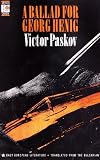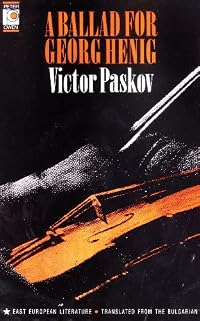
A Ballad for Georg Henig
by Victor Paskov
On This Page
Description
The poignant story of an elderly, impoverished violin maker, a master craftsman who refuses to trim his values for the modern age, as seen through the eyes of his young prot#65533;g#65533;. A best-seller in Bulgaria, this is one of Paskow's major works.Tags
Recommendations



















Member Reviews
This was such a hard book to get hold of! The novel is very short (only 120 pages) but it packs a lot into those pages. And I loved it.
George Henig is a Czech violinist and master maker who emigrated to Sofia in the early 20th century as Bulgaria's arts flourished. 40 years later, he is still renowned but Sofia itself is poverty-stricken and the narrator (a young boy) tells the tale. He first meets Henig shortly before his fifth birthday when his father, a musician, takes him to get his first violin. Years pass and, as with the other families in the same tenement block, Viktor (the narrator's mother) is going wild with the poverty and squalor around her and becomes fixating on getting a sideboard. His father eventually decides to make show more one and stuck for a workshop, they suddenly remember Henig's workshop. And so a new relationship with the master lutenist grows.
At times light and cheerful, at times so poignant I wished I was there to help, this is a tale of poverty (both literal and spiritual), hope, and sadly reflects a demise in culture and the arts. It was so touching how the young Viktor forms a relationship with the ancient Henig and the slightly muddled ideas he then forms of God, ghosts, violins and those around him. The novel showed squalor, cruelty and was overwhelmingly sad. And yet there was always a touch of hope and I couldn't help but love all the characters who we were introduced to properly (apart from Henig's next door neighbours). The overwhelming idea was that poverty is only a material thing. Spiritual poverty is far worse and this novel was rich in depicting how human kindness can make one seem rich. I really enjoyed this and am so glad I made such an effort to get hold of it. show less
George Henig is a Czech violinist and master maker who emigrated to Sofia in the early 20th century as Bulgaria's arts flourished. 40 years later, he is still renowned but Sofia itself is poverty-stricken and the narrator (a young boy) tells the tale. He first meets Henig shortly before his fifth birthday when his father, a musician, takes him to get his first violin. Years pass and, as with the other families in the same tenement block, Viktor (the narrator's mother) is going wild with the poverty and squalor around her and becomes fixating on getting a sideboard. His father eventually decides to make show more one and stuck for a workshop, they suddenly remember Henig's workshop. And so a new relationship with the master lutenist grows.
At times light and cheerful, at times so poignant I wished I was there to help, this is a tale of poverty (both literal and spiritual), hope, and sadly reflects a demise in culture and the arts. It was so touching how the young Viktor forms a relationship with the ancient Henig and the slightly muddled ideas he then forms of God, ghosts, violins and those around him. The novel showed squalor, cruelty and was overwhelmingly sad. And yet there was always a touch of hope and I couldn't help but love all the characters who we were introduced to properly (apart from Henig's next door neighbours). The overwhelming idea was that poverty is only a material thing. Spiritual poverty is far worse and this novel was rich in depicting how human kindness can make one seem rich. I really enjoyed this and am so glad I made such an effort to get hold of it. show less
Georg Henig is a Czech violin maker who immigrated to Bulgaria in 1910 as part of an effort to develop musical ability there. Young Viktor meets him there 50 years later when his father has a small violin made for the child. Several years later they find Georg dying in his rundown apartment. Viktor’s family helps Georg throughout the rest of his life when no one else will. During the time he spends with Georg, Viktor learns to overcome the despair of the poverty they live in through the values of art, faith, and love.
I really liked this short novel, and as a violinist, I adored how Georg put so much love and soul into each of his violins. Both he and Viktor’s father reminded me of the quote from Steinbeck’s The Grapes of Wrath show more about how man is the only animal that grows from work and takes something intangible out of his physical labor that is greater than the result of the work itself. In spite of the sadness in the novel, it just made me feel good because Georg lead such a good life in adhering to the values he believed in and refusing to compromise them even when he had nothing else left. I think this book will stick with me for a while. show less
I really liked this short novel, and as a violinist, I adored how Georg put so much love and soul into each of his violins. Both he and Viktor’s father reminded me of the quote from Steinbeck’s The Grapes of Wrath show more about how man is the only animal that grows from work and takes something intangible out of his physical labor that is greater than the result of the work itself. In spite of the sadness in the novel, it just made me feel good because Georg lead such a good life in adhering to the values he believed in and refusing to compromise them even when he had nothing else left. I think this book will stick with me for a while. show less
A small but rich story of a friendship between a young boy and an elderly craftsmen in poverty stricken town of Sofia. Georg Henig is a Czech who is unregistered in Bulgaria. He is a master craftsmen of violins. The story is set in 1950s to 1960 and presents the cultural decline of Bulgaria. Themes of loneliness, poverty and illness with bourgeoisie values of belief in God and respect for civilized life. What I liked best is the friendship between the young boy and the old man.
The author is a musician; sang opera and became a music critic as well as writing this bestselling book in Bulgaria. It was translated from the Bulgarian by Robert Sturm.
The author is a musician; sang opera and became a music critic as well as writing this bestselling book in Bulgaria. It was translated from the Bulgarian by Robert Sturm.
A short and sweet story of the years young Victor spent hanging out with Georg Henig, an elderly master violin maker.
Victor's father plays trumpet, and knows Henig from his musical ventures. Henig built all of Victor's violins, starting with a unique 1/8 size. Vicotr's father is then shocked to find him starving in his cellar apartment.
While this is a sweet story told by a man about the boy he was when he knew Henig, it is also a story about Bulgaria. Henig, a Czech, had moved to Sofia earlier in the century to make violins and train violin makers. After WWII, he never registers, and thus for Bulgaria, he does not exist. Viktor's father struggles to get him a current passport to prove his existence, and then he is still removed from his show more apartment--undoubtedly the mean neighbors told on him.
Is any of this based in fact? Paskov is a singer and musician--and his name is Victor. show less
Victor's father plays trumpet, and knows Henig from his musical ventures. Henig built all of Victor's violins, starting with a unique 1/8 size. Vicotr's father is then shocked to find him starving in his cellar apartment.
While this is a sweet story told by a man about the boy he was when he knew Henig, it is also a story about Bulgaria. Henig, a Czech, had moved to Sofia earlier in the century to make violins and train violin makers. After WWII, he never registers, and thus for Bulgaria, he does not exist. Viktor's father struggles to get him a current passport to prove his existence, and then he is still removed from his show more apartment--undoubtedly the mean neighbors told on him.
Is any of this based in fact? Paskov is a singer and musician--and his name is Victor. show less
Only 120 pages long, but there is a whole lot packed in to this novel. The story is heartwarming and heartbreaking all at the same time, and the writing (translated from the Bulgarian) is beautiful and complex. I’m not going to forget elderly, lonely Georg, his art, or his young friend Tsar Victor for a long time.
Another gem that I probably never would have found without my 1001books obsession.
Another gem that I probably never would have found without my 1001books obsession.
en overraskende bog der mange steder kalder på latteren.
Jul 13, 2007Danish
Ratings
Members
- Recently Added By
Author Information

3+ Works 101 Members
Some Editions
Awards and Honors
Common Knowledge
- Canonical title
- A Ballad for Georg Henig
- Original title
- Балада за Георг Хених
- Original publication date
- 1987
- People/Characters
- Georg Henih; Victor; Marin (Victor's father); Victor's mother; Frantisek (Franta); Dr. Berberyan (show all 7); Ivan Konov (Vanda)
- Important places
- Sofia, Bulgaria; Hayredin, Vratsa, Bulgaria
- Related movies
- Ti, koyto si na nebeto (1990 | IMDb)
- Original language
- Bulgarian
Classifications
- Genres
- Fiction and Literature, General Fiction
- DDC/MDS
- 891.8133 — Literature & rhetoric Literatures of other languages East Indo-European and Celtic literatures West and South Slavic languages (Bulgarian, Slovene, Polish, Czech, Slovak, Serbo-Croatian, and Macedonian) Bulgarian and other South Slavic languages Bulgarian fiction 1900–1991
- LCC
- PG1038.26 .A74 — Language and Literature Slavic languages and literatures. Baltic languages. Albanian language Slavic. Baltic. Albanian Bulgarian
- BISAC
Statistics
- Members
- 94
- Popularity
- 340,678
- Reviews
- 6
- Rating
- (4.08)
- Languages
- 5 — Danish, English, French, German, Russian
- Media
- Paper
- ISBNs
- 7
- ASINs
- 2