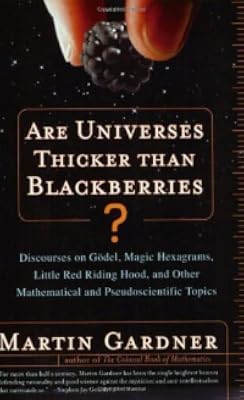
Are Universes Thicker Than Blackberries?: Discourses on Godel, Magic Hexagrams, Little Red Riding Hood, and Other Mathematical and Pseudoscientific Topics
by Martin Gardner
On This Page
Description
"In these essays, many of which originally appeared in The Skeptical Inquirer, Scientific American, and the Los Angeles Times, Gardner spans the realms of science and mathematics, literature, philosophy, religion, and mysticism. He examines influential scientific concepts, such as the possibility of multiple universes and the theory that time can go backward.cation and Primal Scream Therapy and the dubious magic of Uri Geller, who claimed to bend spoons with his mind. With a keen skepticism show more he skewers the practitioners of fallacious pseudoscience, from Dr. Bruno Bettelheim's erroneous theory of autism to the cruel farces of Facilitated Communication and Primal Scream Therapy and the dubious magic of Uri Geller, who claimed to bend spoons with his mind. With sympathy and a wide-ranging intelligence, Gardner analyzes the bizarre tangents produced by Freudians and deconstructionists in their critiques of the "Little Red Riding Hood" fairy tale. Offering several literary appreciations of his own, Gardner lovingly recalls the Tin Woodman from The Wizard of Oz and Chesterton's classic, The Man Who Was Thursday, and he introduces readers to Ian Stewart's popular mathematical fable Flatterworld and to the neglected mysteries of British suspense writer Edgar Wallace." "Gardner's essays are a testament to his invaluable contributions to our understanding of legitimate scientific inquiry of the past century."--Jacket. show lessTags
Recommendations

















Member Reviews
I love Martin Gardner, but I did not find this to be one of his more interesting works. There were parts of it that were excellent, in Gardner style, but as with many collections of previously written essays, there were a number that failed to hold my interest. In a book like this, it's often a good idea to sort of skip from place to place, picking those that work, and moving on from those that don't without finishing them; unfortunately, I am incapable of doing this.
Gardner's scepticism is an admirable weapon when turned on deserving subjects, but his didactic reductionism limits his scientific imagination.
Some good stuff, but the erstwhile Mathematical Gamester may be getting a tad cranky and misdirected in his old age. He's not a bright.
Ratings
Members
- Recently Added By
Lists

Books referenced in Jim Holt's Why Does the World Exist?
119 works; 1 member
Author Information

228+ Works 15,672 Members
Martin Gardner is the author of more than seventy books on a vast range of topics including "Did Adam & Eve Have Navels?", "Calculus Made Easy", & "The Annotated Alice". He lives in Hendersonville, North Carolina. (Publisher Provided)
Common Knowledge
- Original publication date
- 2003
Classifications
Statistics
- Members
- 206
- Popularity
- 157,812
- Reviews
- 4
- Rating
- (3.20)
- Languages
- English, Italian
- Media
- Paper
- ISBNs
- 4
- UPCs
- 1
- ASINs
- 1