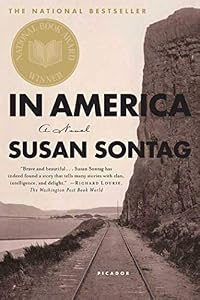
In America
by Susan Sontag 
On This Page
Description
"The Volcano Lover, Susan Sontag's bestselling 1992 novel, retold the love story of Lady Emma Hamilton and Lord Nelson with consummate power. In her enthralling new novel-once again based on a real story-Sontag shows us our own country on the cusp of modernity. In 1876 a group of Poles led by Maryna Zalewska, Poland's greatest actress, travel to California to found a "utopian" commune. Maryna, who has renounced her career, is accompanied by her small son and husband; in her entourage is a show more rising young writer who is in love with her. The novel portrays a West that is still largely empty, where white settlers confront native Californians and Asian coolies. The image of America, and of California-as fantasy, as escape, as radical simplification-constantly meets a more complex reality. The commune fails and most of the emigres go home, but Maryna stays and triumphs on the American stage. In America is a big, juicy, surprising book-about a woman's search for self-transformation, about the fate of idealism, about the world of the theater-that will captivate its readers from the first page. It is Sontag's most delicious, most brilliant achievement."--Publisher's description show lessTags
Recommendations








Member Recommendations
Member Reviews
In 1876, the celebrated Polish actress Maryna Załężowska and a group of her Warsaw-intellectual friends set off to live on a Fourier-inspired commune in California. As so often happens with idealistic communities, it doesn’t quite work out as they had hoped, and Maryna finds herself going back on stage to create a new career for herself in America.
Sontag uses this historical-fiction framework to explore what it might have meant to be a famous woman, successful in a high-profile profession, in late-19th century Europe and America, as well as picking out some of the oddities of American life and thought from a European perspective, and vice-versa, and dissecting the ways that acting on stage intersect with real (family) life and show more relationships. But also about the way that migration creates opportunities — and pressures — for us to adopt new personas and names. We learn quite a lot about Victorian tastes in theatre, meet some interesting real-life figures from the period, and generally get an awful lot of information thrown at us.
Sontag also has a lot of fun playing around with a range of clever — and sometimes plain theatrical — narrative techniques, most notably in the opening chapter, where the far-from-omniscient narrator finds herself watching from the sidelines of a party taking place in an era and a place far outside her own experience, and trying to piece together who these characters might be and how they fit together. The closing chapter is another tour-de-force, a monologue, with stage directions, addressed to Maryna and delivered by her fellow-actor Edwin Booth (brother of…) as he slips in and out of the roles of himself and an assortment of Shakespearean protagonists.
A demanding read, but also quite a rewarding one, with its share of fun. show less
Sontag uses this historical-fiction framework to explore what it might have meant to be a famous woman, successful in a high-profile profession, in late-19th century Europe and America, as well as picking out some of the oddities of American life and thought from a European perspective, and vice-versa, and dissecting the ways that acting on stage intersect with real (family) life and show more relationships. But also about the way that migration creates opportunities — and pressures — for us to adopt new personas and names. We learn quite a lot about Victorian tastes in theatre, meet some interesting real-life figures from the period, and generally get an awful lot of information thrown at us.
Sontag also has a lot of fun playing around with a range of clever — and sometimes plain theatrical — narrative techniques, most notably in the opening chapter, where the far-from-omniscient narrator finds herself watching from the sidelines of a party taking place in an era and a place far outside her own experience, and trying to piece together who these characters might be and how they fit together. The closing chapter is another tour-de-force, a monologue, with stage directions, addressed to Maryna and delivered by her fellow-actor Edwin Booth (brother of…) as he slips in and out of the roles of himself and an assortment of Shakespearean protagonists.
A demanding read, but also quite a rewarding one, with its share of fun. show less
I feel that Sontag's late fiction is being appraised by a new generation these days. Not that this new generation likes it all that much more than the one that preceded it, but, it's more about the stance.
She was a famous writer who decided on writing in a style that was out of step with the times for literary fiction in the late 90's. She had grown frustrated with her career as a essayist (ie. New York Intellectual) and seemed to prefer being known as a fiction writer instead. She intentionally went against the grain of the ironic late 20th century and dove into straight realism with a touch of narrative modernism thrown in.
At the time, it was fashionable to dismiss these two books (this, and The Volcano Lover) out of hand, and say show more just "stick with the essays" which were already fairly canonical by that point. So now, 25 years later, I decided to read her final novel about a bunch of 19th century Poles trying their luck in America. It has some novel narrative experimentation, where it seems to be Susan Sontag narrating in the present (as the real Susan Sontag) yet it is set in the past.
The story is a bit static, flat, I would say, though it's nice to hear about some of Sontag's interests voiced through her characters, though none of these are particularly interesting and most consists of commonplaces and basic cultural knowledge.
Overall, reading this was less painful than I was expecting but that is not to suggest it's a very exciting read. Sontag was an outsized influence in my early 20's and was a formative influence on my thoughts on film, fiction, art and aesthetics. I would love to rave about how wonderful this book is, but that would be really stretching it. Suffice it say, it's more enjoyable than "Death Kit" or "Duet For Cannibals". One gets the feeling she enjoyed writing this story. The subject matter seems like it was close to her heart.
I find it nteresting to think upon what it would be like if she was around today. What she would make of all this. She managed to talk about the Death of Cinema (or cinephilia) while still alive, but what would she think of the Death of Literature and reading in the present era? show less
She was a famous writer who decided on writing in a style that was out of step with the times for literary fiction in the late 90's. She had grown frustrated with her career as a essayist (ie. New York Intellectual) and seemed to prefer being known as a fiction writer instead. She intentionally went against the grain of the ironic late 20th century and dove into straight realism with a touch of narrative modernism thrown in.
At the time, it was fashionable to dismiss these two books (this, and The Volcano Lover) out of hand, and say show more just "stick with the essays" which were already fairly canonical by that point. So now, 25 years later, I decided to read her final novel about a bunch of 19th century Poles trying their luck in America. It has some novel narrative experimentation, where it seems to be Susan Sontag narrating in the present (as the real Susan Sontag) yet it is set in the past.
The story is a bit static, flat, I would say, though it's nice to hear about some of Sontag's interests voiced through her characters, though none of these are particularly interesting and most consists of commonplaces and basic cultural knowledge.
Overall, reading this was less painful than I was expecting but that is not to suggest it's a very exciting read. Sontag was an outsized influence in my early 20's and was a formative influence on my thoughts on film, fiction, art and aesthetics. I would love to rave about how wonderful this book is, but that would be really stretching it. Suffice it say, it's more enjoyable than "Death Kit" or "Duet For Cannibals". One gets the feeling she enjoyed writing this story. The subject matter seems like it was close to her heart.
I find it nteresting to think upon what it would be like if she was around today. What she would make of all this. She managed to talk about the Death of Cinema (or cinephilia) while still alive, but what would she think of the Death of Literature and reading in the present era? show less
When I started Susan Sontag’s “In America,” I half-expected it be as difficult, abstruse, and ultimately impenetrable as I had found her novel “The Benefactor.” But she wrote the latter when she was very young, and we can see now from her diaries how desperately she wanted to impress her intelligence upon people in her early life; I think we can surmise that “The Benefactor” is, among whatever else, a proud and uncompromising declaration that its young author was a serious novelist of ideas. “In America,” written late in her career, is certainly an intelligent novel, but it is also surprisingly readable. That’s not to say it doesn’t take exciting and stimulating formal risks, because it does, or that it follows a show more conventional dramatic arc -- it doesn’t. It’s to say that it tells a great story and, despite a certain authorial detachment, remains riveting throughout.
Funny that I should mention Sontag’s detachment, because though dispassion is the general rule throughout the novel, the prologue is an engrossing exception. In it, a spectral version of late twentieth century Susan Sontag crashes a society party in Poland in 1875. She dreamily describes the surroundings, the clothes, and most of all the people, whose language she does not understand, yet whom she gradually comes to name, and whose secrets she tentatively divines. Sontag as first person narrator, invisible to the company yet shivering in the cold, compares and contrasts her own time and place with that of the guests, shedding light on her fascination with the past and motivations for her foray into the historical fiction genre. This prologue is in part a dramatization of her creative process, an artful and poetic evocation of the conjuring act that precedes the composition of any work of fiction. It’s also a way of reflexively engaging the act of storytelling, of delicately investigating why and how we consistently find ourselves engrossed in fictions.
From there, the action of the novel begins: the important details are that a renowned Polish actress (in fact, Poland’s reigning diva) has set her sights on America, where she will travel with her husband and sundry friends to start a farming commune in California. The journey that follows and the sometimes surprising directions the characters’ lives take form a backdrop against which Sontag plays out her themes, including historical modernity and its relationship to the United States, Polish identity, the complex process of Americanization experienced by immigrants to this country, the dynamics of leaders and followers, and life in theatre and the theatrical nature of life (this last one an old and tired theme, but one that Sontag treats as if it were new, and so manages to illuminate). She even, to my surprise, introduced some queer elements, including diva worship and a character struggling in vain to suppress his homosexual desires. (Though her first person narration doesn’t return, Sontag can be glimpsed in several of the characters: she is the one who spent years unsuccessfully quelling her lesbianism; she is the young writer obsessed with notions of truth and intelligence; and she is, of course, the diva, the powerful, inscrutable, commanding woman of action.) Her narrative is punctuated by stylistic innovations that keep the novel moving at a brisk pace, and in typical Sontagian fashion (whether she’s writing an essay or a novel), she unassumingly drops stray sentences pregnant with meaning and penetrating in their insights, though if you blink, you might miss them.
Glancing at my short list of themes, it strikes me how many I’ve left out, and the novel’s ambitions become clearer. At the time Sontag wrote “In America,” she must have known there was no one left to impress, and she may have been more comfortable than before working in more traditional forms like the historical novel. And in many ways, her book did strike me as traditional, curiously so. But it is also clearly the product of a vastly curious, agile, and disciplined mind, a mind willing to grant readers concessions (like readability) – but unwilling to stop its relentless invention and investigation. show less
Funny that I should mention Sontag’s detachment, because though dispassion is the general rule throughout the novel, the prologue is an engrossing exception. In it, a spectral version of late twentieth century Susan Sontag crashes a society party in Poland in 1875. She dreamily describes the surroundings, the clothes, and most of all the people, whose language she does not understand, yet whom she gradually comes to name, and whose secrets she tentatively divines. Sontag as first person narrator, invisible to the company yet shivering in the cold, compares and contrasts her own time and place with that of the guests, shedding light on her fascination with the past and motivations for her foray into the historical fiction genre. This prologue is in part a dramatization of her creative process, an artful and poetic evocation of the conjuring act that precedes the composition of any work of fiction. It’s also a way of reflexively engaging the act of storytelling, of delicately investigating why and how we consistently find ourselves engrossed in fictions.
From there, the action of the novel begins: the important details are that a renowned Polish actress (in fact, Poland’s reigning diva) has set her sights on America, where she will travel with her husband and sundry friends to start a farming commune in California. The journey that follows and the sometimes surprising directions the characters’ lives take form a backdrop against which Sontag plays out her themes, including historical modernity and its relationship to the United States, Polish identity, the complex process of Americanization experienced by immigrants to this country, the dynamics of leaders and followers, and life in theatre and the theatrical nature of life (this last one an old and tired theme, but one that Sontag treats as if it were new, and so manages to illuminate). She even, to my surprise, introduced some queer elements, including diva worship and a character struggling in vain to suppress his homosexual desires. (Though her first person narration doesn’t return, Sontag can be glimpsed in several of the characters: she is the one who spent years unsuccessfully quelling her lesbianism; she is the young writer obsessed with notions of truth and intelligence; and she is, of course, the diva, the powerful, inscrutable, commanding woman of action.) Her narrative is punctuated by stylistic innovations that keep the novel moving at a brisk pace, and in typical Sontagian fashion (whether she’s writing an essay or a novel), she unassumingly drops stray sentences pregnant with meaning and penetrating in their insights, though if you blink, you might miss them.
Glancing at my short list of themes, it strikes me how many I’ve left out, and the novel’s ambitions become clearer. At the time Sontag wrote “In America,” she must have known there was no one left to impress, and she may have been more comfortable than before working in more traditional forms like the historical novel. And in many ways, her book did strike me as traditional, curiously so. But it is also clearly the product of a vastly curious, agile, and disciplined mind, a mind willing to grant readers concessions (like readability) – but unwilling to stop its relentless invention and investigation. show less
In America is an historical novel, yet it is more. It is a novel about identity, about names and words and people who leave their homeland for a new unknown and undiscovered land called America. The novel is one where the stage and all that it represents mirrors life -- a story set near the end of the nineteenth century.
On the first page of the novel the motif of the stage is hinted at by how snow flakes seen through a window are described as a "scrim" for the moonlight in the background. The unnamed narrator looks out on the wintry landscape from her vantage point in a warm corner of a large room filled with people. Slowly the narrator, who is Sontag herself embedded in this prelude to the novel, gradually introduces the main show more characters who are gathered at a private party. These characters include an actress, Maryna the greatest leading lady in Poland; her husband, Bogdan; and a budding writer, Ryszard, who will eventually become her lover.
Language is an important aspect of the novel as the narrator meditates on all the words in the air swirling around her at this party. Her meditation leads he to comment that "I mean here only to give these words their proper, poignant emphasis. And it occurred to me that this might explain, partly, my presence in this room. For I was moved by the way they possessed these words and regarded themselves bound by them to actions. . . . I was enjoying the repetition. Dare I say I felt at one with them? Almost. Those dreaded words, dreaded by others (not by me), seemed like caresses. Pleasantly numbed, I felt myself borne along by their music . . ." (p 8) While musing on the Polish diva who holds the company spellbound, Sontag notes: "I remember when I first read Middlemarch: I had just turned 18, and a third of the way through the book burst into tears because I realised not only that I was Dorothea but that a few months earlier, I had married Mr Casaubon... It took me nine years to decide that I had the right, the moral right, to divorce Mr Casaubon." (p 24) She indulges herself and suggests that this will be the story of a Dorothea who does not, like George Eliot's heroine, bury herself in the obscurity of "private" good works. She will shine in the public blaze of celebrity.
The party is in Poland, but some converse in French as well. This is their home where they are known and comfortable--yet there is more--ideas are in the air. The narrator hears bits of conversation that hint at plans Maryna has to leave Poland. These words suggest the possibility of a project to create a "perfect" society, one influenced by both Voltaire and Rousseau. After further ruminations on these people surrounding her at the party the narrator decides to write their story: "I decided to follow them out into the world." (p 27)
After this unusual introduction the actual story, an historical one, continues for nine more chapters chronicling the journey of Maryna, her close friends, family, and entourage, to America. They fairly quickly settle in a dusty southern California village established originally by Germans, namely Anaheim. Just as earlier communities like Brook Farm in New England and others have failed theirs does as well. The experiment is unsuccessful due to unexpected difficulties as they find the empty and dry expanse of California is not conducive to their plans. While many of them return to Poland it is at this moment that Maryna, longing for a return to the stage, decides to move to San Francisco and mount an American career where she can once again become a leading lady, perhaps a legend. This is, after all, an historical novel and the main characters are based on real people. Maryna is based on Helena Modrzejewska, who at 35 years old was Poland's greatest actress and who emigrated to America. The story abounds with moments when Maryna is in the theater playing Camille or Juliet for adoring audiences. Gradually her stage character takes hold of the reader much as it must have for those audiences. Following her came her husband and her lover, based on the writer Henryk Sinkiewicz (later famous as the author of Quo Vadis, winner of the Nobel Prize for Literature). However, not all the real names are changed and , not unlike some other historical novels, famous names drop in from time to time including Edwin Booth and Henry James (later in the story as Maryna has moved on to conquer the London stage; her success there was limited but better by far than that of James whose plays bombed).
This is a novel that, according to the author, was inspired by her own family background as all four of her grandparents came from Poland. She herself, in the three years of the novel's conception, frequently visited "besieged Sarajevo" (the novel is dedicated to her friends in that unhappy city). The main character has luminescent moments, but I found the story as a whole uneven. Ryszard and Bogdan both have moments "on stage" but the rest of the characters fade into the background. They all were on stage as followers of Maryna to America and it is a book worth reading to share the experiences of her dramatic and eventful life. show less
On the first page of the novel the motif of the stage is hinted at by how snow flakes seen through a window are described as a "scrim" for the moonlight in the background. The unnamed narrator looks out on the wintry landscape from her vantage point in a warm corner of a large room filled with people. Slowly the narrator, who is Sontag herself embedded in this prelude to the novel, gradually introduces the main show more characters who are gathered at a private party. These characters include an actress, Maryna the greatest leading lady in Poland; her husband, Bogdan; and a budding writer, Ryszard, who will eventually become her lover.
Language is an important aspect of the novel as the narrator meditates on all the words in the air swirling around her at this party. Her meditation leads he to comment that "I mean here only to give these words their proper, poignant emphasis. And it occurred to me that this might explain, partly, my presence in this room. For I was moved by the way they possessed these words and regarded themselves bound by them to actions. . . . I was enjoying the repetition. Dare I say I felt at one with them? Almost. Those dreaded words, dreaded by others (not by me), seemed like caresses. Pleasantly numbed, I felt myself borne along by their music . . ." (p 8) While musing on the Polish diva who holds the company spellbound, Sontag notes: "I remember when I first read Middlemarch: I had just turned 18, and a third of the way through the book burst into tears because I realised not only that I was Dorothea but that a few months earlier, I had married Mr Casaubon... It took me nine years to decide that I had the right, the moral right, to divorce Mr Casaubon." (p 24) She indulges herself and suggests that this will be the story of a Dorothea who does not, like George Eliot's heroine, bury herself in the obscurity of "private" good works. She will shine in the public blaze of celebrity.
The party is in Poland, but some converse in French as well. This is their home where they are known and comfortable--yet there is more--ideas are in the air. The narrator hears bits of conversation that hint at plans Maryna has to leave Poland. These words suggest the possibility of a project to create a "perfect" society, one influenced by both Voltaire and Rousseau. After further ruminations on these people surrounding her at the party the narrator decides to write their story: "I decided to follow them out into the world." (p 27)
After this unusual introduction the actual story, an historical one, continues for nine more chapters chronicling the journey of Maryna, her close friends, family, and entourage, to America. They fairly quickly settle in a dusty southern California village established originally by Germans, namely Anaheim. Just as earlier communities like Brook Farm in New England and others have failed theirs does as well. The experiment is unsuccessful due to unexpected difficulties as they find the empty and dry expanse of California is not conducive to their plans. While many of them return to Poland it is at this moment that Maryna, longing for a return to the stage, decides to move to San Francisco and mount an American career where she can once again become a leading lady, perhaps a legend. This is, after all, an historical novel and the main characters are based on real people. Maryna is based on Helena Modrzejewska, who at 35 years old was Poland's greatest actress and who emigrated to America. The story abounds with moments when Maryna is in the theater playing Camille or Juliet for adoring audiences. Gradually her stage character takes hold of the reader much as it must have for those audiences. Following her came her husband and her lover, based on the writer Henryk Sinkiewicz (later famous as the author of Quo Vadis, winner of the Nobel Prize for Literature). However, not all the real names are changed and , not unlike some other historical novels, famous names drop in from time to time including Edwin Booth and Henry James (later in the story as Maryna has moved on to conquer the London stage; her success there was limited but better by far than that of James whose plays bombed).
This is a novel that, according to the author, was inspired by her own family background as all four of her grandparents came from Poland. She herself, in the three years of the novel's conception, frequently visited "besieged Sarajevo" (the novel is dedicated to her friends in that unhappy city). The main character has luminescent moments, but I found the story as a whole uneven. Ryszard and Bogdan both have moments "on stage" but the rest of the characters fade into the background. They all were on stage as followers of Maryna to America and it is a book worth reading to share the experiences of her dramatic and eventful life. show less
Sontag writes with vivid word visuals, and I felt as if I was right there in the midst of life during the late nineteenth century. In America is a long book, and isn’t a fast read, but fro me it was a satisfying novel. Sontag’s comprehension and mastery of details and history, even the most minute of them, is masterful. The historical content within the pages of In America is valuable. She not only gives the reader insight into the dynamics of political unrest in Poland, but also of American assimilation and identity. Sontag explores life in general during a time when great waves of diverse immigrants were vying for a foothold in order to begin life anew in America. The immigrant had to be strong and determined, no matter the show more situation thrown at them. They had to have an eye for the moment and take advantage of situations dealt them. In other words, they had to be a good actor. show less
http://wineandabook.com/2012/10/01/review-in-america-by-susan-sontag/
"Each of us carries a room within ourselves, waiting to be furnished and peopled, and if you listen closely, you may need to silence everything in your own room, you can hear the sounds of that other room inside your head." (page 27)
In America is such an expansive piece of fiction, in which Sontag takes on everything from immigration to life in the theatre (with the "re"), and from the nature of love to what it means to be American. And she takes it on with an eloquence most can only aspire to. The novel follows Polish actress Maryna Zalezowska, legend of the stage, as she and her close circle of friends leave Poland and immigrate to America to live the simple commune show more life. Each chapter varies stylistically, which really showcases Sontag's versatility, and brings new life to many a well-explored theme.
I'm sure I have nothing super original to contribute to a discussion of Sontag's work, and given that I've only (yet) read 1 1/2 of her novels (I started The Volcano Lover years ago but for some reason never finished), I did some research post-reading. I highly recommend listening to this podcast over from CBC Radio's Writers and Company from October of 2000. First of all, I had no idea Sontag had such a low, resonant voice. Second of all, she is just such a damned eloquent speaker and so fascinating to listen to.
The only part of the book that, initially, didn't really work for me was the last chapter, where Sontag has Edwin Booth go on an alcoholic tirade about life and truth and acting...it just seemed such a sad and almost oppressive way to end the book. But then, during said podcast, Sontag spoke about what was going on in her life when she wrote the last chapter: she said she writes chronologically and was about 30-40 pages from the end of the novel when she received another cancer diagnosis. Now, with that small glimpse into her frame of mind, I can understand where that might have come from and how wrong I was initially.
Rubric rating: Duh. 9. I really want to read her nonfiction work on photography. show less
"Each of us carries a room within ourselves, waiting to be furnished and peopled, and if you listen closely, you may need to silence everything in your own room, you can hear the sounds of that other room inside your head." (page 27)
In America is such an expansive piece of fiction, in which Sontag takes on everything from immigration to life in the theatre (with the "re"), and from the nature of love to what it means to be American. And she takes it on with an eloquence most can only aspire to. The novel follows Polish actress Maryna Zalezowska, legend of the stage, as she and her close circle of friends leave Poland and immigrate to America to live the simple commune show more life. Each chapter varies stylistically, which really showcases Sontag's versatility, and brings new life to many a well-explored theme.
I'm sure I have nothing super original to contribute to a discussion of Sontag's work, and given that I've only (yet) read 1 1/2 of her novels (I started The Volcano Lover years ago but for some reason never finished), I did some research post-reading. I highly recommend listening to this podcast over from CBC Radio's Writers and Company from October of 2000. First of all, I had no idea Sontag had such a low, resonant voice. Second of all, she is just such a damned eloquent speaker and so fascinating to listen to.
The only part of the book that, initially, didn't really work for me was the last chapter, where Sontag has Edwin Booth go on an alcoholic tirade about life and truth and acting...it just seemed such a sad and almost oppressive way to end the book. But then, during said podcast, Sontag spoke about what was going on in her life when she wrote the last chapter: she said she writes chronologically and was about 30-40 pages from the end of the novel when she received another cancer diagnosis. Now, with that small glimpse into her frame of mind, I can understand where that might have come from and how wrong I was initially.
Rubric rating: Duh. 9. I really want to read her nonfiction work on photography. show less
Plot and characters move slowly and so repetitively...
language can be compelling and intriguing, yet there was no one to really connect with.
language can be compelling and intriguing, yet there was no one to really connect with.
Members
- Recently Added By
Published Reviews
ThingScore 100
In America is more than just another coming-of-age story; it is a critique of celebrity and a celebration of Sontag's ability to move seamlessly between essays, criticism, and fiction.
added by Shortride
Lists

National Book Award - Fiction
78 works; 10 members

In Our Time books
4,934 works; 2 members
Author Information

111+ Works 21,288 Members
Susan Sontag was born in New York City on January 16, 1933. She received a B.A. from the University of Chicago and did graduate work in philosophy, literature and theology at Harvard University and Saint Anne's College, Oxford University. She was the author of 17 books including four novels, a collection of short stories, several plays, and eight show more works of nonfiction. Her novels are The Benefactor, Death Kit, The Volcano Lover, and In America, which won the 2000 National Book Award for fiction. On Photography received the 1978 National Book Critics Circle Award. Her stories and essays have appeared in numerous magazines including The New Yorker, The New York Review of Books, The Times Literary Supplement, and Art in America. She also wrote and directed four feature films and stage plays in the United States and Europe. She died from leukemia on December 28, 2004 at the age of 71. (Bowker Author Biography) show less
Susan Sontag has a Legacy Library. Legacy libraries are the personal libraries of famous readers, entered by LibraryThing members from the Legacy Libraries group.
Awards and Honors
Awards
Distinctions
Series
Belongs to Publisher Series
A tot vent (400)
Common Knowledge
- Canonical title
- In America
- Original title
- In America
- Original publication date
- 2000
- Important places
- America; Poland
- Epigraph*
- >>America will be!
- Dedication*
- Für meine Freunde in Sarajewo
- First words*
- Unschlüssig, nein, zitternd platze ich in eine private Gesellschaft, die sich im Speisesaal eines Hotels versammelt hatte.
- Quotations*
- Es ist gut, glücklich zu sein, aber es ist vulgär, glücklich sein zu 'wollen'. Und 'ist' man glücklich, ist es vulgär, es zu wissen. (Seite 64)
>>Muß man denn sterben, um seine Aufrichtigkeit zu beweisen!<< (Seite 52)
Gesundheit ist eine Verheißung von mehr Zukunft. Besitz dagegen verstärkt die Bindungen zur Vergangenheit. (Seite 228) - Last words*
- (Click to show. Warning: May contain spoilers.)<<[...] Ein Schauspieler kann nicht einfach "erfinden". Sollen wir einander versprechen, hier und jetzt, es immer erst dem anderen zu sagen, wenn wir etwas Neues machen? Vor uns liegt eine lange Tournee.<<
- Blurbers
- Lourie, Richard
- Original language
- English
*Some information comes from Common Knowledge in other languages. Click "Edit" for more information.
Classifications
Statistics
- Members
- 1,440
- Popularity
- 16,228
- Reviews
- 14
- Rating
- (3.38)
- Languages
- 13 — Catalan, Danish, Dutch, English, French, German, Italian, Polish, Portuguese, Romanian, Spanish, Swedish, Turkish
- Media
- Paper, Audiobook, Ebook
- ISBNs
- 40
- ASINs
- 13