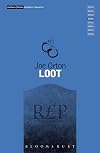
Loot
by Joe Orton
On This Page
Description
A black farce masterpiece, Loot follows the fortunes of two young thieves, Hal and Dennis. Dennis is a hearse driver for an undertaker. They have robbed the bank next door to the funeral parlour and have returned to Hal's home to hide-out with the loot. Hal's mother has just died and the pair put the money in her coffin, hiding the body elsewhere in the house. With the arrival of Inspector Truscott, the thickened plot turns topsy-turvy. Playing with all the conventions of popular farce, show more Orton creates a world gone mad and examines in detail English attitudes at mid-century. The play has been called a Freudian nightmare, which sports with superstitions about death - and life. It is regularly produced in professional and amateur productions. First produced in London in 1966, LOOT was hailed as "the most genuinely quick-witted, pungent and sprightly entertainment by a new, young British playwright for a decade" (Sunday Telegraph). show lessTags
Recommendations



















Member Reviews
Hilarious satire of British cops & robbers; Catholics & Protestents. Orton cited Richard Sheridan, Oliver Goldsmith, and Oscar Wilde as his influences (all of whom I love). This play has the same sense of humor but is less a comedy of manners and bit more of a farce. I would love to see a performance!
I planned on seeing an amateur production of 'Loot', & reread the script in anticipation. I ended up staying at home, but was glad to reacquaint myself with the hilarity & sophistication of Orton.
Versione italiana di Guidarino Guidi: "Il Malloppo"
Dec 7, 2013Italian
Ratings
Members
- Recently Added By
Lists

My Play Collection
769 works; 3 members

Next Plays to Watch
50 works; 1 member
Author Information

31+ Works 2,187 Members
Born in Leicester, Orton trained as an actor but soon turned to writing plays instead. Before his career had barely begun, however, he was murdered by his homosexual lover, apparently in a fit of jealousy over his success. Orton's shocking murder is too easily made the biographical focus for discussion of his plays, devoted as they are to the show more grotesque, the perverse, and the violent. A more relevant landmark in the playwright's life might be the jail term he served for the bizarre crime of defacing library books, replacing illustrations with uproarious collages, and rewriting jacket blurbs in "mildly obscene" parodies of journalistic cliche. Assaulting the cultural consumer by transposing familiar icons and vocabulary was the key to Orton's theatrical method. But it was supplemented by a growing verbal power and stage imagery with aspirations to myth. As Orton's literary powers grew, so did the outrage of social response. The Pinterian ambiance and language of his first works, Entertaining Mr. Sloan (1964) and the radio play The Ruffian on the Stair (1966), were well received. Sloane was chosen best new British play of 1964 and won the blessing of Terence Rattigan himself. But Loot, joking with death, religion, sex, and family, proved more disturbing (it involves a slapstick charade centered on a corpse and a coffin). The first production, directed by Peter Wood, closed on tour without reaching London. It was not until 1966 that the play was staged, to acclaim, in Charles Marowitz's fringe theater. In 1969, What the Butler Saw failed in the West End, despite a cast of many famous names, including Ralph Richardson. Only the Royal Court revival of 1975 gave Orton's undoubted masterpiece its due. But by then the playwright had been dead for eight years. In the phallic epiphany with which Butler ends, as in his version of Euripides' Bacchae, The Erpingham Camp (1965), Orton calls attention to his Dionysian ambitions, his serious use of farce as a means of disruption and liberation. His last plays, in which violent animal spirits subvert dialogue of extreme, even Victorian, formality and outrageous authority figures, represent probably the greatest comic achievement of contemporary British drama. show less
Awards and Honors
Awards
Series
Belongs to Publisher Series
Work Relationships
Common Knowledge
Classifications
Statistics
- Members
- 154
- Popularity
- 213,571
- Reviews
- 4
- Rating
- (3.83)
- Languages
- Dutch, English, Japanese
- Media
- Paper, Ebook
- ISBNs
- 14
- ASINs
- 6