On This Page
Description
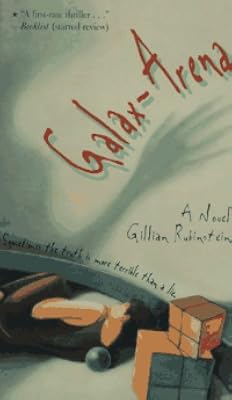
Kidnapped from an Australian train station, Joella, Peter, and Liane are taken on a rocket to the Galax-Arena, where children stolen from Earth perform death-defying stunts for the amusement of the inhabitants of the planet Vexak.Tags
Recommendations







































Member Recommendations


anonrx782 It has a similar theme and is by the same authour.

tweedledumdee Sequel to Galax Arena.
Also recommended by destroydestiny, anonymous user, clockwork.orange
21


by anonymous user

Salshel Thunderwith gives off a similar feel to Galax-Arena and also addresses problems about exclusion, depression, misunderstanding and loneliness, although it is somewhat more emotional and heart-touching than Galax-Arena.
clockwork.orange #7 in The Pendragon Adventure series, it tells the story of a troubled territory whose only hope of salvation for its inhabitants are The Quillan Games, where to lose, is to die.
Member Reviews
Galax- Arena is an epic tale combining both real-life and science fiction elements alike. It was written by the award winning author Gillian Rubinstein (also goes by the pseudonym Lian Hearn) and was first published in 1992. It is generally set in Australia and is of an adventure/science-fiction genre.
A recount told through the eyes of the main protagonist Joella, this book is set along the span of several months. It revolves around the Galax-Arena, a fictional “performance” ground on the planet Vexak where children perform death-defying tricks and acrobatics routines, all for the pleasure of the inhabitants of the planet, the Vexa.
This book tackles many controversial issues in today’s society, such as child exploitation, show more cultural division, poverty and competition/survival. In today’s fast-paced world, we hardly realise what’s actually happening out of our information sphere. Most of us just continue aimlessly on into this never ending rat race, oblivious to the dire and real situations parts of our world are in, which brings us to the themes of this story.
Galax-Arena was written in 1992, not very long before the 21st century, but perhaps what Gillian Rubinstein was actually doing was envisioning an Earth we inhabit, in the not so distant future. Where we are driven to the point of obsession with vanity and selfishness, to the point that all we ever care about are ourselves and being rich.
The writing style of Gillian Rubinstein was hugely descriptive in detail, paying much attention to descriptive passages of the characters’ surroundings, which in turn lets the reader gain a much deeper understanding and picture of the scenes in the book.
Another interesting feature of this book is the use of the fictional contact language called patwa (a mix of slang words, English and Spanish). In Galax-Arena, patwa is the only means of communication between the multi-racial children performers.
Two particular things I disliked about this book was when Joella finally found out that they were in fact still on Earth and also the fact that Bro Rabbit could mysteriously talk.
I remember wondering to myself as I read that part of the book; how could she had just so happen to see a fly? And why would Project Genesis Five be that careless and miss that one little crucial detail? The fact that she could just take the glove off the costume the “Vexa” was wearing just like that seemed a little hard to believe as well.
On the subject of Bro Rabbit, would it not be weird for an eight year old girl to ventriloquise perfectly with no practice or training whatsoever? And why a talking sock puppet? Yes, I do realise that the people involved are children, but does it not seem a tad bit too childish?
Overall, it was a fairly good read and Gillian Rubinstein has managed to compile most of our world’s most pressing issues into a generally good book which propels you into an endless rollercoaster ride, filled with morbid detail on a more ugly side of humanity.
This book is more suited (and was probably also aimed at) a young adult audience and those who like a good, serious read with slight occasional light-hearted instances. If you liked it, then there is a sequel to Galax-Arena called Terra-Farma as well. show less
A recount told through the eyes of the main protagonist Joella, this book is set along the span of several months. It revolves around the Galax-Arena, a fictional “performance” ground on the planet Vexak where children perform death-defying tricks and acrobatics routines, all for the pleasure of the inhabitants of the planet, the Vexa.
This book tackles many controversial issues in today’s society, such as child exploitation, show more cultural division, poverty and competition/survival. In today’s fast-paced world, we hardly realise what’s actually happening out of our information sphere. Most of us just continue aimlessly on into this never ending rat race, oblivious to the dire and real situations parts of our world are in, which brings us to the themes of this story.
Galax-Arena was written in 1992, not very long before the 21st century, but perhaps what Gillian Rubinstein was actually doing was envisioning an Earth we inhabit, in the not so distant future. Where we are driven to the point of obsession with vanity and selfishness, to the point that all we ever care about are ourselves and being rich.
The writing style of Gillian Rubinstein was hugely descriptive in detail, paying much attention to descriptive passages of the characters’ surroundings, which in turn lets the reader gain a much deeper understanding and picture of the scenes in the book.
Another interesting feature of this book is the use of the fictional contact language called patwa (a mix of slang words, English and Spanish). In Galax-Arena, patwa is the only means of communication between the multi-racial children performers.
Two particular things I disliked about this book was when Joella finally found out that they were in fact still on Earth and also the fact that Bro Rabbit could mysteriously talk.
I remember wondering to myself as I read that part of the book; how could she had just so happen to see a fly? And why would Project Genesis Five be that careless and miss that one little crucial detail? The fact that she could just take the glove off the costume the “Vexa” was wearing just like that seemed a little hard to believe as well.
On the subject of Bro Rabbit, would it not be weird for an eight year old girl to ventriloquise perfectly with no practice or training whatsoever? And why a talking sock puppet? Yes, I do realise that the people involved are children, but does it not seem a tad bit too childish?
Overall, it was a fairly good read and Gillian Rubinstein has managed to compile most of our world’s most pressing issues into a generally good book which propels you into an endless rollercoaster ride, filled with morbid detail on a more ugly side of humanity.
This book is more suited (and was probably also aimed at) a young adult audience and those who like a good, serious read with slight occasional light-hearted instances. If you liked it, then there is a sequel to Galax-Arena called Terra-Farma as well. show less
I'm not sure why I put this on my wishlist, but I'm glad I did. It's *so* much deeper, richer, and more complex, than the blurb implies. It's also exciting, a page-turner - I read it in one afternoon. Though it might be targeted to children, I believe SF fans of all ages would enjoy it. We've got a little Lord of the Flies" going, and a little Stockholm Syndrome, and some bits that are metaphysical, or possibly magical, or possibly not.... Recommended."
Galax-Arena is a book written by Gillian Rubinstein in 1992. This novel fits in the genre of science fiction. This book tells us the issues of slavery in the world. The novel also explores the differences between adults and children in society. The story of Galax-Arena talks about a girl named Joella who got kidnapped by aliens, along with her older brother and younger sister. At the Galax-Arena, Joella met other children, who called themselves peb. The novel follows Joella’s and the peb’s lives in the Galax-Arena.
The ideas of slavery can be seen through the exploitation of the children in the Galax-Arena. The pebs were used in gymnastics performances in the Galax-Arena. They were forced to risk their lives, jumping off high show more platforms, solely for the purpose of entertaining the aliens in the Galax-Arena. The children were treated like animals. At a point in the story, Joella was locked up in a cage, being fed food by a Vexa, which were the aliens in Galax-Arena.
As the story progresses, readers will grow to know that the aliens of the story were actually adults who wanted to be immortal. There are many cases of child labour in real life. This point was expressed in the story through the adults using the children for part of their life extending experiment. In the book, it is said that by watching the children risk their lives, it will cause stimulus in the adults’ body, enabling them to live longer. Although this should not be true in real life, in the story, this has conveyed the ideas of adults using children for their benefits.
I feel that the idea of slavery has been cleverly conveyed in this novel. Apart from that the characters were quite dull. There are many instances in the book where events were unconvincing. The use of a made up language called patwa in the book has been quite irritating to read. If that awesome glossary did not exist, readers would have a very difficult time, trying to work out the meanings of the words.
All in all, this book is for those who enjoy reading about the ideas of slavery, adults playing dress-up, children dying in the most uneventful manner. show less
The ideas of slavery can be seen through the exploitation of the children in the Galax-Arena. The pebs were used in gymnastics performances in the Galax-Arena. They were forced to risk their lives, jumping off high show more platforms, solely for the purpose of entertaining the aliens in the Galax-Arena. The children were treated like animals. At a point in the story, Joella was locked up in a cage, being fed food by a Vexa, which were the aliens in Galax-Arena.
As the story progresses, readers will grow to know that the aliens of the story were actually adults who wanted to be immortal. There are many cases of child labour in real life. This point was expressed in the story through the adults using the children for part of their life extending experiment. In the book, it is said that by watching the children risk their lives, it will cause stimulus in the adults’ body, enabling them to live longer. Although this should not be true in real life, in the story, this has conveyed the ideas of adults using children for their benefits.
I feel that the idea of slavery has been cleverly conveyed in this novel. Apart from that the characters were quite dull. There are many instances in the book where events were unconvincing. The use of a made up language called patwa in the book has been quite irritating to read. If that awesome glossary did not exist, readers would have a very difficult time, trying to work out the meanings of the words.
All in all, this book is for those who enjoy reading about the ideas of slavery, adults playing dress-up, children dying in the most uneventful manner. show less
Galax-Arena is the first book of a triology published in 1992 by award-winning author Gillian Rubinstein. A new 2001 edition differs slightly from the original, it is set further into the future and a new idea of an international sports competition, Contest, has been introduced. It’s sequel Terra Farma was published in 2001 and listed as “highly commended” by the Children’s Book Council, 2002.
Awards:
Kids Own Australian Literature Aware (KOALA) 1996 – Shortlisted
Kids Own Australian Literature Award (KOALA) 1996 - Runner-up
Young Australian Best Book Award (YABBA) 1996 - Short-listed
Young Australian Best Book Award (YABBA) 1993 - Short-listed
CROW Award 1994 - Short-listed
S.A. Festival Award for Literature 1994 - Short-listed show more Children’s Book
CBCA Book of the Year 1993 - Honour Book
Victorian Premier’s Literary Award 1993 - Short-listed Children’s Book
Honour Book CBCA Book of the Year 1993: Older Readers
Published by:
Ringwood, Vic: Puffin in 2001
Availability:
2001 Edition still in print.
Recommended Age- (Young adult) Early adolescence 13+
Genre: literature and science-fiction although for me it was sort of anti-science fiction.
Main subject matter:
“If you believe something, because you believe it, it becomes true”
Galax-Arena deals with issues of slavery, what we know versus what we believe in, the difference of power especially, between children and adults and spirituality, to a certain extent.
“It started for us, as for most of the others, with a journey. People on journeys are easy to make disappear. Accidents are arranged, buses never arrive, children vanish on the road here to there.”
Like all thought provoking writing, questions it raises about humanity, the side that we often don’t see, defy against simple answers and although there are aliens and a journey though space, the book gives us exactly that, a device to probe into a new world of much deeper explorations and important themes. Gillian Rubinstein is a brilliant writer and this is one of those ‘circular’ books where when you finish and start reading again, the beginning now takes on an entirely new meaning. Very well researched and put together.
For me, this was quite an interesting book to read, although it started off quite boring and meaningless for me, at the end I was excited for more, so excited that I read the whole book again. That done, I realised exactly how cleverly Gillian Rubinstein had put it all together, what was boring and meaningless before now seemed to make perfect sense in my head; taking on an entirely new meaning.
Although it wasn't very realistic, frankly speaking I don't think anyone could do better. Aliens and outer space books usually spin off randomly and somehow...stupidly. Galax-Arena was a nice change in that. I would recommend it for anyone and everyone who just simply likes to read. Not for the very faint-hearted though. show less
Awards:
Kids Own Australian Literature Aware (KOALA) 1996 – Shortlisted
Kids Own Australian Literature Award (KOALA) 1996 - Runner-up
Young Australian Best Book Award (YABBA) 1996 - Short-listed
Young Australian Best Book Award (YABBA) 1993 - Short-listed
CROW Award 1994 - Short-listed
S.A. Festival Award for Literature 1994 - Short-listed show more Children’s Book
CBCA Book of the Year 1993 - Honour Book
Victorian Premier’s Literary Award 1993 - Short-listed Children’s Book
Honour Book CBCA Book of the Year 1993: Older Readers
Published by:
Ringwood, Vic: Puffin in 2001
Availability:
2001 Edition still in print.
Recommended Age- (Young adult) Early adolescence 13+
Genre: literature and science-fiction although for me it was sort of anti-science fiction.
Main subject matter:
“If you believe something, because you believe it, it becomes true”
Galax-Arena deals with issues of slavery, what we know versus what we believe in, the difference of power especially, between children and adults and spirituality, to a certain extent.
“It started for us, as for most of the others, with a journey. People on journeys are easy to make disappear. Accidents are arranged, buses never arrive, children vanish on the road here to there.”
Like all thought provoking writing, questions it raises about humanity, the side that we often don’t see, defy against simple answers and although there are aliens and a journey though space, the book gives us exactly that, a device to probe into a new world of much deeper explorations and important themes. Gillian Rubinstein is a brilliant writer and this is one of those ‘circular’ books where when you finish and start reading again, the beginning now takes on an entirely new meaning. Very well researched and put together.
For me, this was quite an interesting book to read, although it started off quite boring and meaningless for me, at the end I was excited for more, so excited that I read the whole book again. That done, I realised exactly how cleverly Gillian Rubinstein had put it all together, what was boring and meaningless before now seemed to make perfect sense in my head; taking on an entirely new meaning.
Although it wasn't very realistic, frankly speaking I don't think anyone could do better. Aliens and outer space books usually spin off randomly and somehow...stupidly. Galax-Arena was a nice change in that. I would recommend it for anyone and everyone who just simply likes to read. Not for the very faint-hearted though. show less
Galax-Arena is a sci-fi novel published in 1995. It is the first of an unfinished trilogy by Gillian Rubinstein. The story follows three siblings – Joella, Peter, and Liane – who have been kidnapped by aliens and sent to the distant planet of Vexak to perform high-risk gymnastic stunts in a stadium called the Galax-Arena. Here, they meet an odd bunch of children mostly their age who call themselves ‘the Peb’, and communicate using a pidgin language called ‘patwa’. They are trained and cared for by a man named Hythe, whom the Peb has mixed feelings for.
Several ideas Rubinstein has chosen to convey in Galax-Arena include slavery, deception vs. reality, alienation, and power and corruption. These concepts often go hand in hand show more in Young Adult science-fiction novels, and Rubinstein connected them through the setting (a sort of ‘prison’ where the Peb cannot escape and are forced to risk their lives on a daily basis), the personalities of the characters (the Peb are very competitive; they fight each other for power and Hythe’s affection), point of view (the narrator is Joella, who is the outcast of the group), and through suspense in the events of the story, when things are not what it seems.
Although this book has surprised me and kept me going, I did not enjoy reading it as much as other novels. The dialogue was a little dull and I did not feel as though the author had introduced the sequence of events well enough. It felt like a series of gunshots transformed into words; BANG! They were kidnapped; BANG! They were on a spaceship. Nevertheless, it was a very suspenseful book that kept me guessing. Rubinstein touched on the genre of sci-fi in a way that I have never seen before. She also pulled off writing representing the subject of child exploitation very well.
I recommend this Galax-Arena to those who love suspenseful/adventure and sci-fi novels; age group- 11 and above. show less
Several ideas Rubinstein has chosen to convey in Galax-Arena include slavery, deception vs. reality, alienation, and power and corruption. These concepts often go hand in hand show more in Young Adult science-fiction novels, and Rubinstein connected them through the setting (a sort of ‘prison’ where the Peb cannot escape and are forced to risk their lives on a daily basis), the personalities of the characters (the Peb are very competitive; they fight each other for power and Hythe’s affection), point of view (the narrator is Joella, who is the outcast of the group), and through suspense in the events of the story, when things are not what it seems.
Although this book has surprised me and kept me going, I did not enjoy reading it as much as other novels. The dialogue was a little dull and I did not feel as though the author had introduced the sequence of events well enough. It felt like a series of gunshots transformed into words; BANG! They were kidnapped; BANG! They were on a spaceship. Nevertheless, it was a very suspenseful book that kept me guessing. Rubinstein touched on the genre of sci-fi in a way that I have never seen before. She also pulled off writing representing the subject of child exploitation very well.
I recommend this Galax-Arena to those who love suspenseful/adventure and sci-fi novels; age group- 11 and above. show less
Galax Arena is a sci-fi novel written by Gillian Rubinstein and was first published in 1992. The narrator is a girl named Joella who is remembering her experiences at Galax Arena with her brother Peter and her sister Liane. It starts with Joella recalling her time there and their lifestyle after they were kidnapped.
The novel main themes are kidnapping and child exploitation. The author chooses 3 teenagers to show the actual kidnapping where they take advantage of children’s weak points and convince them to come (in this case, drugging them to come). Then you come to the where most of the story is held, Galax Arena. You are then introduced to many other children who we are made to assume were also kidnapped. They are then made to show more perform, against their will, to entertain what we are told to be Vexa, aliens. This is a form of child exploitation which is conveyed throughout the story as the plot unfolds. Rubinstein uses a scarily realistic setting and skilfully manoeuvres our point of view as we read. She developed her characters to a point where the story seems so real and can actually happen in real life.
My favourite part of Galax Arena is the climax and ending where you feel as if everything is about to be lost and the way the suspense is built to the final moment. The climax and ending tells us that the book itself has been written in a way that the suspense is built up very high then come rushing down as the book concludes.
Galax Arena is a well written suspense sci-fi novel and it interests even those who don’t like the genre much. I, personally, like the fact that the book touches up on reality. Thing like kidnapping and child exploitation, I’m afraid to say, do happen in this world and there are those who are cruel enough to do this things. My constructive criticism of this book as a reader and reviewer would be that the dialogue is hard to understand and is a bit too far-fetched even if it’s for characterisation and setting. I would rate this book a 3 ½ out of 5. I recommend that teenagers 12+ should read this. show less
The novel main themes are kidnapping and child exploitation. The author chooses 3 teenagers to show the actual kidnapping where they take advantage of children’s weak points and convince them to come (in this case, drugging them to come). Then you come to the where most of the story is held, Galax Arena. You are then introduced to many other children who we are made to assume were also kidnapped. They are then made to show more perform, against their will, to entertain what we are told to be Vexa, aliens. This is a form of child exploitation which is conveyed throughout the story as the plot unfolds. Rubinstein uses a scarily realistic setting and skilfully manoeuvres our point of view as we read. She developed her characters to a point where the story seems so real and can actually happen in real life.
My favourite part of Galax Arena is the climax and ending where you feel as if everything is about to be lost and the way the suspense is built to the final moment. The climax and ending tells us that the book itself has been written in a way that the suspense is built up very high then come rushing down as the book concludes.
Galax Arena is a well written suspense sci-fi novel and it interests even those who don’t like the genre much. I, personally, like the fact that the book touches up on reality. Thing like kidnapping and child exploitation, I’m afraid to say, do happen in this world and there are those who are cruel enough to do this things. My constructive criticism of this book as a reader and reviewer would be that the dialogue is hard to understand and is a bit too far-fetched even if it’s for characterisation and setting. I would rate this book a 3 ½ out of 5. I recommend that teenagers 12+ should read this. show less
Galax-Arena by Gillian Rubinstein is a book about Joella, her sister Liane and her brother Peter. They are kidnapped from Earth to perform for an alien race, the Vexa. After meeting twenty other children whom call themselves the “peb”, they are forced to perform gravity defying gymnastic stunts for the Vexa, who thrive off their fear and death.
But Joella is different from the rest of the Peb, she is no Gymnast and therefore she is sent off to be a pet for one of the Vexa. And that is when discovers the terrible truth that they have been hiding.
This novel clearly depicts the cruelty of child exploitation and racism over the world. Joella encounters many problems in her search for escape; she must deal with many issues including show more survival, rebellion and individual verses society.
Ms. Rubinstein gives us a vivid representation of the emotions and thoughts the characters are experiencing throughout the book. The novel portrays so many different moods, feelings and sensations all in one short read. It is often hard to hold a grudge against a character, since we immediately see why he/she acts that way.
She uses several varied subplots and entwines them all together, to give textured layers of characterization.
However, some parts of the book are often predictable and unrealistic. Even though this book is a Sci-Fi novel, it is set on Earth and must have some basis on reality. The fact that “Bro-Rabbit” can talk, immediately ruins the flow of the novel. It instantly turns back into a children’s book.
That may be just me; maybe you feel that a talking bunny adds to the sense of mystery and discretion.
You will only find out if you read this book though.
It is a marvellous book, and it is an enjoyable read for everyone, since it has a little of all the time generations in it. I would recommend it to everyone, even the ones who don't read Sci-Fi. show less
But Joella is different from the rest of the Peb, she is no Gymnast and therefore she is sent off to be a pet for one of the Vexa. And that is when discovers the terrible truth that they have been hiding.
This novel clearly depicts the cruelty of child exploitation and racism over the world. Joella encounters many problems in her search for escape; she must deal with many issues including show more survival, rebellion and individual verses society.
Ms. Rubinstein gives us a vivid representation of the emotions and thoughts the characters are experiencing throughout the book. The novel portrays so many different moods, feelings and sensations all in one short read. It is often hard to hold a grudge against a character, since we immediately see why he/she acts that way.
She uses several varied subplots and entwines them all together, to give textured layers of characterization.
However, some parts of the book are often predictable and unrealistic. Even though this book is a Sci-Fi novel, it is set on Earth and must have some basis on reality. The fact that “Bro-Rabbit” can talk, immediately ruins the flow of the novel. It instantly turns back into a children’s book.
That may be just me; maybe you feel that a talking bunny adds to the sense of mystery and discretion.
You will only find out if you read this book though.
It is a marvellous book, and it is an enjoyable read for everyone, since it has a little of all the time generations in it. I would recommend it to everyone, even the ones who don't read Sci-Fi. show less
Members
- Recently Added By
Lists

Kidnapping -- children's/young adult fiction
598 works; 3 members

Kidnapping, survival -- children's/young adult fiction
14 works; 2 members

Books Read in 2007
326 works; 8 members

Read in 2007
55 works; 1 member
Author Information

79+ Works 17,579 Members
Awards and Honors
Series

Common Knowledge
- Canonical title
- Galax-Arena
- Original publication date
- 1992
- Dedication
- for Jane
- Quotations
- Because no matter how we try and forget, it really happened and it's still going on. No one's going to try and stop it. No one's going to do anything about it.
... (show all) 'Right, Joey, baby,' Hythe said, turning his attention to me. I stood up, so I wouldn't quite feel so small next to him. 'You reckon you can do that? I shook my head. He knew I couldn't. Why did he tease me?
Classifications
Statistics
- Members
- 194
- Popularity
- 169,220
- Reviews
- 25
- Rating
- (3.75)
- Languages
- Dutch, English, Swedish
- Media
- Paper, Audiobook, Ebook
- ISBNs
- 15
- ASINs
- 2