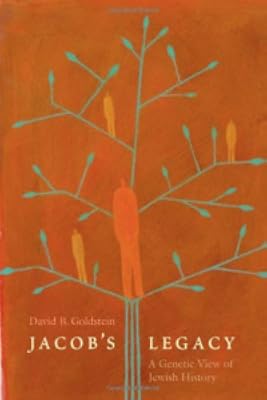
Jacob's Legacy: A Genetic View of Jewish History
by David B. Goldstein
On This Page
Description
Who are the Jews? Where did they come from? What is the connection between an ancient Jewish priest in Jerusalem and today's Israeli sunbather on the beaches of Tel Aviv? These questions stand at the heart of this engaging book. Geneticist David Goldstein analyzes modern DNA studies of Jewish populations and examines the intersections of these scientific findings with the history (both biblical and modern) and oral tradition of the Jews. With a special gift for translating complex scientific show more concepts into language understandable to all, Goldstein delivers an accessible, personal, and fascinating book that tells the history of a group of people through the lens of genetics. In a series of detective-style stories, Goldstein explores the priestly lineage of Jewish males as manifested by Y chromosomes; the Jewish lineage claims of the Lemba, an obscure black South African tribe; the differences in maternal and paternal genetic heritage among Jewish populations; and much more. The author also grapples with the medical and ethical implications of our rapidly growing command of the human genomic landscape. The study of genetics has not only changed the study of Jewish history, Goldstein shows, it has altered notions of Jewish identity and even our understanding of what makes a people a people. show lessTags
Recommendations






























Member Reviews
An excellent account of a fascinating body of population genetic studies focused on the genetic history of the Jews. I found the descriptions of historical events particularly interesting. Goldstein does an exemplary job at explaining the limits of historical inference from these studies, and his frankness about his feelings regarding the social impacts of the conclusions (real or distorted) drawn from his studies by others is refreshing and thought provoking. I am an evolutionary geneticist, and for me, the science in the book was understandable. But this is a book targeted to a general audience, and I think that despite Goldstein's efforts to incorporate analogies, some of the descriptions of methodological and analytical details are show more still too esoteric. Nevertheless, I think any reader will enjoy the book and come away with a better understanding and capacity to think critically about Jewish history, genetics, and the scientific process. show less
An interesting study of various topics in Jewish genetics, by a geneticist who was centrally involved in the research that underlies the book. First, it examines genetic evidence suggesting that a specific group of modern-day Jews (those identifying themselves as of priestly decent, many named Cohen or some variant therof) are in fact descended directly from the priests of ancient Israel. Second, he shows that there is indeed genetic evidence of Jewish descent for an African tribe whose legends claim such descent. Finally, he looks at the claim that a study of "Jewish diseases" like Tay-Sachs showed that Jews have genetic predisposition to high intelligence. This evidence he does not find convincing, arguing that there are several other show more possible explanations for Jewish intellectual achievement, and that much more study is needed. One of the virtues of this book is that it discusses what genetics cannot (at present) tell us, as well as at what it can. Another is that the book presents a clear exposition of how geneticists trace lines of descent -- material which at least one lay reader needs to have explained again and again. The weakness of the book -- it's a less than gripping read -- is the result of its virtues: it is a carefully scientific piece. show less
This book is about what has been learned from genealogical studies of Jews using genetic data. The author appears to be one of the main researchers in the field and it is published by Yale University Press -- although it is geared towards layman.
The most astounding findings are the ones that have already gotten the most attention -- the fact the "Kohen's" or Jewish priests are disproportionately descended from one man about 3,000 years ago and that the African Lemda really are related to Jews. But they get more attention in this book along with more detail of how exactly the research was performed -- some of which led me to think that a lot of this research is still in a relatively primitive stage with more room for judgment than I show more would have expected.
The book also covers some other topics, including the link between genetic diseases like Tay Sachs and intelligence, bringing considerable skepticism to evolutionary explanations of Jewish intelligence by Cochran and his co-authors.
Ultimately, however, much of what one would want to know is simply not accessible to the genetic analysis we can do today -- and may not every be accessible. So while I look forward to the sequel with new discoveries and insights ten or twenty years from now, genes will still leave a maddening number of mysteries. show less
The most astounding findings are the ones that have already gotten the most attention -- the fact the "Kohen's" or Jewish priests are disproportionately descended from one man about 3,000 years ago and that the African Lemda really are related to Jews. But they get more attention in this book along with more detail of how exactly the research was performed -- some of which led me to think that a lot of this research is still in a relatively primitive stage with more room for judgment than I show more would have expected.
The book also covers some other topics, including the link between genetic diseases like Tay Sachs and intelligence, bringing considerable skepticism to evolutionary explanations of Jewish intelligence by Cochran and his co-authors.
Ultimately, however, much of what one would want to know is simply not accessible to the genetic analysis we can do today -- and may not every be accessible. So while I look forward to the sequel with new discoveries and insights ten or twenty years from now, genes will still leave a maddening number of mysteries. show less
This book is about what has been learned from genealogical studies of Jews using genetic data. The author appears to be one of the main researchers in the field and it is published by Yale University Press -- although it is geared towards layman.
The most astounding findings are the ones that have already gotten the most attention -- the fact the "Kohen's" or Jewish priests are disproportionately descended from one man about 3,000 years ago and that the African Lemda really are related to Jews. But they get more attention in this book along with more detail of how exactly the research was performed -- some of which led me to think that a lot of this research is still in a relatively primitive stage with more room for judgment than I show more would have expected.
The book also covers some other topics, including the link between genetic diseases like Tay Sachs and intelligence, bringing considerable skepticism to evolutionary explanations of Jewish intelligence by Cochran and his co-authors.
Ultimately, however, much of what one would want to know is simply not accessible to the genetic analysis we can do today -- and may not every be accessible. So while I look forward to the sequel with new discoveries and insights ten or twenty years from now, genes will still leave a maddening number of mysteries. show less
The most astounding findings are the ones that have already gotten the most attention -- the fact the "Kohen's" or Jewish priests are disproportionately descended from one man about 3,000 years ago and that the African Lemda really are related to Jews. But they get more attention in this book along with more detail of how exactly the research was performed -- some of which led me to think that a lot of this research is still in a relatively primitive stage with more room for judgment than I show more would have expected.
The book also covers some other topics, including the link between genetic diseases like Tay Sachs and intelligence, bringing considerable skepticism to evolutionary explanations of Jewish intelligence by Cochran and his co-authors.
Ultimately, however, much of what one would want to know is simply not accessible to the genetic analysis we can do today -- and may not every be accessible. So while I look forward to the sequel with new discoveries and insights ten or twenty years from now, genes will still leave a maddening number of mysteries. show less
Excellent read.
DNA, genealogy, genetics, Jewish history
Ratings
Members
- Recently Added By
Lists

Books Read in 2013
1,630 works; 51 members
Author Information
1 Work 94 Members
David B. Goldstein is professor of molecular genetics and director of the Institute for Genomic Science and Policy's Center for Population Genomics and Pharmacogenetics, Duke University.
Common Knowledge
- Dedication
- This book is dedicated to the memory
of my grandmother, Estelle Goldstein, who
somehow tied up my cultural moorings
while no one was looking - Blurbers
- Cavalli-Sforza, Luigi Luca; Lander, Eric; Kidd, Kenneth; Schaffner, Stephen
Classifications
- Genres
- Nonfiction, Science & Nature, History, Anthropology, General Nonfiction, Religion & Spirituality
- DDC/MDS
- 909.04924 — History & geography History World history History with respect to ethnic and national groups Other Semites Jews, Hebrews, Israelis
- LCC
- GN547 .G65 — Geography, Anthropology and Recreation Anthropology Anthropology Ethnology. Social and cultural anthropology Ethnic groups and races
- BISAC
Statistics
- Members
- 97
- Popularity
- 331,339
- Reviews
- 6
- Rating
- (3.58)
- Languages
- English
- Media
- Paper, Ebook
- ISBNs
- 4
- ASINs
- 2