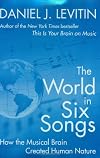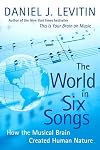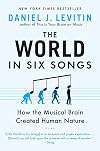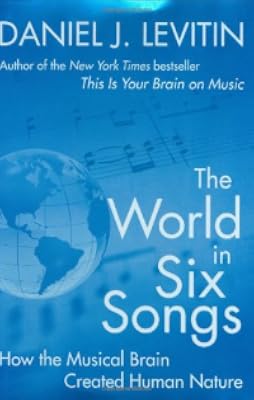
The World in Six Songs: How the Musical Brain Created Human Nature
by Daniel J. Levitin
On This Page
Description
The author of This Is Your Brain on Music showcases his theory of how the brain evolved to play and listen to music in six fundamental forms--for knowledge, friendship, religion, joy, comfort, and love. Preserving the emotional history of our lives and of our species, from its very beginning music was also allied to dance, as the structure of the brain confirms; developing this neurological observation, Levitin shows how music and dance enabled the social bonding and friendship necessary for show more human culture and society to evolve. Blending scientific findings with his own experiences as a musician and music-industry professional, Levitin also incorporates wisdom gleaned from interviews with icons ranging from Sting and Paul Simon to Joni Mitchell, and David Byrne, along with classical musicians and conductors, historians, anthropologists, and evolutionary biologists.--From publisher description. show lessTags
Recommendations










Member Reviews
Daniel Levitin is a neuroscientist who is also a musician and former record producer, so he would seem to be uniquely qualified to write a book like this, about how music has shaped the human mind and how the human mind has shaped music.
The "six songs" of the title are actually six categories of song, which Levitin believes can be used to describe the various functions of music in human society: songs of friendship, joy, comfort, knowledge, religion, and love. He regards this as an exhaustive list. I am unconvinced by that, personally, although I will say that it's at least closer to exhaustive then you might think, as he defines these categories very broadly. "Friendship" songs, for example, are defined as any (non-religious) songs show more that function to bind people together, including national anthems, work songs designed to establish the rhythm of a task, and songs associated with a particular movement or group.
I have decidedly mixed feelings about this book. On one hand, I think it contains a lot of interesting and often insightful commentary on music, the role it plays in human society and the effect it can have on us as individuals. I found the chapter on "knowledge songs" particularly interesting. Here, Levitin discusses the fact that we remember things much better if we learn them in the form of a song, which, when you stop to think about it, is both obvious and kind of strange. He also talks about techniques that make songs easier to memorize, which is extremely important in cultures without writing, where all knowledge and all stories must be passed on orally. And he considers the idea that many songs are written to remind the writer of their own experiences and the life lessons they have learned, and to share those experiences and lessons with others. There's some thought-provoking stuff here.
As a popular science book, though, I think it's less successful. A lot of his discussions about music and the brain seem rather simplistic to me, and to imply a lot more scientific certainty and scientific understanding than we really have yet about how anything this complex works in the brain. (Although Levitin has apparently written a previous book specifically about music and the brain, so it's possible he deals with the subject in a more nuanced way there and has deliberately simplified things a bit here to avoid going over too much of the same ground.) Also, while his more general explanations about evolution are fine, the specific ideas he presents about how music might have influenced human evolution and vice versa are really speculative. Evolutionary psychology is often criticized for making up "Just So Stories." I think that's often kind of an unfair characterization, but there are places here where it most definitely applies.
Levitin can also get a bit rambly and is sometimes prone to repeating himself. And while his tendency to include his own experiences with music provides a nice personal touch, I think there are parts of the book where he lets it all become a little bit too much about him for just a little too long.
Bottom line: It's worth reading and sometimes fascinating, but flawed, and some of it is probably best taken with a grain of salt. show less
The "six songs" of the title are actually six categories of song, which Levitin believes can be used to describe the various functions of music in human society: songs of friendship, joy, comfort, knowledge, religion, and love. He regards this as an exhaustive list. I am unconvinced by that, personally, although I will say that it's at least closer to exhaustive then you might think, as he defines these categories very broadly. "Friendship" songs, for example, are defined as any (non-religious) songs show more that function to bind people together, including national anthems, work songs designed to establish the rhythm of a task, and songs associated with a particular movement or group.
I have decidedly mixed feelings about this book. On one hand, I think it contains a lot of interesting and often insightful commentary on music, the role it plays in human society and the effect it can have on us as individuals. I found the chapter on "knowledge songs" particularly interesting. Here, Levitin discusses the fact that we remember things much better if we learn them in the form of a song, which, when you stop to think about it, is both obvious and kind of strange. He also talks about techniques that make songs easier to memorize, which is extremely important in cultures without writing, where all knowledge and all stories must be passed on orally. And he considers the idea that many songs are written to remind the writer of their own experiences and the life lessons they have learned, and to share those experiences and lessons with others. There's some thought-provoking stuff here.
As a popular science book, though, I think it's less successful. A lot of his discussions about music and the brain seem rather simplistic to me, and to imply a lot more scientific certainty and scientific understanding than we really have yet about how anything this complex works in the brain. (Although Levitin has apparently written a previous book specifically about music and the brain, so it's possible he deals with the subject in a more nuanced way there and has deliberately simplified things a bit here to avoid going over too much of the same ground.) Also, while his more general explanations about evolution are fine, the specific ideas he presents about how music might have influenced human evolution and vice versa are really speculative. Evolutionary psychology is often criticized for making up "Just So Stories." I think that's often kind of an unfair characterization, but there are places here where it most definitely applies.
Levitin can also get a bit rambly and is sometimes prone to repeating himself. And while his tendency to include his own experiences with music provides a nice personal touch, I think there are parts of the book where he lets it all become a little bit too much about him for just a little too long.
Bottom line: It's worth reading and sometimes fascinating, but flawed, and some of it is probably best taken with a grain of salt. show less
Warning! You probably won't be able to get through this book without stopping to listen to the songs the author mentions. I discovered some new ones, and listened to many old favourites while reading this book.
The book is not what I expected. It's not based on scientific research or a hypothesis. Rather, it presents the author's personal framework for how music forms the core of human nature,and how it helped the brain evolve. It was interesting, but rambled a bit.
Another unexpected element is the mismatch between the title and the contents. My husband asked me which were the six songs. And,there aren't six songs, but six types of songs. And should have been more than six types, as I think he sometimes "shoe-horned" songs into his show more framework. show less
The book is not what I expected. It's not based on scientific research or a hypothesis. Rather, it presents the author's personal framework for how music forms the core of human nature,and how it helped the brain evolve. It was interesting, but rambled a bit.
Another unexpected element is the mismatch between the title and the contents. My husband asked me which were the six songs. And,there aren't six songs, but six types of songs. And should have been more than six types, as I think he sometimes "shoe-horned" songs into his show more framework. show less
Summary: Proposes that all the world's songs can be grouped into six categories, and explores the evolutionary, cultural, and musical reasons for each category.
According to Daniel J. Levitin, I could reorganize the music in my collection into six categories--at least the music meant to be sung.
They are songs of:
Friendship: These are the songs that emphasize the bonds within a group, from the classic "Smokin' in the Boys Room" to protest songs like "For What It's Worth" that promoted solidarity around a cause.
Joy: Songs that express delight, the thrill of a wonderful experience, or of just being alive. These include everything from ad jingles like "Sometimes I feel like a nut" to "You are My Sunshine" and often have a TRIP structure show more (Tension, Reaction, Imagination and Prediction). Singing these songs often releases endorphins and oxytocin, hormones often release during peak physical experiences including sex.
Comfort: These are the cathartic songs that lift our spirits in times of crisis, from "God Bless America" (during the aftermath of 9/11) to many country and blues songs, that comfort through the release of prolactin, a hormone associated with crying replacing sorrow with a kind of peacefulness and hopefulness for the future.
Knowledge: Many of these are songs that convey information that help us learn everything from the alphabet (A-B-C-D-E-F-G) to counting songs like "99 Bottles of Beer on the Wall" to "Thirty Days Hath September." He explores why sung words are so readily remembered (as I found out the Karaoke night when I got called out to sing "American Pie" and discovered I knew most of it from memory!).
Religion: He includes here all the songs we use for the important rituals of our lives such as "Pomp and Circumstance" and "The Wedding March" and why they are not appropriate outside certain settings. He proposes evolutionary origins behind why music may be so powerfully connected to the rituals that express ultimate human concerns.
Love: He explores the paradoxical quality of the romantic songs we sing and how they often express some ideal version of real human relationships. Yet there are others that express more realistically the choices in love, such as Johnny Cash's "I Walk the Line," the line being one between marital faithfulness and philandering.
The author is a researcher in Music Perception, Cognition and Expertise at McGill University, but has also worked as a professional musician and music producer. What is surprising is that this is not a research-based book. There is no research by Levitin or others cited to justify his six categories. It seems, rather that this is simply his own conceptual schema, which he fills out in this book. Chapters are made up of a mix of musical examples, musical anecdotes including interviews with musicians ranging from Joni Mitchell and Paul Simon to David Byrne and Sting. He also incorporates speculative theory on evolutionary origins of particular aspects and effects of music, and draws on cognitive research on the neurophysiology of music, a field where he has made his own contributions, as may be found on his website [http://daniellevitin.com/publicpage/books/the-world-in-six-songs/].
I found this an interesting but rather "rambling" book. The particular song type of each chapter seems just a starting point for a wide-ranging mix of research, song lyrics and anecdote, that doesn't always seem well connected, but certainly reflects his wide experiences playing with bands like Blue Oyster Cult, visiting the hotel suite where John Lennon, Yoko Ono, staged their "bed-in" and recorded "Give Peace a Chance," as well as his explorations of evolutionary biology and cognitive research.
I came across a small factual error where he refers to the four "student protesters" (p. 69) who were killed at Kent State. In actual fact, only two of the four were protesters, the other two were students in the vicinity walking between classes who were not part of the protests. This factual inaccuracy (easily checked online) led me to wonder about the author's method and how much he relied on recollection as opposed to carefully documented and cross-checked research. I would probably place the highest confidence in those areas most directly related to his own field of cognition.
One of the most moving sections was in his chapter on "Religion." He writes of attending his Jewish grandmother's funeral and the powerful effect of singing a version of Psalm 131. He writes:
"It was not the memorial speeches that brought us to tears, not the lowering of her casket into the ground, but the haunting strains of that hymn that broke through our stoic veneer and tapped those trapped feelings, pushed down deep beneath the surface of our daily lives; by the end of the song, there wasn't a dry cheek among our group. It was this event that helped all of us accept the death of my grandmother, to mourn appropriately, and ultimately, to replace rumination with resolution. Without music as a catalyst, as the Trojan horse that allowed access to our most private thoughts--and perhaps fears of our own mortality--the morning would have been incomplete, the feelings would have stayed locked inside us, where they might have fermented and built up tension, finally exploding out of us at some distant time in the future and for no apparent reason. Grandma was gone; we had shared the realization and etched it in our minds, sealed with a song" (p. 228).
While Levitin's ideas sometimes get lost in his rambling narratives, his categories and discussion do help us understand the different ways that music powerfully works in our lives, and what might be going on in our brains as it does so. show less
According to Daniel J. Levitin, I could reorganize the music in my collection into six categories--at least the music meant to be sung.
They are songs of:
Friendship: These are the songs that emphasize the bonds within a group, from the classic "Smokin' in the Boys Room" to protest songs like "For What It's Worth" that promoted solidarity around a cause.
Joy: Songs that express delight, the thrill of a wonderful experience, or of just being alive. These include everything from ad jingles like "Sometimes I feel like a nut" to "You are My Sunshine" and often have a TRIP structure show more (Tension, Reaction, Imagination and Prediction). Singing these songs often releases endorphins and oxytocin, hormones often release during peak physical experiences including sex.
Comfort: These are the cathartic songs that lift our spirits in times of crisis, from "God Bless America" (during the aftermath of 9/11) to many country and blues songs, that comfort through the release of prolactin, a hormone associated with crying replacing sorrow with a kind of peacefulness and hopefulness for the future.
Knowledge: Many of these are songs that convey information that help us learn everything from the alphabet (A-B-C-D-E-F-G) to counting songs like "99 Bottles of Beer on the Wall" to "Thirty Days Hath September." He explores why sung words are so readily remembered (as I found out the Karaoke night when I got called out to sing "American Pie" and discovered I knew most of it from memory!).
Religion: He includes here all the songs we use for the important rituals of our lives such as "Pomp and Circumstance" and "The Wedding March" and why they are not appropriate outside certain settings. He proposes evolutionary origins behind why music may be so powerfully connected to the rituals that express ultimate human concerns.
Love: He explores the paradoxical quality of the romantic songs we sing and how they often express some ideal version of real human relationships. Yet there are others that express more realistically the choices in love, such as Johnny Cash's "I Walk the Line," the line being one between marital faithfulness and philandering.
The author is a researcher in Music Perception, Cognition and Expertise at McGill University, but has also worked as a professional musician and music producer. What is surprising is that this is not a research-based book. There is no research by Levitin or others cited to justify his six categories. It seems, rather that this is simply his own conceptual schema, which he fills out in this book. Chapters are made up of a mix of musical examples, musical anecdotes including interviews with musicians ranging from Joni Mitchell and Paul Simon to David Byrne and Sting. He also incorporates speculative theory on evolutionary origins of particular aspects and effects of music, and draws on cognitive research on the neurophysiology of music, a field where he has made his own contributions, as may be found on his website [http://daniellevitin.com/publicpage/books/the-world-in-six-songs/].
I found this an interesting but rather "rambling" book. The particular song type of each chapter seems just a starting point for a wide-ranging mix of research, song lyrics and anecdote, that doesn't always seem well connected, but certainly reflects his wide experiences playing with bands like Blue Oyster Cult, visiting the hotel suite where John Lennon, Yoko Ono, staged their "bed-in" and recorded "Give Peace a Chance," as well as his explorations of evolutionary biology and cognitive research.
I came across a small factual error where he refers to the four "student protesters" (p. 69) who were killed at Kent State. In actual fact, only two of the four were protesters, the other two were students in the vicinity walking between classes who were not part of the protests. This factual inaccuracy (easily checked online) led me to wonder about the author's method and how much he relied on recollection as opposed to carefully documented and cross-checked research. I would probably place the highest confidence in those areas most directly related to his own field of cognition.
One of the most moving sections was in his chapter on "Religion." He writes of attending his Jewish grandmother's funeral and the powerful effect of singing a version of Psalm 131. He writes:
"It was not the memorial speeches that brought us to tears, not the lowering of her casket into the ground, but the haunting strains of that hymn that broke through our stoic veneer and tapped those trapped feelings, pushed down deep beneath the surface of our daily lives; by the end of the song, there wasn't a dry cheek among our group. It was this event that helped all of us accept the death of my grandmother, to mourn appropriately, and ultimately, to replace rumination with resolution. Without music as a catalyst, as the Trojan horse that allowed access to our most private thoughts--and perhaps fears of our own mortality--the morning would have been incomplete, the feelings would have stayed locked inside us, where they might have fermented and built up tension, finally exploding out of us at some distant time in the future and for no apparent reason. Grandma was gone; we had shared the realization and etched it in our minds, sealed with a song" (p. 228).
While Levitin's ideas sometimes get lost in his rambling narratives, his categories and discussion do help us understand the different ways that music powerfully works in our lives, and what might be going on in our brains as it does so. show less
I respect anyone with a more diverse taste in music that me, and Levitin fits the bill. In fact, having read the first sentence of the book, I wonder if anyone alive listens to a broader array of tunes than he does.
Unfortunately, this book wasn't what I expected. Given his vocation (Professor of Psychology, Neuroscience, and Music at McGill University), I expected more science and less conjecture. This book relies quite heavily on personal anecdotes and conversations with musicians to move it along. There were times when the length of some stories felt like he was grasping for content.
The most fascinating part of the book was how he reached cross-genre to provide examples for his various categories—friendship, joy, comfort, knowledge, show more religion and love. If only he had more killer and less filler! show less
Unfortunately, this book wasn't what I expected. Given his vocation (Professor of Psychology, Neuroscience, and Music at McGill University), I expected more science and less conjecture. This book relies quite heavily on personal anecdotes and conversations with musicians to move it along. There were times when the length of some stories felt like he was grasping for content.
The most fascinating part of the book was how he reached cross-genre to provide examples for his various categories—friendship, joy, comfort, knowledge, show more religion and love. If only he had more killer and less filler! show less
La tesi che il libro vuole dimostrare è a dir poco ambiziosa ("tutto ciò che la musica ha fatto per l'uomo può fondamentalmente essere riassunto in sei tipi di canzoni") e benché Levitin faccia di tutto per dimostrarlo le sue argomentazioni convincono solo fino a un certo punto, soprattutto quando il confine fra un tipo di canzone e l'altro è molto debole e/o quando il racconto indulge un po' troppo in episodi personali. I tanti testi citati non sempre aiutano, probabilmente il messaggio di Fatti di musica era più forte (oltre che per il maggio rigore e la compattezza della struttura)perché là si parlava per l'appunto più di musica che di canzoni.
This book I half liked. The part about the songs we love as human beings, the types that run through all sorts of cultures and times. That was great as the author has a wonderfully diverse sense of music and really went to great lengths to insure he was well rounded in talking about songs the world over. There were some great comparisons and some new thoughts. You have to love a book that references the Bible and Lord of the Rings in the same paragraph.
But then the section the subtitle refers to just irritated me. Perhaps I shouldn't have been reading this book with a massive headache, but the evolution sections were annoying. Its not that I have anything against evolution, but using it to explain social phenomena always seems hit or show more miss to me. Sometimes the examples and assumptions are unlikely to the point of being silly. The one that comes to mind is the thought that groups who buried their dead found an evolutionary benefit because it was more hygienic-so they were a tiny bit healthier than other groups. But weren't these ancient groups nomadic? So there would be just as much hygienic value in leaving the bodies at the old campsite. Or just dragging them off where you couldn't smell them any more. Or what of cannibalistic groups? They wouldn't have to spend the energy digging a great big hole and they would get extra protein. I could come up with questions about this particular theory all day. It was mentioned in the book by the way, in the section on religious songs. I think that is another reason I didn't like the evolutionary posts, the author seemed to be bringing in a lot of behaviour evolution to support his thesis, whether it was relevant or not. show less
But then the section the subtitle refers to just irritated me. Perhaps I shouldn't have been reading this book with a massive headache, but the evolution sections were annoying. Its not that I have anything against evolution, but using it to explain social phenomena always seems hit or show more miss to me. Sometimes the examples and assumptions are unlikely to the point of being silly. The one that comes to mind is the thought that groups who buried their dead found an evolutionary benefit because it was more hygienic-so they were a tiny bit healthier than other groups. But weren't these ancient groups nomadic? So there would be just as much hygienic value in leaving the bodies at the old campsite. Or just dragging them off where you couldn't smell them any more. Or what of cannibalistic groups? They wouldn't have to spend the energy digging a great big hole and they would get extra protein. I could come up with questions about this particular theory all day. It was mentioned in the book by the way, in the section on religious songs. I think that is another reason I didn't like the evolutionary posts, the author seemed to be bringing in a lot of behaviour evolution to support his thesis, whether it was relevant or not. show less
Levitin's previous book, This Is Your Brain on Music ,
really impressed me. This one impressed me, too, but less. Levitin is best when discussing music and the neuroscience findings about music and why we like it, play it, sing it. When he is writing on music and neuroscience, Levitin has my attention and his prose is striking, convincing. When he is theorizing about evolutionary anthropology, I was distracted, and there is a lot of that in this book, as well as some editorializing about music and life that I also found interesting but distracting. So, three stars, not four or five.
really impressed me. This one impressed me, too, but less. Levitin is best when discussing music and the neuroscience findings about music and why we like it, play it, sing it. When he is writing on music and neuroscience, Levitin has my attention and his prose is striking, convincing. When he is theorizing about evolutionary anthropology, I was distracted, and there is a lot of that in this book, as well as some editorializing about music and life that I also found interesting but distracting. So, three stars, not four or five.
Members
- Recently Added By
Lists

Science: Health & Medical
100 works; 1 member
Author Information

15 Works 8,974 Members
Daniel J. Levitin was born on December 27, 1957 in San Francisco, California. He studied electrical engineering at the Massachusetts Institute of Technology and music at the Berkley College of Music before dropping out of college to become a record producer and professional musician. He returned to school in his thirties, where he studied show more cognitive psychology/cognitive science, receiving a B.A. from Stanford University in 1992 and a M.Sc. in 1993 and Ph.D. in 1996 from the University of Oregon. He is a cognitive psychologist, neuroscientist, and author. He runs the Levitin Laboratory for Musical Perception, Cognition, and Expertise at McGill University. He has published extensively in scientific journals and music trade magazines such as Grammy and Billboard. He is also the author of several books including This Is Your Brain on Music, The World in Six Songs, and The Organized Mind: Thinking Straight in the Age of Information Overload. (Bowker Author Biography) show less
Some Editions
Awards and Honors
Distinctions
Common Knowledge
- Canonical title
- The World in Six Songs: How the Musical Brain Created Human Nature
- Original publication date
- 2008
- First words
- On my desk right now I have a stack of music CDs that couldn't be more different: an eighteenth-century opera by Martin Marais whose lyrics describe the gory details of a surgical operation; a North African griot singing a so... (show all)ng, offered to businessmen passing by in the hopes of securing a handout; a piece written 185 years ago that requires 120 musicians to perform it properly, each of them reading a very specific and inviolable part off of a page (Beethoven's Symphony no. 9).
- Last words
- (Click to show. Warning: May contain spoilers.)It is all this, and our capacity to write about it—to celebrate it in song—that makes us human.
- Blurbers
- Sting; Martin, George; Gilbert, Elizabeth; Gopnik, Adam; McFerrin, Bobby; Bharucha, Jamshed
Classifications
- Genres
- Music, Nonfiction, Science & Nature, General Nonfiction
- DDC/MDS
- 781.11 — Arts & recreation Music General principles and musical forms Basic principles of music Psychological principles of music
- LCC
- ML3838 .L48 — Music Literature on music Literature on music Philosophical and societal aspects of music. Physics Psychology
- BISAC
Statistics
- Members
- 742
- Popularity
- 38,007
- Reviews
- 15
- Rating
- (3.34)
- Languages
- 5 — English, French, German, Italian, Spanish
- Media
- Paper, Audiobook, Ebook
- ISBNs
- 23
- ASINs
- 18