On This Page
Description
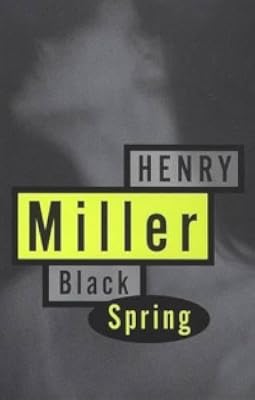
Continuing the subversive self-revelation begun in Tropic of Cancer and Tropic of Capricorn, Henry Miller takes readers along a mad, free-associating journey from the damp grime of his Brooklyn youth to the sun-splashed cafes and squalid flats of Paris. With incomparable glee, Miller shifts effortlessly from Virgil to venereal disease, from Rabelais to Roquefort. In this seductive technicolor swirl of Paris and New York, he captures like no one else the blending of people and the cities they show more inhabit. show lessTags
Recommendations




















Member Reviews
'Black Springs' follows up Tropic of Cancer. Miller carries on, therefore, his confessions, still freely playing with timelines. And, indeed, despite narrating events which had happened before 'Tropic of Cancer', 'Black Spring', where the author displays his childhood memories (happy, despite being in the poor neighbourhoods of Brooklyn) was published after.
The lack of a clear chronology is one of its key strength, though, as it contributes to give it a 'surreal' aspect: memories are just retold as they come, completely randomly -or so it seems. As such, the narrative is building itself up, then dismantle itself, to build itself up again, like a snaking and tortuous river (or should it be like a sewer?) where we struggle, at times, to show more keep our heads above water!
I might have grown up to dislike Miller as a man (he fascinated me when I was a teen, and was then one of my top favourite writers), yet, I still love his writing. It's insane, passionate, delirious. We try, as best as we can, to cling on to it, feeling all the while like being tossed up from one dream to another one, and another one, submerged by constant waves always threatening to drown us. Truth, in any case, surely got drowned into it all long ago! But, as with everything else when it comes to Miller's work: who cares? Truth is irrelevant. What is, is to follow him in his erratic journey; and, quite frankly, 'Black Spring' is one of his best. What else to ask for? show less
The lack of a clear chronology is one of its key strength, though, as it contributes to give it a 'surreal' aspect: memories are just retold as they come, completely randomly -or so it seems. As such, the narrative is building itself up, then dismantle itself, to build itself up again, like a snaking and tortuous river (or should it be like a sewer?) where we struggle, at times, to show more keep our heads above water!
I might have grown up to dislike Miller as a man (he fascinated me when I was a teen, and was then one of my top favourite writers), yet, I still love his writing. It's insane, passionate, delirious. We try, as best as we can, to cling on to it, feeling all the while like being tossed up from one dream to another one, and another one, submerged by constant waves always threatening to drown us. Truth, in any case, surely got drowned into it all long ago! But, as with everything else when it comes to Miller's work: who cares? Truth is irrelevant. What is, is to follow him in his erratic journey; and, quite frankly, 'Black Spring' is one of his best. What else to ask for? show less
"Black Spring" is filled with writings about Miller's youth, both as a child growing up the son of a tailor and as a young man experiencing Paris. It is dedicated to Anais Nin and was published in the mid-30s. Like all of Miller's writing, it is exuberant, weird, over-the-top, and fascinating. The writing puts Kerouac to shame with its uninhibited, wild freedom that is quite satisfying to read.
Black Spring was Miller's second published novel, following Tropic of Cancer and preceding Tropic of Capricorn. It's an autobiography about Brooklyn (circa 1915 or so) and Paris in the Thirties. It is also a very great book, in a way that the two Tropics never quite are. No one, including Thomas Wolfe, has ever described Brooklyn with the gusto Miller lavishes upon every storefront and shifty citizen. Black Spring's first 147 pages are probabl...
Henry in fine spirits, Black Spring is a collection of works seeded together and wrapped up in Miller's later years, the final novel in the Tropics series. Very close in some parts to Lawrence Durrell's The Black Book, which I am to think influenced Miller, as there are some aspects that are too glucose for Henry's regular style.
I just let Millers timeless rants flood me, not worrying too much if my mind wandered, I'd always return back to some part which managed to pull me in deep within the bowels of Henry's mirth at a downcast and sodden world, a world which for all its diseases is eternally Spring.
Some great moments including Henry's observations on French urinals and the art of peeing, the poet Jabberwhorl Cronstadt seeing show more everything and literally including the kitchen sink as poetry, erections whilst listening to Wagner, but as usual I find some of Henry's self reflecting rants as tiresome as my own. Henry Miller has a habit of really pushing the point of who he is under certain phases of mood and perspective, and he labors the point, but Henry gets so caught up in all this, he has to and wants to do it, I imagine less for the sake of the reader but more for the sake of himself. show less
I just let Millers timeless rants flood me, not worrying too much if my mind wandered, I'd always return back to some part which managed to pull me in deep within the bowels of Henry's mirth at a downcast and sodden world, a world which for all its diseases is eternally Spring.
Some great moments including Henry's observations on French urinals and the art of peeing, the poet Jabberwhorl Cronstadt seeing show more everything and literally including the kitchen sink as poetry, erections whilst listening to Wagner, but as usual I find some of Henry's self reflecting rants as tiresome as my own. Henry Miller has a habit of really pushing the point of who he is under certain phases of mood and perspective, and he labors the point, but Henry gets so caught up in all this, he has to and wants to do it, I imagine less for the sake of the reader but more for the sake of himself. show less
This is from the 'tropic' trilogy. it's great to read someone who is full of the joy of living and writes in an uninhibited and unabashed way, about practically anything that takes his fancy. You read his book you feel like you're getting to know the whole man - becoming intimate like a friendship. I have a close friendship with Henry Miller's books.
Henry Miller's Black Spring, like Tropic of Cancer, is a feverish narrative filled with images from the gutter, both beautiful and terrifying. Unlike Cancer, Black Spring is composed of several short pieces and some are better than others. Though not quite the stunning revelation of Miller's most infamous work, Black Spring is a fascinating look into the mind of one of America's greatest modern writers.
The intensity and sublimity of Miller's prose, graphed on a chart depicting beginning to end, would look like an inverted parabola.
Members
- Recently Added By
Published Reviews
ThingScore 100
Black Spring is, I think, one of the finest evocations of low urban life in all American literature. ‘I am a patriot,’ says Miller, ‘of the Fourteenth Ward, Brooklyn, where I was raised. The rest of the United States doesn’t exist for me, except as idea, or history, or literature.’ The patriotism is expressed in an almost myopically close rendering of a world of ‘cancer, dropsy, show more cirrhosis of the liver, insanity, thievery, mendacity, buggery, incest, paralysis, tapeworms, abortions, triplets, idiots, drunkards, ne’er-do-wells, fanatics, sailors, tailors, watchmakers, scarlet fever, whooping cough, meningitis, running ears, chorea, stutterers, jailbirds, dreamers, storytellers, bartenders – and finally there was Uncle George and Tante Melia.’
Though he disavows either a literary aim or a learned technique, Miller belongs to the logorrheal tradition of Rabelais and Sterne (as does Burroughs). He becomes a wordy bore only when he finds it necessary to prophesy; that great American disease we can call vatism is in him as it is in Dahlberg and even Mailer. When Miller starts talking about Love, not amour, I feel like giving him a few francs to go to a brothel. show less
Though he disavows either a literary aim or a learned technique, Miller belongs to the logorrheal tradition of Rabelais and Sterne (as does Burroughs). He becomes a wordy bore only when he finds it necessary to prophesy; that great American disease we can call vatism is in him as it is in Dahlberg and even Mailer. When Miller starts talking about Love, not amour, I feel like giving him a few francs to go to a brothel. show less
added by SnootyBaronet
Lists

Mustich's 1000 Books to Read Before You Die: A Life Changing List
1,001 works; 20 members

Personal 2026 reads
32 works; 1 member
Author Information

232+ Works 31,673 Members
Awards and Honors
Notable Lists
Series

Belongs to Publisher Series
Work Relationships
Is contained in
Has the adaptation
Common Knowledge
- Canonical title
- Black Spring
- Original title
- Black Spring
- Original publication date
- 1936
- Epigraph
- Can I be as I believe myself or as others believe me to be? Here is where these lines become a confession in the presence of my unknown and unknowable me, unknown and unknowable for myself. Here is where I create the legend w... (show all)herein I must bury myself.
MIGUEL DE UNAMUNO - Dedication
- TO ANAÏS NIN
- First words
- What is not in the open street is false, derived, that is to say, literature.
- Quotations
- Up on the Brooklyn Bridge a man is standing in agony, waiting to jump, or waiting to write a poem, or waiting for the blood to leave his vessels because if he advances another foot the pain of his love will kill him.
- Last words
- (Click to show. Warning: May contain spoilers.)Tomorrow you may bring about the destruction of your world. Tomorrow you may sing in Paradise above the smoking ruins of your world-cities. But tonight I would like to think of one man, a lone individual, a man without name or country, a man whom I respect because he has absolutely nothing in common with you—MYSELF. Tonight I shall meditate upon that which I am.
- Disambiguation notice
- Please distinguish between Henry Miller's 1936 novel, Black Spring, and Christina Henry's similarly-titled Black Spring (A Black Wings Novel) from 2014. Thank you.
Classifications
Statistics
- Members
- 1,461
- Popularity
- 16,099
- Reviews
- 14
- Rating
- (3.72)
- Languages
- 13 — Catalan, Czech, Dutch, English, Finnish, French, German, Italian, Portuguese, Romanian, Russian, Spanish, Swedish
- Media
- Paper, Ebook
- ISBNs
- 35
- UPCs
- 1
- ASINs
- 37