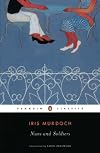
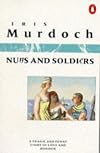
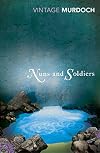
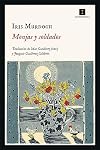
Nuns and Soldiers
by Iris Murdoch 
On This Page
Description
Set in London and in the South of France, this brilliantly structured novel centers on two women: Gertrude Openshaw, bereft from the recent death of her husband, yet awakening to passion; and Anne Cavidge, who has returned in doubt from many years in a nunnery, only to encounter her personal Christ. A fascinating array of men and women hover in urgent orbit around them: the "Count," a lonely Pole obsessively reliving his & eacutemigré father's patriotic anguish; Tim Reede, a seedy yet show more appealing artist, and Daisy, his mistress; the manipulative Mrs. Mount; and many other magically drawn characters moving between desire and obligation, guilt and joy. This edition of "Nuns and Soldiers" includes a new introduction by renowned religious historian Karen Armstrong. show lessTags
Recommendations




















Member Reviews
My occasional project to finish all of Iris Murdoch's 26 novels is now nearing completion - after this one I have just four late works to go ([b:The Good Apprentice|234069|The Good Apprentice|Iris Murdoch|https://i.gr-assets.com/images/S/compressed.photo.goodreads.com/books/1385190904l/234069._SY75_.jpg|2877242], [b:The Green Knight|12819|The Green Knight|Iris Murdoch|https://i.gr-assets.com/images/S/compressed.photo.goodreads.com/books/1385190859l/12819._SY75_.jpg|1410480], [b:The Message to the Planet|114707|The Message to the Planet|Iris Murdoch|https://i.gr-assets.com/images/S/compressed.photo.goodreads.com/books/1349016704l/114707._SY75_.jpg|110450] and [b:Jackson's Dilemma|56089|Jackson's Dilemma|Iris show more Murdoch|https://i.gr-assets.com/images/S/compressed.photo.goodreads.com/books/1347636762l/56089._SY75_.jpg|1833238].
This one is another ensemble piece with farcical and philosophical elements, and I found it quite an absorbing read, if more than a little implausible at times. There is only one nun (now a former nun) in the cast, and the nearest thing to a soldier is the Polish exile known inaccurately as the Count.
The first part of the book introduces the cast as they gather to support the dying Guy Openshaw. The four main characters are Guy's widow Gertrude, Anne, the ex-nun who was her best friend at university, the Count (Peter Szczepanski), whose love for Gertrude is largely unrequited and Tim, a painter of rather limited talent and even more limited means. Tim is employed by Gertrude as a caretaker at their holiday home in France, and when Gertrude comes to stay they start an affair, and soon decide to marry as soon as a decent interval has elapsed since Guy's death. As always with Murdoch, the plot is a lot more complicated than a simple description would suggest, and she arranges for almost every member of the cast to love the wrong person, and some of her plot twists seem almost capricious.
In her introduction, Karen Armstrong notes "Finally, Tim has to undergo ordeal by water. This is a frequent motif in Murdoch's novels; characters often have to endure some watery trial before they can see their way clearly.". This had never struck be before, but I can think of several examples (The Sea, The Sea, The Nice and the Good, The Philosopher's Pupil and The Unicorn all qualify), and there are three separate watery incidents in this book.
The blurb describes Tim's "punk girlfriend", but Daisy, the character this refers to, is not a punk in any sense I would understand - she is an alcoholic former painter who likes to speak her mind in earthy language, but she is not malicious and does not try to cause trouble for Tim. show less
This one is another ensemble piece with farcical and philosophical elements, and I found it quite an absorbing read, if more than a little implausible at times. There is only one nun (now a former nun) in the cast, and the nearest thing to a soldier is the Polish exile known inaccurately as the Count.
The first part of the book introduces the cast as they gather to support the dying Guy Openshaw. The four main characters are Guy's widow Gertrude, Anne, the ex-nun who was her best friend at university, the Count (Peter Szczepanski), whose love for Gertrude is largely unrequited and Tim, a painter of rather limited talent and even more limited means. Tim is employed by Gertrude as a caretaker at their holiday home in France, and when Gertrude comes to stay they start an affair, and soon decide to marry as soon as a decent interval has elapsed since Guy's death. As always with Murdoch, the plot is a lot more complicated than a simple description would suggest, and she arranges for almost every member of the cast to love the wrong person, and some of her plot twists seem almost capricious.
In her introduction, Karen Armstrong notes "Finally, Tim has to undergo ordeal by water. This is a frequent motif in Murdoch's novels; characters often have to endure some watery trial before they can see their way clearly.". This had never struck be before, but I can think of several examples (The Sea, The Sea, The Nice and the Good, The Philosopher's Pupil and The Unicorn all qualify), and there are three separate watery incidents in this book.
The blurb describes Tim's "punk girlfriend", but Daisy, the character this refers to, is not a punk in any sense I would understand - she is an alcoholic former painter who likes to speak her mind in earthy language, but she is not malicious and does not try to cause trouble for Tim. show less
Early on in Nuns and Soldiers, one character reminds another that it is their duty to resist despair. I actually was taken aback at that. Of all the reasons to resist despair somehow duty had never presented itself to me. And I'll tell you: it sounded good. There is something so appealing about that kind of simple moral authority. Unfortunately for our ability to gain consolation, but fortunately, I guess, for the quality of the novel, things don't remain so simple.
I once characterized the typical Iris Murdoch plot as A loves B, who is involved with C, who wants to give his/her life to a Great Ideal.
Well, that's symplistic, of course. But I love Murdoch nonetheless, even though reading all her novels in the space of a summer of romance (I being in love with A, who loved B, and so on) I did find myself making bets with myself as to which page the black dog would appear upon, and where the stones would figure. She's unique. You will love her or you will be wholly.. "what???" about her.
Well, that's symplistic, of course. But I love Murdoch nonetheless, even though reading all her novels in the space of a summer of romance (I being in love with A, who loved B, and so on) I did find myself making bets with myself as to which page the black dog would appear upon, and where the stones would figure. She's unique. You will love her or you will be wholly.. "what???" about her.
In terms of writing quality, "Nuns and Soldiers" is just as good as anything else Iris Murdoch has written. However, over the course of the book, I came to really despise the four main characters, not for their personalities but for the choices they made and the way they lived their lives. Despite this, there are a lot of very memorable scenes, the writing is superb, and the last twenty pages or so, where a few peripheral characters are brought to the fore, pretty much made up for my complaints (so much so that I wish Murdoch had written a five hundred page novel about them instead). So while, in terms of literary quality, "Nuns and Soldiers" ranks around a four and a half, my personal enjoyment of the book was greatly lessened by the show more unlikable characters. show less
The 20th Iris Murdoch novel, and there's a lot of familiar territory here. Everyone falls in love with everyone else whilst wrestling with great ideas and some slapstick comedy happens alongside. Not one of my favourites by her, but a solid novel.
Bought 30 Dec 1994
I must have read this before, as I've read all of Murdoch's novels, but not this pristine copy. It's not one of her better-known novels although I wonder why this is, as I found it a really good read. I didn't remember much besides a few names, scenes and perhaps the "feel" of it, but there are some excellent and varied characters, well-done settings in London and rural France, and a decent plot; also a well described meditation on loss, love and marriage. Plenty of Murdochian themes and characters, but it also reminded me of Margaret Drabble or Doris Lessing, maybe a bit more "open" than some of her more claustrophobic works, and with delightful flashes of humour.
I must have read this before, as I've read all of Murdoch's novels, but not this pristine copy. It's not one of her better-known novels although I wonder why this is, as I found it a really good read. I didn't remember much besides a few names, scenes and perhaps the "feel" of it, but there are some excellent and varied characters, well-done settings in London and rural France, and a decent plot; also a well described meditation on loss, love and marriage. Plenty of Murdochian themes and characters, but it also reminded me of Margaret Drabble or Doris Lessing, maybe a bit more "open" than some of her more claustrophobic works, and with delightful flashes of humour.
Another enthralling offering from IM. Too complex for a short review.
Members
- Recently Added By
Lists

Books We Couldn't Put Down
443 works; 197 members
Author Information

97+ Works 29,201 Members
Iris Murdoch was one of the twentieth century's most prominent novelists, winner of the Booker Prize for The Sea. She died in 1999. (Publisher Provided) Iris Murdoch was born in Dublin, Ireland on July 15, 1919. She was educated at Badminton School in Bristol and Oxford University, where she read classics, ancient history, and philosophy. After show more several government jobs, she returned to academic life, studying philosophy at Newnham College, Cambridge. In 1948, she became a fellow and tutor at St. Anne's College, Oxford. She also taught at the Royal College of Art in London. A professional philosopher, she began writing novels as a hobby, but quickly established herself as a genuine literary talent. She wrote over 25 novels during her lifetime including Under the Net, A Severed Head, The Unicorn, and Of the Nice and the Good. She won several awards including the James Tait Black Memorial Prize for The Black Prince in 1973 and the Booker Prize for The Sea, The Sea in 1978. She died on February 8, 1999 at the age of 79. (Bowker Author Biography) show less
Iris Murdoch has a Legacy Library. Legacy libraries are the personal libraries of famous readers, entered by LibraryThing members from the Legacy Libraries group.
Series
Belongs to Publisher Series
Impedimenta (204)
Common Knowledge
- Original title
- Nuns and Soldiers
- Original publication date
- 1980
- People/Characters
- Gertrude Openshaw; Guy Openshaw; Anne Cavidge; The Count; Tim Reede; Daisy (show all 7); Mrs Mount
- Important places
- London, England, UK; France
- Dedication
- To
NATASHA
and
STEPHEN SPENDER - First words
- 'Wittgenstein-'
'Yes?' said the Count. - Quotations
- Someone said to Tim, ‘You painters must feel as if you are creating the world’. Tim never felt like that. He felt at his best working moments, a sense of total relaxation. Of course he was not creating the world, he was d... (show all)iscovering it, not even that, he was just seeing it and letting it continue to manifest itself. He was not even sure, at these good moments, whether what he was doing was ‘reproducing’. He was just there, active as a part of the world, a transparent part. Daisy, who hated music, had once said to denigrate that art, ‘Music is like chess, it’s all there beforehand, all you do is find it’. ‘Yes,’ said Tim. That was exactly what he felt about painting.
- Last words
- (Click to show. Warning: May contain spoilers.)Anna stood there for a while. Then she began to walk through the snowy strets at random, feeling lightened of her burdens. Tomorrow she would be in America.
Classifications
Statistics
- Members
- 578
- Popularity
- 50,715
- Reviews
- 7
- Rating
- (3.77)
- Languages
- 7 — Danish, Dutch, English, Finnish, French, Spanish, Swedish
- Media
- Paper, Ebook
- ISBNs
- 17
- ASINs
- 6