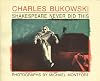
Shakespeare Never Did This
by Charles Bukowski
On This Page
Description
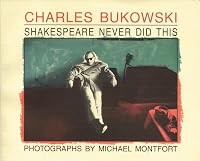
An account of Charles Bukowski's 1978 European trip. In 1978 Europe was new territory for Bukowski holding the secrets of his own personal ancestry and origins. En route to his birthplace in Andernach, Germany, he is trailed by celebrity-hunters and paparazzi, appears drunk on French television, blows a small fortune at a Dusseldorf racetrack and stands in a Cologne Cathedral musing about life and death.Tags
Recommendations
















Member Reviews
Read this without fully realizing that Bukowski dies back in 1994, which ironicly is the same year I first discovered him when I cam across Post Office in a used bookstore (I was working for the USPS at the time). I didn't get him then. Much more on his wavelength thirty years later.
Shakespeare Never Did This is more of a travelogue along the lines of The Curse of Lono, famous author paid to write about their trip to a foreign country, in this case a reading/signing tour of Germany and France.
Reading this, I can see the casual brilliance that has drawn people to Bukowski's work. He'll just prattle on in concise, matter-of-fact language, flippant and casual, and then suddenly he'll spit out a clump of pure, deep, profound prose that show more makes you go back and read that sentence over and over. The quote from Picasso that opens this book serves a perfect definition of what Bukowski means to his audiences; living, breathing evidence that there is the potential a poet in all of us, and with that proof a glimmer of hope for humanity, if not for us personally. show less
Shakespeare Never Did This is more of a travelogue along the lines of The Curse of Lono, famous author paid to write about their trip to a foreign country, in this case a reading/signing tour of Germany and France.
Reading this, I can see the casual brilliance that has drawn people to Bukowski's work. He'll just prattle on in concise, matter-of-fact language, flippant and casual, and then suddenly he'll spit out a clump of pure, deep, profound prose that show more makes you go back and read that sentence over and over. The quote from Picasso that opens this book serves a perfect definition of what Bukowski means to his audiences; living, breathing evidence that there is the potential a poet in all of us, and with that proof a glimmer of hope for humanity, if not for us personally. show less
I wasn't looking for anything serious; I'd heard this was a breezy account of Bukowski's European book promotion tour; and, it is. I read Bukowski more to look at how he structures story telling and his use of different sentences structures. So, for me, I saw here what I think is the longest sentence I've ever seen Bukowski write. It's in the section about his trip to a cathedral and his thoughts about God. I didn't think I'd ever see a sentence that long from Bukowski. The story of the trip itself is not unusual, no transformations occur or any personal growth. Some observations supplement things already said in earlier novels. It's short and very quickly read, cheap entertainment.
Maybe the most interesting thing about this short show more piece is the ease with which Bukowski contradicts himself in making observations about places in Germany, France and the USA. It feels completely normal and genuine. It's the ability to do that, to capture it on paper, and have the reader accept it, that is part of Bukowski's skill. show less
Maybe the most interesting thing about this short show more piece is the ease with which Bukowski contradicts himself in making observations about places in Germany, France and the USA. It feels completely normal and genuine. It's the ability to do that, to capture it on paper, and have the reader accept it, that is part of Bukowski's skill. show less
An account of Charles Bukowski's 1978 European trip. In 1978 Europe was new territory for Bukowski holding the secrets of his own personal ancestry and origins. En route to his birthplace in Andernach, Germany, he is trailed by celebrity-hunters and paparazzi, appears drunk on French television, blows a small fortune at a Dusseldorf racetrack and stands in a Cologne Cathedral musing about life and death.
An account of Charles Bukowski's 1978 European trip. In 1978 Europe was new territory for Bukowski holding the secrets of his own personal ancestry and origins. En route to his birthplace in Andernach, Germany, he is trailed by celebrity-hunters and paparazzi, appears drunk on French television, blows a small fortune at a Dusseldorf racetrack and stands in a Cologne Cathedral musing about life and death.
“È vero che la vita è insopportabile, solo che alla maggior parte delle persone, è stato insegnato a fingere che non lo sia”
1978, Charles Bukowski, all’apice della sua fama, viene invitato in Europa per declamare poesie, continente dove è, per la verità, più conosciuto che negli Stati Uniti, e già che è di strada decide pure di andare alla ricerca delle sue radici in Germania.
Questa è la cronaca, assurda e surreale, di quei giorni passati in Europa dal vecchio “Buko” alla ricerca di nuovi compagni di… sbronze e, in effetti, quello che dovrebbe essere un giro nelle varie sedi culturali dove declamare poesie, diventa un trattato sulla reperibilità del vino e dei suoi derivati nella vecchia Europa.
Ma si sa, Charles show more Bukowski, genio e sregolatezza, non si poteva chiedere a lui di dare il buon esempio. E cosi nel suo peregrinare tra città e alberghi, sempre attento a non rimanere a becco asciutto, prendiamo atto delle sue riflessioni, profonde o meno che siano, su tutto quello che gli sta capitando e come uscirne fuori il più presto possibile. Molte belle considerazioni e bei pensieri; toccante oltremisura la visita alla sua casa natale vista da… lontano e l’incontro con un suo zio con cui riesce a malapena a scambiare qualche parola, ma anche una notevole vis comica che pervade queste pagine, tra equivoci e malintesi, creati in parte dalle incomprensioni linguistiche e per il resto dalla sua perenne condizione alcolica.
Ovviamente, la declamazione delle poesie, fu un successo… show less
1978, Charles Bukowski, all’apice della sua fama, viene invitato in Europa per declamare poesie, continente dove è, per la verità, più conosciuto che negli Stati Uniti, e già che è di strada decide pure di andare alla ricerca delle sue radici in Germania.
Questa è la cronaca, assurda e surreale, di quei giorni passati in Europa dal vecchio “Buko” alla ricerca di nuovi compagni di… sbronze e, in effetti, quello che dovrebbe essere un giro nelle varie sedi culturali dove declamare poesie, diventa un trattato sulla reperibilità del vino e dei suoi derivati nella vecchia Europa.
Ma si sa, Charles show more Bukowski, genio e sregolatezza, non si poteva chiedere a lui di dare il buon esempio. E cosi nel suo peregrinare tra città e alberghi, sempre attento a non rimanere a becco asciutto, prendiamo atto delle sue riflessioni, profonde o meno che siano, su tutto quello che gli sta capitando e come uscirne fuori il più presto possibile. Molte belle considerazioni e bei pensieri; toccante oltremisura la visita alla sua casa natale vista da… lontano e l’incontro con un suo zio con cui riesce a malapena a scambiare qualche parola, ma anche una notevole vis comica che pervade queste pagine, tra equivoci e malintesi, creati in parte dalle incomprensioni linguistiche e per il resto dalla sua perenne condizione alcolica.
Ovviamente, la declamazione delle poesie, fu un successo… show less
Jun 1, 2017Italian
het reisverslag & de foto’s van die luide, gegroefde man met het grote hoofd duwen het richting biografieën, de gedichten (minder sterk dan wat ik reeds van hem kende) richting poëzie – maar in dat reisverslag beschrijft Bukowski zichzelf & omgeving met evenveel kracht & openheid als in al zijn andere boeken, over het drinken, het praten, de media, de ‘German gang’
Feb 3, 2016Dutch
Ratings
Members
- Recently Added By
Author Information

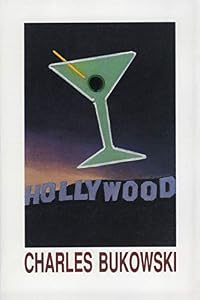
Charles Bukowski was born in Andernach, Germany, on August 16, 1920. He came to the United States with his parents when he was three years old and spent his early years in poverty. As a young man he was a transient, doing odd jobs. He lived most of his live in boarding houses in the Los Angeles area. He attended Los Angeles City College briefly. show more He worked for the United States Postal Service for about ten years. Bukowski was at home with street people and his work contains a brutal realism and graphic imagery. He began publishing short stories in the mid-1940s. Starting with Flower, Fist and Bestial Wail in 1959, he produced poetry collections almost once a year. His following had grown by the time his collection of poetry about down-and-outers titled It Catches My Heart in Its Hands appeared in 1963. His short story collections include Dirty Old Man and Ejaculations, Exhibitions and General Tales of Ordinary Madness. His novels, with an autobiographical character called Henry Chinaski, include Post Office and Factotum. Bukowski wrote the screenplay for the 1987 motion picture Barfly. He later wrote about the filming of Barfly in his novel, Hollywood. Bukowski died in San Pedro, California, on March 9, 1994. (Bowker Author Biography) show less
Some Editions
Series
Belongs to Publisher Series
Common Knowledge
- Original title
- Shakespeare Never Did This
- Original publication date
- 1979; 1995 (expanded) (expanded)
- People/Characters
- Charles Bukowski
- Important places
- Germany; Paris, France
- Related movies
- Koko: A Talking Gorilla (1978 | IMDb)
- First words
- First there was trouble with the French editor, Rodin, he said 2 tickets and then he said one ticket and then I said, all right, and I bought Linda Lee a ticket and then it was Saturday, the day of the flight and I phoned the... (show all) airport and they said, ye, I had a reservation but there was no prepaid ticket waiting for me.
- Last words
- (Click to show. Warning: May contain spoilers.)We were back in America and the meter ticked away and all I had to do was write it one more time.
Classifications
Statistics
- Members
- 324
- Popularity
- 97,839
- Reviews
- 6
- Rating
- (3.73)
- Languages
- 6 — English, French, German, Italian, Japanese, Spanish
- Media
- Paper, Ebook
- ISBNs
- 18
- ASINs
- 6