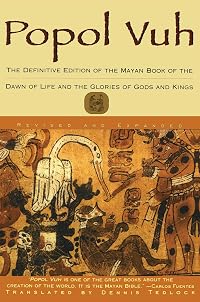
Popol Vuh
by Quiché Maya
On This Page
Description
Popol Vuh, the Quiché Mayan book of creation, is not only the most important text in the native languages of the Americas, it is also an extraordinary document of the human imagination. It begins with the deeds of Mayan gods in the darkness of a primeval sea and ends with the radiant splendor of the Mayan lords who founded the Quiché kingdom in the Guatemalan highlands. Originally written in Mayan hieroglyphs, it was transcribed into the Roman alphabet in the sixteenth century. This new show more edition of Dennis Tedlock's unabridged, widely praised translation includes new notes and commentary, newly translated passages, newly deciphered hieroglyphs, and over forty new illustrations. show lessTags
Recommendations

















Member Recommendations
CGlanovsky Creation myths and pantheons
Member Reviews
The Popol Vuh is a grand mytho-historical cycle, a reflection of an oral history, as told by the K’iche’, one branch of the Mayan peoples. The cycle starts with a creation myth and then continues with the Gods’ repeated failures to create humans, a series of Trickster Twins and their exploits among the Gods and in the underworld of Xibalba, the eventual creation of humans, and an increasingly historical listing of Mayan and allied communities and leaders, down to the eventual Conquest by the Spanish.
For anyone familiar with other grand mythological cycles (Greek, Norse, Hebrew), these stories follow a familiar pattern: a deep time that is highly allegorical and full of symbolism and larger-than-life heroes, and that becomes show more progressively anchored in history as the material approaches the present. As such the Popol Vuh reads like a distinctively Native-American variation on a familiar theme: a standardized history of the people, whose cultural practices have roots in deep time and the forces that shape the universe. Good stuff!
The edition I read was prepared and translated by Dennis Tedlock, and it is doubtlessly awe-inspiring. While the text is presented as a smooth, nicely-flowing narrative, the endnotes (whose pagecount surpasses that of the actual Popol Vuh) make apparent the translation difficulties and the cultural references, and provide insight in many of these items’ history in previous editions. Tedlock defends his editorial choices, compares editions and includes the necessary cultural background for an audience of laypeople and specialists. The whole thing must have been a massive undertaking, and Tedlock’s scrupulousness is admirable.
An exemplary edition of a fascinating cultural narrative belonging to a civilization now conquered and largely erased. show less
For anyone familiar with other grand mythological cycles (Greek, Norse, Hebrew), these stories follow a familiar pattern: a deep time that is highly allegorical and full of symbolism and larger-than-life heroes, and that becomes show more progressively anchored in history as the material approaches the present. As such the Popol Vuh reads like a distinctively Native-American variation on a familiar theme: a standardized history of the people, whose cultural practices have roots in deep time and the forces that shape the universe. Good stuff!
The edition I read was prepared and translated by Dennis Tedlock, and it is doubtlessly awe-inspiring. While the text is presented as a smooth, nicely-flowing narrative, the endnotes (whose pagecount surpasses that of the actual Popol Vuh) make apparent the translation difficulties and the cultural references, and provide insight in many of these items’ history in previous editions. Tedlock defends his editorial choices, compares editions and includes the necessary cultural background for an audience of laypeople and specialists. The whole thing must have been a massive undertaking, and Tedlock’s scrupulousness is admirable.
An exemplary edition of a fascinating cultural narrative belonging to a civilization now conquered and largely erased. show less
Popol Vuh-
The Mayan creation myths are not just entertaining to read, but provide a fascinating look at Mayan culture and history as well, through the dimly remembered prehistory of the people up until their conquest by the Spanish. Popol Vuh doesn’t merely sketch out a story of creation that occurred in the distant past, it links that creation all the way through the time of the European invasion of the Americas and the effective end of Mayan supremacy; it’s as if the Prose and Poetic Eddas were written while Ragnarok was happening, or if the Greek/Roman myth cycle lasted until the Pantheon was overthrown by the next generation of gods. These mythologies had a story to explain their end, but Popol Vuh is a mythology that lived to show more see its end.
Popol Vuh is especially interesting as a mythological text because it presents us with gods who are fallible from the beginning. It takes numerous attempts before they successfully make humanity, their failures sometimes surviving in other forms (animals) and other times just falling apart into dirt and mud (nicely illustrating the life lesson that sometimes mistakes can actually be productive, but sometimes they’re just a waste of your time and effort. Too many texts emphasize the first part while failing to grasp the second). If there’s a story where one of the Greek pantheon goes up to Hephaestus and says “please make me this thing” and Hephaestus answers “sorry, I have no idea how to do that” I’m not familiar with it. The Mayan gods are not all powerful either, and much of the first three parts of the text concern the efforts of the gods to outsmart the brutal lords of the underworld using their wits instead of overwhelming force. There is no Zeus equivalent here to thrash the enemies of the pantheon, instead creation and existence are a struggle even for the gods, who can lose contests and die when things don’t go their way. Man is presented as far closer to the divine in the Mayan myths than in most other myth systems, as man serves as the “knower” as well as the “recorder.” It is through man that the acts of the divine can be transcribed and the world understood.
There are numerous parallels in the Popol Vuh to other myths and religions- there’s a great flood, for instance, there’s a point where the divine saviors die and are reborn (though after five days, not three) and are more powerful than ever after death, there is a Babel-like segment where the gods fear the power of man and so they handicap them (though by reducing their sight, not by confusing their language), there’s even a Prometheus character here. The Mayan myths aren’t just lesser shadows of the Western myths, however, as throughout the text the Mayan myths feel alive and visceral in a way that I haven’t seen in a very long time. I read Ovid’s Metamorphoses earlier in the year, and though that is a masterfully constructed and excellently written text, it felt more like a literary endeavor than a work of passionate belief. Perhaps Ovid believed in the Roman gods, perhaps he believed in them quite strongly, but it is clear to me that he doesn’t see them in every sunrise, beneath every rock, living in every shadow and animal and house and ear of corn like the author of the Popol Vuh did. If you like reading mythology there are few if any books I would recommend more highly than the Popol Vuh, which is why I’m giving it five stars (only the second 5-star ranking I’ve given out of the 70 books I’ve read so far this year).
The Dennis Tedlock edition is wonderful. The extensive introduction summarizes the events of the main text, so you never have trouble understanding what’s going on. The extensive notes and glossary mean that not only will you be able to look up anything that you don’t understand or don’t remember, but you can also read about the linguistic nuances of the translation and see an analysis of how the Popol Vuh relates to the Mayan calendar. Finally the book is embellished by many pictures and images taken from Mayan artifacts and art, which help to make the story more vivid and the text feel more vital. I could not name a single way in which the text could be made better.
P.S. I have a theory that Tohil is a death god that somehow survived the earlier age and escaped the underworld slaughter done by Hunahpu and Xbalanque, given that Tohil is first introduced by a Xibalban messenger. Just an idea, but fun to think about. show less
The Mayan creation myths are not just entertaining to read, but provide a fascinating look at Mayan culture and history as well, through the dimly remembered prehistory of the people up until their conquest by the Spanish. Popol Vuh doesn’t merely sketch out a story of creation that occurred in the distant past, it links that creation all the way through the time of the European invasion of the Americas and the effective end of Mayan supremacy; it’s as if the Prose and Poetic Eddas were written while Ragnarok was happening, or if the Greek/Roman myth cycle lasted until the Pantheon was overthrown by the next generation of gods. These mythologies had a story to explain their end, but Popol Vuh is a mythology that lived to show more see its end.
Popol Vuh is especially interesting as a mythological text because it presents us with gods who are fallible from the beginning. It takes numerous attempts before they successfully make humanity, their failures sometimes surviving in other forms (animals) and other times just falling apart into dirt and mud (nicely illustrating the life lesson that sometimes mistakes can actually be productive, but sometimes they’re just a waste of your time and effort. Too many texts emphasize the first part while failing to grasp the second). If there’s a story where one of the Greek pantheon goes up to Hephaestus and says “please make me this thing” and Hephaestus answers “sorry, I have no idea how to do that” I’m not familiar with it. The Mayan gods are not all powerful either, and much of the first three parts of the text concern the efforts of the gods to outsmart the brutal lords of the underworld using their wits instead of overwhelming force. There is no Zeus equivalent here to thrash the enemies of the pantheon, instead creation and existence are a struggle even for the gods, who can lose contests and die when things don’t go their way. Man is presented as far closer to the divine in the Mayan myths than in most other myth systems, as man serves as the “knower” as well as the “recorder.” It is through man that the acts of the divine can be transcribed and the world understood.
There are numerous parallels in the Popol Vuh to other myths and religions- there’s a great flood, for instance, there’s a point where the divine saviors die and are reborn (though after five days, not three) and are more powerful than ever after death, there is a Babel-like segment where the gods fear the power of man and so they handicap them (though by reducing their sight, not by confusing their language), there’s even a Prometheus character here. The Mayan myths aren’t just lesser shadows of the Western myths, however, as throughout the text the Mayan myths feel alive and visceral in a way that I haven’t seen in a very long time. I read Ovid’s Metamorphoses earlier in the year, and though that is a masterfully constructed and excellently written text, it felt more like a literary endeavor than a work of passionate belief. Perhaps Ovid believed in the Roman gods, perhaps he believed in them quite strongly, but it is clear to me that he doesn’t see them in every sunrise, beneath every rock, living in every shadow and animal and house and ear of corn like the author of the Popol Vuh did. If you like reading mythology there are few if any books I would recommend more highly than the Popol Vuh, which is why I’m giving it five stars (only the second 5-star ranking I’ve given out of the 70 books I’ve read so far this year).
The Dennis Tedlock edition is wonderful. The extensive introduction summarizes the events of the main text, so you never have trouble understanding what’s going on. The extensive notes and glossary mean that not only will you be able to look up anything that you don’t understand or don’t remember, but you can also read about the linguistic nuances of the translation and see an analysis of how the Popol Vuh relates to the Mayan calendar. Finally the book is embellished by many pictures and images taken from Mayan artifacts and art, which help to make the story more vivid and the text feel more vital. I could not name a single way in which the text could be made better.
P.S. I have a theory that Tohil is a death god that somehow survived the earlier age and escaped the underworld slaughter done by Hunahpu and Xbalanque, given that Tohil is first introduced by a Xibalban messenger. Just an idea, but fun to think about. show less
I had NO idea what I was getting into with this. My fifteen-year-old had read about this book when he was researching some project for school, so when he saw it at the bookstore he got excited and said we should read it for family story time. Obviously I said yes.
So this is a verse translation of the Mayan epic origin story. Did I get absolutely stressed about probably mispronouncing ever single name in the story, despite how many times I looked them up? Yes. Did I have a surprising amount of fun reading mythic poetry out loud anyway? Absolutely yes! And the rest of the family enjoyed it, too!
So this is a verse translation of the Mayan epic origin story. Did I get absolutely stressed about probably mispronouncing ever single name in the story, despite how many times I looked them up? Yes. Did I have a surprising amount of fun reading mythic poetry out loud anyway? Absolutely yes! And the rest of the family enjoyed it, too!
Yet another book that makes me sound like a conspiracy theorist when I try to explain it to people. I think my favorite line I like to throw out is "and then his head got cut off, but they played basketball with it?".
All jokes aside, I originally read the human creation story and watched an analysis video about this for a class, and was struck by how the historians referred to this as the craziest mythology they had read, and thought that couldn't possibly be true.
Believe me, they weren't joking. Recall the amazing summary I threw out at the beginning of this review, and know that that is only the beginning.
For a bit of context, the Popol Vuh is both a compilation of Mayan history and mythology. It wasn't recorded until the Spanish show more came and decided the best way to destroy Mayan culture would be to write down their most important book, which is wild considering that is the sole reason why we still have these stories today.
If you've ever liked mythology (Percy Jackson fans I'm looking at you) and don't need it to be spoon fed to you through a fictionalized plot, give this book a chance. You'll thank me later when you're trying to explain to your loved ones why you shouldn't blindly reach into trees if it seems like they are talking to you, and that we really should be more wary of dentists. show less
All jokes aside, I originally read the human creation story and watched an analysis video about this for a class, and was struck by how the historians referred to this as the craziest mythology they had read, and thought that couldn't possibly be true.
Believe me, they weren't joking. Recall the amazing summary I threw out at the beginning of this review, and know that that is only the beginning.
For a bit of context, the Popol Vuh is both a compilation of Mayan history and mythology. It wasn't recorded until the Spanish show more came and decided the best way to destroy Mayan culture would be to write down their most important book, which is wild considering that is the sole reason why we still have these stories today.
If you've ever liked mythology (Percy Jackson fans I'm looking at you) and don't need it to be spoon fed to you through a fictionalized plot, give this book a chance. You'll thank me later when you're trying to explain to your loved ones why you shouldn't blindly reach into trees if it seems like they are talking to you, and that we really should be more wary of dentists. show less
The introduction and notes in the edition I read (ISBN 0671617710 ) were an excellent guide to a culture I am fairly ignorant of. Translator Dennis Tedlock did an great job at explaining the nuances of the cultural significance of the myths.
I found it particularly interesting that most of the stories in the Popol Vuh can be linked to specific astronomical/calendrical events. An incredibly complex and sophisticated world-view.
The journeys of the hero-gods into the underworld realm of Xibalba were both funny and horrifyingly grotesque at the same time. Though probably not as horrifying as the semi-historical section towards the end in which the mythic origins of human sacrifice are explained.
Tedlock very generously acknowledges the help show more he received from contemporary Quiché Maya practitioners, particularly Andrés Xiloj who initiated him as Daykeeper, one who is able to perform divinations using the 260-day ritual calendar of the Maya. show less
I found it particularly interesting that most of the stories in the Popol Vuh can be linked to specific astronomical/calendrical events. An incredibly complex and sophisticated world-view.
The journeys of the hero-gods into the underworld realm of Xibalba were both funny and horrifyingly grotesque at the same time. Though probably not as horrifying as the semi-historical section towards the end in which the mythic origins of human sacrifice are explained.
Tedlock very generously acknowledges the help show more he received from contemporary Quiché Maya practitioners, particularly Andrés Xiloj who initiated him as Daykeeper, one who is able to perform divinations using the 260-day ritual calendar of the Maya. show less
5 stars for the narrative itself, 3.5 for the fact that this "translation" by Michael Bazzett is more poetic license than actual translation. Unless I'm mistaken, as I understood Bazzett's description in the introduction, he doesn't speak Kʼicheʼ , so he relied on other people's notes to "translate" this. So while the end result is very engaging, I'm left feeling like I've just read someone's paraphrase of the Popol Vuh and not the real thing.
The narrative is incredibly interesting. I learned a lot about the Kʼicheʼ world view (at least as recorded by one Spanish priest centuries ago) and it makes me want to learn more.
The narrative is incredibly interesting. I learned a lot about the Kʼicheʼ world view (at least as recorded by one Spanish priest centuries ago) and it makes me want to learn more.
An entertaining read and a glimpse into the mythos of a culture and a people that collided with a stronger, albeit perhaps not better, worldview.
Members
- Recently Added By
Lists

100 Books to Read in a Lifetime (That Are Older Than 200 Years)
415 works; 175 members

Native American / Indigenous Literature
172 works; 100 members

Books written in uncommon languages
97 works; 8 members

Books Read in 2014
2,343 works; 89 members

Books About Non-Abrahamic Religions
98 works; 2 members
Author Information
2 Works 2,206 Members
Some Editions
Awards and Honors
Notable Lists
Series
Belongs to Publisher Series
Work Relationships
Has the adaptation
Inspired
Common Knowledge
- Canonical title
- Popol Vuh
- Alternate titles
- Popol Vuh: The Mayan Book of the Dawn of Life
- People/Characters*
- Hunab Ku; Hunahpú-Vuch; Ixbalanque; Vucub-Caquix; Tzacol; Bitol (show all 8); Alom; Qaholom
- Important places
- Guatemala; Xibalba; Quiché
- Epigraph
- Are 4u ua nuta4alibal, nupresenta
chiquiuach ri nantat, comon chuchkajauib
mu4hulic uleu, mu4hulic poklaj, mu4hulic bak. - First words
- The first four humans, the first four earthly beings who were truly articulate when they moved their feet and hands, their faces and mouths, and who could speak the very language of the gods, could also see everything under t... (show all)he sky and on the earth.
- Quotations
- He who makes an enemy of the Earth makes an enemy of his own body.
- (Preface: P.14)
Now it still ripples, now it still murmurs, ripples, it still sighs, still hums, and it is empty under the sky.
- (P.72) - Last words
- (Click to show. Warning: May contain spoilers.)There is the original book and ancient writing owned by the lords, now lost, but even so, everything has been completed here concerning Quiché, which is now named Santa Cruz.
- Original language
- Spanish; Quiché Maya
*Some information comes from Common Knowledge in other languages. Click "Edit" for more information.
Classifications
- Genres
- Nonfiction, Religion & Spirituality, History
- DDC/MDS
- 299.784 — Religion Other religions Shintoism/Taoism/Other Mythologies Of North American Origin Of Particular Peoples and Cultures Mesoamerican
- LCC
- F1465 .P813 — Local History of the United States, Canada and Latin America Latin America. Spanish America Guatemala
- BISAC
Statistics
- Members
- 2,204
- Popularity
- 9,192
- Reviews
- 31
- Rating
- (3.82)
- Languages
- 15 — Catalan, Danish, Dutch, English, Finnish, French, German, Greek, Italian, Mayan languages, Norwegian (Bokmål), Polish, Portuguese, Spanish, Swedish
- Media
- Paper, Audiobook, Ebook
- ISBNs
- 101
- UPCs
- 1
- ASINs
- 34
