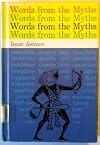
Words from the Myths
by Isaac Asimov
On This Page
Description
In dictionary format explanations are given for words derived from mythology that have found their way into the English language.Tags
Recommendations

















Member Reviews
A fine book and full of interesting connections. Sometimes I wonder, though, if the name of the mythical Greek entity was derived from a word for the thing, which then just becomes our word for the thing or something related. Asimov is a little sloppy about this.
He devotes a whole paragraph to the work of Henrietta Leavitt, because her analysis was on Cepheid variables and Cepheus was the father of Andromeda. Here we get to see all Asimov's interests, science, history, words come together. The book was published in 1961, so it's clear that Asimov was familiar with Leavitt's work, and so she was not totally unknown, even then. At the time, Asimov was teaching at Boston University, and Leavitt had worked at the Harvard observatory, so he show more may have had the advantage of the local connection. show less
He devotes a whole paragraph to the work of Henrietta Leavitt, because her analysis was on Cepheid variables and Cepheus was the father of Andromeda. Here we get to see all Asimov's interests, science, history, words come together. The book was published in 1961, so it's clear that Asimov was familiar with Leavitt's work, and so she was not totally unknown, even then. At the time, Asimov was teaching at Boston University, and Leavitt had worked at the Harvard observatory, so he show more may have had the advantage of the local connection. show less
Words From the Myths was apparently written for young adults, but Dr. Asimov made it interesting enough for older adults, too. Even if you already know the myths themselves, the many words included might come as a surprise. To give just one example, I'd never known that the old expression, 'By Jiminy,' was a corruption of 'By Gemini'. The introduction and each chapter has a small illustration that reminds me of photos of ancient Greek pottery.
Almost all of the myths used are Greek, and if they aren't, they're Roman. Norse myths get a brief mention as the source for most of the English names for days of the week. There's a separate index for the myths after the regular index, which is nice. I recommend this book for anyone interested in show more eponyms (words that come from names), or who just likes to learn new things. show less
Almost all of the myths used are Greek, and if they aren't, they're Roman. Norse myths get a brief mention as the source for most of the English names for days of the week. There's a separate index for the myths after the regular index, which is nice. I recommend this book for anyone interested in show more eponyms (words that come from names), or who just likes to learn new things. show less
Great book. A lot of interesting trivia, mixed with mithology, which i love. Cannot get any better.
FOR REFERENCE:
Contents: Introduction -- 1. The Beginning -- 2. The Titans -- 3. The Olympians -- 4. The Children of Zeus -- 5. Demigods and Monsters -- 6. Tales of Men -- 7. The Heroes -- 8. The Siege of Troy -- Epilogue -- General Index -- Mythological Index
Contents: Introduction -- 1. The Beginning -- 2. The Titans -- 3. The Olympians -- 4. The Children of Zeus -- 5. Demigods and Monsters -- 6. Tales of Men -- 7. The Heroes -- 8. The Siege of Troy -- Epilogue -- General Index -- Mythological Index
Ratings
Members
- Recently Added By
Lists

Books Read in 2015
3,299 works; 129 members
Author Information

Isaac Asimov was born in Petrovichi, Russia, on January 2, 1920. His family emigrated to the United States in 1923 and settled in Brooklyn, New York, where they owned and operated a candy store. Asimov became a naturalized U.S. citizen at the age of eight. As a youngster he discovered his talent for writing, producing his first original fiction at show more the age of eleven. He went on to become one of the world's most prolific writers, publishing nearly 500 books in his lifetime. Asimov was not only a writer; he also was a biochemist and an educator. He studied chemistry at Columbia University, earning a B.S., M.A. and Ph.D. In 1951, Asimov accepted a position as an instructor of biochemistry at Boston University's School of Medicine even though he had no practical experience in the field. His exceptional intelligence enabled him to master new systems rapidly, and he soon became a successful and distinguished professor at Columbia and even co-authored a biochemistry textbook within a few years. Asimov won numerous awards and honors for his books and stories, and he is considered to be a leading writer of the Golden Age of science fiction. While he did not invent science fiction, he helped to legitimize it by adding the narrative structure that had been missing from the traditional science fiction books of the period. He also introduced several innovative concepts, including the thematic concern for technological progress and its impact on humanity. Asimov is probably best known for his Foundation series, which includes Foundation, Foundation and Empire, and Second Foundation. In 1966, this trilogy won the Hugo award for best all-time science fiction series. In 1983, Asimov wrote an additional Foundation novel, Foundation's Edge, which won the Hugo for best novel of that year. Asimov also wrote a series of robot books that included I, Robot, and eventually he tied the two series together. He won three additional Hugos, including one awarded posthumously for the best non-fiction book of 1995, I. Asimov. "Nightfall" was chosen the best science fiction story of all time by the Science Fiction Writers of America. In 1979, Asimov wrote his autobiography, In Memory Yet Green. He continued writing until just a few years before his death from heart and kidney failure on April 6, 1992. (Bowker Author Biography) show less
Some Editions
Series
Belongs to Publisher Series
Ediciones de bolsillo (345)
Common Knowledge
- Canonical title
- Words from the Myths
- Original publication date
- 1961
- Important places
- Greece
- First words
- Human beings wouldn't be human if they didn't wonder about the world about them. [Introduction]
- Last words
- (Click to show. Warning: May contain spoilers.)Even if it ever happened that no one read the stories, our English language would still contain within its words the memory of those days of gods and heroes.
- Original language
- English
- Disambiguation notice
- Contents: Introduction -- 1. The Beginning -- 2. The Titans -- 3. The Olympians -- 4. The Children of Zeus -- 5. Demigods and Monsters -- 6. Tales of Men -- 7. The Heroes -- 8. The Siege of Troy -- Epilogue -- General Index -... (show all)- Mythological Index
Classifications
Statistics
- Members
- 280
- Popularity
- 114,752
- Reviews
- 4
- Rating
- (3.63)
- Languages
- Czech, English, Korean, Spanish
- Media
- Paper
- ISBNs
- 14
- ASINs
- 4