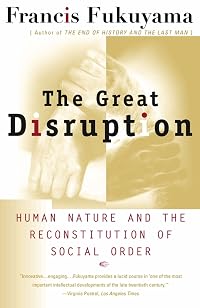
The Great Disruption: Human Nature and the Reconstitution of Social Order
by Francis Fukuyama
On This Page
Description
"The Great Disruption begins by observing that over the past thirty years, the United States and other developed countries have undergone a profound transformation from industrial to information societies; knowledge has replaced mass production as the basis of wealth, power, and social interaction. At the same time, Western societies have endured increasing levels of crime, massive changes in fertility and family structure, decreasing levels of trust, and the triumph of individualism over show more community. Just as the Industrial Revolution brought about momentous changes in society's moral values, a similar Great Disruption in our own time has caused profound changes in our social structure." "Drawing on the latest sociological data and new theoretical models from fields as diverse as economics and biology, Fukuyama reveals that even though the old order has broken apart, a new social order is already taking shape. Indeed, he suggests, the Great Disruption of the 1960s and 1970s may be giving way to a Great Reconstruction, as Western society weaves a new fabric of social and moral values appropriate to the changed realities of the postindustrial world."--Jacket. show lessTags
Recommendations


















Member Reviews
The main fault of this book is that it uses the 1950s as the index for a whole load of social indicators to show how the sixties more or less destroyed the social compact. But if you look at (at least) some of these social indicators, you find that the *fifties* were the outlier period. Just another demonstration of the lies, damn lies . . . . principle. Explaining why the fifties were an extraordinary period of stability might have made for an interesting book, but wouldn't have justified the present-day (socially conservative) policy initiatives Fukuyama clearly wants to agitate for. A fundamentally dishonest book.
Another one of those books looking for an audience by suggesting that we are living in times of great change. Really ? One Amazon reviewer called it "silly". Perhaps.
Ratings
Members
- Recently Added By
Lists

In Our Time books
4,934 works; 2 members
Author Information

66+ Works 8,164 Members
Yoshihiro Francis Fukuyama was born October 27, 1952 in the Hyde Park neighborhood of Chicago. Fukuyama received his Bachelor of Arts degree in classics from Cornell University, where he studied political philosophy under Allan Bloom. He initially pursued graduate studies in comparative literature at Yale University, going to Paris for six months show more to study under Roland Barthes and Jacques Derrida, but became disillusioned and switched to political science at Harvard University. There, he studied with Samuel P. Huntington and Harvey Mansfield, among others. He earned his Ph.D. in Political Science from Harvard for his thesis on Soviet threats to intervene in the Middle East. In 1979, he joined the global policy think tank RAND Corporation. Fukuyama was the Omer L. and Nancy Hirst Professor of Public Policy in the School of Public Policy at George Mason University from 1996 to 2000. Until July 10, 2010, he was the Bernard L. Schwartz Professor of International Political Economy and Director of the International Development Program at the Paul H. Nitze School of Advanced International Studies of Johns Hopkins University, located in Washington, D.C. He is now Olivier Nomellini Senior Fellow and resident in the Center on Democracy, Development, and the Rule of Law at the Freeman Spogli Institute for International Studies at Stanford University. Fukuyama is best known as the author of The End of History and the Last Man, in which he argued that the progression of human history as a struggle between ideologies is largely at an end, with the world settling on liberal democracy after the end of the Cold War and the fall of the Berlin Wall in 1989. Fukuyama predicted the eventual global triumph of political and economic liberalism. He has written a number of other books, among them Trust: The Social Virtues and the Creation of Prosperity and Our Posthuman Future: Consequences of the Biotechnology Revolution. His latest work The Origins of Political Order: From Prehistoric Times to the French Revolution made Publisher's Weekly Best Seller's List for 2011. (Bowker Author Biography) show less
Classifications
- Genres
- Sociology, Nonfiction, General Nonfiction, History, Economics, Philosophy, Politics and Government
- DDC/MDS
- 303.4 — Society, government, & culture Social sciences, sociology & anthropology Social processes Social change
- LCC
- HM851 .F85 — Social sciences Sociology (General) Sociology Social change
- BISAC
Statistics
- Members
- 377
- Popularity
- 83,047
- Reviews
- 2
- Rating
- (3.25)
- Languages
- 14 — Chinese, Czech, Dutch, English, Estonian, French, German, Hungarian, Indonesian, Italian, Polish, Portuguese, Spanish, Turkish
- Media
- Paper, Ebook
- ISBNs
- 22
- ASINs
- 4