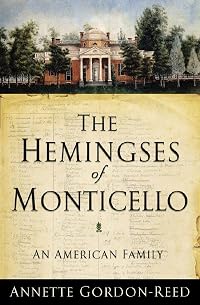
The Hemingses of Monticello: An American Family
by Annette Gordon-Reed
On This Page
Description
Historian and legal scholar Gordon-Reed presents this epic work that tells the story of the Hemingses, an American slave family, and their close blood ties to Thomas Jefferson.Tags
Recommendations




Member Reviews
A well researched but somewhat wordy overview of US chattel slavery in general with particulars paid to the Hemingses. Very well done.
The author does a wonderful job placing the enslaved and those who owned them in upfront, honest, no nonsense terms. She makes multiple references to white supremacy and points out how propaganda and stereotypes controlled how blacks were viewed both during slavery and today in the context of slavery.
I also enjoy the attention given to the racist quotes of John and Abigail Adams. They are much beloved 'abolitionists'. This serves as an excellent reminder that most white abolitionists were as racist as their slave owning counterparts.
Multiple sources are referenced and quoted. The research is clearly show more impeccable. I like that this biography defies many historical standards. US history is allowed to skip over much of the actual personhood of enslaved persons under the guise of 'no reliable info'. Yet, whole stories are pieced together from even less physical and written clues about pre-written history. Applying those same techniques to the lives of the enslaved members of this country is long overdue. Enslaved Peoples were people first and foremost having a human experience. Current history, largely written and maintained by white scholars has continued to silence the voices of the enslaved much like their ancestors.
I ultimately disagree with the author in the definition of sex vs rape. The author argues that we can't know how Sally felt about her relationship with Thomas. This is true. Yet it doesn't matter as to the facts of whether or not Thomas raped her. Sex is either consensual or it is rape. Enslaved person's are incapable of consenting to sex with those that owned, managed and had authority over them. We recognize that as violating consent today and for good reason. A doctor, therapist or professor has no business placing sexual demands on their patients or students. To do so is a terminatable offense for professors. Doctors and therapists can lose their license to practice. This safe guard is in place precisely because we recognize that positions of authority undermine free will in subordinates. As an enslaved person Sally had no grounds to refuse sex to her owner. Add in to the equation that she was a young teen he had watched grow up as well as his wife's unacknowledged sister and it's disturbing. Doesn't mean they didn't love each other. Doesn't mean she didn't choose to go to his bed herself. Just like a 14 year old can't use that argument to save a 47 year old sexual partner from being charged with statutory rape, at the least, that same argument does not absolve TJ in this instance. He was wrong and yes it colors his already tainted character as a slave owner.
The author has too romantic of a view of both Sally and TJ's relationship as well TJ himself. For his rank and class he isn't a bad example. None the less he owned human beings when he knew it was wrong. He did it because it was what was best for him. He is not a good man with flaws nor is he a 'man of his times'. Both sentiments ignore the humanity of the people he enslaved. No one who traded, subjugated and sold human beings as chattel can EVER be described as a good or even ok person. To pretend like it was ok because other members of their immediate times engaged in it is the worst sort of white fragility. First it ignores that as long as slavery existed as an institution, abolitionists existed. Meaning that slave owners absolutely had access to knowledge from contemporaries that their views were wrong. Also it ignores the actual humanity of the enslaved. Slave owners completely surrounded themselves with enslaved person's they did not fsil to see their humanity, they failed to acknowledge it. They didn't fail to acknowledge their humanity cognitively, as TJ's own writings suggest. Rather, they actively ignored their humanity under the belief that their needs were more important than those of the enslaved. Every time historians and modern americans reiterate this ridiculous and extremely white supremacist concept, they continue the path started by the white founders of this nation of discrediting and dismissing the humanity of black people. For the same reasons too, fragility and convenience. show less
The author does a wonderful job placing the enslaved and those who owned them in upfront, honest, no nonsense terms. She makes multiple references to white supremacy and points out how propaganda and stereotypes controlled how blacks were viewed both during slavery and today in the context of slavery.
I also enjoy the attention given to the racist quotes of John and Abigail Adams. They are much beloved 'abolitionists'. This serves as an excellent reminder that most white abolitionists were as racist as their slave owning counterparts.
Multiple sources are referenced and quoted. The research is clearly show more impeccable. I like that this biography defies many historical standards. US history is allowed to skip over much of the actual personhood of enslaved persons under the guise of 'no reliable info'. Yet, whole stories are pieced together from even less physical and written clues about pre-written history. Applying those same techniques to the lives of the enslaved members of this country is long overdue. Enslaved Peoples were people first and foremost having a human experience. Current history, largely written and maintained by white scholars has continued to silence the voices of the enslaved much like their ancestors.
I ultimately disagree with the author in the definition of sex vs rape. The author argues that we can't know how Sally felt about her relationship with Thomas. This is true. Yet it doesn't matter as to the facts of whether or not Thomas raped her. Sex is either consensual or it is rape. Enslaved person's are incapable of consenting to sex with those that owned, managed and had authority over them. We recognize that as violating consent today and for good reason. A doctor, therapist or professor has no business placing sexual demands on their patients or students. To do so is a terminatable offense for professors. Doctors and therapists can lose their license to practice. This safe guard is in place precisely because we recognize that positions of authority undermine free will in subordinates. As an enslaved person Sally had no grounds to refuse sex to her owner. Add in to the equation that she was a young teen he had watched grow up as well as his wife's unacknowledged sister and it's disturbing. Doesn't mean they didn't love each other. Doesn't mean she didn't choose to go to his bed herself. Just like a 14 year old can't use that argument to save a 47 year old sexual partner from being charged with statutory rape, at the least, that same argument does not absolve TJ in this instance. He was wrong and yes it colors his already tainted character as a slave owner.
The author has too romantic of a view of both Sally and TJ's relationship as well TJ himself. For his rank and class he isn't a bad example. None the less he owned human beings when he knew it was wrong. He did it because it was what was best for him. He is not a good man with flaws nor is he a 'man of his times'. Both sentiments ignore the humanity of the people he enslaved. No one who traded, subjugated and sold human beings as chattel can EVER be described as a good or even ok person. To pretend like it was ok because other members of their immediate times engaged in it is the worst sort of white fragility. First it ignores that as long as slavery existed as an institution, abolitionists existed. Meaning that slave owners absolutely had access to knowledge from contemporaries that their views were wrong. Also it ignores the actual humanity of the enslaved. Slave owners completely surrounded themselves with enslaved person's they did not fsil to see their humanity, they failed to acknowledge it. They didn't fail to acknowledge their humanity cognitively, as TJ's own writings suggest. Rather, they actively ignored their humanity under the belief that their needs were more important than those of the enslaved. Every time historians and modern americans reiterate this ridiculous and extremely white supremacist concept, they continue the path started by the white founders of this nation of discrediting and dismissing the humanity of black people. For the same reasons too, fragility and convenience. show less
I've been reading this book for so long (based on my last review here, 7 months?) that I am struggling to remember when I didn't know everything that was in it. I do recall that at the beginning I was brought up short by the author's straightforward references to Sally Hemings' children as Jefferson's, and by the end was annoyed picking up a different Jefferson biography that didn't do the same. This is a stupendous book that described a time and a place and a people so well that what I learned will just be part of me. I was most intrigued by Jefferson's relationships with Robert and James (much better documented by history than his relationship with Sally), and also by the holes in our knowledge of their lives, the stories that are show more lost to history. The author does a great job of showing you just how amazing and interesting their lives were, while highlighting the void left by the absence of their voices. I wanted more.
Notes:
(1) And I also wanted at least another chapter on the Hemingses post-Jefferson.
(2) I also wanted more on the role of overseers in the lives of the Hemings family. When James/Jamey Hemings was brutally beaten by an overseer, I was surprised, because the role of overseers in their lives had not been established.
(3) I liked the author's informed speculation of Sally Hemings' state of mind in Paris, and regretted the absence of such speculation once Sally returned to the U.S. OTOH, when she did speculate regarding the Hemingses in this later time period, I didn't tend to agree with her. She suggested that Sally may have felt deprived by not getting to name her own children, but isn't it just as likely that she was gratified by Jefferson's attention to them? Also, I did not agree with the author's speculation on James Hemings' state of mind when he died. The author suggests he regretted turning down the opportunity to work at the White House, but isn't it just as likely that he didn't want to fall back into the subservience of being at Jefferson's beck and call, and used the request for Jefferson to write him directly as a way to wiggle out of Jefferson's expectation without directly snubbing him?
(4) The last book I read before this happened to be The Keepers of the House, a 1964 novel set in the South, and it interested me how much the world in Jefferson's time had in common with the fictional lives in the novel. The rich white man kept a black woman as his wife, had children with her, everyone in the neighborhood knew about it, but nobody cared as long as he didn't openly acknowledge his wife or children. His white daughter pretended his children came out of the ether. His white granddaughter saw his estate as hers even though it should have been theirs. When his mixed race children came of age, he sent each of them away to live as white. These relationships were common in both time periods. About 125 years later, and so much was the same. show less
Notes:
(1) And I also wanted at least another chapter on the Hemingses post-Jefferson.
(2) I also wanted more on the role of overseers in the lives of the Hemings family. When James/Jamey Hemings was brutally beaten by an overseer, I was surprised, because the role of overseers in their lives had not been established.
(3) I liked the author's informed speculation of Sally Hemings' state of mind in Paris, and regretted the absence of such speculation once Sally returned to the U.S. OTOH, when she did speculate regarding the Hemingses in this later time period, I didn't tend to agree with her. She suggested that Sally may have felt deprived by not getting to name her own children, but isn't it just as likely that she was gratified by Jefferson's attention to them? Also, I did not agree with the author's speculation on James Hemings' state of mind when he died. The author suggests he regretted turning down the opportunity to work at the White House, but isn't it just as likely that he didn't want to fall back into the subservience of being at Jefferson's beck and call, and used the request for Jefferson to write him directly as a way to wiggle out of Jefferson's expectation without directly snubbing him?
(4) The last book I read before this happened to be The Keepers of the House, a 1964 novel set in the South, and it interested me how much the world in Jefferson's time had in common with the fictional lives in the novel. The rich white man kept a black woman as his wife, had children with her, everyone in the neighborhood knew about it, but nobody cared as long as he didn't openly acknowledge his wife or children. His white daughter pretended his children came out of the ether. His white granddaughter saw his estate as hers even though it should have been theirs. When his mixed race children came of age, he sent each of them away to live as white. These relationships were common in both time periods. About 125 years later, and so much was the same. show less
Gordon-Reed, Annette. The Hemingses of Monticello: An American Family. Norton, 2008.
Annette Gordon-Reed has written the best history of the Hemings family that likely will ever be written. It is meticulously researched and carefully nuanced in its assessments and conclusions about the motives and feelings of Jefferson and his enslaved blended family. Sarah Hemings, called Sally, was the half-sister of Thomas Jefferson’s wife. In her early teens, she and her older brother were brought to Paris to join the widowed Jefferson’s household as a servant to his daughter Polly. He broke French law by not registering them as slaves. At some point during her 26-month stay in Paris, Sally became pregnant with Jefferson’s child. By the time show more they returned to America, slavery had been abolished in Revolutionary France. She and her brother could have stayed in France and thus escaped slavery, but both returned to Virginia under conditions they seem to have negotiated with Jefferson. Jefferson agreed to free her children when they turned 21. She was 16. He was 46. We know what they did, but we must guess at the emotional context of their decisions. How much self-interest, self-deception, and rational thinking were involved? The historical record is silent. But Gordon-Reed’s depiction of the lives of many members of the Hemings family suggests that they were for the most part intelligent, rational people who made the best decisions they could under conditions that gave them little agency. Jefferson, on the other hand, seems to have been afraid to lose people close to him. Slavery made it possible for him to feed the self-indulgent and self-absorbed sides of the personality, no matter the moral conflict. show less
Annette Gordon-Reed has written the best history of the Hemings family that likely will ever be written. It is meticulously researched and carefully nuanced in its assessments and conclusions about the motives and feelings of Jefferson and his enslaved blended family. Sarah Hemings, called Sally, was the half-sister of Thomas Jefferson’s wife. In her early teens, she and her older brother were brought to Paris to join the widowed Jefferson’s household as a servant to his daughter Polly. He broke French law by not registering them as slaves. At some point during her 26-month stay in Paris, Sally became pregnant with Jefferson’s child. By the time show more they returned to America, slavery had been abolished in Revolutionary France. She and her brother could have stayed in France and thus escaped slavery, but both returned to Virginia under conditions they seem to have negotiated with Jefferson. Jefferson agreed to free her children when they turned 21. She was 16. He was 46. We know what they did, but we must guess at the emotional context of their decisions. How much self-interest, self-deception, and rational thinking were involved? The historical record is silent. But Gordon-Reed’s depiction of the lives of many members of the Hemings family suggests that they were for the most part intelligent, rational people who made the best decisions they could under conditions that gave them little agency. Jefferson, on the other hand, seems to have been afraid to lose people close to him. Slavery made it possible for him to feed the self-indulgent and self-absorbed sides of the personality, no matter the moral conflict. show less
A very detailed and meticulously researched account of the family of Sally Hemings, the infamous enslaved mistress of Thomas Jefferson. The entire extended family of Sally is described in all the known detail we have. The complex and corrupt family relationships that slavery created is excruciatingly examined. Finally, the character of Jefferson is much examined and analyzed. The deft and self-aware way in which he manages his life, public image, and legacy is carefully dissected.
The most interesting part of this book for me was the realization of just how many of his own in-laws Jefferson owned. The Hemingses were a prolific family and many of them came to Monticello to serve their half-brother in-law. Sally herself make the strategic show more decision to become Jefferson's mistress because he promised her and her children certain things. Much of his family served him their whole life only to be jilted in his will because of his poor financial dealings and his anxieties about how his decisions might be perceived.
This is a grim story about the ethical warping that will result under the reign of slavery. I thought it was very informative, but the author's style is a bit dry and prosaic at times. show less
The most interesting part of this book for me was the realization of just how many of his own in-laws Jefferson owned. The Hemingses were a prolific family and many of them came to Monticello to serve their half-brother in-law. Sally herself make the strategic show more decision to become Jefferson's mistress because he promised her and her children certain things. Much of his family served him their whole life only to be jilted in his will because of his poor financial dealings and his anxieties about how his decisions might be perceived.
This is a grim story about the ethical warping that will result under the reign of slavery. I thought it was very informative, but the author's style is a bit dry and prosaic at times. show less
Well, I don’t like Jefferson any better after this book, a painstaking reconstruction of what’s known about the Hemings family at Monticello, starting with Sally Hemings’ mother and continuing through several generations of Hemingses. The book could have been profitably shortened—because so little documentary evidence remains (some having been deliberately destroyed by Jefferson’s family, and some apparently having been carefully not created in the first place), a lot of times Gordon-Reed ends up speculating about, e.g., what a young woman far from home and far from older family members might have felt, courted by a man who enjoyed charming people and having his life be conflict-free. Gordon-Reed says that Sally and her show more brother, who could have stayed in France as free blacks, returned with Jefferson after a promise from Jefferson that he’d free Sally’s children and her brother, but she doesn’t make clear whether this promise is known from a family tradition or just inferred from subsequent events. I was also really interested in the fact that several of Sally’s children left Monticello and “passed” by adopting a white identity (which actually would have been legally theirs before Virginia’s anti-black laws became even more vicious and adopted the one-drop rule) that required them to break off contact with the remaining Hemingses—the focus on Monticello makes it hard to ask “what happened then?” show less
The first thing to understand about this book is that it is not just a story about Thomas Jefferson and Sally Hemings, nor is it in fact focused on Jefferson, although he naturally plays a large role in this history. The author took the opportunity provided by Jefferson’s fame and record-keeping to profile a slave family, the Hemingses, because accounts about the lives of slaves in early America are few and far between. As many as 70 members of the Hemings family lived in slavery at Monticello over five generations.
It begins with Elizabeth Hemings, the daughter of an enslaved black mother and a free white father. Elizabeth and her mother came into the ownership of John Wayles when Wayles married Martha Eppes in 1746. After the death show more of his third wife, John Wayles took his slave Elizabeth Hemings as his mistress, and was the father of six of her children. Sarah (Sally) Hemings was one of their daughters. The mixed-race children of John Wayles were kept in slavery. Virginia had a number of laws to ensure this rule obtained.
The Virginia House of Burgesses was called upon in the late 1600’s to answer the question of “whether children got by an Englishman upon a Negro woman should be slave or free” on account of challenges to enslaved status by mulattos (people of mixed race). Their response was to turn English law upside down by reaching back to an archaic Roman rule, partus sequitur ventrem (you are what your mother was). That is, Virginia passed laws establishing that the legal status of the mother, not the father, as stipulated in Britain, determined the legal status of the child. The author explains that this change from British law ensured that white masters could retain the value of "increase" when these female slaves gave birth, because as long as the child's mother was a slave, it wouldn't matter who the father was. Masters could therefore continue to exploit the popular option of using female slaves for sex without having to worry that this would cause them to lose their "property." [Other states, particularly in the South, quickly followed suit. Further laws were passed to ensure that even "one drop" of "black blood" made the difference between slavery and freedom. You can read more about the history of the "one drop rule" (and its uniqueness to the U.S.) here.]
The legal degradation of blacks played a “useful” role in uniting the country as well. The sore point of inequalities of class, initially the cause of greatest tensions in the colonies, was superseded as the prime dividing line for status within the colony when race entered the picture: “Instead, poor whites, encouraged by the policies of the elites, took refuge in their whiteness and the dream that one day they, too, could become slave owners, though only a relative handful could ever hope to amass the land, wealth, and social position of the most prominent member of the Virginia gentry…”. (As historian Keri Leigh Merritt observes: "Throughout American history, the economic elite have used vile forms of racism to perpetuate the current hierarchy — politically, socially and economically. White supremacy is most commonly conceptualized as a way for lower-class whites to feel socially superior to people from other ethnic backgrounds.")
Before long, “whiteness” came to signify the superiority of one socially and legally defined population over others, while simultaneously inculcating notions that character, intelligence, and other traits were associated with whiteness or non-whiteness. Thomas Jefferson himself contributed to that idea with his Notes on the State of Virginia, a book written by him in 1781, and updated and enlarged in 1782 and 1783. While the book also discussed Virginia’s natural resources and economy, it is remembered today primarily for Jefferson’s observations about slavery, miscegenation, and his beliefs that whites and blacks could not live together in a free society. Jefferson said he thought blacks were inferior to whites in terms of beauty (he cites such “superior” traits in whites as “flowing hair”) and reasoning intelligence. (He observes, for example, “They are at least as brave, and more adventuresome. But this may perhaps proceed from a want of forethought, which prevents their seeing a danger till it be present.”). But as Gordon-Reed often has cause to point out, the “public” and “rhetorical” Jefferson was quite a different man than the private Jefferson. The author sardonically observes: "White supremacy does not demand deep conviction. Ruthless self interests, not sincere belief, is the signature feature..."
In fact in private, Jefferson had a long-standing relationship (38 years) with a mixed-race woman, Sally Hemings, who was, as noted above, Elizabeth Hemings’s daughter by a white father. (Elizabeth Hemings and her children arrived at Monticello around 1774 as part of Jefferson’s inheritance from his father-in-law, John Wayles.) Sally (a nickname for Sarah), bore seven children by Jefferson, four of whom survived to adulthood, over the course of their liaison. Since Elizabeth herself was half white, Sally was one-fourth white, and by all accounts quite a beauty, “in spite of” (or because of) her part-black ancestry. Sally was also the half-sister of Jefferson’s wife, Martha Wayles. When Martha married Jefferson, John Wayles had already died, and the whole Hemings family had moved with Martha to Monticello. Jefferson and Martha had two daughters that survived, and Sally became their ladies’ maid. Portentously, when Jefferson went overseas to serve as United States ambassador to pre-revolutionary France, he wanted his daughters to follow him, and Sally came along as a companion. But Jefferson’s daughters went away to attend a boarding school outside of Paris. Sally, then around 14, and Jefferson, in his early forties, began a sexual affair. [While this sounds egregious to us, “the age of consent in eighteenth-century Virginia was ten.”] By the time Jefferson was ready to return to the U.S., Sally was pregnant.
The author explains how it was that Sally forwent the opportunity of freedom she could have had by staying in France. Rather, she opted (if that word even applies to a slave who was a young, impressionable, and inexperienced girl, not to mention one who was pregnant) to come back to Virginia with Jefferson, having apparently extracted a promise from him that their children would be freed when they came of age. [The author suggests that because Jefferson was both self-indulgent, ambitious, and anxious to make his mark on America without any mark on his reputation, Sally had a bit of “power” over Jefferson at that point since an affair with a slave would have sullied his image in America.] And note: the only promise she could apparently get was not that their children be freed immediately, but only at the age of 21. Sally herself could not be freed since "interbreeding" between whites and free blacks was illegal but having sex with a “slave” was not, and it seems Jefferson wanted to continue their "arrangement." [As the author observes, as long as white men did not try to elevate slaves and the children they had with them to the “status” of white people or bestow upon them the privileges of whites, they were left alone to do with their “property” as they pleased.] But again, allegedly, Jefferson agreed to treat Sally well.
The book is about more than Sally, however, and the author also goes into great detail about the other Hemings of Monticello, including the children Sally had with Jefferson, three of whom, being only one-eighth black, could apparently pass for white. While Jefferson was meticulous in recording even the smallest detail about most things and most slaves, including most Hemingses, his records are also notable for their omissions. The legacy-conscious Jefferson left out any information about Sally. When he had cause to refer to their children, it was only obliquely with no names, a markedly different practice than he used otherwise. His documentation of the minutiae of his life except as noted above allows us to know a great deal about the rest of this slave family.
There is no way to know whether the alleged affection and loyalty shown by slaves to Jefferson was genuine, but both his presence and his absence had serious consequences for them. As long as he lived, he endeavored to keep the Hemingses together and in a somewhat privileged position (vis-a-vis other slaves) at Monticello. But within six months of his death on July 4, 1826, the contents of Monticello and 130 slaves, including Hemingses, were auctioned off.
The slaves themselves had no control over who was sold, who purchased them, or where they went and for what purposes. Family members were separated to the great heartache of those affected. This included the Hern family. David Hern Sr. performed a multitude of tasks during his 50 years at Monticello. He was a skilled woodworker and wheelwright. His son, David Hern Jr., was a wagoner who made regular solo trips to transport goods between Monticello and Washington during Jefferson’s presidency. Nevertheless, after Jefferson’s death, David Hern and his 34 surviving children and grandchildren were sold. Similarly, Joseph Fossett and his wife Edith served as the blacksmith and head cook at Monticello, respectively. Jefferson freed Joseph Fossett in his will, but Edith and seven of their children were sold.
This fact reminds us of an important point stressed throughout the book by the author. In spite of Jefferson’s relative “laxness” regarding his slaves, they were never totally free in any sense, because they were at all times living in a slave society under a regime of white supremacy. Thus “slavery was more than just the relationship between an individual master and an individual slave. The entire white community was involved in maintaining the institution and the racial rules that grew up around it…. ”
(At the same time, as the author also shows, “The profanity of slavery does not define the entirety of lives of enslaved people.”)
Sally Hemings was 53 at the time Jefferson died. It was thought her disposition was made in oral requests by Jefferson, still loathe to mention her specifically in any document. Jefferson’s daughter Martha, who possibly had a great resentment for Sally ever since Jefferson took her as his “concubine,” granted Sally her “time” 8 years after Jefferson’s death. This was a way to grant freedom without formal emancipation, which would force the person to leave the state. (Martha did however permit Sally to leave Monticello after Jefferson died to go live with their sons in Charlottesville.]. Why did Martha wait 8 years? It is unclear. Thomas Jefferson did free all of Sally Hemings's children: Beverly and Harriet were allowed to leave Monticello in 1822; Madison and Eston were released in Jefferson's 1826 will.
The Monticello website reports:
“[Sally’s] son Madison told a newspaperman in 1873 that ‘shortly after’ Jefferson's death he and his brother Eston, who both had been freed in Jefferson's will, took their mother to live in Charlottesville with them. Sally Hemings had not been freed in the will, yet she appeared with Madison Hemings as a free person of color in a special census in 1833 (and the census of 1830 also suggests she was considered free). In a superseded will of 1834, Jefferson's daughter Martha Randolph wrote that ‘to Betsy Hemmings, Sally & Wormley I wish my children to give their time. If liberated they would be obliged to leave the state of Virginia.’ This was probably a written reinforcement of a previous verbal arrangement. If it was made at Jefferson's recommendation before his death, no document has been found to confirm it.”
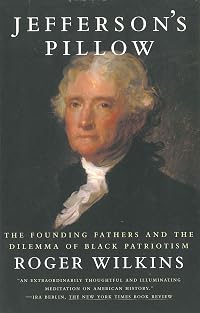
While, as stated previously, this book was not meant to be primarily about Jefferson, we get an excellent look at the man behind the legend from this story. As Roger Wilkins wrote in Jefferson’s Pillow: “He was a dizzying mixture of searing brilliance and infuriating self-indulgence, of idealism and base racism, of soaring patriotism and myopic self-involvement. He was America writ small.”
Ironically, however, Annette Gordon-Reed paints Jefferson in rather a more positive light than other recent historians. While she mentions that he didn't like to lose on any issue, she also emphasizes how much he disliked conflict, almost suggesting he would "give in" rather than have disagreement be a part of his life. She thereby downplays his consistent record of using often vicious tactics by operating sub rosa through lackeys to destroy the careers and lives of anyone and everyone who disagreed with him. One could see him using every aspect of this trait to bend Sally to his will.
The author wants to confer agency on Sally, but the entire time she was his mistress, she did, after all, continue to serve as his slave, in addition to being pregnant almost continuously when he was in town. She moreover was relegated to a hidden room in Monticello, while Jefferson's daughter served as the mistress of the estate.
Discussion: The Hemings and Jefferson family trees are a bit hard to follow, through no fault of the author’s. It seems there were a limited number of names in use by these intertwined families (in part because naming each other in honor of other family members was practiced). Besides having the same names, they had nicknames which bore no logical relationships to the names themselves. Access to charts detailing, for example, which Martha was which, is helpful. The hard copy of the book has a chart, and you can see a small portion of one below.
Evaluation:This is an excellent and detailed recounting of the complex nature and legacy of someone who was not only a seminal figure in the history of America, but the author of the founding credo “All men are created equal.” It explores the interrelationships between the man who wrote this, and the slaves he owned. It is also a story of slave family in greater detail than we often have access to; a story that has so many elements of tragedy, even while revealing occasional moments of triumph and joy.
Students of American history should not avoid this book because of its length. I found it consistently engaging and full of riveting details about the early years of America that are critical to understanding what our country was then, and what it has become. show less
It begins with Elizabeth Hemings, the daughter of an enslaved black mother and a free white father. Elizabeth and her mother came into the ownership of John Wayles when Wayles married Martha Eppes in 1746. After the death show more of his third wife, John Wayles took his slave Elizabeth Hemings as his mistress, and was the father of six of her children. Sarah (Sally) Hemings was one of their daughters. The mixed-race children of John Wayles were kept in slavery. Virginia had a number of laws to ensure this rule obtained.
The Virginia House of Burgesses was called upon in the late 1600’s to answer the question of “whether children got by an Englishman upon a Negro woman should be slave or free” on account of challenges to enslaved status by mulattos (people of mixed race). Their response was to turn English law upside down by reaching back to an archaic Roman rule, partus sequitur ventrem (you are what your mother was). That is, Virginia passed laws establishing that the legal status of the mother, not the father, as stipulated in Britain, determined the legal status of the child. The author explains that this change from British law ensured that white masters could retain the value of "increase" when these female slaves gave birth, because as long as the child's mother was a slave, it wouldn't matter who the father was. Masters could therefore continue to exploit the popular option of using female slaves for sex without having to worry that this would cause them to lose their "property." [Other states, particularly in the South, quickly followed suit. Further laws were passed to ensure that even "one drop" of "black blood" made the difference between slavery and freedom. You can read more about the history of the "one drop rule" (and its uniqueness to the U.S.) here.]
The legal degradation of blacks played a “useful” role in uniting the country as well. The sore point of inequalities of class, initially the cause of greatest tensions in the colonies, was superseded as the prime dividing line for status within the colony when race entered the picture: “Instead, poor whites, encouraged by the policies of the elites, took refuge in their whiteness and the dream that one day they, too, could become slave owners, though only a relative handful could ever hope to amass the land, wealth, and social position of the most prominent member of the Virginia gentry…”. (As historian Keri Leigh Merritt observes: "Throughout American history, the economic elite have used vile forms of racism to perpetuate the current hierarchy — politically, socially and economically. White supremacy is most commonly conceptualized as a way for lower-class whites to feel socially superior to people from other ethnic backgrounds.")
Before long, “whiteness” came to signify the superiority of one socially and legally defined population over others, while simultaneously inculcating notions that character, intelligence, and other traits were associated with whiteness or non-whiteness. Thomas Jefferson himself contributed to that idea with his Notes on the State of Virginia, a book written by him in 1781, and updated and enlarged in 1782 and 1783. While the book also discussed Virginia’s natural resources and economy, it is remembered today primarily for Jefferson’s observations about slavery, miscegenation, and his beliefs that whites and blacks could not live together in a free society. Jefferson said he thought blacks were inferior to whites in terms of beauty (he cites such “superior” traits in whites as “flowing hair”) and reasoning intelligence. (He observes, for example, “They are at least as brave, and more adventuresome. But this may perhaps proceed from a want of forethought, which prevents their seeing a danger till it be present.”). But as Gordon-Reed often has cause to point out, the “public” and “rhetorical” Jefferson was quite a different man than the private Jefferson. The author sardonically observes: "White supremacy does not demand deep conviction. Ruthless self interests, not sincere belief, is the signature feature..."
In fact in private, Jefferson had a long-standing relationship (38 years) with a mixed-race woman, Sally Hemings, who was, as noted above, Elizabeth Hemings’s daughter by a white father. (Elizabeth Hemings and her children arrived at Monticello around 1774 as part of Jefferson’s inheritance from his father-in-law, John Wayles.) Sally (a nickname for Sarah), bore seven children by Jefferson, four of whom survived to adulthood, over the course of their liaison. Since Elizabeth herself was half white, Sally was one-fourth white, and by all accounts quite a beauty, “in spite of” (or because of) her part-black ancestry. Sally was also the half-sister of Jefferson’s wife, Martha Wayles. When Martha married Jefferson, John Wayles had already died, and the whole Hemings family had moved with Martha to Monticello. Jefferson and Martha had two daughters that survived, and Sally became their ladies’ maid. Portentously, when Jefferson went overseas to serve as United States ambassador to pre-revolutionary France, he wanted his daughters to follow him, and Sally came along as a companion. But Jefferson’s daughters went away to attend a boarding school outside of Paris. Sally, then around 14, and Jefferson, in his early forties, began a sexual affair. [While this sounds egregious to us, “the age of consent in eighteenth-century Virginia was ten.”] By the time Jefferson was ready to return to the U.S., Sally was pregnant.
The author explains how it was that Sally forwent the opportunity of freedom she could have had by staying in France. Rather, she opted (if that word even applies to a slave who was a young, impressionable, and inexperienced girl, not to mention one who was pregnant) to come back to Virginia with Jefferson, having apparently extracted a promise from him that their children would be freed when they came of age. [The author suggests that because Jefferson was both self-indulgent, ambitious, and anxious to make his mark on America without any mark on his reputation, Sally had a bit of “power” over Jefferson at that point since an affair with a slave would have sullied his image in America.] And note: the only promise she could apparently get was not that their children be freed immediately, but only at the age of 21. Sally herself could not be freed since "interbreeding" between whites and free blacks was illegal but having sex with a “slave” was not, and it seems Jefferson wanted to continue their "arrangement." [As the author observes, as long as white men did not try to elevate slaves and the children they had with them to the “status” of white people or bestow upon them the privileges of whites, they were left alone to do with their “property” as they pleased.] But again, allegedly, Jefferson agreed to treat Sally well.
The book is about more than Sally, however, and the author also goes into great detail about the other Hemings of Monticello, including the children Sally had with Jefferson, three of whom, being only one-eighth black, could apparently pass for white. While Jefferson was meticulous in recording even the smallest detail about most things and most slaves, including most Hemingses, his records are also notable for their omissions. The legacy-conscious Jefferson left out any information about Sally. When he had cause to refer to their children, it was only obliquely with no names, a markedly different practice than he used otherwise. His documentation of the minutiae of his life except as noted above allows us to know a great deal about the rest of this slave family.
There is no way to know whether the alleged affection and loyalty shown by slaves to Jefferson was genuine, but both his presence and his absence had serious consequences for them. As long as he lived, he endeavored to keep the Hemingses together and in a somewhat privileged position (vis-a-vis other slaves) at Monticello. But within six months of his death on July 4, 1826, the contents of Monticello and 130 slaves, including Hemingses, were auctioned off.
The slaves themselves had no control over who was sold, who purchased them, or where they went and for what purposes. Family members were separated to the great heartache of those affected. This included the Hern family. David Hern Sr. performed a multitude of tasks during his 50 years at Monticello. He was a skilled woodworker and wheelwright. His son, David Hern Jr., was a wagoner who made regular solo trips to transport goods between Monticello and Washington during Jefferson’s presidency. Nevertheless, after Jefferson’s death, David Hern and his 34 surviving children and grandchildren were sold. Similarly, Joseph Fossett and his wife Edith served as the blacksmith and head cook at Monticello, respectively. Jefferson freed Joseph Fossett in his will, but Edith and seven of their children were sold.
This fact reminds us of an important point stressed throughout the book by the author. In spite of Jefferson’s relative “laxness” regarding his slaves, they were never totally free in any sense, because they were at all times living in a slave society under a regime of white supremacy. Thus “slavery was more than just the relationship between an individual master and an individual slave. The entire white community was involved in maintaining the institution and the racial rules that grew up around it…. ”
(At the same time, as the author also shows, “The profanity of slavery does not define the entirety of lives of enslaved people.”)
Sally Hemings was 53 at the time Jefferson died. It was thought her disposition was made in oral requests by Jefferson, still loathe to mention her specifically in any document. Jefferson’s daughter Martha, who possibly had a great resentment for Sally ever since Jefferson took her as his “concubine,” granted Sally her “time” 8 years after Jefferson’s death. This was a way to grant freedom without formal emancipation, which would force the person to leave the state. (Martha did however permit Sally to leave Monticello after Jefferson died to go live with their sons in Charlottesville.]. Why did Martha wait 8 years? It is unclear. Thomas Jefferson did free all of Sally Hemings's children: Beverly and Harriet were allowed to leave Monticello in 1822; Madison and Eston were released in Jefferson's 1826 will.
The Monticello website reports:
“[Sally’s] son Madison told a newspaperman in 1873 that ‘shortly after’ Jefferson's death he and his brother Eston, who both had been freed in Jefferson's will, took their mother to live in Charlottesville with them. Sally Hemings had not been freed in the will, yet she appeared with Madison Hemings as a free person of color in a special census in 1833 (and the census of 1830 also suggests she was considered free). In a superseded will of 1834, Jefferson's daughter Martha Randolph wrote that ‘to Betsy Hemmings, Sally & Wormley I wish my children to give their time. If liberated they would be obliged to leave the state of Virginia.’ This was probably a written reinforcement of a previous verbal arrangement. If it was made at Jefferson's recommendation before his death, no document has been found to confirm it.”
While, as stated previously, this book was not meant to be primarily about Jefferson, we get an excellent look at the man behind the legend from this story. As Roger Wilkins wrote in Jefferson’s Pillow: “He was a dizzying mixture of searing brilliance and infuriating self-indulgence, of idealism and base racism, of soaring patriotism and myopic self-involvement. He was America writ small.”
Ironically, however, Annette Gordon-Reed paints Jefferson in rather a more positive light than other recent historians. While she mentions that he didn't like to lose on any issue, she also emphasizes how much he disliked conflict, almost suggesting he would "give in" rather than have disagreement be a part of his life. She thereby downplays his consistent record of using often vicious tactics by operating sub rosa through lackeys to destroy the careers and lives of anyone and everyone who disagreed with him. One could see him using every aspect of this trait to bend Sally to his will.
The author wants to confer agency on Sally, but the entire time she was his mistress, she did, after all, continue to serve as his slave, in addition to being pregnant almost continuously when he was in town. She moreover was relegated to a hidden room in Monticello, while Jefferson's daughter served as the mistress of the estate.
Discussion: The Hemings and Jefferson family trees are a bit hard to follow, through no fault of the author’s. It seems there were a limited number of names in use by these intertwined families (in part because naming each other in honor of other family members was practiced). Besides having the same names, they had nicknames which bore no logical relationships to the names themselves. Access to charts detailing, for example, which Martha was which, is helpful. The hard copy of the book has a chart, and you can see a small portion of one below.
Evaluation:This is an excellent and detailed recounting of the complex nature and legacy of someone who was not only a seminal figure in the history of America, but the author of the founding credo “All men are created equal.” It explores the interrelationships between the man who wrote this, and the slaves he owned. It is also a story of slave family in greater detail than we often have access to; a story that has so many elements of tragedy, even while revealing occasional moments of triumph and joy.
Students of American history should not avoid this book because of its length. I found it consistently engaging and full of riveting details about the early years of America that are critical to understanding what our country was then, and what it has become. show less
Such an important and yet strange Pulitzer prize winning book, as the voice of the main protagonist, Sally Hemmings, is absent. Very little has been told about her, but it seems that the author has included everything ever printed or said. The reader misses her terribly.
However, this is a most rewarding challenge of a history book. It's very long. There are many duplicate names and generations. But the writing is so beautiful, with both separation from and involvement with, due to the lack of information and the passing of time. It is a ground-breaking masterpiece.
What I learned and/or appreciated:
- "the lowliest indentured servant was encouraged to identify with their white masters while distancing themselves from the blacks with whom show more they worked" - not really news to anyone, but what a way to express it!
- "Americans have lived with the universe...where the humanity, family integrity, and honor of slave owners counted for more than...those of slaves."
- " In England you "were" what your father "was". In the rules of slavery, Virginians adopted the Roman rule partus sequitur ventrem, which says you are what your MOTHER was." So as to make children of enslaved women the property of their father-masters.
-"Mulattoes" comes from the Spanish word for "mule" - meaning the offspring of a horse and a donkey." Although, unlike mules, who are sterile, the so named mulattoes could reproduce, to the benefit of the slave owners.
- "Slave traders were generally looked down on in Virginian society" - pretty ironic, huh?
- "Planter indebtedness to British merchants grew to such enormous heights that some scholars suggest that it was the chief catalyst for the Virginia colony breaking away from the British Empire." - hmmm - so much for liberty or death.
- "As late as the 1950s, some newspapers in southern states refused to apply the honorific "Mrs" to legally married black women." - so when racists tell people to "just get over" slavery, cite this one!
- "Robert and James Hemmings were the sons of the man who gave Jefferson his fortune, and the half brothers to his wife. In a world with any degree of morality, these young men...would have had a share of that fortune." - so much for being born on second base with a silver spoon.
All in all, Jefferson is given his full due, both as a brilliant thinker and as a cruel enslaver. As more and more of these revealing narratives come out, the founding fathers look like villains rather than heroes, just as it should be. BLACK LIVES MATTER.
- show less
However, this is a most rewarding challenge of a history book. It's very long. There are many duplicate names and generations. But the writing is so beautiful, with both separation from and involvement with, due to the lack of information and the passing of time. It is a ground-breaking masterpiece.
What I learned and/or appreciated:
- "the lowliest indentured servant was encouraged to identify with their white masters while distancing themselves from the blacks with whom show more they worked" - not really news to anyone, but what a way to express it!
- "Americans have lived with the universe...where the humanity, family integrity, and honor of slave owners counted for more than...those of slaves."
- " In England you "were" what your father "was". In the rules of slavery, Virginians adopted the Roman rule partus sequitur ventrem, which says you are what your MOTHER was." So as to make children of enslaved women the property of their father-masters.
-"Mulattoes" comes from the Spanish word for "mule" - meaning the offspring of a horse and a donkey." Although, unlike mules, who are sterile, the so named mulattoes could reproduce, to the benefit of the slave owners.
- "Slave traders were generally looked down on in Virginian society" - pretty ironic, huh?
- "Planter indebtedness to British merchants grew to such enormous heights that some scholars suggest that it was the chief catalyst for the Virginia colony breaking away from the British Empire." - hmmm - so much for liberty or death.
- "As late as the 1950s, some newspapers in southern states refused to apply the honorific "Mrs" to legally married black women." - so when racists tell people to "just get over" slavery, cite this one!
- "Robert and James Hemmings were the sons of the man who gave Jefferson his fortune, and the half brothers to his wife. In a world with any degree of morality, these young men...would have had a share of that fortune." - so much for being born on second base with a silver spoon.
All in all, Jefferson is given his full due, both as a brilliant thinker and as a cruel enslaver. As more and more of these revealing narratives come out, the founding fathers look like villains rather than heroes, just as it should be. BLACK LIVES MATTER.
- show less
Members
- Recently Added By
Published Reviews
ThingScore 92
...this is an excellent book. Worth buying if you have any interest in the families of Virginia even free families of color from Virginia because so many of Sally’s children apparently passed into the white community and disappeared, like some of my own family members. The abuse from the press that poor Sally was subjected to at the time by Jefferson’s enemies is terrible to read about, show more but the empathy and the sympathy the author uses in reconstructing Thomas Jefferson’s life, and his inevitable dilemma around this relationship, really moved me. ... show less
added by ShiraDest
The Hemingses of Monticello is a brilliant book. It marks the author as one of the most astute, insightful, and forthright historians of this generation. Not least of Annette Gordon-Reed's achievements is her ability to bring fresh perspectives to the life of a man whose personality and character have been scrutinized, explained, and justified by a host of historians and biographers.... While show more praising her grasp of the sources, her legal acuity, her erudition, and the stylishness of her narrative, it remains to be said that her great achievement lies in telling this story. Because it is one of the stories that really matter. show less
Engrossing and suggestive, it is also repetitive (we are frequently reminded that the law does not necessarily reflect social reality) and filled with unnecessary pronouncements about human nature (e.g., “Youth in females has attracted men in all eras across all cultures”). Readers will find it absorbing, but many will wish it had been a shorter, more focused book.
added by Shortride
Lists

Must-Read Books by Black Authors
114 works; 92 members

Pulitzer Prize for History
16 works; 2 members

Ten books that most shaped your view of history
91 works; 12 members

Black Authors
384 works; 32 members

Thomas Jefferson Books
43 works; 1 member

BLM
210 works; 1 member

2008-2012 Notable Books for Adults
127 works; 10 members

Books Read in 2021
5,361 works; 114 members

Works Cited in The History of White People by Nell Irvin Painter
321 works; 2 members

el
1,139 works; 1 member

Schomburg Centennial Reading List
100 works; 4 members
Author Information

11+ Works 3,314 Members
Annette Gordon-Reed grew up in east Texas. She majored in History at Dartmouth College, graduating in 1981, and then attended Harvard Law School. Gordon-Reed worked as an associate at Cahill Gordon & Reindel and was Counsel to the New York City Board of Corrections before becoming a professor of law at New York Law School in 1992. Gordon-Reed show more wrote the book Thomas Jefferson and Sally Hemings: An American Controversy after first becoming interested in the president as a child. She co-authored Vernon Can Read!: A Memoir and wrote Race on Trial: Law and Justice in American History. Gordon-Reed is the author of the New York Times bestseller The Hemingses of Monticello. (Bowker Author Biography) show less
Some Editions
Awards and Honors
Awards
Distinctions
Notable Lists
Common Knowledge
- Original title
- The Hemingses of Monticello: An American Family
- Original publication date
- 2008-09-17
- People/Characters
- Thomas Jefferson; Sally Hemings; Martha Jefferson; Abigail Adams; John Adams; Thomas Bell (show all 26); Critta Hemings Bowles; Betty Brown; James Callender; Burwell Colbert; Maria Cosway; Maria Jefferson Eppes; Joseph Fossett; Betty Hemings; James Hemings; James Madison Hemings; John Hemings; Martin Hemings; Robert Hemings; William Beverly Hemings; James Madison; Adrien Petit; Martha Jefferson Randolph; Thomas Mann Randolph; George Washington; John Wayles
- Important places
- Monticello, Virginia, USA; Hôtel de Langeac
- Epigraph
- So the beginning of this was a woman...
-- Zora Neale Hurston,
Their Eyes Were Watching God - Dedication
- To my husband, Robert Reed, and our daughter, Susan Jean Gordon Reed, and our son, Gordon Penn Reed
- First words
- Elizabeth Hemings began life when America was still a colonial possession. She lived through the Revolution in the home of one of the men who helped make it and died during the formative years of the American Republic, an un... (show all)known person in the midst of pivotal events in national and world history.
- Last words
- (Click to show. Warning: May contain spoilers.)That we remember them today is the best and most fitting tribute to the no doubt terrified and unknown African who arrived on the shores of Virginia so many years ago to begin this family's saga.
- Blurbers
- Morgan, Edmund S.; Ellis, Joseph J.; Lewis, David Levering; Blight, David W.; Onuf, Peter; Franklin, John Hope
- Original language
- English
Classifications
- Genres
- History, General Nonfiction, Nonfiction, Biography & Memoir
- DDC/MDS
- 973.460922 — History & geography History of North America United States Constitutional period (1789-1809) XYZ Affair, Quasi-War, Alien and Sedition Acts Biographies
- LCC
- E332.74 .G67 — History of the United States United States Revolution to the Civil War, 1775/1783-1861 By period 1789-1809. Constitutional period Jefferson's administrations, 1801-1809
- BISAC
Statistics
- Members
- 1,505
- Popularity
- 15,371
- Reviews
- 37
- Rating
- (3.92)
- Languages
- English
- Media
- Paper, Audiobook, Ebook
- ISBNs
- 14
- ASINs
- 13