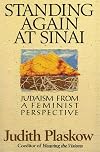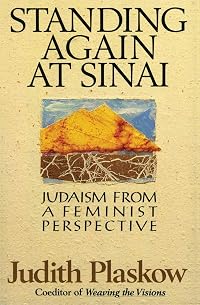
Standing Again at Sinai: Judaism from a Feminist Perspective
by Judith Plaskow
On This Page
Description
A feminist critique of Judaism as a patriarchal tradition and an exploration of the increasing involvement of women in naming and shaping Jewish tradition.Tags
Recommendations

















Member Reviews
Plaskow's central thesis (with which I agree) is that Jewish tradition is fundamentally male centered and rooted in patriarchal culture, and she does a good job of showing how--from the texts, to halakha, to the very language we use.
What this does, however, is define negative space. We can see what is missing--the language and narratives of women's experience. What we do not know is what should fill it. The evidence we do have of women's religious practice in the past, such as the tkhines she references, show only what women might have added (in this case to the liturgy), not how they have related to the existing text. Plaskow has a variety of ideas, but at times, she risks essentializing women's experience, such as her questioning of show more women's relationship to law or motherhood.
This book was written in 1988 (per the foreword; published in 1990) and as such, is a little dated (the section on women's relationships with the modern state of Israel is notably so, but to be honest, not getting caught up in the politics of that issue is not a bad thing). Plaskow is upfront about her own biases, which is helpful, but nonetheless, more traditionally observant women may find it difficult to relate to her Reform-turned-women's havurah suggestions.
Despite this critique--I found myself disagreeing frequently--I recommend this book to anyone interested in Jewish feminism, including the Orthodox. She forces you to examine how you view Jewish text and tradition and how you might define that space for women in Jewish history. You may shake your head and laugh at language about the Goddess, or her (somewhat slapdash) treatment of how rabbinic Judaism is only the survivor, not the only branch of Judaism. But you'll have to think about your answers. show less
What this does, however, is define negative space. We can see what is missing--the language and narratives of women's experience. What we do not know is what should fill it. The evidence we do have of women's religious practice in the past, such as the tkhines she references, show only what women might have added (in this case to the liturgy), not how they have related to the existing text. Plaskow has a variety of ideas, but at times, she risks essentializing women's experience, such as her questioning of show more women's relationship to law or motherhood.
This book was written in 1988 (per the foreword; published in 1990) and as such, is a little dated (the section on women's relationships with the modern state of Israel is notably so, but to be honest, not getting caught up in the politics of that issue is not a bad thing). Plaskow is upfront about her own biases, which is helpful, but nonetheless, more traditionally observant women may find it difficult to relate to her Reform-turned-women's havurah suggestions.
Despite this critique--I found myself disagreeing frequently--I recommend this book to anyone interested in Jewish feminism, including the Orthodox. She forces you to examine how you view Jewish text and tradition and how you might define that space for women in Jewish history. You may shake your head and laugh at language about the Goddess, or her (somewhat slapdash) treatment of how rabbinic Judaism is only the survivor, not the only branch of Judaism. But you'll have to think about your answers. show less
Densely written book that I had trouble deciphering at times. A sample sentence that addresses some of Plaskow's topics: "A spirituality that emerges out of the vision and sometime reality of diverse, egalitarian communities, that knows God as present within---not above---community as its binder, sustainer, and goad, can nourish and is nourished by the critique and transformation of all structures of oppression." [page 234] OK, I think I understand this, after reading it a few times.
What impressed me most, as I understand it, was that after the destruction of the Second Temple, the rabbis of that time reimagined Jewish history so that Rabbinic Judaism was seen as having always existed: for example, Abraham kept kosher. Thus, there was show more continuity with the past and not a major disruption: Jews could continue being Jews, even after their primary way of connecting to God---sacrifices---was no longer possible. Plaskow's point is that if the rabbis back then could do this, then Jewish feminists now can do something similar and add the missing stories of women and feminist concepts to Jewish tradition.
She doesn't like the use of masculine pronouns or masculine attributes for God. It is not enough to change "king" to "sovereign" or "ruler;" our relationship with God should be one of partnership; God dominating people leads people to feel unable to act on their own. Another problem with God only described with masculine qualities is that men see themselves as godlike and women become "other" and less-than in the eyes of men and perhaps also in their own eyes.
There is a lot more in the book, which is an early and now classic work on Jewish feminist theology.
A picky point: the notes, at the end of the book, are important and relevant to the text, but it's annoying to flip back and forth, and I eventually gave up doing it.
BTW, this book can be found on Sefaria.org (as of March 2026). show less
What impressed me most, as I understand it, was that after the destruction of the Second Temple, the rabbis of that time reimagined Jewish history so that Rabbinic Judaism was seen as having always existed: for example, Abraham kept kosher. Thus, there was show more continuity with the past and not a major disruption: Jews could continue being Jews, even after their primary way of connecting to God---sacrifices---was no longer possible. Plaskow's point is that if the rabbis back then could do this, then Jewish feminists now can do something similar and add the missing stories of women and feminist concepts to Jewish tradition.
She doesn't like the use of masculine pronouns or masculine attributes for God. It is not enough to change "king" to "sovereign" or "ruler;" our relationship with God should be one of partnership; God dominating people leads people to feel unable to act on their own. Another problem with God only described with masculine qualities is that men see themselves as godlike and women become "other" and less-than in the eyes of men and perhaps also in their own eyes.
There is a lot more in the book, which is an early and now classic work on Jewish feminist theology.
A picky point: the notes, at the end of the book, are important and relevant to the text, but it's annoying to flip back and forth, and I eventually gave up doing it.
BTW, this book can be found on Sefaria.org (as of March 2026). show less
Reevaluation of women's role in Judaism by professor of Religious Studies. Topics include Torah, Israel, God, new theology of sexuality
Ratings
Members
- Recently Added By
Lists

Jewish Books
367 works; 24 members
Author Information

18+ Works 1,552 Members
Awards and Honors
Common Knowledge
- Original publication date
- 1990
- Epigraph
- What do we want for our sons? ... We Want them... to discover new ways of being men even as we are discovering new ways of being women.
-- Adrienne Rich, "Of Woman Born" - Dedication
- To my son, Alexander Gideon Plaskow Goldenberg
- First words
- The need for a feminist Judaism begins with hearing silence.
- Last words
- (Click to show. Warning: May contain spoilers.)As we work toward the creation of a feminist Judaism as part of a larger struggle toward a more just world, we place our small piece in a mosaic that will finally provide a new pattern—a new religious and social order.
Classifications
- Genres
- Religion & Spirituality, Nonfiction, Sexuality and Gender Studies, General Nonfiction
- DDC/MDS
- 296.082 — Religion Other religions Judaism Judaism Culture Studies
- LCC
- BM729 .W6 .P55 — Philosophy, Psychology and Religion Judaism Judaism Practical Judaism Jewish way of life. Spiritual life. Mysticism. Personal
- BISAC
Statistics
- Members
- 463
- Popularity
- 66,152
- Reviews
- 4
- Rating
- (3.88)
- Languages
- Dutch, English
- Media
- Paper
- ISBNs
- 3