On This Page
Description
Conceptual design, along with need identification and analysis, make up the initial stage of the design process. Need analysis transforms the often vague statement of a design task into a set of design requirements. Conceptual design encompasses the generation of concepts and integration into system-level solutions, leading to a relatively detailed design. This 2001 book is devoted to the crucial initial stage of engineering design. In particular, it focuses on parameter analysis, a show more methodology that leads the user through the design process, helping to identify critical issues (parameters) of the design and propose configuration-specific solutions. To illustrate the principles discussed, the authors present numerous examples and a variety of real-world case studies. The emphasis throughout is on innovation. This useful text will appeal to advanced undergraduate and graduate students, as well as practising engineers, architects, and product development managers. show lessTags
Recommendations
















Member Reviews
The Incompleat Enchanter is just right: fun without descending into Piers Anthony smugness; short enough to sustain interest in its simple stories; and written with enough skill to excuse the retrograde gender and other clangers that occasionally drop. Vintage sword-and-sorcery from the early, pulp days of the genre, this is a tasty glimpse into a lot of modern fantasy's antecedents.
Harold Shea is an unconventional psychologist, bored of his hum-drum existence and craving adventure. When he and his professor discover a "mathematics of magic" that will allow them to teleport into the legends of yore, Shea jumps at the opportunity. Before you can say "zounds!", Shea finds himself first in the world of Norse myth, and then to Spenser's show more Faerie Queene. Evil sorcerers, powerful gods, noble knights and of course dashing damsels follow.
I enjoyed this book. It's not perfect, by any means, but given its publication date (1940) and seminal status, I'm willing to forgive a lot. The audience for these novellas was originally teenage boys buying Weird Tales and the like, and I think it's pretty much perfect for that audience, even now over seventy years later. Impressive.
Don't misunderstand; The Incompleat Enchanter is not breath-takingly contemporary in the way that some of Howard's stories are; the novellas are definitely a product of their times. But personally I found this added to some of its camp appeal.
Spratt and De Camp's stories are definitely not required reading for the discerning fantasy fan, but they do make for a fun weekend. show less
Harold Shea is an unconventional psychologist, bored of his hum-drum existence and craving adventure. When he and his professor discover a "mathematics of magic" that will allow them to teleport into the legends of yore, Shea jumps at the opportunity. Before you can say "zounds!", Shea finds himself first in the world of Norse myth, and then to Spenser's show more Faerie Queene. Evil sorcerers, powerful gods, noble knights and of course dashing damsels follow.
I enjoyed this book. It's not perfect, by any means, but given its publication date (1940) and seminal status, I'm willing to forgive a lot. The audience for these novellas was originally teenage boys buying Weird Tales and the like, and I think it's pretty much perfect for that audience, even now over seventy years later. Impressive.
Don't misunderstand; The Incompleat Enchanter is not breath-takingly contemporary in the way that some of Howard's stories are; the novellas are definitely a product of their times. But personally I found this added to some of its camp appeal.
Spratt and De Camp's stories are definitely not required reading for the discerning fantasy fan, but they do make for a fun weekend. show less
The first two in a series of five novellas written by de Camp and Pratt. Titles of the available collections can get complicated, so here's the quick overview (and I'm not even going to try to sort out the correct touchstones for the different volumes):
The Incomplete Enchanter (1941) includes "The Roaring Trumpet" and "The Mathematics of Magic." The Castle of Iron (1950) is a novel-length expansion of a novella originally published in 1941. Those three stories were collected in 1975 as The Compleat Enchanter. The remaining stories, "Wall of Serpents" (1953) and "The Green Magicians" (1954) were collected in 1960 as Wall of Serpents. All five are gathered The Complete Compleat Enchanter (1989).
After Pratt's death in 1956, de Camp was show more reluctant to continue the series, believing that he could not recreate the collaborative magic on his own. He was eventually persuaded to return to the series in the 1990s, when he wrote two additional stories and allowed several other authors to write stories, some of them based on his outlines. Those stories are gathered in two collections, The Enchanter Reborn (1992) and The Exotic Enchanter (1995). One additional story by Lawrence Watt-Evans appears in a 2005 anthology of stories written in tribute to de Camp. There is no single-volume collection of the entire series.
So what are all of these stories? They are the adventures of Harold Shea, a psychologist journeying into various fictional and mythological worlds of fantasy, where he finds that his logical mind isn't always helpful. In this volume, he travels into the worlds of Norse mythology ("The Roaring Trumpet") and Spenser's The Faerie Queene ("The Mathematics of Magic").
I chose to pick up this particular combination of stories because these are the two stories included in my master list of award-nominated SF stories; both are Retro Hugo nominated novellas. I went in knowing that this sort of fantasy is not my cuppa, and these stories in particular are very much not written for someone who's not into fantasy. De Camp and Pratt do not spend a lot of time on exposition about the worlds to which Harold and his colleagues travel; it is assumed that the reader comes in with a basic knowledge of Norse mythology and Spenser's poem.
I could sort of stumble through the Norse story with my Marvel Comics level of knowledge. I at least know who Odin, Thor, and Loki are, and have some vague sense of Ragnarok as an apocalyptic event. But by the time the third or fourth different set of giants show up, all of them with indistinguishable Nordic names (the letter "j" pops up in so many places where the letter "j" has no business being...), I was floundering. And I know nothing about Spenser, so most of that story was incomprehensible to me.
If you like this sort of thing, though, I think you might enjoy these stories. The prose is a touch old-fashioned, but doesn't have the heavy clumsiness that you often find in SF and fantasy of this era. And in the chapters set in our world, the banter among Harold and his colleagues zips along with a crisp energy that made me understand why some critics refer to these tales as "screwball fantasy."
Even when I was lost about the story in the fantasy worlds, I could tell that certain plot points or bits of dialogue would be funny or poignant or ominous if only I had the knowledge to appreciate them.
So I'm left with a weird critical reaction: I think these are probably good stories, even if I don't have the background to appreciate or enjoy them. show less
The Incomplete Enchanter (1941) includes "The Roaring Trumpet" and "The Mathematics of Magic." The Castle of Iron (1950) is a novel-length expansion of a novella originally published in 1941. Those three stories were collected in 1975 as The Compleat Enchanter. The remaining stories, "Wall of Serpents" (1953) and "The Green Magicians" (1954) were collected in 1960 as Wall of Serpents. All five are gathered The Complete Compleat Enchanter (1989).
After Pratt's death in 1956, de Camp was show more reluctant to continue the series, believing that he could not recreate the collaborative magic on his own. He was eventually persuaded to return to the series in the 1990s, when he wrote two additional stories and allowed several other authors to write stories, some of them based on his outlines. Those stories are gathered in two collections, The Enchanter Reborn (1992) and The Exotic Enchanter (1995). One additional story by Lawrence Watt-Evans appears in a 2005 anthology of stories written in tribute to de Camp. There is no single-volume collection of the entire series.
So what are all of these stories? They are the adventures of Harold Shea, a psychologist journeying into various fictional and mythological worlds of fantasy, where he finds that his logical mind isn't always helpful. In this volume, he travels into the worlds of Norse mythology ("The Roaring Trumpet") and Spenser's The Faerie Queene ("The Mathematics of Magic").
I chose to pick up this particular combination of stories because these are the two stories included in my master list of award-nominated SF stories; both are Retro Hugo nominated novellas. I went in knowing that this sort of fantasy is not my cuppa, and these stories in particular are very much not written for someone who's not into fantasy. De Camp and Pratt do not spend a lot of time on exposition about the worlds to which Harold and his colleagues travel; it is assumed that the reader comes in with a basic knowledge of Norse mythology and Spenser's poem.
I could sort of stumble through the Norse story with my Marvel Comics level of knowledge. I at least know who Odin, Thor, and Loki are, and have some vague sense of Ragnarok as an apocalyptic event. But by the time the third or fourth different set of giants show up, all of them with indistinguishable Nordic names (the letter "j" pops up in so many places where the letter "j" has no business being...), I was floundering. And I know nothing about Spenser, so most of that story was incomprehensible to me.
If you like this sort of thing, though, I think you might enjoy these stories. The prose is a touch old-fashioned, but doesn't have the heavy clumsiness that you often find in SF and fantasy of this era. And in the chapters set in our world, the banter among Harold and his colleagues zips along with a crisp energy that made me understand why some critics refer to these tales as "screwball fantasy."
Even when I was lost about the story in the fantasy worlds, I could tell that certain plot points or bits of dialogue would be funny or poignant or ominous if only I had the knowledge to appreciate them.
So I'm left with a weird critical reaction: I think these are probably good stories, even if I don't have the background to appreciate or enjoy them. show less
I had a good time when I encountered this pair of novellas. Dr. harold shea tries out a logical formula...and it almost works. having prepared for the Celtic corpus of "The Cattle raid of Cooley', he gets the heroes and Gods of Asgard instead. In many ways it is the most unfantastic of fantasy classics. Though later embodied as part of "The complete compleat enchanter" the original pair of stories embody the charm that any later additions try to continue.
The first of the ‘D’ challenge books. This one is a bit of a cheat as these stories weren’t written by one writer, but two. They were the result of a long term collaboration by friends and fellow authors; L. Sprague De Camp and Fletcher Pratt. Fletcher Pratt is best known in SFF circles for his work on the Harold Shea Incompleat Enchanter stories. He unfortunately passed away at the tragically young age of 59, just as his books had begun to hit the best seller lists. L. (Lyon) Sprague De Camp had a 60 year long career as a writer, spanning over 100 books, he was best known for his sword and sorcery novels and this collaboration with Pratt, the World Science Fiction Society awarded him the title of Grand Master in 1976, he won a show more Hugo in 1997 for his autobiography and won the Nebula as a Grandmaster in 1978.
People tend to think that ‘funny’ fantasy began with Terry Pratchett, however De Camp and Pratt predate the great British author by around 40 years, they began working on the Harold Shea stories in 1940.
Harold Shea is an occasionally reckless and generally eccentric pyschologist. He comes up with a form of mathematical magic which he believes can transport him from this world into ages of myth and magic. In The Roaring Trumpet he begins by trying to send himself to the Ireland of Cuchulainn and Queen Maev, but instead finds himself in Asgard rubbing shoulders with Odin, Thor, Loki and Heimdall.
One thing that was a little disconcerting was how long it took for Harold; he appeared to have a strong working knowledge of a number of well known mythologies, to work out where he was, despite knowing what Odin was supposed to look like and even after hearing the name Heimdall, he still didn’t work it out until it was spelled out to him.
Harold has the great misfortune to arrive in Asgard not long before Ragnarok and accompanies his godly companions, and their servant Thjalfi on a quest to reclaim Thor’s hammer and Frey’s sword from the giants. The depiction of the gods was very much as anyone with a decent knowledge of the myths would expect, however the giants were different. They looked and acted like the warlike barbaric characters they are, but they spoke using a mid 20th century American slang. I have to admit that I quite liked this innovation. Harold manages to use his psychological knowledge and his modern day sensibilities to get himself and his companions out of a number of scrapes and finds his way back to his own world and time just before Ragnarok really kicks in.
It’s a fun romp and a very promising start to what became a classic series.
The second of Harold Shea’s adventures; The Mathematics of Magic takes place directly after his unexpected journey to the Asgard.
Harold tells best friend and colleague Reed Chalmers about what happened and how. Initially Reed thinks Harold is mad, but goes along with it to humour Harold before realising that the theory behind what the younger man did is at least sound. Harold still wants to visit the Ireland that he tried for the first time, but Reed convinces him to instead shoot for the world of Spenser’s epic poem; The Fairie Queen. This time, possibly because Reed is helping Harold, they get to their intended destination.
I’m nowhere near as familiar with the world of The Faerie Queen as I was with Norse mythology, so a lot of what Reed and Harold saw was new to me. It seemed a little fresher, definitely funnier and better written all around. It may have been that De Camp and Pratt were more comfortable with what they’d created the second time around.
The story improved with Reed along for the ride, it gave Harold someone to talk to and bounce things off. Reed also tends to counsel his younger friend and prevent him from making ill considered moves that could have disastrous consequences for all concerned. I’m not sure who’s idea it was to include the program for the wizard’s convention in this, but that had me laughing out loud. It was expertly done and a nice dig at conventions in general.
Reed decided to stay in the world with Florimel and Harold inadvertently got transported back, taking the object of his affection; Belphebe, with him. It will be interesting to see Belphebe make the transaction from 15th century epic poem warrior woman to 20th century girl about town.
One criticism is Harold’s treatment of Gertude Mugler. Gertrude works with Harold and his friends Reed Chalmers and Walter Bayard. Gertrude appears to carry a bit of a torch for Harold, she was the one who hired a private detective to investigate his disappearance when he went missing one his first adventure, and yet Harold dismisses her when he speaks about her and quite happily flaunts Belphebe in front of her at the end of The Mathematics of Magic. Maybe I’ve read it wrong, but Harold needs a smack for that behaviour.
The third of the Harold Shea adventures: Castle of Iron, begins with Harold being quizzed by the police about the disappearance of his wife Belphebe. Harold is convinced that she’s somehow been sorcerously removed from our realm and so is his other colleague and friend Walter Bayard, however Gert reported the incident to the authorities. Hell hath no fury like a woman scorned, eh Harold?
Before things can get too unpleasant for our hero, he, one of the policemen, Walter Bayard and another colleague Vaclav ‘Votsy’ Polacek, also known as the Rubber Czech, are whisked off to the court of Kubla Khan as imagined by Samuel Taylor Coleridge in his epic poem. While Harold is trying to work out how this happened and get back to his own world he and Votsy are removed from the court and find themselves in another realm. At least this one has two familiar faces in it; Harold’s good friend Reed Chalmers and Reed’s lady love Florimel from the Faerie Queen.
Apparently Reed had an issue with Florimel. She’s made of snow and won’t last unless they can find a way to make her enchantment as a lady more permanent. In order to accomplish this Reed has transported himself and Florimel to the land of Orlando Furioso as that is not dissimilar to the Faerie Queen. In fact Orlando Furioso is believed to have inspired Spenser’s epic work. In doing this Reed also managed to remove Belphebe as the character of Belphegor is analogous to that of Belphebe. He brought Harold along for extra assistance and Vaclav was a total accident.
I wasn’t greatly impressed by this installment. I wasn’t familiar with the work, but that didn’t present a problem with the Faerie Queen and De Camp and Pratt take significant liberties with the source. To the best of my knowledge the Astolph or Astolfo in Orlando Furioso was not an adventuring English duke with knowledge of this world’s 20th century, nor was he a friend of Merlin’s. I felt that this one was a little formulaic. Harold is transported to a fictional world, he uses his psychological knowledge to personal advantage and amazes the inhabitants with his knowledge of sword play, gets in and out of scrapes by the skin of his teeth and often does it in the most incredible of ways. It may be that I’ve read a number of works inspired by these ones and it’s become a bit tired to me. The other problem was Votsy. He was the stereotypical socially awkward, sex obsessed nerd. There didn’t seem to be much of a reason to have him there really. He may have been included as comedy relief, but I found him irritating and hope he doesn’t reappear.
The Wall of Serpents finds Harold and his lady love Belphebe adjusting to married life in modern day Ohio, however they are concerned about their friend, the laid back Walter Bayard and the detective Pete Brodsky, whp are still stuck in the court of Kubla Khan as imagined by Coleridge. To get them back Harold needs a high powered enchanter. He decides that Vainamoinen from the Finnish epic The Kalevala is what he's after. He manages to get himself and Belphebe into the epic, but not to Vainamoinen, they instead find themselves dealing with the boastful and lecherous Lemminkainen.
After the duo equal Lemminkainen with sword and bow he agrees to help them and true to his word does transport Walter and Pete to the world of The Kalevala. They find themselves having to help the magic using warrior. Both Bayard and Brodsky prove themselves of worth. Walter, being of an extremely practical mind, can see through any magical illusion and Pete is a dab hand at jiu jitsu, claiming that any detective who has worked in Chicago needs it.
Walter's attempt at magic gets them tossed in a prison and held for execution. Harold transports them before things can get worse and this is how they end up in Cuchulainn's Ireland and The Green Magician.
The story was much the same as all the others. The skills of the adventurers are strange and useful to the natives of the story they find themselves in and they have to put them to use to save the hero, before managing to get back home. I read some of the Cuchulainn stories as a kid and I have to admit I wasn't happy with his portrayal in this story. He was an unpleasant bully and sexist, he also had the strange habit of referring to male companions as darling.
The character of tough detective; Pete Brodsky, was these stories comedy relief. He was less annoying and more useful than Vaclav Polacek, however I found much of his dialogue almost unintelligible, littered as it was with, to my eye, anachronistic mid 20th century street slang.
The stories were enjoyable and easy to read, although I felt they hit a high point in The Mathematics of Magic that they never attained again. They are however well worth reading as an example of the evolution of the SFF field and proof that even in the 1940's the field had developing sub genres.
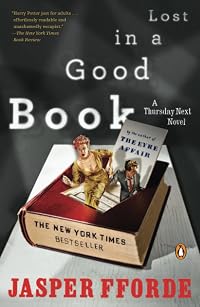
I haven't read a lot of fantasy where the protagonist enters works of fiction, but one that I can heartily recommend is Jasper Fforde's Thursday Next series, especially the first book; The Eyre Affair. If you like Harold Shea, you'll love Thursday Next. show less
People tend to think that ‘funny’ fantasy began with Terry Pratchett, however De Camp and Pratt predate the great British author by around 40 years, they began working on the Harold Shea stories in 1940.
Harold Shea is an occasionally reckless and generally eccentric pyschologist. He comes up with a form of mathematical magic which he believes can transport him from this world into ages of myth and magic. In The Roaring Trumpet he begins by trying to send himself to the Ireland of Cuchulainn and Queen Maev, but instead finds himself in Asgard rubbing shoulders with Odin, Thor, Loki and Heimdall.
One thing that was a little disconcerting was how long it took for Harold; he appeared to have a strong working knowledge of a number of well known mythologies, to work out where he was, despite knowing what Odin was supposed to look like and even after hearing the name Heimdall, he still didn’t work it out until it was spelled out to him.
Harold has the great misfortune to arrive in Asgard not long before Ragnarok and accompanies his godly companions, and their servant Thjalfi on a quest to reclaim Thor’s hammer and Frey’s sword from the giants. The depiction of the gods was very much as anyone with a decent knowledge of the myths would expect, however the giants were different. They looked and acted like the warlike barbaric characters they are, but they spoke using a mid 20th century American slang. I have to admit that I quite liked this innovation. Harold manages to use his psychological knowledge and his modern day sensibilities to get himself and his companions out of a number of scrapes and finds his way back to his own world and time just before Ragnarok really kicks in.
It’s a fun romp and a very promising start to what became a classic series.
The second of Harold Shea’s adventures; The Mathematics of Magic takes place directly after his unexpected journey to the Asgard.
Harold tells best friend and colleague Reed Chalmers about what happened and how. Initially Reed thinks Harold is mad, but goes along with it to humour Harold before realising that the theory behind what the younger man did is at least sound. Harold still wants to visit the Ireland that he tried for the first time, but Reed convinces him to instead shoot for the world of Spenser’s epic poem; The Fairie Queen. This time, possibly because Reed is helping Harold, they get to their intended destination.
I’m nowhere near as familiar with the world of The Faerie Queen as I was with Norse mythology, so a lot of what Reed and Harold saw was new to me. It seemed a little fresher, definitely funnier and better written all around. It may have been that De Camp and Pratt were more comfortable with what they’d created the second time around.
The story improved with Reed along for the ride, it gave Harold someone to talk to and bounce things off. Reed also tends to counsel his younger friend and prevent him from making ill considered moves that could have disastrous consequences for all concerned. I’m not sure who’s idea it was to include the program for the wizard’s convention in this, but that had me laughing out loud. It was expertly done and a nice dig at conventions in general.
Reed decided to stay in the world with Florimel and Harold inadvertently got transported back, taking the object of his affection; Belphebe, with him. It will be interesting to see Belphebe make the transaction from 15th century epic poem warrior woman to 20th century girl about town.
One criticism is Harold’s treatment of Gertude Mugler. Gertrude works with Harold and his friends Reed Chalmers and Walter Bayard. Gertrude appears to carry a bit of a torch for Harold, she was the one who hired a private detective to investigate his disappearance when he went missing one his first adventure, and yet Harold dismisses her when he speaks about her and quite happily flaunts Belphebe in front of her at the end of The Mathematics of Magic. Maybe I’ve read it wrong, but Harold needs a smack for that behaviour.
The third of the Harold Shea adventures: Castle of Iron, begins with Harold being quizzed by the police about the disappearance of his wife Belphebe. Harold is convinced that she’s somehow been sorcerously removed from our realm and so is his other colleague and friend Walter Bayard, however Gert reported the incident to the authorities. Hell hath no fury like a woman scorned, eh Harold?
Before things can get too unpleasant for our hero, he, one of the policemen, Walter Bayard and another colleague Vaclav ‘Votsy’ Polacek, also known as the Rubber Czech, are whisked off to the court of Kubla Khan as imagined by Samuel Taylor Coleridge in his epic poem. While Harold is trying to work out how this happened and get back to his own world he and Votsy are removed from the court and find themselves in another realm. At least this one has two familiar faces in it; Harold’s good friend Reed Chalmers and Reed’s lady love Florimel from the Faerie Queen.
Apparently Reed had an issue with Florimel. She’s made of snow and won’t last unless they can find a way to make her enchantment as a lady more permanent. In order to accomplish this Reed has transported himself and Florimel to the land of Orlando Furioso as that is not dissimilar to the Faerie Queen. In fact Orlando Furioso is believed to have inspired Spenser’s epic work. In doing this Reed also managed to remove Belphebe as the character of Belphegor is analogous to that of Belphebe. He brought Harold along for extra assistance and Vaclav was a total accident.
I wasn’t greatly impressed by this installment. I wasn’t familiar with the work, but that didn’t present a problem with the Faerie Queen and De Camp and Pratt take significant liberties with the source. To the best of my knowledge the Astolph or Astolfo in Orlando Furioso was not an adventuring English duke with knowledge of this world’s 20th century, nor was he a friend of Merlin’s. I felt that this one was a little formulaic. Harold is transported to a fictional world, he uses his psychological knowledge to personal advantage and amazes the inhabitants with his knowledge of sword play, gets in and out of scrapes by the skin of his teeth and often does it in the most incredible of ways. It may be that I’ve read a number of works inspired by these ones and it’s become a bit tired to me. The other problem was Votsy. He was the stereotypical socially awkward, sex obsessed nerd. There didn’t seem to be much of a reason to have him there really. He may have been included as comedy relief, but I found him irritating and hope he doesn’t reappear.
The Wall of Serpents finds Harold and his lady love Belphebe adjusting to married life in modern day Ohio, however they are concerned about their friend, the laid back Walter Bayard and the detective Pete Brodsky, whp are still stuck in the court of Kubla Khan as imagined by Coleridge. To get them back Harold needs a high powered enchanter. He decides that Vainamoinen from the Finnish epic The Kalevala is what he's after. He manages to get himself and Belphebe into the epic, but not to Vainamoinen, they instead find themselves dealing with the boastful and lecherous Lemminkainen.
After the duo equal Lemminkainen with sword and bow he agrees to help them and true to his word does transport Walter and Pete to the world of The Kalevala. They find themselves having to help the magic using warrior. Both Bayard and Brodsky prove themselves of worth. Walter, being of an extremely practical mind, can see through any magical illusion and Pete is a dab hand at jiu jitsu, claiming that any detective who has worked in Chicago needs it.
Walter's attempt at magic gets them tossed in a prison and held for execution. Harold transports them before things can get worse and this is how they end up in Cuchulainn's Ireland and The Green Magician.
The story was much the same as all the others. The skills of the adventurers are strange and useful to the natives of the story they find themselves in and they have to put them to use to save the hero, before managing to get back home. I read some of the Cuchulainn stories as a kid and I have to admit I wasn't happy with his portrayal in this story. He was an unpleasant bully and sexist, he also had the strange habit of referring to male companions as darling.
The character of tough detective; Pete Brodsky, was these stories comedy relief. He was less annoying and more useful than Vaclav Polacek, however I found much of his dialogue almost unintelligible, littered as it was with, to my eye, anachronistic mid 20th century street slang.
The stories were enjoyable and easy to read, although I felt they hit a high point in The Mathematics of Magic that they never attained again. They are however well worth reading as an example of the evolution of the SFF field and proof that even in the 1940's the field had developing sub genres.
I haven't read a lot of fantasy where the protagonist enters works of fiction, but one that I can heartily recommend is Jasper Fforde's Thursday Next series, especially the first book; The Eyre Affair. If you like Harold Shea, you'll love Thursday Next. show less
Two novellas in one. In the first, when an accidental discovery drops him smack in the middle of an alternate world in which the gods of Norse mythology are hard at work battling frost giants and each other, our hero Harold Shea is left with only his wits about him. The second story takes Harold and a companion to the world of Spenser's Faerie Queen, where the pair learn more regarding the rules of science/magic, but not without some entertaining mishaps. I particularly liked their conjured creatures, which included a large number of forest-munching, vegetarian dragons.
On a cautionary note, this is classic science fiction/fantasy published in the early 1940's. The "present day" world which Harold inhabits may prove as foreign for young show more readers today as the Scandinavian landscape is to Harold, and perhaps even more so. show less
On a cautionary note, this is classic science fiction/fantasy published in the early 1940's. The "present day" world which Harold inhabits may prove as foreign for young show more readers today as the Scandinavian landscape is to Harold, and perhaps even more so. show less
I didn’t enjoy The Incomplete Enchanter too much. On the other hand, I didn’t hate it either. It was just kind of there. The idea that L. Sprague de Camp and Fletcher Pratt had was to explore the physics of magic by placing modern day psychologists into fictional magic worlds. There the scientists have adventures as well as extrapolate what the rules are that govern magic in the realms they visit.
(Full review at my blog)
(Full review at my blog)
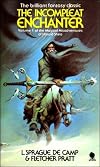
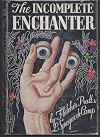
Cute but disappointing (after having read how great & groundbreaking it's supposed to be.) Book 1 was much better than Book 2. Love the cover art.
Members
- Recently Added By
Lists

Survey of Fantasy Classics
111 works; 23 members

1940s
221 works; 25 members
Author Information

330+ Works 25,133 Members
L. Sprague de Camp, winner of the World Fantasy Award for Life Achievement, was fluent in several languages and traveled the world. He was chased by a hippopotamus in Uganda and sea lions in the Galapagos Islands. He saw tigers and rhinoceroses from elephantback in India, and he was bitten by a lizard in the jungles of Guatemala. His fascinating show more autobiography. Time and Chance, won the 1997 Hugo Award for best nonfiction. L. Sprague de Camp passed away in May 2000 show less

110+ Works 6,283 Members
Some Editions
Awards and Honors
Distinctions
Series

Belongs to Publisher Series
Heyne Fantasy Classics (3768)
Work Relationships
Is contained in
Common Knowledge
- Canonical title
- The Incomplete Enchanter
- Original publication date
- 1960
- People/Characters
- Harold Shea; Reed Chalmers
- Important places
- Asgard
- First words
- The Roaring Trumpet:
There were three men and a woman in the room.
The Mathematics of Magic:
'Steak,' said Harold Shea. - Quotations
- Yngvi is a louse!
- Last words
- (Click to show. Warning: May contain spoilers.)The Roaring Trumpet:
'God bless my soul,' exclaimed Chalmers, and followed Shea out.
(Click to show. Warning: May contain spoilers.)The Mathematics of Magic:
'I still lack the explanation of those strange words in the poem wherewith you bested the Blatant Beast!'
Classifications
Statistics
- Members
- 316
- Popularity
- 101,259
- Reviews
- 7
- Rating
- (3.77)
- Languages
- 5 — Dutch, English, German, Italian, Spanish
- Media
- Paper, Ebook
- ISBNs
- 7
- ASINs
- 20