
Fletcher Pratt (1897–1956)
Author of The Complete Compleat Enchanter
About the Author
Disambiguation Notice:
also wrote as George U. Fletcher. Fantastic Fiction says he wrote as George W. Fletcher but I have a first edition of The Well of the Unicorn whose title page has George U. Fletcher.
Image credit: Bread Loaf Writers Conference, Summer 1941
Series
Works by Fletcher Pratt
The Marines' war, an account of the struggle for the Pacific from both American and Japanese sources (1948) 21 copies
War for the World: A Chronicle of Our Fighting Forces in World War II (Yale chronicles of American series) (1975) 9 copies
Dr. Grimshaw's Sanitorium 4 copies
Official Record 2 copies
The Roger Bacon Formula 2 copies
U.S.A.: The Aggressor Nation 1 copy
Pardon My Mistake 1 copy
America and total war 1 copy
Il muro dei serpenti 1 copy
ONE BY PRATT 1 copy
Ralph 124C 41 1 copy
Hail, Caesar! 1 copy
War in Heaven 1 copy
Associated Works
Twenty Thousand Leagues Under the Sea (1869) — Introduction, some editions — 21,407 copies, 283 reviews
The Tavern Lamps Are Burning: Literary Journeys through Six Regions and Four Centuries of New York State (1964) — Contributor — 24 copies
Beyond Human Ken: 21 Startling Stories of Science Fiction and Fantasy (1952) — Introduction, some editions — 20 copies
The Magazine of Fantasy and Science Fiction Winter-Spring 1950, Vol. 1, No. 2 (1950) — Contributor — 8 copies
Cetus Insolitus: Sea Serpents, Giant Cephalopods, and Other Marine Monsters in Classic Science Fiction and Fantasy (2008) — Contributor — 2 copies
Fantasy Fiction Magazine, June 1953 (Vol. 1, No. 2) — Contributor — 2 copies
Fantasy Fiction - November 1953 - Vol. 1, No. 4 — Contributor — 1 copy
Tagged
Common Knowledge
- Legal name
- Pratt, Murray Fletcher
- Other names
- Fletcher, George U. (pseudonym)
- Birthdate
- 1897-04-25
- Date of death
- 1956-06-11
- Gender
- male
- Education
- Hobart College
Sorbonne University - Occupations
- historian
novelist
journalist
inventor of a pre-World War II naval war game
short story writer
science writer - Organizations
- Trap Door Spiders
Civil War Round Table of New York (president, 1953-1954) - Awards and honors
- Fletcher Pratt Award (named in his honor by the Civil War Round Table of New York)
- Relationships
- Inga Stephens Pratt (2nd spouse)
- Nationality
- USA
- Birthplace
- Buffalo, New York, USA
- Places of residence
- Buffalo, New York, USA
Highlands, New Jersey, USA - Place of death
- Highlands, New Jersey, USA
- Disambiguation notice
- also wrote as George U. Fletcher. Fantastic Fiction says he wrote as George W. Fletcher but I have a first edition of The Well of the Unicorn whose title page has George U. Fletcher.
- Associated Place (for map)
- New Jersey, USA
Members
Discussions
A Midummer Night's Gleam in Good Show Sir! — bad science fiction and fantasy covers (June 23)
Reviews

Fletcher Pratt, a journalist turned freelance writer, composed Sea Power and Today's War in the summer of 1939, when war loomed on the horizon. He was revising the proofs when German tanks rolled across the Polish border. Pratt junked the original, now obsolete, preface (with its now obsolete prediction that war might be long-delayed, or even averted) and wrote a new one. The rest of the work, in Pratt's words "a purely technical study of the strength of the sea powers and of their tactics show more and strategy in the event of a general war," remains what it was in the summer of 1939.
It is, as a result, an utterly fascinating time capsule for naval historians. Its pages preserve, like a fly in amber, a view of naval strategy where guns are king, the line-of-battle is the core of the fleet, and admirals dream of the next Trafalgar or Tsushima. It is the world of Alfred Thayer Mahan, Admiral "Jackie" Fisher, and the forgotten architects of War Plan Orange, captured in the last possible moment before actual events on, under, and above the high seas began knocking holes it.
Pratt was neither a navy veteran nor a naval architect, but he was an enthusiastic naval player and designer of naval wargames. He created an elaborate set of rules for modeling fleet-size engagements with scale models (1" = 50') on room-sized mock oceans, using elaborate tables to determine the effects of each salvo. His analysis of the world's navies reflects this outlook. It is elaborately, minutely technical, and tacitly assumes that comparing "the numbers" -- speed; armor thickness;number, size, and weight of guns -- of opposing ships (considered individually and in groups) is sufficient to predict the outcomes of battles.
The human element of naval warfare enters Pratt's calculations only in the broadest possible strokes. He not only believes in the existence of "national character" -- the idea that, say, "the Germans" are rigid and precise, "the French" are bold and daring, and "the Italians" are unreliable -- but uses it to explain (or predict) how naval strategy differs (and will differ in the war-to-come). Absurd as it sounds to modern ears, you don't have to read far in the popular nonfiction of the 1920s and 30s to realize how pervasive it was.
Beyond its value as a time capsule, Pratt's book is an extraordinary example of someone so thoroughly committed to one way of viewing the world that they cannot even conceive of an alternative. His brief chapter on "New Weapons" nods at atomic propulsion, rockets, and "death rays," but his vision of future naval warfare is still built around lines of battleships seeking to, as Lord Nelson did at Trafalgar, "cross the enemy's T."
Recommended, on those terms, for anyone with a serious interest in 20th century naval history or the history of military technology. show less
It is, as a result, an utterly fascinating time capsule for naval historians. Its pages preserve, like a fly in amber, a view of naval strategy where guns are king, the line-of-battle is the core of the fleet, and admirals dream of the next Trafalgar or Tsushima. It is the world of Alfred Thayer Mahan, Admiral "Jackie" Fisher, and the forgotten architects of War Plan Orange, captured in the last possible moment before actual events on, under, and above the high seas began knocking holes it.
Pratt was neither a navy veteran nor a naval architect, but he was an enthusiastic naval player and designer of naval wargames. He created an elaborate set of rules for modeling fleet-size engagements with scale models (1" = 50') on room-sized mock oceans, using elaborate tables to determine the effects of each salvo. His analysis of the world's navies reflects this outlook. It is elaborately, minutely technical, and tacitly assumes that comparing "the numbers" -- speed; armor thickness;number, size, and weight of guns -- of opposing ships (considered individually and in groups) is sufficient to predict the outcomes of battles.
The human element of naval warfare enters Pratt's calculations only in the broadest possible strokes. He not only believes in the existence of "national character" -- the idea that, say, "the Germans" are rigid and precise, "the French" are bold and daring, and "the Italians" are unreliable -- but uses it to explain (or predict) how naval strategy differs (and will differ in the war-to-come). Absurd as it sounds to modern ears, you don't have to read far in the popular nonfiction of the 1920s and 30s to realize how pervasive it was.
Beyond its value as a time capsule, Pratt's book is an extraordinary example of someone so thoroughly committed to one way of viewing the world that they cannot even conceive of an alternative. His brief chapter on "New Weapons" nods at atomic propulsion, rockets, and "death rays," but his vision of future naval warfare is still built around lines of battleships seeking to, as Lord Nelson did at Trafalgar, "cross the enemy's T."
Recommended, on those terms, for anyone with a serious interest in 20th century naval history or the history of military technology. show less

The Blue Star predates The Lord of the Rings: it’s fantasy from an earlier era – no dwarfs, elves or Celtic myths, and what magic there is is only slightly less abstract than the sex. Actually, the 1969 edition is labelled adult fantasy, and one of the unexpected pleasures of the book is discovering just how chaste adult fantasy could be back then.
A prologue promises an alternative universe where magic occupies the place that science occupies in ours. If that promise creates an show more expectation of something like Terry Pratchett’s Discworld, then the book will disappoint. In fact, the practitioners of magic are a tiny, proscribed minority. Our young hero starts out as an idealistic member of a revolutionary group in a land ruled by a queen (who remains an abstraction) and a repressive social order. Following orders from the Central Committee he seduces a young witch and promises fidelity in order to gain control of her Blue Star, an amulet that gives its wearer telepathic powers. There’s a love story, then, and a political story: will the seduction lead to true love? can a revolutionary movement with such a utilitarian attitude to young love really lead to freedom? The playing out of these questions is diverting enough, and the subversively anti-romantic politics are engaging, especially the section about the Amorosans, who talk the talk of everything being done in love, but are just as repressive as their enemies across the water. On the whole, though, the book didn't overwhelm me. If you can imagine a Lord of the Rings where Bilbo decides that there are more important things than destroying the ring and that the Return of the King and the defeat of Sauron, for good or bad, will happen (or not) without his help, you have some idea of the impact.
A word of warning: skip Lin Carter’s spoilerish introduction, or at least save it for after you’ve read the rest of the book. You might also want to skip the prologue, which seems to be there to justify the fantasy mode, and doesn’t do it very well. show less
A prologue promises an alternative universe where magic occupies the place that science occupies in ours. If that promise creates an show more expectation of something like Terry Pratchett’s Discworld, then the book will disappoint. In fact, the practitioners of magic are a tiny, proscribed minority. Our young hero starts out as an idealistic member of a revolutionary group in a land ruled by a queen (who remains an abstraction) and a repressive social order. Following orders from the Central Committee he seduces a young witch and promises fidelity in order to gain control of her Blue Star, an amulet that gives its wearer telepathic powers. There’s a love story, then, and a political story: will the seduction lead to true love? can a revolutionary movement with such a utilitarian attitude to young love really lead to freedom? The playing out of these questions is diverting enough, and the subversively anti-romantic politics are engaging, especially the section about the Amorosans, who talk the talk of everything being done in love, but are just as repressive as their enemies across the water. On the whole, though, the book didn't overwhelm me. If you can imagine a Lord of the Rings where Bilbo decides that there are more important things than destroying the ring and that the Return of the King and the defeat of Sauron, for good or bad, will happen (or not) without his help, you have some idea of the impact.
A word of warning: skip Lin Carter’s spoilerish introduction, or at least save it for after you’ve read the rest of the book. You might also want to skip the prologue, which seems to be there to justify the fantasy mode, and doesn’t do it very well. show less
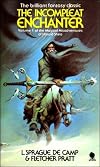
The Incompleat Enchanter is just right: fun without descending into Piers Anthony smugness; short enough to sustain interest in its simple stories; and written with enough skill to excuse the retrograde gender and other clangers that occasionally drop. Vintage sword-and-sorcery from the early, pulp days of the genre, this is a tasty glimpse into a lot of modern fantasy's antecedents.
Harold Shea is an unconventional psychologist, bored of his hum-drum existence and craving adventure. When he show more and his professor discover a "mathematics of magic" that will allow them to teleport into the legends of yore, Shea jumps at the opportunity. Before you can say "zounds!", Shea finds himself first in the world of Norse myth, and then to Spenser's Faerie Queene. Evil sorcerers, powerful gods, noble knights and of course dashing damsels follow.
I enjoyed this book. It's not perfect, by any means, but given its publication date (1940) and seminal status, I'm willing to forgive a lot. The audience for these novellas was originally teenage boys buying Weird Tales and the like, and I think it's pretty much perfect for that audience, even now over seventy years later. Impressive.
Don't misunderstand; The Incompleat Enchanter is not breath-takingly contemporary in the way that some of Howard's stories are; the novellas are definitely a product of their times. But personally I found this added to some of its camp appeal.
Spratt and De Camp's stories are definitely not required reading for the discerning fantasy fan, but they do make for a fun weekend. show less
Harold Shea is an unconventional psychologist, bored of his hum-drum existence and craving adventure. When he show more and his professor discover a "mathematics of magic" that will allow them to teleport into the legends of yore, Shea jumps at the opportunity. Before you can say "zounds!", Shea finds himself first in the world of Norse myth, and then to Spenser's Faerie Queene. Evil sorcerers, powerful gods, noble knights and of course dashing damsels follow.
I enjoyed this book. It's not perfect, by any means, but given its publication date (1940) and seminal status, I'm willing to forgive a lot. The audience for these novellas was originally teenage boys buying Weird Tales and the like, and I think it's pretty much perfect for that audience, even now over seventy years later. Impressive.
Don't misunderstand; The Incompleat Enchanter is not breath-takingly contemporary in the way that some of Howard's stories are; the novellas are definitely a product of their times. But personally I found this added to some of its camp appeal.
Spratt and De Camp's stories are definitely not required reading for the discerning fantasy fan, but they do make for a fun weekend. show less

Essentially the book equivalent of a low budget community theater play. The plot races wildly then jumps randomly like it has ADHD. The characters are so one-dimensional it felt like one person was just putting on wigs and doing different accents.
As long as you're okay with shutting off your brain and just accepting what appears to be a hasty summary of a comic book, this isn't the worst scifi out there. The lengthy flashback sequence is actually very well written.
As long as you're okay with shutting off your brain and just accepting what appears to be a hasty summary of a comic book, this isn't the worst scifi out there. The lengthy flashback sequence is actually very well written.
Lists
1940s (1)
Awards


You May Also Like


Associated Authors
Statistics
- Works
- 110
- Also by
- 32
- Members
- 6,279
- Popularity
- #3,907
- Rating
- 4.0
- Reviews
- 92
- ISBNs
- 118
- Languages
- 8
- Favorited
- 3