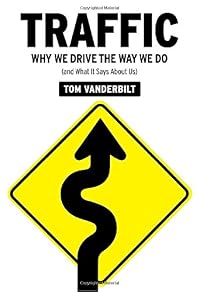
Traffic: Why We Drive the Way We Do (and What It Says About Us)
by Tom Vanderbilt
On This Page
Description
Based on exhaustive research and interviews with driving experts and traffic officials around the globe, Traffic gets under the hood of the everyday activity of driving to uncover the surprisingly complex web of physical, psychological, and technical factors that explain how traffic works, why we drive the way we do, and what our driving says about us. Vanderbilt examines the perceptual limits and cognitive underpinnings that make us worse drivers than we think we are. He demonstrates why show more plans to protect pedestrians from cars often lead to more accidents. He shows how roundabouts, which can feel dangerous and chaotic, actually make roads safer--and reduce traffic in the bargain. He uncovers who is more likely to honk at whom, and why. He explains why traffic jams form, outlines the unintended consequences of our quest for safety, and even identifies the most common mistake drivers make in parking lots.--From publisher description. show lessTags
Recommendations





Member Recommendations
Member Reviews
Fascinating, hard-hitting, and often terrifying, this in-depth study of how and why we drive will blow your friggin' mind. What is it that makes a road "safe" or "dangerous"? The answers may surprise you. Is it true that every safety feature that has been introduced to cars from the seat belt to anti-lock brakes has actually cost more lives? This author thinks so, and his arguments are air tight. Travel with him around the world to see how other countries have overhauled their transit systems with astonishingly unorthodox methods. This book will forever change how you drive, how you think about driving, and how you look at the road.
Call me a geek or a nerd or whatever, but I really enjoyed this book. Speaking as a dedicated non-driver, I am somewhat perversely (not pervertedly; this isn't a David Cronenberg film here) interested in the havoc caused by cars and the people who drive them, so this book is just the ticket.
Vanderbilt's writing is accessible and smart without trying to be excessively clever, and packed with references to studies and interviews with experts. The notes section at the back is also extensive, potentially providing other interesting reading material for those who are so inclined.
The book comprises a prologue, nine chapters and an epilogue, variously discussing the following topics: the merits of late merging, how traffic messes with our show more heads, why people are not as good drivers as they think they are, how our eyes and minds betray us on the road, examples of good and bad traffic jams in nature (with ants as an example of a good traffic system), why women cause more congestion than men, why more roads lead to more traffic, when dangerous roads are safer, traffic differences around the world, what is risky on the road and why, and the experiences of race car drivers versus those of the general public.
Of all the chapters, I think Chapter 6 (why more roads lead to more traffic) is a strong contender for "favourite". I really agree with this thesis, and it always makes me cross to see road-widening projects, because it just encourages more people to fill that extra road space, and then that's even more land eaten up by heat-absorbing, road-salt-clogged-runoff-generating asphalt. I quote from p. 155:
"[S]tudies suggest that induced travel is real: When more lane-miles of roads are built, more miles are driven, even more so than might be expected by 'natural' increases in demand, like population growth. In other words, the new lanes may immediately bring relief to those who wanted to use the highway before, but they will also encourage those same people to use the highway more---they may make those 'rational locators' move farther out, for example---and they will bring new drivers onto the highway, because they suddenly find it a better deal."
I also agree with the idea of driving as an "overlearned" behaviour -- people learn how to do it, it becomes automatic, and then they get complacent and don't pay attention to what's going on. This is why more crashes than you would expect occur close to home and/or on sunny, dry days. When things become more dangerous, people tend to adjust their behaviour accordingly. Chapter 7 discusses this concept in great detail with some interesting examples from the Netherlands.
This book is packed with neat (sometimes surprising) tidbits of information, such as this:
"The rapidly evolving Chinese insurance industry was dealing with customers who were reporting as many as thirty claims in a multiyear period. Some insurers reported accident risk for certain classes of individuals at nearly 100 percent---virtually moving them from the category of 'accident risk' to the paradoxical 'accident certainty'." (233)
as well as some fabulously dry-witted lines, like this parenthetical statement in a paragraph discussing the argument in favour of raising speed limits:
"It's not speed that kills, it's variance. (This belief, studies have indicated, is most strongly held by young males---who are, after all, experts, given that they get in the most crashes.) And what causes the most variance? Speed limits that are too low!" (253)
If you like books by Malcolm Gladwell, you may like this one as well. And if your interests lie in cars, traffic or just stupid things people manage to do in everyday situations, this book may well fit the bill next time you're looking for some in-depth but still interesting non-fiction. show less
Vanderbilt's writing is accessible and smart without trying to be excessively clever, and packed with references to studies and interviews with experts. The notes section at the back is also extensive, potentially providing other interesting reading material for those who are so inclined.
The book comprises a prologue, nine chapters and an epilogue, variously discussing the following topics: the merits of late merging, how traffic messes with our show more heads, why people are not as good drivers as they think they are, how our eyes and minds betray us on the road, examples of good and bad traffic jams in nature (with ants as an example of a good traffic system), why women cause more congestion than men, why more roads lead to more traffic, when dangerous roads are safer, traffic differences around the world, what is risky on the road and why, and the experiences of race car drivers versus those of the general public.
Of all the chapters, I think Chapter 6 (why more roads lead to more traffic) is a strong contender for "favourite". I really agree with this thesis, and it always makes me cross to see road-widening projects, because it just encourages more people to fill that extra road space, and then that's even more land eaten up by heat-absorbing, road-salt-clogged-runoff-generating asphalt. I quote from p. 155:
"[S]tudies suggest that induced travel is real: When more lane-miles of roads are built, more miles are driven, even more so than might be expected by 'natural' increases in demand, like population growth. In other words, the new lanes may immediately bring relief to those who wanted to use the highway before, but they will also encourage those same people to use the highway more---they may make those 'rational locators' move farther out, for example---and they will bring new drivers onto the highway, because they suddenly find it a better deal."
I also agree with the idea of driving as an "overlearned" behaviour -- people learn how to do it, it becomes automatic, and then they get complacent and don't pay attention to what's going on. This is why more crashes than you would expect occur close to home and/or on sunny, dry days. When things become more dangerous, people tend to adjust their behaviour accordingly. Chapter 7 discusses this concept in great detail with some interesting examples from the Netherlands.
This book is packed with neat (sometimes surprising) tidbits of information, such as this:
"The rapidly evolving Chinese insurance industry was dealing with customers who were reporting as many as thirty claims in a multiyear period. Some insurers reported accident risk for certain classes of individuals at nearly 100 percent---virtually moving them from the category of 'accident risk' to the paradoxical 'accident certainty'." (233)
as well as some fabulously dry-witted lines, like this parenthetical statement in a paragraph discussing the argument in favour of raising speed limits:
"It's not speed that kills, it's variance. (This belief, studies have indicated, is most strongly held by young males---who are, after all, experts, given that they get in the most crashes.) And what causes the most variance? Speed limits that are too low!" (253)
If you like books by Malcolm Gladwell, you may like this one as well. And if your interests lie in cars, traffic or just stupid things people manage to do in everyday situations, this book may well fit the bill next time you're looking for some in-depth but still interesting non-fiction. show less
I enjoyed Traffic tremendously. My wife can testify how much—apparently, I wouldn't stop talking about it the whole time I was reading it. It presents a constant stream of interesting facts and ideas to mull over.
I picked it up on the recommendation of a co-worker, and because I'm interested in anything that can help me to be a better driver. This book completely changed my perspective about driving. It's changed what I notice on the road and how I act behind the wheel. I already find myself thinking differently about how I drive, and why I drive the way I do.
I believe that Traffic should be required reading in every Driver's Ed course in this country.
Truthfully, it's uncanny and a bit disturbing how precisely and accurately Mr. show more Vanderbilt capture the details of my personal experience of driving, how fully he describes the thoughts that go through my head as I travel down the road.
Traffic is a fascinating, eye-opening, impressively comprehensive, conventional-assumption-challenging, wonderful work. It's for people interested in being better drivers, but even more for people interested in a too often overlooked aspect of our society and culture.
How we drive says a lot about who we are. show less
I picked it up on the recommendation of a co-worker, and because I'm interested in anything that can help me to be a better driver. This book completely changed my perspective about driving. It's changed what I notice on the road and how I act behind the wheel. I already find myself thinking differently about how I drive, and why I drive the way I do.
I believe that Traffic should be required reading in every Driver's Ed course in this country.
Truthfully, it's uncanny and a bit disturbing how precisely and accurately Mr. show more Vanderbilt capture the details of my personal experience of driving, how fully he describes the thoughts that go through my head as I travel down the road.
Traffic is a fascinating, eye-opening, impressively comprehensive, conventional-assumption-challenging, wonderful work. It's for people interested in being better drivers, but even more for people interested in a too often overlooked aspect of our society and culture.
How we drive says a lot about who we are. show less
This was a fun read. Traffic is interesting because it's something most of us experience frequently, and it's possibly the most visible complex system most of us deal with. In this book, Vanderbilt explores the challenges of traffic. Traffic suffers from the dual challenges of individual psychology and dueling external constraints.
On the psychology side, people are prone to making traffic decisions that seem personally optimal, but these often lead to sub par performance. For example, in heavy traffic, drivers will often speed up when they see gaps in front of them and then slow down when they approach the end of those gaps. The acceleration and deceleration cause ripple affects behind them, leading to more variation in traffic flow. show more Everyone would be better off if they stayed at a steady pace -- even if "that jerk" then takes the space you didn't -- but that doesn't feel like the best choice.
An example of external constraints are that traffic varies throughout the day. A road system that was built to smoothly handle peak traffic would be ridiculously over provisioned for the bulk of the time when traffic isn't at peak.
Most interesting are the examples of how individual psychology interacts with the external constraints. A 5 lane road with wide shoulders and sidewalks with no obstructions may seem safer -- cars are less likely to hit obstructions and pedestrians are further from cars -- but when compared with similarly placed smaller roads, there are often less car/pedestrian accidents. On the first road, pedestrians are an aberration. Cars are driving, essentially, as if they are on a highway, so if a pedestrian is present, they are less likely to be noticed. The smaller road, on the other hand, doesn't feel like a place one should drive fast. The greater need for attention and the slower speeds decrease both the number of car/pedestrian accidents and their severity.
The book is full of interesting thought experiments like these. If anything, the main weakness of the book is that it is essentially a collection of tales of the traffic system and leaves me wanting to read some actual books on traffic engineering and psychology. :-) show less
On the psychology side, people are prone to making traffic decisions that seem personally optimal, but these often lead to sub par performance. For example, in heavy traffic, drivers will often speed up when they see gaps in front of them and then slow down when they approach the end of those gaps. The acceleration and deceleration cause ripple affects behind them, leading to more variation in traffic flow. show more Everyone would be better off if they stayed at a steady pace -- even if "that jerk" then takes the space you didn't -- but that doesn't feel like the best choice.
An example of external constraints are that traffic varies throughout the day. A road system that was built to smoothly handle peak traffic would be ridiculously over provisioned for the bulk of the time when traffic isn't at peak.
Most interesting are the examples of how individual psychology interacts with the external constraints. A 5 lane road with wide shoulders and sidewalks with no obstructions may seem safer -- cars are less likely to hit obstructions and pedestrians are further from cars -- but when compared with similarly placed smaller roads, there are often less car/pedestrian accidents. On the first road, pedestrians are an aberration. Cars are driving, essentially, as if they are on a highway, so if a pedestrian is present, they are less likely to be noticed. The smaller road, on the other hand, doesn't feel like a place one should drive fast. The greater need for attention and the slower speeds decrease both the number of car/pedestrian accidents and their severity.
The book is full of interesting thought experiments like these. If anything, the main weakness of the book is that it is essentially a collection of tales of the traffic system and leaves me wanting to read some actual books on traffic engineering and psychology. :-) show less
Traffic as a phenomenon is full of irritating paradoxes. Driving faster can mean everyone drives slower. Building roads to relieve congestion creates even more congestion. Redesigning roads to make them safer can cause more accidents. Putting up more warning signs means fewer of them get read. Trying to keep pedestrians protected from cars makes them less safe. Tailgating the car in front of you in a traffic jam does nothing to let you escape it. Traffic the book is an excellent in-depth study on driving and its effects on society that manages to both confirm a lot of my own driving prejudices and offer a lot of good insights into traffic congestion and a host of other related subjects. Vanderbilt talks about the history of traffic jams show more going back to the Romans and how modern technology is trying to stay one step ahead of the monster jams that modern technology helps create in the first place. Very readable and full of fun info. Quick takeaways, some of which should be obvious yet somehow aren't for a lot of people:
- Don't tailgate, it's really unsafe and often causes people to actually slow down
- Driving and texting/eating/anything in the car makes you way more likely to get into a wreck
- In a traffic jam, drive a slow but consistent speed instead of stopping and going; you won't get out of the jam any more quickly but you will both save on gas and help out the people behind you
- Late merging is the way to go, as it maximizes the use of space; don't get pissed off at people who zoom ahead of you, you didn't "own" a place in line
- Support toll roads/congestion pricing/higher street parking fees; recognizing that the precious resources of road and parking space aren't free will help everyone in the long run even if it hurts your wallet up front
- Stop thinking of roads as car transport devices only, there are lots of other types of transportation like bikes and pedestrians that have just as much of a right to be there as cars
- Suburban sprawl is ruining cities and in very real ways making us poorer as a nation, encourage any and every policy to spur density and alternatives to driving you see
If you're like me, you hate driving and try to do as little of it as possible, yet you still find the subject very interesting. Vanderbilt goes through a great tour of the many ways in which the rise of mega-commuting has warped our culture (e.g. we spend so much time in our cars that radio stations time their broadcasts to give you "driveway moments" that get you to stay in your car even after your trip has ended to hear the end of the segment) and the superhuman efforts of traffic engineers to shave even seconds off our journeys. Highly recommended. show less
- Don't tailgate, it's really unsafe and often causes people to actually slow down
- Driving and texting/eating/anything in the car makes you way more likely to get into a wreck
- In a traffic jam, drive a slow but consistent speed instead of stopping and going; you won't get out of the jam any more quickly but you will both save on gas and help out the people behind you
- Late merging is the way to go, as it maximizes the use of space; don't get pissed off at people who zoom ahead of you, you didn't "own" a place in line
- Support toll roads/congestion pricing/higher street parking fees; recognizing that the precious resources of road and parking space aren't free will help everyone in the long run even if it hurts your wallet up front
- Stop thinking of roads as car transport devices only, there are lots of other types of transportation like bikes and pedestrians that have just as much of a right to be there as cars
- Suburban sprawl is ruining cities and in very real ways making us poorer as a nation, encourage any and every policy to spur density and alternatives to driving you see
If you're like me, you hate driving and try to do as little of it as possible, yet you still find the subject very interesting. Vanderbilt goes through a great tour of the many ways in which the rise of mega-commuting has warped our culture (e.g. we spend so much time in our cars that radio stations time their broadcasts to give you "driveway moments" that get you to stay in your car even after your trip has ended to hear the end of the segment) and the superhuman efforts of traffic engineers to shave even seconds off our journeys. Highly recommended. show less
Note to the audiobook users: Be careful listening to a book on traffic while in traffic! You may find many of the insights a little too close to home.
Traffic by Tom Vanderbilt takes a closer look at a phenomenon of modern living we're all familiar with and one that we all think (secretly, at least) we're better at handling than our peers. The way we drive is selfish, inefficient and messy and yet there is a certain ease and harmony to it which is why it is still the most preferred form of travel.
The most compelling argument in this book is what I'll call "The Congestion Tax" or simply charging drivers for the privilege for using the most traveled roads. I've seen this argument in other forms (a carbon tax, for instance) and it is so show more compelling because there's an excellent case for both sides. The pros: Congestion would be eliminated, daily commute times would improve and fuel use per car would on average decrease. The cons: It's a regressive tax on the poorer auto users, it would be politically unpopular to enact and many would see it as a moral assault to our way of life which views roads as a shared public space freely accessible to all.
As modern progress goes, traffic will only grow larger and more complex. A universal network of toll roads is probably inevitable. It's a common contradiction that most of us view traffic as what other drivers cause and not what we ourselves are a part of too. show less
Traffic by Tom Vanderbilt takes a closer look at a phenomenon of modern living we're all familiar with and one that we all think (secretly, at least) we're better at handling than our peers. The way we drive is selfish, inefficient and messy and yet there is a certain ease and harmony to it which is why it is still the most preferred form of travel.
The most compelling argument in this book is what I'll call "The Congestion Tax" or simply charging drivers for the privilege for using the most traveled roads. I've seen this argument in other forms (a carbon tax, for instance) and it is so show more compelling because there's an excellent case for both sides. The pros: Congestion would be eliminated, daily commute times would improve and fuel use per car would on average decrease. The cons: It's a regressive tax on the poorer auto users, it would be politically unpopular to enact and many would see it as a moral assault to our way of life which views roads as a shared public space freely accessible to all.
As modern progress goes, traffic will only grow larger and more complex. A universal network of toll roads is probably inevitable. It's a common contradiction that most of us view traffic as what other drivers cause and not what we ourselves are a part of too. show less
Holy cow, this book was awesome. Pop science in which the author puts together a lot of studies about how driving actually works (like the physics and technology of how cars move) and ways this gets translated by people driving cars. It was the kind of book where every single paragraph contained at least one amazing fact. Like so amazing that everyone I know is really lucky that I wasn't calling you at 2 AM on a Wednesday to tell you that up to 20% of the earth's surface can be covered in insect swarms in a given moment. TWENTY PERCENT, PEOPLE. If you're wondering how that relates to traffic, apparently it came up in a conversation he was having with someone who was comparing information about insect swarming behaviors to traffic show more congestion models. I should point out that most of the amazing facts were more directly about driving, but the fact that the author was compelled to wedge this one in there makes me feel like he's a kindred spirit.
This is also the kind of book that makes me wish I had a better guidance counselor in high school, in terms of career planning. Or I don't know, maybe the guidance counselor wouldn't even have had a chance, given that a basic description of how engineers can use systems analysis to make recommendations about public policy sounds like a terrible job. It sounds like the most boring thing ever, until you get to the actual examples of engineers and other scientists playing around with traffic flow and then it sounds like the best job ever.
Of course this was a winner with me right out of the gate, because the very first section is an explanation of why the zipper merge is more efficient for everyone than the early merge. THE ZIPPER. Be still my heart. show less
This is also the kind of book that makes me wish I had a better guidance counselor in high school, in terms of career planning. Or I don't know, maybe the guidance counselor wouldn't even have had a chance, given that a basic description of how engineers can use systems analysis to make recommendations about public policy sounds like a terrible job. It sounds like the most boring thing ever, until you get to the actual examples of engineers and other scientists playing around with traffic flow and then it sounds like the best job ever.
Of course this was a winner with me right out of the gate, because the very first section is an explanation of why the zipper merge is more efficient for everyone than the early merge. THE ZIPPER. Be still my heart. show less
Members
- Recently Added By
Lists

Urban Planning (Michelle TBR)
39 works; 3 members

Books Read in 2013
1,629 works; 51 members

2008-2012 Notable Books for Adults
127 works; 10 members

Penguin Random House
458 works; 4 members

Books Read in 2021
5,361 works; 114 members

The War on Cars podcast
108 works; 1 member
Author Information

7+ Works 2,547 Members
Tom Vanderbilt is a writer based in Brooklyn, New York. His work has appeared in Wired, Nest, the New York Times Magazine, & The Nation. He is author of The Sneaker Book: An Anatomy of an Industry & An Icon. (Bowker Author Biography)
Some Editions
Awards and Honors
Common Knowledge
- Canonical title
- Traffic: Why We Drive the Way We Do (and What It Says About Us) (and What It Says About Us)
- Alternate titles
- Traffic: Why We Drive the Way We Do (and What It Says About Us) [Audio book] (and What It Says About Us)
- Original publication date
- 2008-07
- People/Characters
- Ian Walker; Leonard Evans
- Important places
- The Netherlands; Delhi, India; New York, New York, USA; Oudehaske, Friesland, Netherlands; Drachten, Friesland, Netherlands; Laweiplein, Drachten, Friesland, Netherlands (show all 7); England, UK
- First words
- Why does the other lane always seem to be moving faster?
- Last words
- (Click to show. Warning: May contain spoilers.)Even if drivers are taken away from the wheel, can we ever take the mere fact of being human out of traffic?
- Blurbers
- Surowiecki, James; Taleb, Nassim Nicholas; Sunstein, Cass R.; Cowen, Tyler; Roach, Mary; Yardley, Jonathan (show all 10); Glaeser, Edward; Dokoupil, Tony; Gladwell, Malcolm; Self, Will
- Canonical DDC/MDS
- 629.283
- Canonical LCC
- TL152.5
Classifications
- Genres
- Sociology, General Nonfiction, Nonfiction, Science & Nature
- DDC/MDS
- 629.283 — Applied Science & Technology Engineering Transportation Vehicles Cars, Trucks, Bulldozers, RVs, Motocyles Tests, driving, maintenance, repair Driving
- LCC
- TL152.5 — Technology Motor vehicles. Aeronautics. Astronautics Motor vehicles. Aeronautics. Astronautics Motor vehicles. Cycles
- BISAC
Statistics
- Members
- 1,966
- Popularity
- 10,697
- Reviews
- 78
- Rating
- (3.64)
- Languages
- 6 — Dutch, English, German, Italian, Russian, Spanish
- Media
- Paper, Audiobook, Ebook
- ISBNs
- 22
- ASINs
- 12