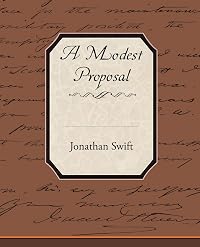
A Modest Proposal [essay]
by Jonathan Swift
On This Page
Description
A Modest Proposal is a satirical essay by Jonathan Swift written in 1729. It's a social commentary on British society's treatment of the poor. Saying more than this would be a spoiler! Please enjoy this unabridged and crisply narrated rendition of Swift's greatest work.Tags
Recommendations












Member Recommendations

Member Reviews
Reading A Modest Proposal as someone from Ireland felt different than I expected. I had heard about the essay before, mostly that it was “shocking” and “satirical” but I wasn’t prepared for how unsettled it would make me. The idea itself is horrifying, yet Swift presents it so calmly, so logically, that for a split second you almost follow his reasoning.
What makes the essay powerful isn’t just the outrage. It’s the restraint. Swift never breaks character. He never tells you directly that he’s angry. Instead, he forces you to feel the cruelty of a system that treated Irish people as economic burdens rather than human beings. Reading it as an Irish person, I couldn’t help but feel a quiet heaviness. This wasn’t just show more satire it was written out of real suffering in this country’s history.
A lot of Irish people have been affected by the housing crisis and it’s impossible to live in Ireland today and not be aware of it. You see it in news headlines, conversations, and the constant talk about rent prices, especially in places like Dublin. What struck me while reading Swift was how familiar the language felt. Discussions about housing often revolve around markets, supply, demand, and investment. Those conversations matter, but they can sometimes feel detached from the reality that people are simply trying to find a place to live.
Swift exaggerates economic thinking to an extreme, reducing children to numbers and profit margins, but his point feels painfully clear. When human lives are discussed only in terms of cost and efficiency, something deeply important is lost. The comparison isn’t about equating situations; today’s Ireland is not 18th-century Ireland. But emotionally, the essay made me more aware of how easily suffering can be normalized when it’s framed as a financial issue.
What I appreciated most about A Modest Proposal is that it didn’t just inform me it made me uncomfortable in a way that felt necessary. It pushed me to think about how societies justify inequality and how quickly compassion can be overshadowed by practicality. As someone from Ireland, that reflection feels personal, even if the events Swift wrote about happened centuries ago.
In the end, the essay lingers. It’s not enjoyable in a traditional sense, but it’s powerful. It reminds me that literature can act as both a mirror and a warning reflecting our past while quietly asking what we might be overlooking in the present. show less
What makes the essay powerful isn’t just the outrage. It’s the restraint. Swift never breaks character. He never tells you directly that he’s angry. Instead, he forces you to feel the cruelty of a system that treated Irish people as economic burdens rather than human beings. Reading it as an Irish person, I couldn’t help but feel a quiet heaviness. This wasn’t just show more satire it was written out of real suffering in this country’s history.
A lot of Irish people have been affected by the housing crisis and it’s impossible to live in Ireland today and not be aware of it. You see it in news headlines, conversations, and the constant talk about rent prices, especially in places like Dublin. What struck me while reading Swift was how familiar the language felt. Discussions about housing often revolve around markets, supply, demand, and investment. Those conversations matter, but they can sometimes feel detached from the reality that people are simply trying to find a place to live.
Swift exaggerates economic thinking to an extreme, reducing children to numbers and profit margins, but his point feels painfully clear. When human lives are discussed only in terms of cost and efficiency, something deeply important is lost. The comparison isn’t about equating situations; today’s Ireland is not 18th-century Ireland. But emotionally, the essay made me more aware of how easily suffering can be normalized when it’s framed as a financial issue.
What I appreciated most about A Modest Proposal is that it didn’t just inform me it made me uncomfortable in a way that felt necessary. It pushed me to think about how societies justify inequality and how quickly compassion can be overshadowed by practicality. As someone from Ireland, that reflection feels personal, even if the events Swift wrote about happened centuries ago.
In the end, the essay lingers. It’s not enjoyable in a traditional sense, but it’s powerful. It reminds me that literature can act as both a mirror and a warning reflecting our past while quietly asking what we might be overlooking in the present. show less
Gloom and doom
When I was an undergraduate, Thomas Malthus’ 1798 An Essay on the Principle of Population was on the geography curriculum, and as a studious student, I read (some of) it.
It was depressing, as the gist seemed to be that we’re all going to die. All of us. Slowly. Painfully. Because population grows exponentially, whereas the ability of humans to feed themselves grows only arithmetically/ linearly.
Image: Linear versus exponential growth (Source.)
So we’ll starve. And before that, we’ll be too poor to buy what food there is, because population growth will increase the labour supply and drive down wages. The birth rate must be cut. Celibacy should be promoted, too. And higher death rates accepted.
Kenneth Boulding’s show more poem, from a 20th century environmental angle, seemed to agree:
(Douglas Adams agreed with that moral.)
Soylent pink?
I also discovered that seventy years before Malthus’ book, Jonathan Swift had a different solution to the problem of overpopulation. A Modest Proposal starts with grim descriptions of extreme poverty and hunger in Ireland:
“It is a melancholy object to those, who walk through this great town, or travel in the country, when they see the streets, the roads, and cabbin-doors crowded with beggars of the female sex, followed by three, four, or six children, all in rags, and importuning every passenger for an alms… [and] women murdering their bastard children.”
A particular problem is that children are an expense for years before their parents can get any return on the investment they can’t afford in the first place:
“I am assured by our merchants, that a boy or a girl, before twelve years old, is no saleable commodity.”
After such concern, his “modest” proposal is a total shock, and would have been even more so to 18th century readers unused to deadpan satire:
“A young healthy child well nursed, is, at a year old, a most delicious nourishing and wholesome food, whether stewed, roasted, baked, or boiled; and I make no doubt that it will equally serve in a fricasee, or a ragoust.”
Image: Dinner! (Source.)
He goes into great detail, not just culinary, but about the practicalities of the trade. He indirectly mocks his own suggestion by saying the only possible objection anyone might have is that it would reduce the population, which, he points out, is his intention. And just in case readers can’t think of any better solutions, such as raising taxes, controlling rents, buying local products, he lists them (supposedly to dismiss them).
But we’re still here
(I hope that writing that during the Coronavirus Covid-19 pandemic isn’t tempting fate.)
When I was reading Swift and Malthus a couple of centuries after they were written, there was certainly poverty and hunger around the world, even in England, and the Chinese One-child policy was being strictly enforced. Malthusianism hadn’t gone away, but it hadn’t entirely come true either. I had no immediate fears of starvation or even poverty.
Why was this, I wondered? Kenneth Boulding had an answer:
Back then, I was firmly with the optimistic technologist.
As a cynical middle-aged adult in a country torn by Brexit and ravaged by a global pandemic, I think both poems miss the crucial social-political aspects, and the fact that humans are not omnipotent.
Science has certainly helped, but it's not all positive:
* Crops and livestock have higher yields and are more resistant to disease - but there are risks from GM and antibiotic resistance.
* Land that was unsuitable for farming, can now be used - but irrigation in one place leaves others barren.
* Machines work faster than people - so some lose their jobs.
* Packaging and chilling reduce damage - and yet waste increases.
* Efficiency increases in many spheres - but that increases demand, so resources are used up faster (Jevons paradox).
* Technological advances benefit the rich more than the poor.
And we could all be wiped out by a virus. Cheers!
Image: Optimist, pessimist, realist, opportunist (Source.)
Sources
You can read Swift and Malthus, free on Gutenberg:
* A Modest Proposal, HERE
* An Essay on the Principle of Population, HERE. show less
When I was an undergraduate, Thomas Malthus’ 1798 An Essay on the Principle of Population was on the geography curriculum, and as a studious student, I read (some of) it.
It was depressing, as the gist seemed to be that we’re all going to die. All of us. Slowly. Painfully. Because population grows exponentially, whereas the ability of humans to feed themselves grows only arithmetically/ linearly.
Image: Linear versus exponential growth (Source.)
So we’ll starve. And before that, we’ll be too poor to buy what food there is, because population growth will increase the labour supply and drive down wages. The birth rate must be cut. Celibacy should be promoted, too. And higher death rates accepted.
Kenneth Boulding’s show more poem, from a 20th century environmental angle, seemed to agree:
A Conservationist’s Lament
The world is finite, resources are scarce,
Things are bad and will be worse.
Coal is burned and gas exploded,
Forests cut and soils eroded.
Wells are dry and air’s polluted,
Dust is blowing, trees uprooted,
Oil is going, ores depleted,
Drains receive what is excreted.
Land is sinking, seas are rising,
Man is far too enterprising.
Fire will rage with Man to fan it,
Soon we’ll have a plundered planet.
People breed like fertile rabbits,
People have disgusting habits.
Moral:
The evolutionary plan
Went astray by evolving Man.
(Douglas Adams agreed with that moral.)
Soylent pink?
I also discovered that seventy years before Malthus’ book, Jonathan Swift had a different solution to the problem of overpopulation. A Modest Proposal starts with grim descriptions of extreme poverty and hunger in Ireland:
“It is a melancholy object to those, who walk through this great town, or travel in the country, when they see the streets, the roads, and cabbin-doors crowded with beggars of the female sex, followed by three, four, or six children, all in rags, and importuning every passenger for an alms… [and] women murdering their bastard children.”
A particular problem is that children are an expense for years before their parents can get any return on the investment they can’t afford in the first place:
“I am assured by our merchants, that a boy or a girl, before twelve years old, is no saleable commodity.”
After such concern, his “modest” proposal is a total shock, and would have been even more so to 18th century readers unused to deadpan satire:
“A young healthy child well nursed, is, at a year old, a most delicious nourishing and wholesome food, whether stewed, roasted, baked, or boiled; and I make no doubt that it will equally serve in a fricasee, or a ragoust.”
Image: Dinner! (Source.)
He goes into great detail, not just culinary, but about the practicalities of the trade. He indirectly mocks his own suggestion by saying the only possible objection anyone might have is that it would reduce the population, which, he points out, is his intention. And just in case readers can’t think of any better solutions, such as raising taxes, controlling rents, buying local products, he lists them (supposedly to dismiss them).
But we’re still here
(I hope that writing that during the Coronavirus Covid-19 pandemic isn’t tempting fate.)
When I was reading Swift and Malthus a couple of centuries after they were written, there was certainly poverty and hunger around the world, even in England, and the Chinese One-child policy was being strictly enforced. Malthusianism hadn’t gone away, but it hadn’t entirely come true either. I had no immediate fears of starvation or even poverty.
Why was this, I wondered? Kenneth Boulding had an answer:
The Technologist’s Reply
Man’s potential is quite terrific,
You can’t go back to the Neolithic.
The cream is there for us to skim it,
Knowledge is power, and the sky’s the limit.
Every mouth has hands to feed it,
Food is found when people need it.
All we need is found in granite
Once we have the men to plan it.
Yeast and algae give us meat,
Soil is almost obsolete.
Men can grow to pastures greener
Till all the earth is Pasadena.
Moral:
Man’s a nuisance, Man’s a crackpot.
But only Man can hit the jackpot.
Back then, I was firmly with the optimistic technologist.
As a cynical middle-aged adult in a country torn by Brexit and ravaged by a global pandemic, I think both poems miss the crucial social-political aspects, and the fact that humans are not omnipotent.
Science has certainly helped, but it's not all positive:
* Crops and livestock have higher yields and are more resistant to disease - but there are risks from GM and antibiotic resistance.
* Land that was unsuitable for farming, can now be used - but irrigation in one place leaves others barren.
* Machines work faster than people - so some lose their jobs.
* Packaging and chilling reduce damage - and yet waste increases.
* Efficiency increases in many spheres - but that increases demand, so resources are used up faster (Jevons paradox).
* Technological advances benefit the rich more than the poor.
And we could all be wiped out by a virus. Cheers!
Image: Optimist, pessimist, realist, opportunist (Source.)
Sources
You can read Swift and Malthus, free on Gutenberg:
* A Modest Proposal, HERE
* An Essay on the Principle of Population, HERE. show less
I can never resist a quick short read, reviewed and rated highly by a GR Friend. This one came from Sara and since I have not read anything by Jonathan Swift - not even Gulliver's Travels (I suppose I should be ashamed to own up to that), I thought I'd leap at the opportunity. What a surprise! Swift writes a brilliant, witty and satiric essay (albeit a touch macabre) addressing the urgent problem of poverty and starvation among the poor in 1720's Ireland. His "solution"? Selling off Ireland's abundant commodity of babies as food for the rich!
It's hard to even imagine laughing at such a macabre notion, but even without knowing the history of the period, a heavy-handed sarcasm is obvious and the poison arrows are aimed at....not the Starving Downtrodden Poor, but rather the aristocrats who address the issue of the (sdp) burden from their Ivory Tower (or so it seemed to me).
The essay is freely available in numerous places online, including: https://www.gutenberg.org/files/1080/1080-h/1080-h.htm
The recording, read by Sir Alec Guinness can be found at:
https://archive.org/details/alec-guinness-a-modest-proposal show less
“I have been assured by a very knowing American of my acquaintance in London, that a young healthy child well nursed, is, at a year old, a most delicious nourishing and wholesome food, whethershow more
stewed, roasted, baked, or boiled; and I make no doubt that it will equally serve in a fricasee, or a ragoust.”
It's hard to even imagine laughing at such a macabre notion, but even without knowing the history of the period, a heavy-handed sarcasm is obvious and the poison arrows are aimed at....not the Starving Downtrodden Poor, but rather the aristocrats who address the issue of the (sdp) burden from their Ivory Tower (or so it seemed to me).
“I grant this food will be somewhat dear, and therefore very proper for landlords, who, as they have already devoured most of the parents, seem to have the best title to the children.”
The essay is freely available in numerous places online, including: https://www.gutenberg.org/files/1080/1080-h/1080-h.htm
The recording, read by Sir Alec Guinness can be found at:
https://archive.org/details/alec-guinness-a-modest-proposal show less
Finally found the quiet time to read this again. Written in response to a very real problem, the poverty and starvation in 1729 Ireland, Jonathan Swift puts forth a shocking proposal for a solution that will make you laugh and also cry. Sometimes to make people listen you have to outrage them, and this piece of satire was Swift's last resort--an attempt to make people look in the mirror and see themselves as part of the problem. I remember this being taught to me in high school as the perfect illustration of satire and irony. I'm pretty sure it still holds first place.
With thanks to my GR friend, Tamar, I have come back again to include a reading of this essay by Sir Alec Guinness, and having listened to it, revise my rating to a solid show more 5-stars.
Sir Alec reads Swift show less
With thanks to my GR friend, Tamar, I have come back again to include a reading of this essay by Sir Alec Guinness, and having listened to it, revise my rating to a solid show more 5-stars.
Sir Alec reads Swift show less
A perfectly written piece of classic literature. 'A Modest Proposal' is a slyly tongue-in-cheek discourse that shines an absolutely brilliant light on racist elitism.
Even some 300 years after the publication of this story, it still rings true in today's world, and is very much relevant, which makes this short work of satire a true success. It might only have been meant as a work of satire, but the fact that the solution he offers is practical - if not ethical - is thought-provoking and he addresses some of the ills - ills that exist even in the 21st century - that brought about the need for such a solution.
Satirical musings upon the state of Ireland in the 18th Century, wherein the author of Gulliver's Travels tries to provide ways in which the country could provide for itself in an unusual manner...
A mixture of satirical and semi-realistic essays with some poetry thrown in, A Modest Proposal illuminates the writings of Swift quite well. He is obviously very concerned about the state of his country, Ireland, and deals out various ways in which the country can regain its footing again. Mostly concerning the ways in which children can become very helpful towards their state, it combines right-wing thinking with left-wing humour. There is one surprise you could not fail to notice, which is quite ridiculous considering how well written it was show more at first. I very nearly believed him. show less
A mixture of satirical and semi-realistic essays with some poetry thrown in, A Modest Proposal illuminates the writings of Swift quite well. He is obviously very concerned about the state of his country, Ireland, and deals out various ways in which the country can regain its footing again. Mostly concerning the ways in which children can become very helpful towards their state, it combines right-wing thinking with left-wing humour. There is one surprise you could not fail to notice, which is quite ridiculous considering how well written it was show more at first. I very nearly believed him. show less
Members
- Recently Added By
Lists

Best Satire
188 works; 29 members

1001 Books You Must Read Before You Die
1,448 works; 1,134 members

Tour of Ireland
40 works; 11 members

The Joe Rogan Experience Library
254 works; 3 members

1,001 BYMRBYD Concensus
723 works; 27 members

18th Century
42 works; 12 members

1720s
5 works; 1 member

Books Read in 2006
421 works; 8 members

Shaykh Hamza's Book Recommendations
439 works; 3 members

How to Read a Book's Recommended Reading List
309 works; 10 members

Funny Classics
20 works; 2 members

Greatest Books, allegedly
484 works; 9 members

Books Read in 2024
4,623 works; 126 members

Recommended Reading : 600 Classics Reviewed, Editors of Salem Press, 2015
634 works; 6 members

In Our Time books
4,934 works; 2 members
Author Information

1,105+ Works 45,646 Members
Apparently doomed to an obscure Anglican parsonage in Laracor, Ireland, even after he had written his anonymous masterpiece, A Tale of a Tub (c.1696), Swift turned a political mission to England from the Irish Protestant clergy into an avenue to prominence as the chief propagandist for the Tory government. His exhilaration at achieving importance show more in his forties appears engagingly in his Journal to Stella (1710--13), addressed to Esther Johnson, a young protegee for whom Swift felt more warmth than for anyone else in his long life. At the death of Queen Anne and the fall of the Tories in 1714, Swift became dean of St. Patrick's Cathedral, Dublin. In Ireland, which he considered exile from a life of power and intellectual activity in London, Swift found time to defend his oppressed compatriots, sometimes in such contraband essays as his Drapier's Letters (1724), and sometimes in such short mordant pieces as the famous A Modest Proposal (1729); and there he wrote perhaps the greatest work of his time, Gulliver's Travels (1726). Using his characteristic device of the persona (a developed and sometimes satirized narrator, such as the anonymous hack writer of A Tale of a Tub or Isaac Bickerstaff in Predictions for the Ensuing Year, who exposes an astrologer), Swift created the hero Gulliver, who in the first instance stands for the bluff, decent, average Englishman and in the second, humanity in general. Gulliver is a full and powerful vision of a human being in a world in which violent passions, intellectual pride, and external chaos can degrade him or her---to animalism, in Swift's most horrifying images---but in which humans do have scope to act, guided by the Classical-Christian tradition. Gulliver's Travels has been an immensely successful children's book (although Swift did not care much for children), so widely popular through the world for its imagination, wit, fun, freshness, vigor, and narrative skill that its hero is in many languages a common proper noun. Perhaps as a consequence, its meaning has been the subject of continuing dispute, and its author has been called everything from sentimental to mad. Swift died in Dublin and was buried next to his beloved "Stella." (Bowker Author Biography) show less
Some Editions
Awards and Honors
Series
Belongs to Publisher Series
Work Relationships
Is contained in
Has the adaptation
Has as a student's study guide
Common Knowledge
- Canonical title
- A Modest Proposal [essay]
- Original title
- A modest proposal for preventing the children of poor people from being a burthen to their parents or country
- Alternate titles*
- Modeste Proposition pour empêcher les enfants des pauvres d'Irlande d'être à charge, en en faisant un article d'alimentation; Humble proposition pour empêcher les enfants des pauvres en Irlande d’être à la charge de leurs parents ou de leur pays et pour les rendre utiles au public; Humble Proposition
- Original publication date
- 1729
- People/Characters
- Jonathan Swift
- First words
- It is a melancholy object to those, who walk through this great town, or travel in the country, when they see the streets, the roads and cabbin-doors crowded with beggars of the female sex, followed by three, four, or six chi... (show all)ldren, all in rags, and importuning every passenger for an alms.
- Last words
- (Click to show. Warning: May contain spoilers.)I have no children, by which I can propose to get a single penny; the youngest being nine years old, and my wife past child-bearing.
- Original language*
- Anglais
- Disambiguation notice
- This is an essay (sometimes mislabeled a short story), do NOT combine with any collections.
*Some information comes from Common Knowledge in other languages. Click "Edit" for more information.
Classifications
Statistics
- Members
- 1,537
- Popularity
- 14,931
- Reviews
- 53
- Rating
- (4.00)
- Languages
- 9 — English, Finnish, French, German, Italian, Portuguese, Spanish, Swedish, Turkish
- Media
- Paper, Audiobook, Ebook
- ISBNs
- 74
- ASINs
- 32