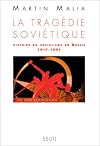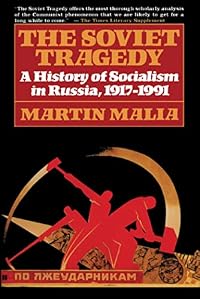
Soviet Tragedy: A History of Socialism in Russia
by Martin Malia
On This Page
Description
Details the evolution of Sovietism over seventy-four years from its origins to its end in 1991.Tags
Recommendations












Member Reviews
If you are looking for the complete reckoning with the Soviet system, Marxism, Leninism, Stalinism, and even Gorbachevs perestroika, well then Martin Malia’s “the Soviet Tragedy” is your pick.
According to Malia, the reason why the socialist revolution occurred in backward Russia instead, as Marx thought, in the leading industrialized nations can’t be explained by inequality, and poverty of the masses. Those requirements were hardly extreme in Russia compared to numerous other countries where no such thing has happened. Instead Russia of 1917 was the weakest link in the capitalist world, and the October Revolution was nothing more than a military insurrection by a well-organized minority. Another question that has caused show more numerous discussions between historians is the true face of the Soviet Union. The theory of Malia is that Lenin’s War Communism from 1917 was the normal state of this ideological empire trying to build a new socialist world order without private property and money. Instead the somewhat softer NEP during the twenties was born out of necessity, since War Communism was ruining the country and the economy. In other words, NEP was an essential retreat from ideology so the Party could fight another day. This idea has a very important consequence since it means that Stalin with his murderous strategy was the logical heir of Lenin. It also means that policies of Khrushchevs and Gorbachev weren’t Communism with a human face, but tactical means to keep the socialist empire alive.
Accordingly Stalinism was the peak of the socialist state. Stalin built a highly industrialized superpower. The problem was that it didn’t have any foundation. A planned economy and industry based on slave work, repression, murdering millions, ecological and economical wastefulness, that produced mainly heavy industrial equipment with poor quality that the people of the Soviet system hardly gained anything from. It functioned for a while, due to the seemingly immense recourses of Russia, both in manpower and raw materials. But in the long run the bill had to be paid, and thereby the system would break down due to ecological and demographical catastrophes, and the inability of a planned economy to work. So after Stalin, USSR was in a constant decline to an unavoidable collapse that the Party rulers tried to avoid with different means. Khrushchevs liberalized the economy and oppression, thereby undermining the total power of the party, which also threatened the whole existence of the Soviet empire. The party Nomenclature with Brezhnev in the front fought back, and thereafter returned to a more static Stalinist fold. But Stalinism could only occur once, building an industrial state. As a gate keeper it further deepened the abysmal economical and moral state of the USSR, with negative growth at the end of the seventies. In the mid-eighties the perestroika of Gorbachev was actually the last hope for USSR, but it failed miserably.
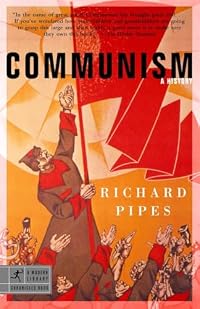
Malia provides an utterly complete analysis of Marxism, the specific background Russia posed for the Bolsheviks, and then the complete history of the Soviet Union from the Red October of 1917, until the demise of the empire in 1991. He argues impeccable for his views, with a broad use of sources and writes very well. The Soviet tragedy is certainly the book to read for anyone who wants to understand the USSR on a level that goes a bit deeper than biographical descriptions of Lenin and Stalin. There is however one of his thesis that can be disputed. Malia strongly oppose the explanation by Richard Pipes that the existence and nature of the Soviet Union in Russia would be that it was formed in a country where private property actually never had taken root. According to Malia, the answer lies instead in Marxism. But looking at post-Soviet Russia, it seams odd that this is the only part of the old empire (compared to the Baltic and the former East European states) where market economy never really got a chance, and the Russians don't seem to oppose that. In defense of Malia, there are ample of other explanations for this than any possible cultural anomalism on behalf of the Russians. One of the best books I ever had the pleasure to read. show less
According to Malia, the reason why the socialist revolution occurred in backward Russia instead, as Marx thought, in the leading industrialized nations can’t be explained by inequality, and poverty of the masses. Those requirements were hardly extreme in Russia compared to numerous other countries where no such thing has happened. Instead Russia of 1917 was the weakest link in the capitalist world, and the October Revolution was nothing more than a military insurrection by a well-organized minority. Another question that has caused show more numerous discussions between historians is the true face of the Soviet Union. The theory of Malia is that Lenin’s War Communism from 1917 was the normal state of this ideological empire trying to build a new socialist world order without private property and money. Instead the somewhat softer NEP during the twenties was born out of necessity, since War Communism was ruining the country and the economy. In other words, NEP was an essential retreat from ideology so the Party could fight another day. This idea has a very important consequence since it means that Stalin with his murderous strategy was the logical heir of Lenin. It also means that policies of Khrushchevs and Gorbachev weren’t Communism with a human face, but tactical means to keep the socialist empire alive.
Accordingly Stalinism was the peak of the socialist state. Stalin built a highly industrialized superpower. The problem was that it didn’t have any foundation. A planned economy and industry based on slave work, repression, murdering millions, ecological and economical wastefulness, that produced mainly heavy industrial equipment with poor quality that the people of the Soviet system hardly gained anything from. It functioned for a while, due to the seemingly immense recourses of Russia, both in manpower and raw materials. But in the long run the bill had to be paid, and thereby the system would break down due to ecological and demographical catastrophes, and the inability of a planned economy to work. So after Stalin, USSR was in a constant decline to an unavoidable collapse that the Party rulers tried to avoid with different means. Khrushchevs liberalized the economy and oppression, thereby undermining the total power of the party, which also threatened the whole existence of the Soviet empire. The party Nomenclature with Brezhnev in the front fought back, and thereafter returned to a more static Stalinist fold. But Stalinism could only occur once, building an industrial state. As a gate keeper it further deepened the abysmal economical and moral state of the USSR, with negative growth at the end of the seventies. In the mid-eighties the perestroika of Gorbachev was actually the last hope for USSR, but it failed miserably.
Malia provides an utterly complete analysis of Marxism, the specific background Russia posed for the Bolsheviks, and then the complete history of the Soviet Union from the Red October of 1917, until the demise of the empire in 1991. He argues impeccable for his views, with a broad use of sources and writes very well. The Soviet tragedy is certainly the book to read for anyone who wants to understand the USSR on a level that goes a bit deeper than biographical descriptions of Lenin and Stalin. There is however one of his thesis that can be disputed. Malia strongly oppose the explanation by Richard Pipes that the existence and nature of the Soviet Union in Russia would be that it was formed in a country where private property actually never had taken root. According to Malia, the answer lies instead in Marxism. But looking at post-Soviet Russia, it seams odd that this is the only part of the old empire (compared to the Baltic and the former East European states) where market economy never really got a chance, and the Russians don't seem to oppose that. In defense of Malia, there are ample of other explanations for this than any possible cultural anomalism on behalf of the Russians. One of the best books I ever had the pleasure to read. show less
Malia necessarily brief history of the Soviet Union is invaluable. He traces the trajectory of Socialism as it moved first away from market economics then when failure loomed, revived limited markets and price setting. Once breathing room was restored, back to building Socialism and suppressing markets. Malia shows how the series of Terrors hammered the populations of the Soviet Union into the mold that made them tools to be used and disposed of by the Party.
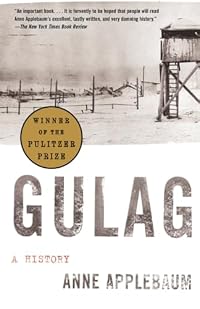
In parallel, I read Anne Applebaum's "Gulag: a History" and reading and comparing the evolution of the Gulag in lock step with the developments in larger Soviet command state made clear the fact that all Soviet citizens occupied a vast prison. The Gulag merely was a prison within a show more prison, able and willing to requisition bodies as needed from the outer prison whenever some more blood was needed to grease the wheels of the Train of History. show less
In parallel, I read Anne Applebaum's "Gulag: a History" and reading and comparing the evolution of the Gulag in lock step with the developments in larger Soviet command state made clear the fact that all Soviet citizens occupied a vast prison. The Gulag merely was a prison within a show more prison, able and willing to requisition bodies as needed from the outer prison whenever some more blood was needed to grease the wheels of the Train of History. show less
Perhaps my favorite book. This was the book that began my interest in Soviet history and intellectual history in general. Well-written and lucid. The author, an anti-revisionist historian of the Soviet Union stresses the importance of ideology in Soviet history.
A well thought out critique of Soviet Socialism from the early beginnings and origins to the, some say inevitable, downfall.
Ouvrage visant à prouver que l'idée même de communisme impliquait Staline, entre autres thèses tout aussi polémiques. Pas de reconstruction, mais de pensée sur l'histoire. Enivrant, stimulant, probablement pas tout à fait exact - je ne suis pas qualifié pour en juger - mais indéniablement fécond: ce livre fait réfléchir, plus qu'a ce qu'est arrivé, à comment on peut penser l'histoire.
May 29, 2006French
Un travail de réflexion sur les causes profonde de l'échec soviétique. Rien de novateur mais utile.
Jun 24, 2019French
Ratings
Members
- Recently Added By
Lists

r/History Recommended Reading List
603 works; 12 members
Author Information

The late Martin Malia taught at the University of California, Berkeley
Some Editions
Series
Belongs to Publisher Series
Common Knowledge
- Canonical title*
- La tragédie soviétique. Histoire du socialisme en Russie, 1917-1991
- Original title
- The Soviet tragedy : a history of socialism in Russia, 1917-1991
- Original publication date
- 1994 (1e édition originale anglaisee, Free Press) (1e édition originale anglaisee, Free Press); 1995-02-01 (1e traduction et édition française, L'univers historique, Seuil) (1e traduction et édition française, L'univers historique, Seuil); 1999-03-18 (Réédition française mise à jour par l'auteur, Points histoire, N° 257, Seuil) (Réédition française mise à jour par l'auteur, Points histoire, N° 257, Seuil)
- Important places
- USSR (Soviet Union); Russia
- Original language*
- Français
*Some information comes from Common Knowledge in other languages. Click "Edit" for more information.
Classifications
- Genres
- History, Nonfiction, Politics and Government, General Nonfiction
- DDC/MDS
- 321.9 — Society, Government, and Culture Political science Systems of governments and states Authoritarian government: Despotism, dictatorship, totalitarianism [formerly : Anarchism as political system]
- LCC
- HX311.5 .M355 — Social sciences Socialism. Communism. Anarchism Socialism. Communism. Anarchism
- BISAC
Statistics
- Members
- 211
- Popularity
- 153,509
- Reviews
- 6
- Rating
- (3.95)
- Languages
- English, French, German, Russian
- Media
- Paper, Ebook
- ISBNs
- 9
- ASINs
- 3