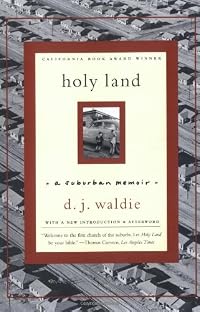
Holy Land: A Suburban Memoir
by D. J. Waldie
On This Page
Description
Since its publication in 1996, Holy Land has become an American classic. In "quick, translucent prose" (Michiko Kakutani, New York Times) that is at once lyrical and unsentimental, D. J. Waldie recounts growing up in Lakewood, California, a prototypical post-World War II suburb. Laid out in 316 sections as carefully measured as a grid of tract houses, Holy Land is by turns touching, eerie, funny, and encyclopedic in its handling of what was gained and lost when thousands of blue-collar show more families were thrown together in the suburbs of the 1950s. An intensely realized and wholly original memoir about the way in which a place can shape a life, Holy Land is ultimately about the resonance of choices--how wide a street should be, what to name a park--and the hopes that are realized in the habits of everyday life. show lessTags
Recommendations

















Member Reviews
I grew up in the rural Midwest and have always been put off by suburbs. Admittedly, this book is clearly and economically written. Admittedly, it is thoroughly researched concerning the land and water on which Lakewood stands. Yet,the life at which the book hints seems so restricted, so circumscribed, and so stereotyped that I have a difficult time understanding the appeal of this book to so many readers. Is it that someone has at last accurately described their poverty of experience?
Ratings
Members
- Recently Added By
Lists

Books Read in 2013
1,630 works; 51 members

Books Set in California
111 works; 15 members

Mustich's 1000 Books to Read Before You Die: A Life Changing List
1,001 works; 18 members
Author Information

5+ Works 351 Members
Awards and Honors
Notable Lists
Common Knowledge
- Original publication date
- 1996
- First words
- I live where a majority of Americans live: a tract house on a block of other tract houses in a neighborhood of even more. My place is at the extreme southeast corner of Los Angeles County in a 957-square-foot house of wood fr... (show all)ame and stucco construction put up hastily during the Second World War on dead-level farmland just far enough from a Douglas Aircraft plant so that bombs dropped by Japanese planes might miss it. -Introduction
That evening he thought he was becoming his habits, or - even more - he thought he was becoming the grid he knew.
He knew his suburb's first 17,500 houses had been built in less than three years. He knew what this mus... (show all)t have cost, but he did not care.
The houses still worked.
He thought of them as middle class even though 1,100-square-foot tract houses on streets meeting at right angles are not middle class at all.
Middle-class houses are the homes of people who would not live here.
-Chapter 1 - Canonical DDC/MDS
- 979.493
- Canonical LCC
- F869.L217 W35
Classifications
- Genres
- Nonfiction, Biography & Memoir, History
- DDC/MDS
- 979.493 — History & geography History of North America Great Basin and Pacific Slope region of United States California Southern Counties Los Angeles County
- LCC
- F869 .L217 .W35 — Local History of the United States, Canada and Latin America United States local history California
- BISAC
Statistics
- Members
- 240
- Popularity
- 134,965
- Reviews
- 1
- Rating
- (3.86)
- Languages
- English
- Media
- Paper, Ebook
- ISBNs
- 5
- ASINs
- 3