The Wall
by Eve Bunting
On This Page
Description
A boy and his father come from far away to visit the Vietnam War Memorial in Washington and find the name of the boy's grandfather, who was killed in the conflict.Tags
Recommendations




Member Reviews
I had to read at least one Eve Bunting book this summer and this seemed like a good complement to Walter Dean Myer's "Patrol". Written in the voice of a young boy, at first I wondered if my middle school students would have the patience for the simple prose and observations of the Vietnam Memorial wall and it's visitors. However, when the boy and his father find the name they're looking for, the story becomes personal and heart wrenching. The image of the boy's father standing, head bowed at the wall, as people come and go is powerful, and the final lines strike the most important note--that pride is okay, but we'd all rather have our loved ones with us. Even middle school students can connect to that.
I never knew my Uncle Clip, my father's youngest brother, who died eight years before I was born. But although it would probably be an overstatement to say I grew up in his shadow, there is no denying that he was a presence in my childhood home. His picture - a black and white photograph of a handsome young man, laughing, with the sun in his face - hung, framed, on my father's study wall. Beneath it, also in a frame, was an oblong piece of paper, with a pencil rubbing of his name. Long before I understood the significance of these two images, or their relationship to one another, long before I heard Uncle Clip's story, and my father's, I instinctively recognized this was a sacred space. We all of us, consciously or not, know what a show more shrine looks like.
I used to find it terrifying that Uncle Clip looked so much like my father, when he was young, almost as if the image on the wall were of my father, almost as if they might still, despite the passage of time, switch places, my father disappearing into that photograph. My older sisters, thinking perhaps, to frighten me briefly, and probably never dreaming that I would believe them for so long, once told me that the old tarp in our attic was actually the body bag in which Uncle Clip had been shipped home, from far-off Southeast Asia. As bizarre, grotesque (and patently absurd) as such an idea might seem now, it did not come as a surprise to me then, and I believed it for years. Just as Uncle Clip's photograph was with us, in the house, so too, I often felt, was his spirit - why not his body bag? It seemed frightening and strange, but then, so too did the war.
I can't remember when I first heard the story - perhaps all at once, perhaps in bits, as I questioned my parents - of my father's idealistic young brother: of his belief in the justness of the American cause in Vietnam, his belief that he would be fighting for democracy, and to protect the threatened South Vietnamese; of his determination to serve something greater than himself, and his desire to do his duty to the country he loved; of his enlistment in the army, despite the disapproval of his family, who all believed the war to be wrong; of his deployment to Vietnam, and the letter he wrote home, telling his mother (my grandmother) that the American people had been deceived, and that nothing was as he had expected it to be; and finally, of his death, on Good Friday, 1968. I can't remember when I learned that it was my father, and my Great Uncle Bob, who identified his returning body, because my grandparents were so heart-broken that they couldn't bear to do it; or when I discovered that there was such a thing as the Vietnam Veteran's Memorial - the Wall - from which the rubbing of Uncle Clip's name (my grandfather's name, too) was obtained, and to which my grandmother could never bring herself to go.
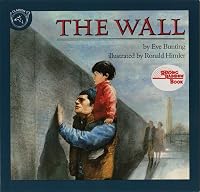
Suffice it to say that, long before I ever knew it existed, the Wall was a part of my life, and of the life of my family. It has a presence amongst us, and it casts a shadow. It belongs to us, like it belongs to so many other Americans, in a way that few public monuments do. Naturally, walking past the Veteran's Day display, in the children's room of my local public library this past weekend, I was arrested by the sight of this book, sitting on the shelf - arrested by that cover image, of father and son at the Wall. Almost against my will, not sure I really wanted to read it at all, I checked it out, and this morning, reluctantly, I put it in my bag, to be read on my commute. What would Eve Bunting have to say, I wondered, about the Wall? Would she understand its unique power and significance? Would she take an ideological position on the Vietnam War? Would I hate her book? Love it? Be indifferent?
I loved it, and am so glad I gave it a chance! The Wall is a beautiful story, told in a gentle and contemplative way, of a father and his young son visiting the memorial, to find the name of the father's father (and the son's grandfather), who died in Vietnam. Together, they search for his name, encountering others who have also come to visit the Wall: a grieving older couple, a veteran amputee in a wheelchair, a group of schoolgirls with flags, and (most poignant of all) a grandfather with his grandson. This last, in particular, had me tearing up, and was a deeply moving reminder of the loss experienced by the young boy, who would never know his own grandfather.
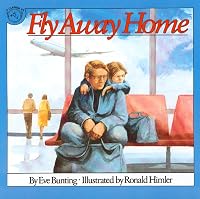
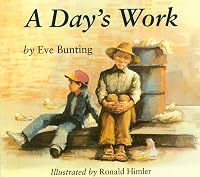
Like the Wall itself, Bunting concentrates on the grief attendant on losing a loved one in war, rather than on the politics of the war itself. This allows the reader to come to their own conclusions - although the young boy's declaration, at the end of the book, that as proud as he is of his grandfather's service to country, he would rather have had the chance to get to know him - can be read as a commentary of sorts, I suppose. The illustrations, done in somber watercolor by Ronald Himler - who has also collaborated with Bunting on titles such as Fly Away Home and A Day's Work - perfectly capture the emotional intensity of each scene, whether it be the one in which the young boy's father prays, beside the wall, or that in which the elderly couple embrace one another.
Given the way in which this book perfectly captures one of the most important aspects of the Vietnam Veterans' Memorial - that it manages to honor the fallen, without glorifying the war - I was more than a little incensed to read that one of my fellow reviewers considers it "patriotic pornography." I guess Bunting wasn't as explicitly condemnatory as this person could have wished. In addition to being a gross misreading of the story, and one of the most appallingly heartless things I have read of late, it seems to me that this fellow reviewer's comments point to a fundamental misunderstanding of what the Wall is, to so many of us.
Just as I can't remember when and where I first learned the details of Uncle Clip's story, I can't remember when I learned my father's: that he was involved, as a young seminarian and minister, in the Civil Rights and anti-War movements. That he had been in the midst of his first pastorate, at a church in Kansas, when Uncle Clip died, and had been speaking out, from the pulpit, against the Vietnam War. That he had been labeled a "communist" by some (nowadays I expect it would be "terrorist"), although the career Army men in his congregation thanked him, privately, for speaking the truth that they could not. Most of all, although I cannot remember when or how I learned it, that, whatever my father's view of the war, he loved his brother with all his heart, and knew that his actions, in volunteering, came from a noble and honorable impulse, and a selfless desire to serve. That it wasn't necessary to agree with a man's decisions, or his views, to see the goodness and nobility in him, and to honor that.
I don't think, really, I could have put all that into words, as a child, or even a young(er) adult. But it was with a deep sense of recognition that I first read, a few years back, On the Slain Collegians, one of Herman Melville's Civil War poems, in which he wrote:
"Woe for the homes of the North,
And woe for the seats of the South:
All who felt life's spring in prime,
And were swept by the wind of their place and time--
All lavish hearts, on whichever side,
Of birth urbane or courage high,
Armed them for the stirring wars--
Armed them--some to die."
And then, later:
"Warred one for Right, and one for Wrong?
So be it; but they both were young--
Each grape to his cluster clung,
All their elegies are sung."
That's how I think of my Uncle Clip: as an idealistic young man who was "swept by the wind of his place and time," a young man - one amongst many - who paid a terrible price for the misguided ambitions of the powerful. I don't need to agree with the war (and I don't) to believe he was a good man, and to mourn his death. And The Wall - whether we're speaking of this book, or of The Wall itself - doesn't require me to. It doesn't require anything of me, of us, politically. What it does do is provide a space, a unique and powerful space, in which we all, regardless of our views, can mourn our loved ones, and honor the dead. Oh Maya Lin! You did a good, good thing, and a profoundly important service to your country, when you designed that wall!
Today, as I write this review, it is Veteran's Day. My father, who isn't in the best of health, has been speaking recently of seeing the Wall, one last time, before he dies. I think that I will look into going down to D.C., this spring. We'll go to the Wall, my father and I, like the two in this book, and we'll search for the name of that laughing young man, amongst the many thousands of his comrades. My father will pray for the dead, and that his brother's soul be at peace. And I? I will sing my uncle's elegy. With all my heart, will I sing it. show less
I used to find it terrifying that Uncle Clip looked so much like my father, when he was young, almost as if the image on the wall were of my father, almost as if they might still, despite the passage of time, switch places, my father disappearing into that photograph. My older sisters, thinking perhaps, to frighten me briefly, and probably never dreaming that I would believe them for so long, once told me that the old tarp in our attic was actually the body bag in which Uncle Clip had been shipped home, from far-off Southeast Asia. As bizarre, grotesque (and patently absurd) as such an idea might seem now, it did not come as a surprise to me then, and I believed it for years. Just as Uncle Clip's photograph was with us, in the house, so too, I often felt, was his spirit - why not his body bag? It seemed frightening and strange, but then, so too did the war.
I can't remember when I first heard the story - perhaps all at once, perhaps in bits, as I questioned my parents - of my father's idealistic young brother: of his belief in the justness of the American cause in Vietnam, his belief that he would be fighting for democracy, and to protect the threatened South Vietnamese; of his determination to serve something greater than himself, and his desire to do his duty to the country he loved; of his enlistment in the army, despite the disapproval of his family, who all believed the war to be wrong; of his deployment to Vietnam, and the letter he wrote home, telling his mother (my grandmother) that the American people had been deceived, and that nothing was as he had expected it to be; and finally, of his death, on Good Friday, 1968. I can't remember when I learned that it was my father, and my Great Uncle Bob, who identified his returning body, because my grandparents were so heart-broken that they couldn't bear to do it; or when I discovered that there was such a thing as the Vietnam Veteran's Memorial - the Wall - from which the rubbing of Uncle Clip's name (my grandfather's name, too) was obtained, and to which my grandmother could never bring herself to go.
Suffice it to say that, long before I ever knew it existed, the Wall was a part of my life, and of the life of my family. It has a presence amongst us, and it casts a shadow. It belongs to us, like it belongs to so many other Americans, in a way that few public monuments do. Naturally, walking past the Veteran's Day display, in the children's room of my local public library this past weekend, I was arrested by the sight of this book, sitting on the shelf - arrested by that cover image, of father and son at the Wall. Almost against my will, not sure I really wanted to read it at all, I checked it out, and this morning, reluctantly, I put it in my bag, to be read on my commute. What would Eve Bunting have to say, I wondered, about the Wall? Would she understand its unique power and significance? Would she take an ideological position on the Vietnam War? Would I hate her book? Love it? Be indifferent?
I loved it, and am so glad I gave it a chance! The Wall is a beautiful story, told in a gentle and contemplative way, of a father and his young son visiting the memorial, to find the name of the father's father (and the son's grandfather), who died in Vietnam. Together, they search for his name, encountering others who have also come to visit the Wall: a grieving older couple, a veteran amputee in a wheelchair, a group of schoolgirls with flags, and (most poignant of all) a grandfather with his grandson. This last, in particular, had me tearing up, and was a deeply moving reminder of the loss experienced by the young boy, who would never know his own grandfather.
Like the Wall itself, Bunting concentrates on the grief attendant on losing a loved one in war, rather than on the politics of the war itself. This allows the reader to come to their own conclusions - although the young boy's declaration, at the end of the book, that as proud as he is of his grandfather's service to country, he would rather have had the chance to get to know him - can be read as a commentary of sorts, I suppose. The illustrations, done in somber watercolor by Ronald Himler - who has also collaborated with Bunting on titles such as Fly Away Home and A Day's Work - perfectly capture the emotional intensity of each scene, whether it be the one in which the young boy's father prays, beside the wall, or that in which the elderly couple embrace one another.
Given the way in which this book perfectly captures one of the most important aspects of the Vietnam Veterans' Memorial - that it manages to honor the fallen, without glorifying the war - I was more than a little incensed to read that one of my fellow reviewers considers it "patriotic pornography." I guess Bunting wasn't as explicitly condemnatory as this person could have wished. In addition to being a gross misreading of the story, and one of the most appallingly heartless things I have read of late, it seems to me that this fellow reviewer's comments point to a fundamental misunderstanding of what the Wall is, to so many of us.
Just as I can't remember when and where I first learned the details of Uncle Clip's story, I can't remember when I learned my father's: that he was involved, as a young seminarian and minister, in the Civil Rights and anti-War movements. That he had been in the midst of his first pastorate, at a church in Kansas, when Uncle Clip died, and had been speaking out, from the pulpit, against the Vietnam War. That he had been labeled a "communist" by some (nowadays I expect it would be "terrorist"), although the career Army men in his congregation thanked him, privately, for speaking the truth that they could not. Most of all, although I cannot remember when or how I learned it, that, whatever my father's view of the war, he loved his brother with all his heart, and knew that his actions, in volunteering, came from a noble and honorable impulse, and a selfless desire to serve. That it wasn't necessary to agree with a man's decisions, or his views, to see the goodness and nobility in him, and to honor that.
I don't think, really, I could have put all that into words, as a child, or even a young(er) adult. But it was with a deep sense of recognition that I first read, a few years back, On the Slain Collegians, one of Herman Melville's Civil War poems, in which he wrote:
"Woe for the homes of the North,
And woe for the seats of the South:
All who felt life's spring in prime,
And were swept by the wind of their place and time--
All lavish hearts, on whichever side,
Of birth urbane or courage high,
Armed them for the stirring wars--
Armed them--some to die."
And then, later:
"Warred one for Right, and one for Wrong?
So be it; but they both were young--
Each grape to his cluster clung,
All their elegies are sung."
That's how I think of my Uncle Clip: as an idealistic young man who was "swept by the wind of his place and time," a young man - one amongst many - who paid a terrible price for the misguided ambitions of the powerful. I don't need to agree with the war (and I don't) to believe he was a good man, and to mourn his death. And The Wall - whether we're speaking of this book, or of The Wall itself - doesn't require me to. It doesn't require anything of me, of us, politically. What it does do is provide a space, a unique and powerful space, in which we all, regardless of our views, can mourn our loved ones, and honor the dead. Oh Maya Lin! You did a good, good thing, and a profoundly important service to your country, when you designed that wall!
Today, as I write this review, it is Veteran's Day. My father, who isn't in the best of health, has been speaking recently of seeing the Wall, one last time, before he dies. I think that I will look into going down to D.C., this spring. We'll go to the Wall, my father and I, like the two in this book, and we'll search for the name of that laughing young man, amongst the many thousands of his comrades. My father will pray for the dead, and that his brother's soul be at peace. And I? I will sing my uncle's elegy. With all my heart, will I sing it. show less
I liked this book for a couple of reasons. First, using the point of view of the little boy was a very powerful tool to demonstrate the innocence and naivety of children, especially in the face of such a difficult war and it's detrimental aftermath. For example, when the little boy's dad finds his father's name on the wall and is tracing it onto paper the little boy describes his actions as "Dad's rubbing the name, rubbing and rubbing as if he wants to wipe it away. Maybe he wants to remember the way it feels." This shows that the little boy might not totally understand why his father is doing what he's doing, but can understand that this moment means a lot to his dad. The illustrations included in this book were also very powerful and show more complimented the story well. It was a rainy day when the dad and son went to visit the wall and the color of the pictures reflects the gray, dreary feel of rainy days. The big idea of this book is to show the impact of the Vietnam War on American families even decades after it has ended. show less
I have read this book multiple times over the years and each time i read it, it is like it's my first time. I love this book and recommend it to anyone of any age. It is really an emotional book that connects to all readers. The characters in this cook are a boy and his father looking for the grandfathers name on the wall. The characters emotions are very well expressed throughout the whole story. The fathers mood is very somber and sad. The boys emotions are sad but also very curious and intrigued. The illustrations pretty much make the whole story. You don't even need the words to know what is going on in the story. The illustrations show the wall and the expression on all the characters faces and the flags lined against the wall. I show more think if you took the illustrations away from the book it would get a little boring and have less emotional connection to it. I think the big idea of this book is that we are not alone in our loss of loved ones and that many people are going through the same pain as us. We see that with the solider with no legs and the lady who comes and is crying and all just by all the flags and flowers that are left along the wall to show love. show less
This book perfectly conveyed the meaning of loss and longing for loved ones that have passed. I loved the vivid descriptions of how sacred this trip to the grandfather's memorial wall was to the father and son, especially when they place the paper over his name to trace their loved one's name. I also thought it was sweet when towards the end, the young boy realized how sad he was that he never would meet his grandfather and the longing and loss that accompanied this. This book is a perfect example of a narrative done right, with the inner dialogue and feeling of being placed directly into this sad moment. I think it would be great to show to a student who has experienced loss. I really loved this book!
In my opinion, this is a fantastic book because the author is able to create so much emotion through the descriptions and language she uses in the text. For instance, she paints pictures with her words such as, “Dad’s rubbing the name, rubbing and rubbing as if he wants to wipe it away” and “They make a lot of noise and ask a lot of questions and all the time Dad just stands there with his head bowed, and I stand beside him.” These images create the solemn mood of the story by using specific word choice and juxtaposing the father’s mood with the mood of everyone else around him. In addition, the illustrations portray the love and the connection between the young boy and his father. There are illustrations of the boy show more imitating his father, the father with his hand on the boys shoulder, and the boy and the father holding hands. These images emphasize the connection between the two and make them loving and relatable characters. The big idea of this story is that sad and emotional times can bring people together in the most meaningful ways. show less
I liked this book overall. It was emotionally moving, which isn't a common trait of most picture books I've read. From the sadness felt by the boy because of missing his grandfather, to the sense of pride that the boy's father has in recognizing his father's sacrifice. This book pushes readers to think about difficult issues like war and loss, but also helps them address pride and being grateful to those who have sacrificed so much for us. The big idea is all about war and it's consequences.
Members
- Recently Added By
Lists

Reading Rainbow
193 works; 10 members

Books That Made Us Cry
278 works; 145 members
Author Information

276+ Works 51,830 Members
Eve Bunting was born in 1928 in Maghera, Ireland, as Anne Evelyn Bunting. She graduated from Northern Ireland's Methodist College in Belfast in 1945 and then studied at Belfast's Queen's College. She emigrated with her family in 1958 to California, and became a naturalized citizen in 1969. That same year, she began her writing career, and in 1972, show more her first book, "The Two Giants" was published. In 1976, "One More Flight" won the Golden Kite Medal, and in 1978, "Ghost of Summer" won the Southern California's Council on Literature for Children and Young People's Award for fiction. "Smokey Night" won the American Library Association's Randolph Caldecott Medal in 1995 and "Winter's Coming" was voted one of the 10 Best Books of 1977 by the New York Times. Bunting is involved in many writer's organizations such as P.E.N., The Authors Guild, the California Writer's Guild and the Society of Children's Book Writers. She has published stories in both Cricket, and Jack and Jill Magazines, and has written over 150 books in various genres such as children's books, contemporary, historic and realistic fiction, poetry, nonfiction and humor. (Bowker Author Biography) show less
All Editions
Awards and Honors
Awards
Distinctions
Notable Lists
Common Knowledge
- Canonical title
- The Wall
- Important events
- Vietnam War
- First words
- This is the wass, my grandfather's wall.
- Last words
- (Click to show. Warning: May contain spoilers.)I'd rather have him here.
Classifications
- Genre
- Children's Books
- DDC/MDS
- 791.45 — Arts & recreation Recreation, sports, and performing arts Public performances Motion pictures, radio, television, podcasting Television
- LCC
- PZ7 .B91527 .W — Language and Literature Fiction and juvenile belles lettres Fiction and juvenile belles lettres Juvenile belles lettres
- BISAC
Statistics
- Members
- 1,878
- Popularity
- 11,464
- Reviews
- 190
- Rating
- (4.32)
- Languages
- Chinese, English
- Media
- Paper, Audiobook, Ebook
- ISBNs
- 20
- UPCs
- 3
- ASINs
- 9