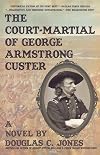
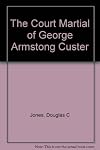
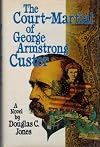
The Court-Martial of George Armstrong Custer
by Douglas C. Jones
On This Page
Description
Suppose that George Armstrong Custer did not die at the Battle of Little Bighorn. Suppose that, instead, he was found close to death at the scene of the defeat and was brought to trial for his actions. With a masterful blend of fact and fiction, "The Court-Martial of George Armstrong Custer" tells us what might have happened at that trial as it brings to life the most exciting period in the history of the American West.Tags
Recommendations



















Member Reviews
This is a novel that is chock fill of real historic detail, valid suppositions and great storytelling. The author is a military lawyer and so the account of the court-martial is detailed and convincing. The basis of the story is simple; suppose Custer had survived Little Big Horn? The book is not some overblown action story or historical romance. It is, as accurately as the author can surmise, what the subsequent court-martial of Custer would have been like. But it is not a dry supposition; Jones does a marvelous job in making his players interesting, memorable but completely in character. His protagonist is the chief prosecutor for the army and we see most of the story through his eyes, but we also are witness to events taking place show more from out West to the White House.
We listen in rapt attention to the testimony of Generals Terry and Crook, who led the expedition, explain how Custer exceeded his orders, and to Benteen and Reno as they retell the battle. There are other witnesses as well, but much is also going on behind the scenes as the government wrestles with conflicting goals; punish the man who brought such disaster on the army, but also defend the military actions of his superiors and the leaders back in Washington.
Jones also does a fantastic job in setting the scene. The court-martial is held in New York City in the late 1870s and Jones adds authenticity and atmosphere when we leave the courtroom to go to eat at Delmonico's or tour down Fifth Avenue.
I happily recommend this book to those who like their historic fiction with more emphasis on the history and also those who might be interested in learning more about the Battle of Little Bighorn and the political and military actions and discussions leading up to the battle and subsequent to it. show less
We listen in rapt attention to the testimony of Generals Terry and Crook, who led the expedition, explain how Custer exceeded his orders, and to Benteen and Reno as they retell the battle. There are other witnesses as well, but much is also going on behind the scenes as the government wrestles with conflicting goals; punish the man who brought such disaster on the army, but also defend the military actions of his superiors and the leaders back in Washington.
Jones also does a fantastic job in setting the scene. The court-martial is held in New York City in the late 1870s and Jones adds authenticity and atmosphere when we leave the courtroom to go to eat at Delmonico's or tour down Fifth Avenue.
I happily recommend this book to those who like their historic fiction with more emphasis on the history and also those who might be interested in learning more about the Battle of Little Bighorn and the political and military actions and discussions leading up to the battle and subsequent to it. show less
George Custer was an ambitious soldier, who had risen as high as Brigadier General, but had been cut back to peace-time Colonel after the Civil war. He tried to attack the largest concentration of Northern Plains Indians ever achieved, at Little Big horn Creek. Using a plan he had tried before, he plowed into them, and was wiped out along with all of his immediate command. What if he had survived the battle, after losing it the way he actually did? A Court Martial would have been held. It is a fun read, revealing that Douglas Jones had researched the man's previous career, and gathered an interesting set of generals to preside.
Read it twice.
Read it twice.
Historical fiction at its best. What if Custer had survived Little Big Horn? Did he make the right decisions in the heat of battle? Is it right to punish an officer for the decisions he makes while in battle based on the facts he has at hand? This are the questions discussed in this book.
Ratings
Members
- Recently Added By
Lists

Best Alternate History
111 works; 60 members
Author Information
21+ Works 748 Members
Awards and Honors
Awards
Common Knowledge
- Canonical title
- The Court-Martial of George Armstrong Custer
- Original publication date
- 1976
- People/Characters
- George Armstrong Custer
- Related movies
- Hallmark Hall of Fame: The Court-Martial of George Armstrong Custer (1977 | IMDb)
Classifications
- Genres
- Fiction and Literature, General Fiction, Historical Fiction
- DDC/MDS
- 813.5 — Literature & rhetoric American literature in English American fiction in English 1900-1999
- LCC
- PZ4 .J7534 — Language and Literature Fiction and juvenile belles lettres Fiction and juvenile belles lettres Fiction in English
- BISAC
Statistics
- Members
- 146
- Popularity
- 224,837
- Reviews
- 3
- Rating
- (3.27)
- Languages
- English
- Media
- Paper, Audiobook
- ISBNs
- 9
- ASINs
- 3