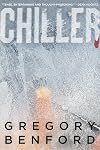
Chiller
by Sterling Blake
On This Page
Description
Blake enters the arena of consummate suspense writers with a novel that pits a scientist working in the misunderstood field of cryonics--freezing corpses for future revival--against a serial killer. A fascinating subject explored realistically . . . thought-provoking.--Dean Koontz.Tags
Recommendations































Member Reviews
This is a thriller about an Alcor-like cryonics facility originally published in 1993 under the pen name "Sterling Blake," republished in 2011 under the real name of Gregory Benford, hard sf writer. It's cleverly put together. The novel rotates between four perspectives: a scientist who helps out at Immortality Incorporated (I²), a technician and cryonicist who works there, that cryonicist's girlfriend, and a deranged religious killer who sees cryonics as an affront against God. At first it seems like a fairly standard thriller with cryonics as the maguffin: the killer stalks the other characters, his attacks gradually increasing in ferocity and impact.
I don't normally do this, but it seems warranted in this case: DON'T READ IF YOU show more EVER INTEND TO READ THIS BOOK!Both the back cover and the review blurbs in front give away what I think is a pretty clever twist. The killer succeeds in killing one of the other protagonists... then another... then another! At that point cryonics is reviewed to not just be a maguffin, because all the dead characters suddenly wake up thirty years in the future, revived by the advancements of medical science. Their killer had gone to ground, but now that they're back, he emerges from hiding to finish the job. It's a clever spin on the typical technothiller formula, where usually the specifics of the technological advance don't matter, and any changes to society don't actually transpire. This is also enhanced by how meticulous the story's details about cryonics are. Benford is a paid-up member of the real Alcor, and we get a lot of good detail and defenses of the movement.
That said, at six hundred pages it feels a bit bloated; you could cut at least a hundred, if not more, and accelerate things quite a bit. Around the midpoint I started to get bored waiting for things to pick up. Conversely, I wish we'd gotten to see a bit more ofthe future and cryonics' impact on society; it seemed like there was only time to quickly finish off the killer plotline once we were there, though maybe 1990s technothrillers aren't a place to expect a lot of interesting futurism .
Also, the small press 2011 reprint is a bit rough: "straight quotes" instead of proper “curly quotes” look amateurish, and lots of paragraphs are missing their indentations. The whole thing read like it was printed from the file Benford sent to his publisher back in 1993, not the properly copy-edited version they would have prepared. show less
I don't normally do this, but it seems warranted in this case: DON'T READ IF YOU show more EVER INTEND TO READ THIS BOOK!
That said, at six hundred pages it feels a bit bloated; you could cut at least a hundred, if not more, and accelerate things quite a bit. Around the midpoint I started to get bored waiting for things to pick up. Conversely, I wish we'd gotten to see a bit more of
Also, the small press 2011 reprint is a bit rough: "straight quotes" instead of proper “curly quotes” look amateurish, and lots of paragraphs are missing their indentations. The whole thing read like it was printed from the file Benford sent to his publisher back in 1993, not the properly copy-edited version they would have prepared. show less
Ratings
Members
- Recently Added By
Author Information

239+ Works 22,495 Members
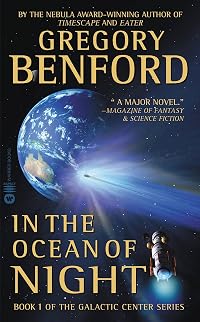
Gregory Benford, was born on January 30, 1941 in Mobile, Alabama. He is a physicist and science fiction writer who earned his Ph.D. from the University of California, San Diego, in 1967. He is a Woodrow Wilson Fellow and a consultant for NASA. Benford's first novel "Deeper than the Darkness" (1970), which was revised as "The Stars in Shroud" show more (1978), gave him notice as a serious Science Fiction writer. His most popular work is "Timescape" (1980), which was the winner of the Nebula and John W. Campbell Memorial Awards; it presented a hard physics approach to limited time travel. "In the Ocean of Night" (1977), "Across the Sea of Suns" (1984), "Great Sky River" (1987), "Tides of Light" (1989) and "Furious Gulf" (1994) were all a part of the Galactic Cluster Series. He has also written the juvenile novel "Jupiter Project" (1975), "Against Infinity" (1983) and the thriller "Artifact" (1985). He has been nominated for 12 Nebula Awards (winning for "Timescape" and for the novelette, "If the Stars are Gods"). Benford, writing alternately with Bruce Sterling, produces science fact articles for the Magazine of Fantasy and Science Fiction. They took over after the death of regular columnist Isaac Asimov. He has also co-edited theme anthologies with Martin H. Greenburg, which include "Hitler Victorious" (1986), "Nuclear War" (1988), "What Might Have Been, Volume 1: Alternate Empires" (1988), "Volume 2: Alternate Heroes" (1989) and "Volume 3: Alternate Wars." (Bowker Author Biography) show less
Awards and Honors
Awards
Classifications
Statistics
- Members
- 85
- Popularity
- 374,607
- Reviews
- 2
- Rating
- (3.69)
- Languages
- English
- Media
- Paper, Ebook
- ISBNs
- 4
- ASINs
- 1