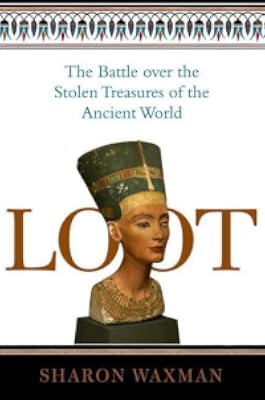
Loot: The Battle over the Stolen Treasures of the Ancient World
by Sharon Waxman
On This Page
Description
For the past two centuries, the West has been plundering the treasures of the ancient world to fill its great museums, but in recent years, the countries where ancient civilizations originated have begun to push back, taking museums to court, prosecuting curators, and threatening to force the return of these priceless objects. Where do these treasures rightly belong? Sharon Waxman, a former culture reporter for The New York Times and a longtime foreign correspondent, brings us inside this show more high-stakes conflict, examining the implications for the preservation of the objects themselves and for how we understand our shared cultural heritage. show lessTags
Recommendations














Member Recommendations
Member Reviews
Reads like a thriller, in my view, and provides deep context on the anything but black and white issues of who owns antiquities. Waxman tells a story like nobody's business, and this ability raises more questions than answers about a controversy we'll likely never move past.
[a:Sharon Waxman|61214|Sharon Waxman|http://www.goodreads.com/images/nophoto/nophoto-U-50x66.jpg] does an excellent job in Loot tackling the world of cultural antiquities in museum collections. Written in a journalistic style, Loot offers a view from the many sides of a complicated issue. As a museum professional, it was heartbreaking at times to read of what were presented as illicit and at times illegal acquisitions by curators and institutions (Waxman focuses mostly on the Louvre, the Met and the Getty). More challenging is the question of materials taken under colonial rule. Waxman's portrayal of pillaging antiquities dealers who manipulated weak colonial governments into relinquishing their vast cultural patrimony makes the reader show more want to side with those advocating restitution. However, the story doesn't end there. Waxman also tells us about the continued difficulties that many of these countries have in preventing looting and illegal export of materials found in archeological sites and their own museums.
For me, Loot was also fascinating because many of the recent and important cases for restitution have largely rested on the availability of information. Museums who acquired materials have often been complicit with antiquities dealers and auction houses in suppressing information about the provenance of acquisitions. Waxman also notes that museums also conveniently leave out this information when discussing pieces acquired through other distasteful means, such as colonial conquest. Where ever you end up standing on the question of repatriation, Loot will change the way you think about the objects you see on your next museum visit. show less
An eye-opening series of accounts of the secret history of your favorite museum installations. In addition to tracing the path that antiquities take from their countries of origin to the national institutions that house them, Waxman continually raises and reraises the ethical question of the organizations and governments that acquire these antiquities in order to preserve them in perpetuity, and the practical desire of returning them to their home regions, where political and social situations may be less than ideal.Basically, the book boils down to this: who does ancient art belong to, the world, or the specific country of origin? Would it deprive the world of something precious to take the Elgin Marbles out of the British Museum, show more where millions of people who otherwise wouldn't be able to see them, and return them to Greece, where there are serious doubts about the country's ability to continue to preserve them? And what right does one country have over another to say such a thing? show less
If you asked me a few months ago if the treasures of the ancient world should be given back to their respective countries from the museums of the west I would have with my whole heart said yes. However as this book points out the issue is not as simple as that. The true ownership of some of the treasures has become murky through time. Do they just belong to their country of origin or to the whole of humanity? If you are of the camp that they belong to everyone then they are certainly safest in the museums of the west. I was shocked to learn that the average Egyptian has little regard for the artifacts of the ancient world. The picture of people lounging on ancient statues in the courtyard of the Cairo museum was hard for me to believe. show more Of course I grew up visiting museums where they don't even allow you to take a picture of their fairly modern items, let alone touch anything. Zahi Hawass has been spearheading Egypts attempts to get it's treasures back. It seems like he was making headway too, I read online that the Met agreed to give back 19 items from it's collection in exchange for the King Tut exhibit now in Time Square. Of course as we all know Egypt has been having some problems of late. As of March 5, Hawass has quit his post because of the wide spread looting of the Cairo museum as well as other dig sites throughout Egypt. What if the museums of the world had given back the Rosetta Stone and the bust of Nefertiti. Would they even be safe in Egypt right now? This book will make you think and rethink your position. I found this book fascinating. As an avid museum goer it put collections in museums in whole new light for me. show less
This is a though-provoking look at large encyclopedic museums, their practices in the past and present in dealing with antiquities from across the globe. As the author states, the book raises more questions than answers about cultural patrimony, looting, restitution, who should keep antiquities, and whether the 1970 UNESCO laws really discourage looting or whether they actually foster black market selling of antiquities to individuals which will never be seen by anyone else. I read this book for a book club, and probably would not have picked it up otherwise. However, it was a surprisingly easy read, and very interesting.
In "Loot" Sharon Waxman attempts to explain the story of how many of the great museums of the West acquired their artifacts, and how they expand upon their collections today. Unfortunately, the author eventually succumbs to a shallow flashiness that leaves the reader without a full understanding of how the antiquity trade operates on a global scale.
Waxman examines her story primarily through a series of high-profile interviews with prominent operators such as Zahi Hawas, then secretary-general of Egypt's Council of Antiquities (and all-purpose thorn-in-the-side to the curators and collectors of the great museums outside of his country), Neil MacGregor, director of the BM, Philippe de Montebello, director of the Met, and Henri Loyrette, show more director of the Louvre. Much of the pre-twentieth century collections of these institutions were acquired (though acquired seems far too mild a word for works such as the zodiac ceiling of the Temple of Denderah and half of the statues of the Parthenon, both literally ripped from their masonry) under the auspices of the Ottoman Empire, which was indifferent if not outright hostile to the treasures of other cultures within its boundaries, or during, in the case of Egypt, a corrupt system of partage that existed until the 1920's. She dutifully recounts the early history of archeology since its beginnings in the mid eighteenth century, relying heavily (and I am putting this mildly) on such well-known works such as "Gods, Graves, and Scholars" and especially "The Rape of the Nile" to recount the horrifying antiquities-grab that occured during previous centuries. Waxman goes on to describe how buying objects with questionable--or often entirely unknown provenance--was considered acceptable untl the late 1960's. It was only then than the cultural branch of the UN put into place a series of strictures designed to prevent the looting or smuggling of artifacts.
It is to the author's credit that she remains objective and tries to examine both sides to this difficult problem. Should an institution be responsible for returning items obtained centuries ago under conditions that would now be considered illegal? Does an object belong to the world or to a particular people-especially when the cultural heirs of that culture have vanished? Is is better to keep a unique object in the holdings of an museum that can display it for more people to wonder over? In the case of an institution that doesn't have the financial ability to keep something safe (the tragic story of the golden hippocampus of the Lydian Horde, returned to the brief custodianship of a tiny provincial museum by a reluctant Met, and now gone, perhaps forever, is described in detail), should an item be returned at all? Does insistence of strict provenance for trading antiquities really help, or does it merely drive the trade underground?
At this point, I might have given the book four stars. I kept waiting, however, for something more. Waxman makes many digs at the patronizing or even culturally imperialistic stances of Europe and the United States, yet she herself is guilty of this myopic attitude. Of the huge problems of looting and smuggling that exist in Latin America and Asia she breathes not a word.( Only the sack of the statues of Benin are mentioned.) Of the industry of manufactured fakes? Nothing. Does she go out into the field except in Egypt--even to Ceveteri, the great Etruscan site just north of Rome, and the scene of so much looting? No, she does not. Does she make a foray to Geneva, a prominent conduit for so many antiquities due to its status as a free port and talk to a few Swiss paper-pushers and ask them to explain themselves? Nope. This latter omission is simply inexcusable as Switzerland is cited again and again as a problem in the antiquities trade. Indeed, Waxman pretty much confines her investigations to talks with the famous, their overworked curators, and a few rumpled and driven journalists for old time's sake. She scarcely talks to field archeologists, giving only a cursory nod to Jack Davis, head of the consortium of the US universities operating archeology programs in Greece--a person who should have had much more time devoted to his position, which is that most everything should remain in situ to begin with. Indeed, except for Usak, the little museum in Turkey, Waxman confines herself to exploring the cushy and the well-known.
This could be excused, of course, as perhaps acceptable gaps in an overview that can't do everything. Yet Waxman spends a huge amount of time and space dealing with the case of Marion True, the former antiquities curator for the Getty, who was tried by the Italian government for illegal antiquities trading. This last part of the book, frankly, is an embarrassment. She spends far too much time on the bed-hopping activities of the staff, making the feeble excuse for her own salacious interest that who is sleeping with whom somehow has something to do with greater problems at the Getty. She jets off to Paros, where Ms True bought a house with a questionable mortgage from donors, for a little look-see of the Greek Isles--entirely irrelevant to the greater story. She interviews Giacomo Medici, the source of many of the Getty's gains via Ms True, though she doesn't speak Italian and he doesn't speak English. Would it have killed her to use an interpreter for such an important part of the story? Indeed, her entire understanding of the Italian judicial system seems muddled and confused.
In the end, Marion True's career is over and the Getty was forced to return many of the highlights of their collection. The author makes a few weak recommendations that museums should do a better job of labeling their works and citing in greater detail where they come from. And there the book ends, not with a bang, but with a whimper.Even the author's last set-piece of the book, as she lingers outside a dealer's showroom window in the fabulously wealthy town of St. Moritz and ponders the treasures within, is more of a reminder that she perhaps cares more for an ego-boosting glamour-trot amongst the great and the good than to really demonstrate the true global ramifications of the international illegal antiquities trade, and the sacking of the world's patrimony. show less
Waxman examines her story primarily through a series of high-profile interviews with prominent operators such as Zahi Hawas, then secretary-general of Egypt's Council of Antiquities (and all-purpose thorn-in-the-side to the curators and collectors of the great museums outside of his country), Neil MacGregor, director of the BM, Philippe de Montebello, director of the Met, and Henri Loyrette, show more director of the Louvre. Much of the pre-twentieth century collections of these institutions were acquired (though acquired seems far too mild a word for works such as the zodiac ceiling of the Temple of Denderah and half of the statues of the Parthenon, both literally ripped from their masonry) under the auspices of the Ottoman Empire, which was indifferent if not outright hostile to the treasures of other cultures within its boundaries, or during, in the case of Egypt, a corrupt system of partage that existed until the 1920's. She dutifully recounts the early history of archeology since its beginnings in the mid eighteenth century, relying heavily (and I am putting this mildly) on such well-known works such as "Gods, Graves, and Scholars" and especially "The Rape of the Nile" to recount the horrifying antiquities-grab that occured during previous centuries. Waxman goes on to describe how buying objects with questionable--or often entirely unknown provenance--was considered acceptable untl the late 1960's. It was only then than the cultural branch of the UN put into place a series of strictures designed to prevent the looting or smuggling of artifacts.
It is to the author's credit that she remains objective and tries to examine both sides to this difficult problem. Should an institution be responsible for returning items obtained centuries ago under conditions that would now be considered illegal? Does an object belong to the world or to a particular people-especially when the cultural heirs of that culture have vanished? Is is better to keep a unique object in the holdings of an museum that can display it for more people to wonder over? In the case of an institution that doesn't have the financial ability to keep something safe (the tragic story of the golden hippocampus of the Lydian Horde, returned to the brief custodianship of a tiny provincial museum by a reluctant Met, and now gone, perhaps forever, is described in detail), should an item be returned at all? Does insistence of strict provenance for trading antiquities really help, or does it merely drive the trade underground?
At this point, I might have given the book four stars. I kept waiting, however, for something more. Waxman makes many digs at the patronizing or even culturally imperialistic stances of Europe and the United States, yet she herself is guilty of this myopic attitude. Of the huge problems of looting and smuggling that exist in Latin America and Asia she breathes not a word.( Only the sack of the statues of Benin are mentioned.) Of the industry of manufactured fakes? Nothing. Does she go out into the field except in Egypt--even to Ceveteri, the great Etruscan site just north of Rome, and the scene of so much looting? No, she does not. Does she make a foray to Geneva, a prominent conduit for so many antiquities due to its status as a free port and talk to a few Swiss paper-pushers and ask them to explain themselves? Nope. This latter omission is simply inexcusable as Switzerland is cited again and again as a problem in the antiquities trade. Indeed, Waxman pretty much confines her investigations to talks with the famous, their overworked curators, and a few rumpled and driven journalists for old time's sake. She scarcely talks to field archeologists, giving only a cursory nod to Jack Davis, head of the consortium of the US universities operating archeology programs in Greece--a person who should have had much more time devoted to his position, which is that most everything should remain in situ to begin with. Indeed, except for Usak, the little museum in Turkey, Waxman confines herself to exploring the cushy and the well-known.
This could be excused, of course, as perhaps acceptable gaps in an overview that can't do everything. Yet Waxman spends a huge amount of time and space dealing with the case of Marion True, the former antiquities curator for the Getty, who was tried by the Italian government for illegal antiquities trading. This last part of the book, frankly, is an embarrassment. She spends far too much time on the bed-hopping activities of the staff, making the feeble excuse for her own salacious interest that who is sleeping with whom somehow has something to do with greater problems at the Getty. She jets off to Paros, where Ms True bought a house with a questionable mortgage from donors, for a little look-see of the Greek Isles--entirely irrelevant to the greater story. She interviews Giacomo Medici, the source of many of the Getty's gains via Ms True, though she doesn't speak Italian and he doesn't speak English. Would it have killed her to use an interpreter for such an important part of the story? Indeed, her entire understanding of the Italian judicial system seems muddled and confused.
In the end, Marion True's career is over and the Getty was forced to return many of the highlights of their collection. The author makes a few weak recommendations that museums should do a better job of labeling their works and citing in greater detail where they come from. And there the book ends, not with a bang, but with a whimper.Even the author's last set-piece of the book, as she lingers outside a dealer's showroom window in the fabulously wealthy town of St. Moritz and ponders the treasures within, is more of a reminder that she perhaps cares more for an ego-boosting glamour-trot amongst the great and the good than to really demonstrate the true global ramifications of the international illegal antiquities trade, and the sacking of the world's patrimony. show less
This is one of those books that you have to read if you're into Museum Ethics. Some of the well-known cases of cultural property contention are highlighted and they are each unique situations. Cultural property ownership will never be solved and museums will continually evolve to new schools of thought.
Members
- Recently Added By
Author Information

2 Works 548 Members
Common Knowledge
- Canonical title
- Loot: The Battle over the Stolen Treasures of the Ancient World
- People/Characters
- Giovanni Batista Belzoni; Claude Louis Berthollet; Napoleon Bonaparte; Ludwig Borchardt; Captain Pierre-François Bouchard; Jean-François Champollion (show all 23); Nicolas-Jacques Conté; Baron Dominique Vivant Denon; Costaz Desgenette; Maurizio Fiorilli; Zawi Hawass; General John Hely-Hutchinson; Ibrahim Bey El-Greitli; Baron Dominique-Jean Larrey; Giacomo Medici; Nefertiti; Horatio Nelson, 1st Viscount Nelson; François-Auguste Parseval-Grandmaison; Qassim Bey; Alire Raffeneau-Delile; Abbé Reynard; Etienne Geoffrey Saint-Hilaire; Marion True
- Important places
- Getty Villa, J. Paul Getty Museum, Malibu, California, USA; Paros, Greece; Louvre Museum, Paris, France; Denderah; Abu Simbel, Egypt; Metropolitan Museum of Art, New York, New York, USA (show all 14); Aboukir Bay; Alexandria, Egypt; Cairo, Egypt; Damietta, Egypt; Fort Rashid, Egypt; Rosetta, Egypt; Malta; Syria
- Important events
- Rosetta Stone written (196 BC); Battle of the Pyramids (1798-07-21)
- Dedication
- To Art Buchwald, Sparky Schultz, Joan Goodman, and william Paris-mentors who are greatly missed.
- First words
- It was just like Zahi Hawass to toss a bomb into the middle of someone's well-laid plans. On a bright, breezy night in June 2006, dozens of reporters and news crews, cameras and microphones were lined up at the Field Museum ... (show all)in Chicago for a pleasant and entirely noncontroversial news event; the opening of an exhibit of the treasure of King Tutankhamun, on loan from Egypt for the first time since 1977.
- Last words
- (Click to show. Warning: May contain spoilers.)It was as if the debate raging in the world of art and archaeology over provenance didn't exist. It was as if the legal histrionics going on just a few thousand miles to the south-the prosecutions and headlines-were of no significance. It was as if Jean Paul Cahn, from a famous family of antiquities dealers, had decided that he could still live by the phrase that accompanied the exhibit of antiquities at the Egyptian Hall in London in 1929:"They say it is God's property, and he gives it to whom he pleases."
- Original language
- English
Classifications
Statistics
- Members
- 371
- Popularity
- 84,742
- Reviews
- 7
- Rating
- (3.89)
- Languages
- English, Spanish
- Media
- Paper, Ebook
- ISBNs
- 6
- ASINs
- 5