On This Page
Description
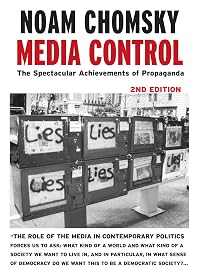
"Chomsky's backpocket classic on wartime propaganda and opinion control has been updated and expanded into a two-section book, and redesigned following the acclaimed format of his Open Media anti-war bestseller, 9-11. The new edition of Media Control also includes 'The Journalist from Mars, ' Chomsky's 2002 talk on the media coverage of America's 'new war on terrorism.' Chomsky begins by asserting two models of democracy -- one in which the public actively participates, and one in which the show more public is manipulated and controlled. According to Chomsky 'propaganda is to democracy what the bludgeon is to a totalitarian state, ' and the mass media is the primary vehicle for delivering propaganda in the United States. From an examination of how Woodrow Wilson's Creel Commission 'suceeded, within six months, in turning a pacifist population into a hysterical, war-mongering population, ' to Bush Sr.'s war on Iraq, Chomsky examines how the mass media and public relations industries have been used as propaganda to generate public support for going to war. Chomsky touches on how the modern public relations industry has been influenced by Walter Lippmann's theory of 'spectator democracy, ' in which the public is seen as a 'bewildered herd' that needs to be directed, not empowered; and how the public relations industry in the United States focuses on 'controlling the public mind, ' and not on informing it. Originally written in the immediate aftermath of the Gulf War, Media Control cites numerous examples of how Bush Sr. pushed the American population into supporting an attack on Iraq, a particularly relevant analysis today as Bush Jr. attempts to convince a reluctant population that we should again go to war."--Publisher description. show lessTags
Recommendations




Member Reviews
Read: July 2017
Shorter, and more readable than the last Chomsky book I read, I found Media Control thoroughly chilling. He calls the majority of the population (of America, though it can apply anywhere else as well) 'the bewildered herd' - the majority of which are by nature peaceful, and happy to not go to war with other countries. The media's job therefore, is to stir up patriotism with vague slogans like 'support our troops' which of course no one will be against, and to highlight atrocities committed by the enemy whilst suppressing any narratives which don't fit the public image of the government: evidence of the use of torture and indiscriminate bombings of civilian areas in the countries America and their allies go to war in. show more
Media Control is the sort of book that on the one hand I'm glad I read, because I do want to be informed, but on the other hand contains information that I wish I didn't know; because it is scary how easy it is to manipulate an entire population through the use of the media, and in such a way that we don't even realise it is happening until someone like Chomsky comes along and points it out. show less
Shorter, and more readable than the last Chomsky book I read, I found Media Control thoroughly chilling. He calls the majority of the population (of America, though it can apply anywhere else as well) 'the bewildered herd' - the majority of which are by nature peaceful, and happy to not go to war with other countries. The media's job therefore, is to stir up patriotism with vague slogans like 'support our troops' which of course no one will be against, and to highlight atrocities committed by the enemy whilst suppressing any narratives which don't fit the public image of the government: evidence of the use of torture and indiscriminate bombings of civilian areas in the countries America and their allies go to war in. show more
Media Control is the sort of book that on the one hand I'm glad I read, because I do want to be informed, but on the other hand contains information that I wish I didn't know; because it is scary how easy it is to manipulate an entire population through the use of the media, and in such a way that we don't even realise it is happening until someone like Chomsky comes along and points it out. show less
READ IT!!!!
That really is all that needs to be said and, for once, the use of a plethora of exclamation marks is justified: indeed, one could argue that I haven't used nearly enough.
Having said that 'Read It!!!' is all that needs to be said, I have never let the superfluity of my words halt a stream of verbiage, and I am not about to start. This is more a pamphlet, than a book, reaching only 100 pages. Do not let this fool you, I have struggled through works of a thousand plus pages and been less enlightened at the conclusion. The section upon the early history of propaganda is only two pages but, were I to learn it word for word, my input to any discussion of media control would be improved exponentially.
The author, Noam Chomsky, is show more American and the book concentrates upon American media. This would usually be a downside to the arguments but, in this case, the parallels between Britain and US media control are so close that the points are accentuated rather than diminished. This really is a must read work. show less
That really is all that needs to be said and, for once, the use of a plethora of exclamation marks is justified: indeed, one could argue that I haven't used nearly enough.
Having said that 'Read It!!!' is all that needs to be said, I have never let the superfluity of my words halt a stream of verbiage, and I am not about to start. This is more a pamphlet, than a book, reaching only 100 pages. Do not let this fool you, I have struggled through works of a thousand plus pages and been less enlightened at the conclusion. The section upon the early history of propaganda is only two pages but, were I to learn it word for word, my input to any discussion of media control would be improved exponentially.
The author, Noam Chomsky, is show more American and the book concentrates upon American media. This would usually be a downside to the arguments but, in this case, the parallels between Britain and US media control are so close that the points are accentuated rather than diminished. This really is a must read work. show less
An enjoyable book by Noam Chomsky, the first I have read by him. We live in a world where propaganda drives us, and it is almost impossible to know what the truth is. Noam Chomsky spent the first pages describing how propaganda began around World War I.
Most of his examples are American, but if you read well, you will draw lessons for your own country. Since the book was published, social media's rise has made propaganda even more effective and insidious.
In the second section of the book, which is a talk he gave, he assumes a Martian has come to earth and is reporting everything he sees. There is a delicious irony in this section, which is worth reading
The book is an essential read, especially for the times we live in.
Most of his examples are American, but if you read well, you will draw lessons for your own country. Since the book was published, social media's rise has made propaganda even more effective and insidious.
In the second section of the book, which is a talk he gave, he assumes a Martian has come to earth and is reporting everything he sees. There is a delicious irony in this section, which is worth reading
The book is an essential read, especially for the times we live in.
It has been written over a decade ago yet still not lost its significance. "Media Control" is more like a book of example on his concept in "Manufacturing Consent." There are some events that I didn't know the whole story, but this book successfully kept me up to the information.
“The point of public relations slogans like “Support our troops” is that they don’t mean anything. They mean as much as whether you support the people in Iowa. Of course, there was an issue. The issue was, Do you support our policy? But you don’t want people to think about that issue. That’s the whole point of good propaganda. You want to create a slogan that nobody’s going to be against, and everybody’s going to be for. Nobody knows what it show more means, because it doesn’t mean anything. Its crucial value is that it diverts your attention from a question that does mean something: Do you support our policy?”
Chomsky wrote how the media holds such power to manipulate its audiences without them knowing it. Much of the examples happened in the United States, yet the issue resonances with the condition of my country. Thus, this helps me understand a bit about why the media in my country behave in such a way that close to propaganda.
“Propaganda is to a democracy what the bludgeon is to a totalitarian state.” show less
“The point of public relations slogans like “Support our troops” is that they don’t mean anything. They mean as much as whether you support the people in Iowa. Of course, there was an issue. The issue was, Do you support our policy? But you don’t want people to think about that issue. That’s the whole point of good propaganda. You want to create a slogan that nobody’s going to be against, and everybody’s going to be for. Nobody knows what it show more means, because it doesn’t mean anything. Its crucial value is that it diverts your attention from a question that does mean something: Do you support our policy?”
Chomsky wrote how the media holds such power to manipulate its audiences without them knowing it. Much of the examples happened in the United States, yet the issue resonances with the condition of my country. Thus, this helps me understand a bit about why the media in my country behave in such a way that close to propaganda.
“Propaganda is to a democracy what the bludgeon is to a totalitarian state.” show less
This little book (more of a pamphlet, actually) might be my favourite one by Chomsky. It is an introduction to a subject that is extremely important for modern America. Due to the lack of examples, notes and appendices, it is much more concise and readable than Chomsky's other works on media and propaganda. Of course, the readability comes at a cost - this is not one of Chomsky's typically thorough academic treatments. One should still have a look at his more comprehensive works to become familiar with all of the evidence supporting his claims in Media Control.
Around 2005 I cataloged a video for the library where I work. In 1990 Edward Bernays, the creator of public relations as we presently understand it, spoke at my school. He was about 100 years old at the time and died a few years later. He gave a fascinating talk and although all that happened was a staionary camera focused on him as he told stories for a couple of hours I took a bit longer to catalog the tape for having found myself taken up with the narrative. He told a story about World War I in which he mentioned, only in passing, that at the time he was doing some "work as a civilian advisor' to the War Department. He did not say "the Creel Commission," which leads me to believe that he at least had some idea that many view his work show more as something other than noble or admirable. If he thought his work good and honorable, why did he talk about anything else but how he helped invent propaganda and worked to bring the United States into the First World War.
This book by Chomsky provides the background and context to help understand how one of the father's of propaganda would evade credit (or blame?) while telling the story of public relations. Unlike his longer books, this one proves very easy to read and much more straight-forward. Small independent presses have, over the last 10 years or so, published short, pocket sized, books of Chomsky's thoughts on a given theme. When heavily edited, Chomsky comes across as far more accessible and understandable than in any of his larger works, such as Necessary Illusions or Manufacturing Consent.
The word "Propoganda" has acquired a pejorative meaning. Those creating and disseminating it have a need to avoid having their life's work recognized for what it is. As such you read and hear numerous definitions of "propaganda" and various self-serving explanations of what does and does not constitute this type of communication. Chomsky takes most of the book to describe and define propaganda and place it in the context of U.S. history. show less
This book by Chomsky provides the background and context to help understand how one of the father's of propaganda would evade credit (or blame?) while telling the story of public relations. Unlike his longer books, this one proves very easy to read and much more straight-forward. Small independent presses have, over the last 10 years or so, published short, pocket sized, books of Chomsky's thoughts on a given theme. When heavily edited, Chomsky comes across as far more accessible and understandable than in any of his larger works, such as Necessary Illusions or Manufacturing Consent.
The word "Propoganda" has acquired a pejorative meaning. Those creating and disseminating it have a need to avoid having their life's work recognized for what it is. As such you read and hear numerous definitions of "propaganda" and various self-serving explanations of what does and does not constitute this type of communication. Chomsky takes most of the book to describe and define propaganda and place it in the context of U.S. history. show less
Members
- Recently Added By
Author Information

585+ Works 47,641 Members
Noam Chomsky was born in Philadelphia, Pennsylvania on December 7, 1928. Son of a Russian emigrant who was a Hebrew scholar, Chomsky was exposed at a young age to the study of language and principles of grammar. During the 1940s, he began developing socialist political leanings through his encounters with the New York Jewish intellectual show more community. Chomsky received his Ph.D. from the University of Pennsylvania, where he studied linguistics, mathematics, and philosophy. He conducted much of his research at Harvard University. In 1955, he began teaching at MIT, eventually holding the Ferrari P. Ward Chair of Modern Language and Linguistics. Today Chomsky is highly regarded as both one of America's most prominent linguists and most notorious social critics and political activists. His academic reputation began with the publication of Syntactic Structures in 1957. Within a decade, he became known as an outspoken intellectual opponent of the Vietnam War. Chomsky has written many books on the links between language, human creativity, and intelligence, including Language and Mind (1967) and Knowledge of Language: Its Nature, Origin, and Use (1985). He also has written dozens of political analyses, including Manufacturing Consent: The Political Economy of the Mass Media (1988), Chronicles of Dissent (1992), and The Prosperous Few and the Restless Many (1993). (Bowker Author Biography) show less
Series

Belongs to Publisher Series
Common Knowledge
- Canonical title
- Media Control: the Spectacular Achievements of Propaganda
- Original publication date
- 1997
Classifications
Statistics
- Members
- 1,182
- Popularity
- 21,251
- Reviews
- 9
- Rating
- (3.83)
- Languages
- 12 — Chinese, English, Finnish, French, German, Greek, Italian, Japanese, Portuguese, Serbian, Croatian, Turkish
- Media
- Paper, Audiobook, Ebook
- ISBNs
- 20
- ASINs
- 6