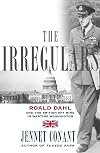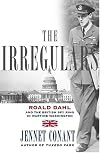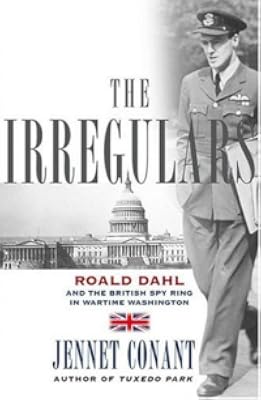
The Irregulars: Roald Dahl and the British Spy Ring in Wartime Washington
by Jennet Conant
On This Page
Description
Conant tells the story of young writer Roald Dahl who is assigned by His Majesty's Government to Washington, D.C. as a diplomat to gather intelligence about America's isolationist circles. In the course of his "spying," he meets or works closely with David Ogilvy, Ian Fleming, and the great spymaster William Stephenson (aka Intrepid).Tags
Recommendations












Member Reviews
As a huge Roald Dahl fan, both of his children’s books and adult short stories and memoirs, this nonfiction piece was a no-brainer for me. After being injured during his stint as an RAF pilot Dahl is sent to America to insinuate himself into the political society in Washington D.C. He’s been recruited to work for an obscure British intelligence agency that gathered information in America during World War II.
Conant tells of Dahl’s liaisons with a gossipy intimacy that makes the book read like a novel. He was a bit of a rake, unfettered by marriage and able to find friends and lovers wherever he went. A wealthy publisher, Charles Marsh, took Dahl under his wing and helped him along in the publishing world, which eventually led to show more Dahl’s career as an author. Fellow spy and friend Ian Fleming went on to write the James Bond novels.
I love that this book fills in an important gap in Dahl’s life. It picks up where his first two memoirs, Boy and Going Solo, leave off. It explains how he became a writer while also giving the readers fascinating details about his work as a spy.
BOTTOM LINE: A must for fans of Dahl, Fleming or spy novels in the style of John le Carré. It’s not an action packed story, but a look at what went on behind-the-scenes during WWII. show less
Conant tells of Dahl’s liaisons with a gossipy intimacy that makes the book read like a novel. He was a bit of a rake, unfettered by marriage and able to find friends and lovers wherever he went. A wealthy publisher, Charles Marsh, took Dahl under his wing and helped him along in the publishing world, which eventually led to show more Dahl’s career as an author. Fellow spy and friend Ian Fleming went on to write the James Bond novels.
I love that this book fills in an important gap in Dahl’s life. It picks up where his first two memoirs, Boy and Going Solo, leave off. It explains how he became a writer while also giving the readers fascinating details about his work as a spy.
BOTTOM LINE: A must for fans of Dahl, Fleming or spy novels in the style of John le Carré. It’s not an action packed story, but a look at what went on behind-the-scenes during WWII. show less
During a casual conversation a couple weeks ago, I mentioned I had a passing interest in Ian Fleming. One of my family members who is a big history buff suggested I try reading this book about Roald Dahl and his work with the BSC Irregulars during World War II. Like many other bookies, I was vaguely familiar with Roald Dahl because of the fame he attained authoring popular children's books like "James and the Giant Peach", but I knew little else about his history. Somewhat reluctantly I decided to give it a try and it turned out to be one of the most intriguing historical accounts I have read in many years. J Conant's research on the charismatic Dahl and the other dashing men-about-town (Fleming included) utilized by William Stephenson show more as propaganda agents in wartime Washington reads in places like page-turning fiction, but this wartime tale is based on meticulous research including official correspondence and telegrams, personal diaries, family interviews, etc. Dahl certainly crammed a lot of living into his time here on Earth (RAF fighter pilot, spy, seducer of the rich and famous, husband, father, award-winning author, etc.), but I almost wish he had squeezed in a few more adventures because the book ended much too soon for me. Dahl's personal exploits aside, this book also provides valuable insights into the ways politicians and the media influence public opinion and national policy. Conspiracy theorists, communists, isolationists, politicians, aviators, historians, cryptographers, journalists, and even those just interested in the juicy gossip of high society will all find golden nuggets here. Bottom line: It's an interesting piece of history and a very entertaining story -- I highly recommend it. show less
I did not know that Roald Dahl, author of "Charlie and the Chocolate Factory" and "James and the Giant Peach" had been a spy. Conant tells a rollicking story of the tall and dashing RAF pilot in Washington DC during the war years. He cuts a wide swathe through the pretty young things of the era - irresistible to many apparently, but not a particularly nice person.
Dahl's patron was one Charles Marsh, super-rich publisher and behind the scenes machinator for Vice President Wallace, future President Lyndon B. Johnson, and others. Marsh adopted Dahl, mentored him, sometimes financed him, and enabled Dahl to function as a conduit between Roosevelt and Churchill, and more broadly between the US and British governments.
Most of the book is show more taken up with a little too much detail about the gossipy, alcohol soaked, cocksmanship of Roald Dahl, Ian Flemming and their other buddies in wartime Washington. They social-climb, they charm, they seduce, they joke, they party in the city, they party in the country. The book enables us to contemplate the ways in which awful people can be charming, and fascinating people can be repulsive. It's enjoyable in its way, perhaps particularly if you are a former international relations scholar such as myself.
In the course of the story we are reminded and enlightened about the early days of the OSS, predecessor to the CIA, and its close relationship to the British secret service. We watch the emergence of an American intelligence service as a close parallel to the emergence of the United States as an effective world empire.
The real literary punch comes in the final chapter in which the author sums up everything that happened after the halcyon days of spying and screwing, from the late 1940s until Dahl's death in 1990. As, decade by decade, Dahl's marriages and children and travels and books role by, we get a marvelous cinematic sense of a life lived. His later life may have been lived well or poorly (it certainly produced some good children's literature) but it was all rather ordinary compared to those days of parties and sex and secret messages when the fate of the world hung in the balance. show less
Dahl's patron was one Charles Marsh, super-rich publisher and behind the scenes machinator for Vice President Wallace, future President Lyndon B. Johnson, and others. Marsh adopted Dahl, mentored him, sometimes financed him, and enabled Dahl to function as a conduit between Roosevelt and Churchill, and more broadly between the US and British governments.
Most of the book is show more taken up with a little too much detail about the gossipy, alcohol soaked, cocksmanship of Roald Dahl, Ian Flemming and their other buddies in wartime Washington. They social-climb, they charm, they seduce, they joke, they party in the city, they party in the country. The book enables us to contemplate the ways in which awful people can be charming, and fascinating people can be repulsive. It's enjoyable in its way, perhaps particularly if you are a former international relations scholar such as myself.
In the course of the story we are reminded and enlightened about the early days of the OSS, predecessor to the CIA, and its close relationship to the British secret service. We watch the emergence of an American intelligence service as a close parallel to the emergence of the United States as an effective world empire.
The real literary punch comes in the final chapter in which the author sums up everything that happened after the halcyon days of spying and screwing, from the late 1940s until Dahl's death in 1990. As, decade by decade, Dahl's marriages and children and travels and books role by, we get a marvelous cinematic sense of a life lived. His later life may have been lived well or poorly (it certainly produced some good children's literature) but it was all rather ordinary compared to those days of parties and sex and secret messages when the fate of the world hung in the balance. show less
Roald Dahl's own work is defined by twisting expectations and perceptions. So it is only fitting that Jennet Conant's look at his service as a British spy on the United States does just that to what most Americans think about World War II.
The very idea that the Allies would have spied on each other is something that most readers may never have considered. Conant consistently emphasizes the desperation with which Britain in general and Churchill in particular worried over American involvement in and perception of the war. In his own role, Roald Dahl was but a foot soldier, but as in all authentic tales those on the front lines have the best stories to tell.
The heroes here are people we know: Dahl, Ian Fleming, David Ogilvy, FDR and show more Churchill. But Conant digs beyond their exploits and shines light on the movers behind them, people like William Stephenson, who headed the British intelligence effort in the U.S., and Charles Marsh, an American newspaper tycoon and would-be Washington power player. It is these folks, with their myriad motivations, both high-minded and patriotic and vengeful, protective and territorial that informed the progress of the way. Conant presents it all down to the sordid details of Dahl's and Marsh's ribald correspondence, Dahl's affair with Tyrone Power's wife and another with Congresswoman Clare Boothe Luce. Dropping in from time to time are the heroes of later stories, Harry Truman (who played poker with Dahl) and Lyndon Johnson (who was a frequent guest at Marsh's Virginia retreat).
All of the major moves of the war, from Lend-Lease to D-Day, are given fresh impetus to American readers with the British perspective, which was downright combative at times for such a close ally. Dahl and Co. were not above stealing, lying or propagandizing to achieve their ends, and it is such impolite behavior that saw them largely ostracized from polite society following the war. The machinations are as compellingly rendered here as in any spy novel, and anyone with interest in the period (or in Dahl) should read the book. show less
The very idea that the Allies would have spied on each other is something that most readers may never have considered. Conant consistently emphasizes the desperation with which Britain in general and Churchill in particular worried over American involvement in and perception of the war. In his own role, Roald Dahl was but a foot soldier, but as in all authentic tales those on the front lines have the best stories to tell.
The heroes here are people we know: Dahl, Ian Fleming, David Ogilvy, FDR and show more Churchill. But Conant digs beyond their exploits and shines light on the movers behind them, people like William Stephenson, who headed the British intelligence effort in the U.S., and Charles Marsh, an American newspaper tycoon and would-be Washington power player. It is these folks, with their myriad motivations, both high-minded and patriotic and vengeful, protective and territorial that informed the progress of the way. Conant presents it all down to the sordid details of Dahl's and Marsh's ribald correspondence, Dahl's affair with Tyrone Power's wife and another with Congresswoman Clare Boothe Luce. Dropping in from time to time are the heroes of later stories, Harry Truman (who played poker with Dahl) and Lyndon Johnson (who was a frequent guest at Marsh's Virginia retreat).
All of the major moves of the war, from Lend-Lease to D-Day, are given fresh impetus to American readers with the British perspective, which was downright combative at times for such a close ally. Dahl and Co. were not above stealing, lying or propagandizing to achieve their ends, and it is such impolite behavior that saw them largely ostracized from polite society following the war. The machinations are as compellingly rendered here as in any spy novel, and anyone with interest in the period (or in Dahl) should read the book. show less
'The Irregulars of Baker Street' were not only the street spies helping Sherlock Holmes in Doyle's work, but, also, a group of British spies sent by Winston Churchill to the USA, during WWII, in order to force the Americans to militarily intervene in Europe, and, after Pearl Harbour, to lobby in support of Britain for it to have a key role in the post-war world.
One of the few free bastions still standing in Europe, Britain was indeed then isolated, on its knees, and in desperate need of help. The thing was, even though most Americans were opposed to Hitler, British Imperialism didn't attract any more sympathy either, and, the anti-interventionist climate then prevailing was (again, before Peal Harbour) very strong. From the liberals show more supporting pacifist ideals to Republicans opposed to every aspects of Roosevelt's policies, non-interventionists were, in fact, so powerful that they had their own committees evolving within the upper echelons of the political spheres.
This is why the BSC (British Security Council), a group those activities were secret and led by a Canadian industrial (William Stephenson) was implemented, specialised in sabotage, political propaganda and subversion, and that Roald Dahl, charming intellectual, ex RAF pilot, will join in 1942.
The book here mostly focuses on the histories on these spies, and the conflict of interests they engaged in; involving officials, media barons, and wealthy philanthropists and politicians (Dahl will even succeed to become a friend of the Roosevelt family!). Yet it gives to see, also, the birth of a writer.
It was indeed at around this time that Dahl began to write -war stories at first, using his personal experience of being pilot- and, spotted by publishers, joined this flock of authors (A.A. Milne, Somerset Maugham, H.G. Wells...) engaged as propagandists for the press and the radio. Yet, he would also later demarked himself by building his very own, personal style, incorporating in his stories creatures from Norse mythologies. Success seemed to be so close, that a collaboration with Walt Disney was even envisaged...
'The Irregulars', then, is a book killing two birds with one stone: it will appeal to history geeks, as much as to the fans of Dahl the author. A engrossing read on both front. show less
One of the few free bastions still standing in Europe, Britain was indeed then isolated, on its knees, and in desperate need of help. The thing was, even though most Americans were opposed to Hitler, British Imperialism didn't attract any more sympathy either, and, the anti-interventionist climate then prevailing was (again, before Peal Harbour) very strong. From the liberals show more supporting pacifist ideals to Republicans opposed to every aspects of Roosevelt's policies, non-interventionists were, in fact, so powerful that they had their own committees evolving within the upper echelons of the political spheres.
This is why the BSC (British Security Council), a group those activities were secret and led by a Canadian industrial (William Stephenson) was implemented, specialised in sabotage, political propaganda and subversion, and that Roald Dahl, charming intellectual, ex RAF pilot, will join in 1942.
The book here mostly focuses on the histories on these spies, and the conflict of interests they engaged in; involving officials, media barons, and wealthy philanthropists and politicians (Dahl will even succeed to become a friend of the Roosevelt family!). Yet it gives to see, also, the birth of a writer.
It was indeed at around this time that Dahl began to write -war stories at first, using his personal experience of being pilot- and, spotted by publishers, joined this flock of authors (A.A. Milne, Somerset Maugham, H.G. Wells...) engaged as propagandists for the press and the radio. Yet, he would also later demarked himself by building his very own, personal style, incorporating in his stories creatures from Norse mythologies. Success seemed to be so close, that a collaboration with Walt Disney was even envisaged...
'The Irregulars', then, is a book killing two birds with one stone: it will appeal to history geeks, as much as to the fans of Dahl the author. A engrossing read on both front. show less
Everyone knows Roald Dahl as the writer of many popular children’s books, but as a young man he led a fascinating life as an RAF pilot and then an agent for the BSC in Washington D.C. during World War II. The Irregulars by Jennet Conant covers Dahl’s time in covert operations while examining his personal life, the lives of the people around him, and the larger happenings of the war. Conant uses a lot of primary sources to reveal many details while still keeping the narrative moving to paint a picture of a flawed but very interesting man who played an important role during the war. Readers who enjoy historical nonfiction — especially WWII — should not miss this one.
There were somewhat more parts of this books of which I would say "I liked it" than of which I would say "it was okay." Two and a half stars seems about right.
Roald Dahl wrote the two favorite books of my childhood: "James and the Giant Peach" and "Charlie and the Chocolate Factory." So there's a possible inherent interest in learning more about the early career of a creative writer. Moreover, the premise of "The Irregulars" sounds really interesting: Roald Dahl and a group of other young talented "dashing" British spies in wartime Washington DC! Moreover, one of those other young talented "dashing" British spies was Ian Fleming! But Dahl and Fleming had relatively little to do with one another.
And then you realize that the main focus show more of Dahl's "espionage" work involved collecting ordinary daily stories about the Vice-President, and also doing research on the post-war relationship of Britain and the United States regarding commercial international air travel. In other words, fairly mundane stuff. As author Conant admits, "A lot of what passed for espionage in those day could be described as enterprising reporting." [If you don't know what "cabotage" means and why it was important, you will learn about it here.] Interesting up to a point, but not exactly page-turning material.
There's something rather limiting about the scope of the book: the really genuinely important British spies in Washington DC during World War II were working for the Soviets! [Most notably Donald Maclean and Guy Burgess, who are only mentioned here in a brief footnote.]
What I did like from the book was the unexpected insight it provides into some of the internal politics of FDR's administration between Pearl Harbor and the elections of November 1944, in which Roosevelt won a remarkable fourth term. Dahl was never part of FDR's inner circle, but he was an occasional guest at Hyde Park, and kept particularly close tabs on the President's relationship with his peculiar and independent Vice President Henry Wallace. The young Dahl socialized often with Wallace, and they shared a very close mutual friend in the wealthy generous and ambitious Texas newspaper magnate Charles Marsh. I gained a lot of insight into Wallace in this book, something I didn't expect going into it.
I also picked up some interest historical gossip/trivia/factoids that I hadn't known before. Sir William Stephenson, head of "British Security Coordination" in the United Stated during World War II, was a Canadian by birth. Roald Dahl had an affair during the war with American Congressperson, playwright, and anti-communist crusader Claire Booth Luce. Charles Marsh's second wife Alice Glass was a long-time lover of future President Lyndon Johnson. And Patricia Neal, who became Dahl's first wife in 1952, had earlier been the lover of film icon Gary Cooper.
An earlier reviewer here noted Conant's peculiar mistake of describing Cardiff Wales as "a small fishing village". There are a few other howlers as well. In a previous era, an editor at a prestigious commercial firm like Simon and Schuster would have caught these errors. Times have changed! show less
Roald Dahl wrote the two favorite books of my childhood: "James and the Giant Peach" and "Charlie and the Chocolate Factory." So there's a possible inherent interest in learning more about the early career of a creative writer. Moreover, the premise of "The Irregulars" sounds really interesting: Roald Dahl and a group of other young talented "dashing" British spies in wartime Washington DC! Moreover, one of those other young talented "dashing" British spies was Ian Fleming! But Dahl and Fleming had relatively little to do with one another.
And then you realize that the main focus show more of Dahl's "espionage" work involved collecting ordinary daily stories about the Vice-President, and also doing research on the post-war relationship of Britain and the United States regarding commercial international air travel. In other words, fairly mundane stuff. As author Conant admits, "A lot of what passed for espionage in those day could be described as enterprising reporting." [If you don't know what "cabotage" means and why it was important, you will learn about it here.] Interesting up to a point, but not exactly page-turning material.
There's something rather limiting about the scope of the book: the really genuinely important British spies in Washington DC during World War II were working for the Soviets! [Most notably Donald Maclean and Guy Burgess, who are only mentioned here in a brief footnote.]
What I did like from the book was the unexpected insight it provides into some of the internal politics of FDR's administration between Pearl Harbor and the elections of November 1944, in which Roosevelt won a remarkable fourth term. Dahl was never part of FDR's inner circle, but he was an occasional guest at Hyde Park, and kept particularly close tabs on the President's relationship with his peculiar and independent Vice President Henry Wallace. The young Dahl socialized often with Wallace, and they shared a very close mutual friend in the wealthy generous and ambitious Texas newspaper magnate Charles Marsh. I gained a lot of insight into Wallace in this book, something I didn't expect going into it.
I also picked up some interest historical gossip/trivia/factoids that I hadn't known before. Sir William Stephenson, head of "British Security Coordination" in the United Stated during World War II, was a Canadian by birth. Roald Dahl had an affair during the war with American Congressperson, playwright, and anti-communist crusader Claire Booth Luce. Charles Marsh's second wife Alice Glass was a long-time lover of future President Lyndon Johnson. And Patricia Neal, who became Dahl's first wife in 1952, had earlier been the lover of film icon Gary Cooper.
An earlier reviewer here noted Conant's peculiar mistake of describing Cardiff Wales as "a small fishing village". There are a few other howlers as well. In a previous era, an editor at a prestigious commercial firm like Simon and Schuster would have caught these errors. Times have changed! show less
Members
- Recently Added By
Published Reviews
Entertaining social history that also reveals a little-known aspect of an important literary figure’s life.
added by John_Vaughan
Roald Dahl is famous for his mischievous children’s stories. But as Jennet Conant reports in “The Irregulars,” he was also a British spy. Conant shows that Dahl, a former R.A.F. hero, parachuted himself into Washington blue-blood circles in 1942 and used his embassy post to begin spying on Britain’s closest and most important ally.
How much does all this have to do with World War II? show more Dahl’s stream of gossipy reports about the doings of the Washington glitterati were nectar for London. Every government, then and now, is keen to learn the inside dope. But what Conant never makes quite clear is whether Dahl ever supplied any information of real consequence.
Conant herself becomes so entranced by the glistening details she has excavated from oblivion that she never provides a coherent narrative. It’s a pity that Conant, a diligent researcher and gifted writer, has produced a mere trifle so conspicuously lacking the verve and panache of Dahl himself. show less
How much does all this have to do with World War II? show more Dahl’s stream of gossipy reports about the doings of the Washington glitterati were nectar for London. Every government, then and now, is keen to learn the inside dope. But what Conant never makes quite clear is whether Dahl ever supplied any information of real consequence.
Conant herself becomes so entranced by the glistening details she has excavated from oblivion that she never provides a coherent narrative. It’s a pity that Conant, a diligent researcher and gifted writer, has produced a mere trifle so conspicuously lacking the verve and panache of Dahl himself. show less
added by kthomp25
Lists

Best Espionage (Non-Fiction)
32 works; 6 members

Favourite Roald Dahl
22 works; 18 members
Author Information

7 Works 2,789 Members
Jennet Conant is the New York Times best-selling author of several books, including Tuxedo Park, 109 East Palace, The Irregulars, and the critically acclaimed Man of the Hour. She lives in Sag Harbor, New York, with her husband, son, and two golden retrievers.
Some Editions
Common Knowledge
- Original publication date
- 2008-09-08
- People/Characters
- Roald Dahl; William Stephenson; Franklin Delano Roosevelt; Drew Pearson; Walter Winchell; Ian Fleming (show all 8); Ivar Bryce; Charles Edward Marsh (oil tycoon)
- Important places
- Washington, D.C., USA
- Important events
- World War II (1939-1945)
- Epigraph
- "No, it's not quite as bad as that. It's the unofficial force - the Baker Street irregulars . . . They can go everywhere, see everything, overhear every one." - Arthur Conan Doyle, The Sign of the Four
'Say from when you owe this strange intelligence . . ." - Macbeth I, iii - Dedication
- For my boys
- First words
- It was an unseasonably warm spring evening in 1942, and between the cherry blossoms and soldiers in uniform, brightly lit shopwindows and partly darkened government buildings, wartime Washington was a strange sight.
- Last words
- (Click to show. Warning: May contain spoilers.)Quoting his favorite Spanish proverb, "No one can steal the dance you've danced," he added, "For full lives, particularly the ones of world crises, which we shared, we must admit we've had a hell of a ball."
- Blurbers
- Bradlee, Ben; Furst, Alan; Meacham, Jon
Classifications
- Genres
- History, General Nonfiction, Nonfiction, Biography & Memoir
- DDC/MDS
- 940.5486410973 — History & geography History of Europe History of Europe 1918- Military history of World War II Other Topics Unconventional warfare of Allies Europe British Isles
- LCC
- D810 .S8 .D234 — History of Europe, Asia, Africa and Oceania History (General) World War II (1939-1945)
- BISAC
Statistics
- Members
- 836
- Popularity
- 32,851
- Reviews
- 32
- Rating
- (3.25)
- Languages
- English, Norwegian (Bokmål)
- Media
- Paper, Audiobook, Ebook
- ISBNs
- 10
- ASINs
- 8