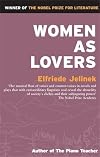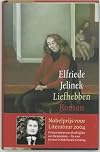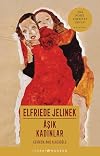
Women as Lovers
by Elfriede Jelinek
On This Page
Description
In Austria, two women get their man. Brigitte resorts to sex to ensnare Heinz-the-electrician, Paula uses good food to land Erich-the-woodcutter. Unfortunately, by the time wedding bells ring, both women are a little tired of their catch.Tags
Recommendations

































Member Reviews
This book is hateful, frustrating, and fairly extraordinary. The STYLE of it is extraordinary, drawing itself into a corner like engravings on brightwork and just when you think the space is full it manages to fit in another curlicue. Jelinek shows great, deep, if awful, understanding of a lot of abiding things we try to ignore in our love-relationships because there's just no bearing up under it really - especially we of the working classes, if that's indeed what I am - but the funny thing is that you feel like the writer - and I take the writer and narrator to be fairly close, because this is a polemic - unites the protagonists, Brigitte and Paula, in herself, and that writing the book must have been a process of destroying Paula's show more dreamy impulse toward compassion, which destroys Paula after all, and relying on Brigitte's sustaining hate. Maybe it just hits me strong because I'm in "this BEAUTIFUL land" Austria right now and realizing how much harder the hate and food and scheiss-glut and piggy satisfaction hits when it's not Japanese uyoku but something approaching your own people - but you can't do that. If you are soft or cold and constitutionally or by long pain inclined to a certain bleak view of things, you have to have a light hand, or it diminishes you. You have to give the good some due, or it makes good and bad both seem a little like a joke. Kicking pregnant women around is just not that widespread a sport among men, even in rural Austria, and the insistence damages this story. I feel like in a better version of "Women as Lovers" the Susi character could have carried some hope, but here it's all poisoned by the hatefulness of sex and all people and I just like Susi because I'm a man. show less
Eloquent, purposeful, writing. Should be required reading for all young adults - male or female.
Provincial 'love' explored in brutal terms.
Az Európa-hírű osztrák szerzőnő Kis csukák című regénye a földhözragadt, hétköznapi helyzeteket a végletekig lecsupaszított megfogalmazásban, nyers szókimondással tárja elénk. Jelinek erkölcsi távolságtartás nélkül vizsgálja a gyári munkásnők manipulált, előre meghatározott, egyetlen pillanatban sem természetes belső világát, akik egy falusi közösségben és a zsarnoki hagyomány formálta szülőknél élnek.
Jan 24, 2022Hungarian
Frases curtes, repetitives que et van martellejant el cap.
Mar 11, 2012 (Edited)Catalan
Ratings
Members
- Recently Added By
Lists

1970s
657 works; 23 members
Author Information

103+ Works 5,170 Members
Elfriede Jelinek was born on October 20, 1946 in Mürzzuschlag, Styria, Austria. She is an Austrian playwright and novelist. Jelinek was awarded the Nobel Prize in Literature in 2004. Jelinek started writing poetry at a young age. She made her literary debut with the collection Lisas Schatten (Lisa's Shadow) in 1967 and received her first literary show more prize in 1969. Female sexuality, its abuse, and the battle of the sexes in general are prominent topics in her work. Her works include: Wir sind Lockvögel, Baby! (We are Decoys, Baby!), Die Liebhaberinnen (Women as Lovers) and Die Klavierspielerin (The Piano Teacher). That last novel was the basis for the 2001 Austrian film of the same name, The Piano Teacher, directed by Michael Haneke and starring French actress Isabelle Huppert. When awarded the Nobel prize in 2004, Jelinek was criticized for not accepting the prize in person; instead, a video message was presented at the ceremony. Jelinek revealed that she suffers from agoraphobia and social phobia, so she was more comfortable accepting via video. Jelinek was also awarded many other prizes for her literature. These include: Georg Büchner Prize, 1998; Franz Kafka Prize, 2004; and the German Mülheimer Dramatikerpreis award three times, 2004, 2009 and 2011. (Bowker Author Biography) show less
Some Editions
Awards and Honors
Distinctions
Notable Lists
Series
Belongs to Publisher Series
Volk und Welt Spektrum (112)
Common Knowledge
- Canonical title
- Women as Lovers
- Original title
- Die Liebhaberinnen
- Alternate titles*
- Women as Lovers
- Original publication date
- 1975 (Duits) (Duits); 2005 (Nederlands) (Nederlands)
- Original language
- German
*Some information comes from Common Knowledge in other languages. Click "Edit" for more information.
Classifications
- Genres
- Fiction and Literature, General Fiction
- DDC/MDS
- 833.914 — Literature & rhetoric German & related literatures German fiction 1900- 1900-1990 1945-1990
- LCC
- PT2670 .E46 .L513 — Language and Literature German, Dutch and Scandinavian literatures German literature Individual authors or works 1961-2000
- BISAC
Statistics
- Members
- 516
- Popularity
- 57,844
- Reviews
- 6
- Rating
- (3.61)
- Languages
- 18 — Bosnian, Catalan, Czech, Danish, Dutch, English, French, German, Hungarian, Italian, Norwegian (Bokmål), Polish, Portuguese, Romanian, Russian, Spanish, Swedish, Turkish
- Media
- Paper, Audiobook, Ebook
- ISBNs
- 32
- ASINs
- 6