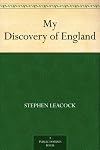
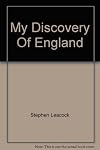
My Discovery of England
by Stephen Leacock
On This Page
Description
Canadian humorist and academic Stephen Leacock had a plethora of opportunities to explore new cultures as he traveled the globe in support of his many popular books, often giving scholarly talks along the way. In this uproarious volume of essays and vignettes, Leacock sets down his impressions of a promotional tour of England..
Tags
Recommendations




















Member Reviews
This is a series of essays in which Stephen Leacock compares England with North America in order to find similarities and differences. He is doing this in a spirit of redressing the "balance of trade" in impressions; lots of English authors have come to North America to get impressions of it, but not many North Americans have done the same for England. In a historical context, it was interesting to read because it was published in 1922, and a few essays touched on the question of German reparations. It's weird as a 21st-century reader to read it and know that World War 2 will happen, but the audience at the time of the book has no idea.
Overall, the essays were easy to read, and I really liked the essay on different types of humour show more (although he and I disagree on the hilarity of the pun -- I love puns, whereas he does not think they are terribly funny, at least not on the level the English apparently find them). However, his essay on education (and visiting Oxford) had some very dated and sexist views on the value of women's education. Despite the fact that he taught coed classes at McGill, he didn't seem to think it worthwhile for the women to be there because the vast majority of them were just going to go and get married anyway. He does acknowledge that there are women who are able to make careers for themselves and not get married or have children, but he doesn't seem to think it wrong that they should have to give up the use of their education or their jobs when they get married. He also touches on the subject of different aptitudes, but he divides them along gender lines, assuming that women do worse at math and science, for example. I do realize that this perspective is a product of his times, but he went on about it for too long for me to just brush off.
I would NOT recommend the essay about Oxford, but the humour essay was all right, and the one where he writes the same editorial for several different newspapers was an interesting literary exercise. This is also not the book to be starting out with if you've never read Leacock -- go to Sunshine Sketches of a Little Town instead. show less
Overall, the essays were easy to read, and I really liked the essay on different types of humour show more (although he and I disagree on the hilarity of the pun -- I love puns, whereas he does not think they are terribly funny, at least not on the level the English apparently find them). However, his essay on education (and visiting Oxford) had some very dated and sexist views on the value of women's education. Despite the fact that he taught coed classes at McGill, he didn't seem to think it worthwhile for the women to be there because the vast majority of them were just going to go and get married anyway. He does acknowledge that there are women who are able to make careers for themselves and not get married or have children, but he doesn't seem to think it wrong that they should have to give up the use of their education or their jobs when they get married. He also touches on the subject of different aptitudes, but he divides them along gender lines, assuming that women do worse at math and science, for example. I do realize that this perspective is a product of his times, but he went on about it for too long for me to just brush off.
I would NOT recommend the essay about Oxford, but the humour essay was all right, and the one where he writes the same editorial for several different newspapers was an interesting literary exercise. This is also not the book to be starting out with if you've never read Leacock -- go to Sunshine Sketches of a Little Town instead. show less
this is not Leacock's best work. It could be seen as from the American or Canadian point of view, pretty much a by-the-numbers put-down of the Brits. the chapter on pronunciation is the funniest.
Ratings
Members
- Recently Added By
Lists

New Canadian Library
191 works; 7 members
Author Information

143+ Works 3,142 Members
Born in Swanmore, England, Stephen Leacock was one of 11 children of an unsuccessful farmer and an ambitious mother, a woman to whom Leacock no doubt owed his energetic and status-conscious nature. In 1891, while teaching at the prestigious Upper Canada College in Toronto, Leacock obtained a modern language degree from the University of Toronto. show more In 1903, after receiving a Ph.D. in political economy from the University of Chicago, he joined the staff of McGill University, Montreal, as professor of politics and economics. Leacock's career as a humorist began when he had some comic pieces published as Literary Lapses in 1910. This successful book was followed by two more books of comic sketches, Nonsense Novels (1911) and Sunshine Sketches of a Little Town (1912), which is now considered his best book. Leacock continued this frantic literary output for the remainder of his career, producing more than 30 books of humor as well as biographies and social commentaries. The Stephen Leacock Medal for Humour was established after his death to honor annually an outstanding Canadian humorist. (Bowker Author Biography) show less
Series
Belongs to Publisher Series
New Canadian Library (28)
Common Knowledge
- Original publication date
- 1922
- People/Characters
- Stephen Leacock
- First words
- For some years past a rising tide of lecturers and literary men from England has washed upon the shores of our North American continent.
Classifications
Statistics
- Members
- 82
- Popularity
- 388,975
- Reviews
- 2
- Rating
- (3.08)
- Languages
- English
- Media
- Paper, Ebook
- ISBNs
- 25
- ASINs
- 12