
On This Page
Description
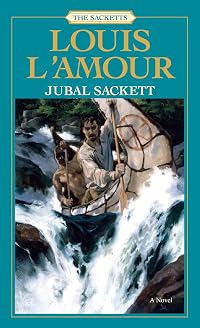
In Jubal Sackett, the second generation of Louis L’Amour’s great American family pursues a destiny in the wilderness of a sprawling new land.Jubal Sackett’s urge to explore drove him westward, and when a Natchez priest asks him to undertake a nearly impossible quest, Sackett ventures into the endless grassy plains the Indians call the Far Seeing Lands. He seeks a Natchez exploration party and its leader, Itchakomi. It is she who will rule her people when their aging chief dies, but show more first she must vanquish her rival, the arrogant warrior Kapata. Sackett’s quest will bring him danger from an implacable enemy . . . and show him a life—and a woman—worth dying for. show less
Tags
Recommendations























Member Reviews
I couldn't wait each day to get back to this thrilling tale of survival and discovery. Jubal Sackett tells his story, a tale of discovering the beauty of the land that would become the United States and facing up to it's dangers. Going west from his family's settlement he leaves the colonies behind and soon his only associates are the Native Americans and occasional Spanish soldiers he encounters. He befriends a Kickapoo warrior, and is sent on a quest to find another Indian--this one an Indian Princess, a 'Son'. She will change his life in ways he never imagined, but then he never imagined taming a buffalo and any of the other adventures he relates. He also makes enemies of both a formidable Indian foe and a Spaniard, both of which show more will take all his skill to defeat. This yarn gets very unbelievable in places, but the enjoyment is in seeing how a resourceful man can win against insurmountable odds. Listen to this fine tale if you like man vs. nature stories, westerns, or just good old fashioned adventure stories. show less
Each of Louis L'Amour's Sackett novels becomes my new favorite as I read along, but I'm starting to see a bit of a pattern forming of which I might tire. That pattern being that each novel is, in no small part, about its chosen Sackett's quest for a wife with whom to make more Sacketts to be waiting there to greet the rest of the white folks when they finally get around to settling the interior of the North American continent.
So far, though, there is plenty of variety within that narrative, and Jubal Sackett has the most interesting twist on that basic plot, in that our man Jubal, the youngest son of dynastic founder Barnabas Sackett, really doesn't think he's looking for a wife when he takes off wandering, itching to see unknown lands show more and explore mountains farther west than those his father had once itched to explore. And explore he does, for a while, in the company of a native companion he picks up, a Kickapoo called Keokotah, who feels similarly ill at ease hanging around his own people -- he met and became fascinated by an Englishmen when he was just a lil' Kickapoo.
Soon the pair encounter a Mississippi River tribe, the Natchez (often referred to, in this book, as "Natchee"), who are having a bit of a territory crisis, and also a crisis of leadership. Their chief is dying, their territory being encroached on by other, stronger tribes, and their medicine man has heard of the legendary Sackett family and what a bunch of stand-up guys they are, for white men, and would Jubal mind heading west to find their exploration party that was sent out a while ago to find a new place for them to live? Oh, and find their crown princess, Itchakomi, and ask her to come home and lead her people since the chief is dying and all?
Well, Jubal and Keokotah were going that way, anyway, so why not?
Oh, by the way, there's this half-breed Natchez jerk who thinks he's going to marry Itchakomi and take power among us, and like we said, he's really a jerk and we'd rather he didn't but it's really up to her whom she marries because she's that important and all. Anyway, he's probably going to be trying to hunt her down and he already doesn't like you because he's that guy over there that tried to pick a fight, mmmkay?
Sure, whatever.
Of course, we all know who is really going to get to marry Itchakomi, but it's still fun watching Jubal be the last one to realize it, especially since he spends most of the first half of the novel just trying to find her out in the great unknown and mostly unexplored wilds between the Mississippi River and the Rocky Mountains. Which is really quite a vast territory in which to be trying to find anyone and anything. But duh, this is like no spoiler at all, he finds her. Just as his brother found Carrie and Diana in the Caribbean last novel. Just as Keokotah, from whom Jubal becomes separated when he chooses to seek out some caves (maybe Mammoth in Kentucky?*), still manages to find him even when Jubal is unexpectedly hampered and delayed from making their agreed rendezvous. These people are awfully, awfully good at finding each other, these Louis L'Amour characters. Like Dickensianly good. I find this hard to swallow at times, but, yannow, Romance.
What really sold this book to me as my new favorite Sackett novel, though, is the scenery porn and attendant displays of survival skills in solitude Jubal constantly displays. To read Louis L'Amour (for me anyway) is to come to resent the year of one's birth; mine was a good 150 years too late**; I am forever deprived of the sight of the country through which Jubal travels as it was before it got covered in pavement and gas stations and tract housing and big box stores. L'Amour is a pretty good nature writer, and gives Jubal a unique and lyrical narrative voice that marks out his mystical, solitary character as very different from his brothers Yance and Kin-Ring, and from his father Barnabas.
I have one pet peeve though, and it's both insignificant and hugely annoying. For no good reason except to make sure we know that Itchakomi digs Jubal, two-thirds of the way through the book we get a single chapter from her first person perspective. And it's all about her romantic dilemma of how to make him "see" her without sacrificing her pride or losing face. And then it's back to Jubal's narration for the rest of the novel. This seems a clumsy and amateurish thing to do in a book that otherwise flows so beautifully (and I assure you, willfully blind as Jubal is, there are plenty of hints for us readers to pick up to clue us in to Itchakomi's feelings. Really, we spend quite a bit of time watching Jubal's mental gymnastics and contortions via which he preserves his ignorance of the fact that he and Itchakomi are in lurve. It's quite amusing). I hope it's not a sign of things to come, I really do.
But for now, I'm still on board, especially since the next novel, Ride the River, has my curiosity already; its protagonist is female. Can L'Amour handle that well? His silly Itchakomi chapter argues against the idea, but we'll see. We'll see.
*Part of these novels is working out where our characters are, based on purely geographical clues; no modern names for anything are used in these novels. Thus the Mississippi is "the Great River" and the Rockies are "the Shining Mountains" but the more southerly part is already called the Sangre de Christos because the Spaniards who so named them are already there and using the name at the time of this novel.
**Funny because, as mostly a science fiction fan, I'm more likely to grouse about being born 150 years too early. There's just no pleasing me, I guess. show less
So far, though, there is plenty of variety within that narrative, and Jubal Sackett has the most interesting twist on that basic plot, in that our man Jubal, the youngest son of dynastic founder Barnabas Sackett, really doesn't think he's looking for a wife when he takes off wandering, itching to see unknown lands show more and explore mountains farther west than those his father had once itched to explore. And explore he does, for a while, in the company of a native companion he picks up, a Kickapoo called Keokotah, who feels similarly ill at ease hanging around his own people -- he met and became fascinated by an Englishmen when he was just a lil' Kickapoo.
Soon the pair encounter a Mississippi River tribe, the Natchez (often referred to, in this book, as "Natchee"), who are having a bit of a territory crisis, and also a crisis of leadership. Their chief is dying, their territory being encroached on by other, stronger tribes, and their medicine man has heard of the legendary Sackett family and what a bunch of stand-up guys they are, for white men, and would Jubal mind heading west to find their exploration party that was sent out a while ago to find a new place for them to live? Oh, and find their crown princess, Itchakomi, and ask her to come home and lead her people since the chief is dying and all?
Well, Jubal and Keokotah were going that way, anyway, so why not?
Oh, by the way, there's this half-breed Natchez jerk who thinks he's going to marry Itchakomi and take power among us, and like we said, he's really a jerk and we'd rather he didn't but it's really up to her whom she marries because she's that important and all. Anyway, he's probably going to be trying to hunt her down and he already doesn't like you because he's that guy over there that tried to pick a fight, mmmkay?
Sure, whatever.
Of course, we all know who is really going to get to marry Itchakomi, but it's still fun watching Jubal be the last one to realize it, especially since he spends most of the first half of the novel just trying to find her out in the great unknown and mostly unexplored wilds between the Mississippi River and the Rocky Mountains. Which is really quite a vast territory in which to be trying to find anyone and anything. But duh, this is like no spoiler at all, he finds her. Just as his brother found Carrie and Diana in the Caribbean last novel. Just as Keokotah, from whom Jubal becomes separated when he chooses to seek out some caves (maybe Mammoth in Kentucky?*), still manages to find him even when Jubal is unexpectedly hampered and delayed from making their agreed rendezvous. These people are awfully, awfully good at finding each other, these Louis L'Amour characters. Like Dickensianly good. I find this hard to swallow at times, but, yannow, Romance.
What really sold this book to me as my new favorite Sackett novel, though, is the scenery porn and attendant displays of survival skills in solitude Jubal constantly displays. To read Louis L'Amour (for me anyway) is to come to resent the year of one's birth; mine was a good 150 years too late**; I am forever deprived of the sight of the country through which Jubal travels as it was before it got covered in pavement and gas stations and tract housing and big box stores. L'Amour is a pretty good nature writer, and gives Jubal a unique and lyrical narrative voice that marks out his mystical, solitary character as very different from his brothers Yance and Kin-Ring, and from his father Barnabas.
I have one pet peeve though, and it's both insignificant and hugely annoying. For no good reason except to make sure we know that Itchakomi digs Jubal, two-thirds of the way through the book we get a single chapter from her first person perspective. And it's all about her romantic dilemma of how to make him "see" her without sacrificing her pride or losing face. And then it's back to Jubal's narration for the rest of the novel. This seems a clumsy and amateurish thing to do in a book that otherwise flows so beautifully (and I assure you, willfully blind as Jubal is, there are plenty of hints for us readers to pick up to clue us in to Itchakomi's feelings. Really, we spend quite a bit of time watching Jubal's mental gymnastics and contortions via which he preserves his ignorance of the fact that he and Itchakomi are in lurve. It's quite amusing). I hope it's not a sign of things to come, I really do.
But for now, I'm still on board, especially since the next novel, Ride the River, has my curiosity already; its protagonist is female. Can L'Amour handle that well? His silly Itchakomi chapter argues against the idea, but we'll see. We'll see.
*Part of these novels is working out where our characters are, based on purely geographical clues; no modern names for anything are used in these novels. Thus the Mississippi is "the Great River" and the Rockies are "the Shining Mountains" but the more southerly part is already called the Sangre de Christos because the Spaniards who so named them are already there and using the name at the time of this novel.
**Funny because, as mostly a science fiction fan, I'm more likely to grouse about being born 150 years too early. There's just no pleasing me, I guess. show less
While I have read five of Louis L' Amour's western novels, this is my first selection from his celebrated "Sackett" series. Although this one is 4th in the Sackett series chronologically, it does not suffer from a reader's lack of previous experience with the family saga.
Jubal Sackett is a lone explorer, making his way through the wilderness of North America in the early to mid 1600s. Despite the harsh wilderness conditions, the chief dangers Jubal faces are native Americans of various tribes, with whom he barters and battles. Along the way, he joins up with an Indian companion, a Kickapoo named Keokotah; he also gains a mission: to find a crown princess Itchakomi and tell her that her home tribe, the Nathchee, want her to return and show more lead her people, since the chief is dying. He finds Itchakomi, and she falls for Jubal, and seeks to make a life with him instead, but not before Jubal has fought off and killed the half-breed Natchee who has been seeking her for his own lustful and ambitious purposes. One recurring element that stretches the truth to the breaking point is how, in the vast wilderness, Jubal, Keokotah and Itchakomi manage to find each other easily enough across vast stretches of territory. Another aspect, one that grows a bit tiresome on repetition, is Jubal's own periodic ruminations on what his siblings and relatives back in England are doing at any given time. Nevertheless, the story itself is enjoyable (if a bit long for its content).
I found it especially interesting to view the country through which Jubal travels through his eyes, and since the landmarks are not given their modern names, to figure out what they were encountering (Smoky Mts, Mississippi River, and what may be the Mammoth Caves). The book ends with a startling episoide; supposedly mammoths / mastodons have not yet died out, and Jubal battles one to the death. In an addendum, the author asserts that while the great beasts are thought to have died out by 6000 BCE (a date a few thousand years more recently than paleontologists cite), that enigmatic reports from the 1800s suggest that the animals were still extant. A questionable assertion, that, but the episode spiced up the story. In any case, I found this book enjoyable. It's a "western" of a different sort, being dated to >200 years before the typical cowboy novels. show less
Jubal Sackett is a lone explorer, making his way through the wilderness of North America in the early to mid 1600s. Despite the harsh wilderness conditions, the chief dangers Jubal faces are native Americans of various tribes, with whom he barters and battles. Along the way, he joins up with an Indian companion, a Kickapoo named Keokotah; he also gains a mission: to find a crown princess Itchakomi and tell her that her home tribe, the Nathchee, want her to return and show more lead her people, since the chief is dying. He finds Itchakomi, and she falls for Jubal, and seeks to make a life with him instead, but not before Jubal has fought off and killed the half-breed Natchee who has been seeking her for his own lustful and ambitious purposes. One recurring element that stretches the truth to the breaking point is how, in the vast wilderness, Jubal, Keokotah and Itchakomi manage to find each other easily enough across vast stretches of territory. Another aspect, one that grows a bit tiresome on repetition, is Jubal's own periodic ruminations on what his siblings and relatives back in England are doing at any given time. Nevertheless, the story itself is enjoyable (if a bit long for its content).
I found it especially interesting to view the country through which Jubal travels through his eyes, and since the landmarks are not given their modern names, to figure out what they were encountering (Smoky Mts, Mississippi River, and what may be the Mammoth Caves). The book ends with a startling episoide; supposedly mammoths / mastodons have not yet died out, and Jubal battles one to the death. In an addendum, the author asserts that while the great beasts are thought to have died out by 6000 BCE (a date a few thousand years more recently than paleontologists cite), that enigmatic reports from the 1800s suggest that the animals were still extant. A questionable assertion, that, but the episode spiced up the story. In any case, I found this book enjoyable. It's a "western" of a different sort, being dated to >200 years before the typical cowboy novels. show less
Jubal Sackett was born a free spirit, seeking adventure, always roaming. In this tale, he has many adventures and close calls. He also meets and marries his wife, an Indian of high standing in her nation. Well written, with good character development, this installment in the series is an excellent addition. It contains many of the elements one would expect to find in westerns set in that time period. It also has some story aspects that are unusual. Typical of Louis L’Amour writings, it is entertaining and exciting.
Jubal Sackett by Louis L’Amour is part of the continuing saga of the Sackett Family. This story is set in the 1700’s and follows the adventures of Jubal, third son of the original Sackett to come to America.
Although his brothers were content to settle down and raise families on their original home site in North Carolina, Jubal is a wanderer. He vows to follow his dreams and heads west. Along the way he explores much virgin territory, meets with various people, finds a travelling companion and a beautiful Indian woman to love.
This book required a large stretch of imagination as the events become more and more unbelievable. By the end of the book we have Jubal fighting a mammoth that should have been extinct centuries before. I show more managed to finish the book, but it will remain one of my least favorite of this series so far. With the territory that Jubal covered, this could have been an excellent adventure story instead of such a disappointment. show less
Although his brothers were content to settle down and raise families on their original home site in North Carolina, Jubal is a wanderer. He vows to follow his dreams and heads west. Along the way he explores much virgin territory, meets with various people, finds a travelling companion and a beautiful Indian woman to love.
This book required a large stretch of imagination as the events become more and more unbelievable. By the end of the book we have Jubal fighting a mammoth that should have been extinct centuries before. I show more managed to finish the book, but it will remain one of my least favorite of this series so far. With the territory that Jubal covered, this could have been an excellent adventure story instead of such a disappointment. show less
This falls in the category of "historical fiction," but in all honesty, I did have trouble suspending disbelief in some parts. I wanted to believe, I tried to believe, and yet ...
Still for the most part it is romping good fun. The fun far outweighed the "nooooo" moments.
If you are a true fan of the Sacketts, this is a must read. People who like Westerns or historical fiction might like it.
Still for the most part it is romping good fun. The fun far outweighed the "nooooo" moments.
If you are a true fan of the Sacketts, this is a must read. People who like Westerns or historical fiction might like it.
I think Louis L'amour meant to write a sequel because he left a major plot thread hanging at the end, but, of course, he ran out of time to write that sequel. Anyway, this is a well-written novel with plenty of drive and suspense. Jubal is a bit oblivious to the obvious when it comes to women, but that is common with Louis L'amour characters. However, it is an engaging story.
Members
- Recently Added By
Author Information

870+ Works 99,522 Members
Born in Jamestown, North Dakota on March 22, 1908, Louis L'Amour's adventurous life could have been the subject of one of his novels. Striking out on his own in 1923, at age 15, L'Amour began a peripatetic existence, taking whatever jobs were available, from skinning dead cattle to being a sailor. L'Amour knew early in life that he wanted to be a show more writer, and the experiences of those years serve as background for some of his later fiction. During the 1930s he published short stories and poetry; his career was interrupted by army service in World War II. After the war, L'Amour began writing for western pulp magazines and wrote several books in the Hopalong Cassidy series using the pseudonym Tex Burns. His first novel, Westward the Tide (1950), serves as an example of L'Amour's frontier fiction, for it is an action-packed adventure story containing the themes and motifs that he uses throughout his career. His fascination with history and his belief in the inevitability of manifest destiny are clear. Also present and typical of L'Amour's work are the strong, capable, beautiful heroine who is immediately attracted to the equally capable hero; a clear moral split between good and evil; reflections on the Native Americans, whose land and ways of life are being disrupted; and a happy ending. Although his work is somewhat less violent than that of other western writers, L'Amour's novels all contain their fair share of action, usually in the form of gunfights or fistfights. L'Amour's major contribution to the western genre is his attempt to create, in 40 or more books, the stories of three families whose histories intertwine as the generations advance across the American frontier. The novels of the Irish Chantry, English Sackett, and French Talon families are L'Amour's most ambitious project, and sadly were left unfinished at his death. Although L'Amour did not complete all of the novels, enough of the series exists to demonstrate his vision. L'Amour's strongest attribute is his ability to tell a compelling story; readers do not mind if the story is similar to one they have read before, for in the telling, L'Amour adds enough small twists of plot and detail to make it worth the reader's while. L'Amour fans also enjoy the bits of information he includes about everything from wilderness survival skills to finding the right person to marry. These lessons give readers the sense that they are getting their money's worth, that there is more to a L'Amour novel than sheer escapism. With over 200 million copies of his books in print worldwide, L'Amour must be counted as one of the most influential writers of westerns in this century. He died from lung cancer on June 10, 1988. (Bowker Author Biography) Louis L'Amour, truly America's favorite storyteller, was the first fiction writer ever to receive the Congressional Gold Medal from the United States Congress in honor of his life's work, & was also awarded the Medal of Freedom. There are over 260 million copies of his books in print worldwide. (Publisher Provided) show less
Awards and Honors
Distinctions
Series

Work Relationships
Common Knowledge
- Canonical title
- Jubal Sackett
- Original title
- Jubal Sackett
- Original publication date
- 1985
- People/Characters
- Jubal Sackett; Itchakomi Ishai "Komi"; Keokotah; NiKwanna; Kapata; Asatiki (show all 8); Diego; Gomez
- Dedication
- To Hazel and Charlie Daniels -
His fiddle-playing would bring
the Sacketts right down from the hills. - First words
- A cold wind blew off Hanging Dog Mountain and I had no fire, nor dared I strike so much as a spark that might betray my hiding place.
- Quotations
- When men have gone down the longest rivers, climbed the highest mountains, and crossed the greatest deserts there will still be the stars.
But what child in his later years does not wish he had listened when his parents talked among themselves, about themselves, their families, the way they had lived? So often we do not realize how much we could have learned unt... (show all)il it is too late and there is no going back. - Last words
- (Click to show. Warning: May contain spoilers.)Unstwita lingered, drinking the last of the coffee.
- Original language*
- Amerikanisch
*Some information comes from Common Knowledge in other languages. Click "Edit" for more information.
Classifications
Statistics
- Members
- 1,462
- Popularity
- 15,921
- Reviews
- 23
- Rating
- (3.90)
- Languages
- 5 — Czech, English, German, Norwegian (Bokmål), Swedish
- Media
- Paper, Audiobook, Ebook
- ISBNs
- 25
- ASINs
- 20