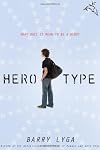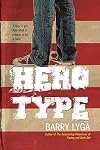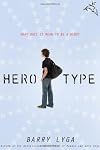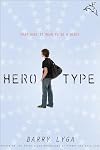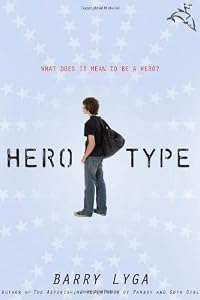
Hero-Type
by Barry Lyga
On This Page
Description
Feeling awkward and ugly is only one reason sixteen-year-old Kevin is uncomfortable with the publicity surrounding his act of accidental heroism, but when a reporter photographs him apparently being unpatriotic, he steps into the limelight to encourage people to think about what the symbols of freedom really mean.Tags
Recommendations



Member Recommendations
Member Reviews
Kevin Ross (Kross to his friends) is a genuine hero. Outside the library one day, Kross was able to rescue a girl named Beth from a serial killer, wrestling the serial killer to the ground. He is given the key to the city, reporters are following him everywhere, and he even gets a great discount on a car from the Mayor (who also runs a car lot).
The car is where the problems really start. The mayor throws in a couple of “Support the Troops” ribbons, and Kross' dad, who served in the military and hates the ribbons, forces Kross to remove them. The act is witnessed by a reporter, and suddenly the headlines saying “Local Teen is a Hero” change to “Why Does Kevin Ross Hate America?”
Kross actually hadn't thought much about show more patriotism or what it means to “support the troops” or “love your country,” but self-defense (and a desire to prove his greatest rival wrong) drive him to the Internet and library to learn more. He is also still trying to understand his actions the day he rescued Beth, and everything that preceded and followed that fateful day.
As always, Barry Lyga's strength is in his characters. Kross isn't always likeable – many of his actions are creepy at best, and illegal at worst – but he felt real. He struggles with his guilt, with his anger, and his desire to “do something” - even when he doesn't know what that “something” is. The secondary characters are also well-drawn, especially Kross's father and his friends Tits and Fam.
There are a lot of issues in this book – what patriotism really means, living with guilt, dealing with the fallout of divorce, obsession...the list could go on an on. What is remarkable to me is that the book never dissolves into preachiness. There are no easy answers to the questions raised, and the book doesn't insult the reader's intelligence by attempting to provide neat answers. show less
The car is where the problems really start. The mayor throws in a couple of “Support the Troops” ribbons, and Kross' dad, who served in the military and hates the ribbons, forces Kross to remove them. The act is witnessed by a reporter, and suddenly the headlines saying “Local Teen is a Hero” change to “Why Does Kevin Ross Hate America?”
Kross actually hadn't thought much about show more patriotism or what it means to “support the troops” or “love your country,” but self-defense (and a desire to prove his greatest rival wrong) drive him to the Internet and library to learn more. He is also still trying to understand his actions the day he rescued Beth, and everything that preceded and followed that fateful day.
As always, Barry Lyga's strength is in his characters. Kross isn't always likeable – many of his actions are creepy at best, and illegal at worst – but he felt real. He struggles with his guilt, with his anger, and his desire to “do something” - even when he doesn't know what that “something” is. The secondary characters are also well-drawn, especially Kross's father and his friends Tits and Fam.
There are a lot of issues in this book – what patriotism really means, living with guilt, dealing with the fallout of divorce, obsession...the list could go on an on. What is remarkable to me is that the book never dissolves into preachiness. There are no easy answers to the questions raised, and the book doesn't insult the reader's intelligence by attempting to provide neat answers. show less
I don't even remember why I picked this book up, except it looked intriguing, and boy was it. It's the story of Kevin. He's the town hero, he saved Leah's life, but he's also harboring a secret. That may sound a little like a cop out, but you don't know what the secret is until almost halfway through the novel. And, to be perfectly honest, I think it works just fine. What makes this book good, aside from the rather complex plot, is the fact that Lyga portrays Kevin exactly as he is -- a reluctant hero so caught up in his own shortcomings (those that his friends and family overlook) that he ends up mixed up in more than just the fame of being a hero. Kevin doesn't believe he's a hero and when we find out why, we can't help but feeling show more sorry for him. Lyga has Kevin redeem himself in one of the most unlikely ways, turning the book from an excellent coming of age story, into a novel that's both about coming of age but what it means to grow up and to fight for what you believe in. Maybe Kevin's a hero, maybe it's not. But, in the end, it doesn't matter. show less
After Kevin Ross saves Leah Muldoon from a serial killer known as The Surgeon everyone calls him a hero and wants a piece of him, the news media, the mayor, everybody. Kross, as he’s known by his friends in the Council of Fools, was on a national news program, the school had an assembly honoring him, and he received a $30,000 reward; and all because he happened to be at the library when Leah was attacked. He wonders what people would think if they knew the real reason he was in the right place at the right time. But he doesn’t dwell on that possibility. The mayor of Brookdale offers to sell Kross a cheap car from his dealership and the media makes an event out of it. The mayor places two ribbon magnets on the car supporting the show more troops and when Kevin’s father, who is a Gulf War veteran, asks him to remove them, someone from the school paper captures him throwing the ribbons in the garbage. The repercussions of this action drive the rest of the novel and raise questions for Kross about freedom of speech, supporting the troops. A whole new media circus begins and Kross wonders how he went from being the town’s hero to the town’s goat. He and the Council of Fools were always misfits but now Kross is virtually a pariah. show less
http://lampbane.livejournal.com/596177.html
"After reading Fanboy and Goth Girl I got curious about Lyga's other books, especially as they're all set at the same high school. Cross-title continuity: a sure sign of a comic geek. There are some references to characters/situations from his other books but it's not necessary to have read them to enjoy this one. In fact, some of the references feel rather forced, as if he's name-dropping for the sake of name-dropping and not because these are things that kids would actually say.
The story itself is fine, though if you don't agree with the politics of the author (by way of the main character) you may not enjoy it. He does a good job of explaining his position well-enough, but Kevin had this show more tendency to speechify everything, even when he's not giving a speech, and I could see that turning people off.
Something I really appreciated about this book was how the parents seemed more complete; in contrast with my complaints about how we never understand the parents in Fanboy and Goth Girl, the problems of the parents in Hero-Type are the root of the problem and have to be dealt with for the book to have any sort of closure. It's got a nice ending, one that's pretty open but with some hope in it." show less
"After reading Fanboy and Goth Girl I got curious about Lyga's other books, especially as they're all set at the same high school. Cross-title continuity: a sure sign of a comic geek. There are some references to characters/situations from his other books but it's not necessary to have read them to enjoy this one. In fact, some of the references feel rather forced, as if he's name-dropping for the sake of name-dropping and not because these are things that kids would actually say.
The story itself is fine, though if you don't agree with the politics of the author (by way of the main character) you may not enjoy it. He does a good job of explaining his position well-enough, but Kevin had this show more tendency to speechify everything, even when he's not giving a speech, and I could see that turning people off.
Something I really appreciated about this book was how the parents seemed more complete; in contrast with my complaints about how we never understand the parents in Fanboy and Goth Girl, the problems of the parents in Hero-Type are the root of the problem and have to be dealt with for the book to have any sort of closure. It's got a nice ending, one that's pretty open but with some hope in it." show less
On the surface, this novel seems quite light in its presentation of Kevin Ross, an extremely awkward and funny protagonist. Yet Lyga engages with some very serious issues, including the nature of heroism, our culture’s expressions of patriotism, and the disconnect we all feel during a time of war. This novel had a deep impact on me when I least expected it.
Kevin' doesn't think he's much of a hero. The whole town considers him one, though, since he saved a girl from his school from being kidnapped by "The Surgeon," a brutal serial killer and rapist. Sometimes the attention is nice, since his dad barely pays attention to him at home and it's not like he's the most popular guy or the handsomest guy in school - he's far from it. Kevin told everyone that he was just at the right place at the right time, which, in a way he was. But the truth is there is more to that night, and the secret reason that he was there to save the girl - Leah, the unwitting object of his affection - is less than honorable, perhaps even perverse. So when the town stops worshiping Kevin and starts treating him like the show more villain he really is, it wouldn't bother him so much, except that they still don't know his secret. They're up in arms over the "Support the Troops" magnets that he refuses to put on his car. And it's not even that Kevin doesn't support th troops - he just believes in free speech, and he doesn't think that putting magnets on your car does very much for the soldiers fighting overseas. So Kevin starts a debate, one he is sure to lose. Meanwhile his friends, the self-appointed "Council of Fools" are pulling some politically-inspired pranks all over town. But when the local paper starts publishing less than flattering stories about Kevin's dad, and the Council starts to lose perspective, Kevin sees that proving his point about free speech is more important than he could have imagined. And so is confronting the ugly truth about the night that he saved Leah.
Lyga's presentation of some very relevant issues is engaging and fast-paced. The character of Kevin, despite all of his flaws (the darker of which come to light over the course of the novel) is sympathetic and his problems aren't unlike those of most teenagers - he isn't in with the in crowd, his self-image is terrible, and he has trouble at home. As Kevin narrates the story, while sometimes the reader is acknowledged in a way that nearly pulls him away from the fiction at hand, it is done with a skillful conversational tone that is easy to fall into. Hero-Type is an important book, one that should be considered for high school libraries across the country. show less
Lyga's presentation of some very relevant issues is engaging and fast-paced. The character of Kevin, despite all of his flaws (the darker of which come to light over the course of the novel) is sympathetic and his problems aren't unlike those of most teenagers - he isn't in with the in crowd, his self-image is terrible, and he has trouble at home. As Kevin narrates the story, while sometimes the reader is acknowledged in a way that nearly pulls him away from the fiction at hand, it is done with a skillful conversational tone that is easy to fall into. Hero-Type is an important book, one that should be considered for high school libraries across the country. show less
Kevin is a teenager with a secret. Yes, he did save Leah from the Surgeon (a man who drugged, raped, and murdered four other girls) but jut because he saved her.. does that make him a hero? And worse, what if people discover the reason that he was there in that alley on the night that he saved her?
Barry Lyga once more tackles difficult questions in a young adult novel that can be enjoyed by just about anyone. The question of morals comes into play, but nowhere near as much as the questions of free speech, free thought, and right action. In the end, this is a book that transcends political parties and affiliations and instead digs deep into what it means to be an American.
Perhaps a bit surprisingly, this is a very timely book, and in my show more opinion, a very important one. Lyga certainly has a lot of good things to say. show less
Barry Lyga once more tackles difficult questions in a young adult novel that can be enjoyed by just about anyone. The question of morals comes into play, but nowhere near as much as the questions of free speech, free thought, and right action. In the end, this is a book that transcends political parties and affiliations and instead digs deep into what it means to be an American.
Perhaps a bit surprisingly, this is a very timely book, and in my show more opinion, a very important one. Lyga certainly has a lot of good things to say. show less
Members
- Recently Added By
Author Information

44+ Works 6,291 Members
Barry Lyga was born on September 11, 1971. He received a BA in English from Yale University in 1993. Before becoming a full-time author, he worked in the comic book industry for ten years. His first young adult novel, The Astonishing Adventures of Fanboy and Goth Girl, was published in 2006. His other works include Boy Toy, Hero-Type, Goth Girl show more Rising, I Hunt Killers, After the Red Rain, and as the Archvillain series for middle-grade readers. (Bowker Author Biography) show less
Awards and Honors
Common Knowledge
- Canonical title
- Hero-Type
- Original publication date
- 2008
- People/Characters
- Kevin Ross ('Kross'); Leah Muldoon; Jonathan Jackson Ross; Jesse Ross; Bill Yingling ('Jedi'); Speedo (show all 13); Greg Titus ('Tit'); Julia ('Fam'); Joseph Brenner ('Flip'); Mrs Sawyer; Mrs Grant; John Riordon; Dr Goethe
- Important places
- South Brook High School; Brookdale, Maryland, USA; Susan Ann Marchetti Memorial Park
- Important events
- Iraq War
- Dedication
- Dedicated to Captain Peter G. Madriñan and Major Gregory C. Tine, United States Army, both serving in the Middle East as I write this.
Fine soldiers, better friends. - First words
- You know those pictures of fat people?
- Quotations
- No one's mother should be a hot lesbian. It should be illegal or something.
What's the point of freedom of speech if everyone says and thinks the same thing anyway? What's the point of freedom of speech if everyone is forced to say the same thing? Or afraid to say anything different?
Give us guns and bombs and helicopter support and tell a bunch of kids to make foreign policy work. Kill people to save people's lives. Blow things up to build them up. And what's the result? Ten years, fifteen years ... (show all)later, we're right back there again, doing it all over again. - Last words
- (Click to show. Warning: May contain spoilers.)"Because this way, I have to come back for it."
Classifications
Statistics
- Members
- 231
- Popularity
- 140,317
- Reviews
- 17
- Rating
- (3.69)
- Languages
- English
- Media
- Paper, Audiobook, Ebook
- ISBNs
- 10
- ASINs
- 2