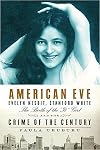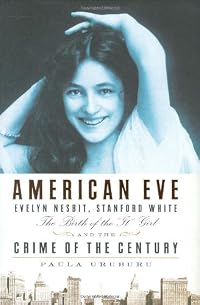
American Eve: Evelyn Nesbit, Stanford White, the Birth of the "It" Girl, and the Crime of the Century
by Paula Uruburu
On This Page
Description
Famous by her sixteenth birthday in 1900, Gibson Girl Evelyn Nesbit was the most photographed woman of her era, an iconic figure who set the standard for female beauty. Women wanted to be her. Men wanted her. When her jealous millionaire husband, Harry K. Thaw, killed her lover--celebrity architect Stanford White, builder of the Washington Square Arch and much of New York City--she found herself at the center of the "crime of the century" and the scandal that marked the beginning of a show more national obsession with youth, beauty, celebrity, and sex. The story of Evelyn Nesbit is one of glamour, money, romance, madness, and murder, and Paula Uruburu weaves all of these elements into an elegant narrative that reads like the best fiction--only it's all true, a picture of America as it crossed from the Victorian era into the modern.--From publisher description. show lessTags
Recommendations













Member Reviews
I just read about the early 1900s version of the Epstein files. I didn't really know what I was getting into with this nonfiction book. Evelyn Nesbit was the "it girl" of early 1900s New York. At the young age of about 14, her down-on-her-luck mother took Evelyn to Philadelpia where she was discovered and started modeling for artists. They then moved to New York where she continued to model for artists and photographers and made a move to the stage. Evelyn's combination of dark hair, pale skin, large eyes, and an expression that is both innocent and knowing made her a huge sensation. There are tons of photographs included in the book and she really is stunning and magnetic.
Evelyn attracted the attention of the incredibly wealthy show more Stanford White, one of NYC's most popular architects of the time. White begins supporting Evelyn and her family. Of course, he is not in this for altruistic reasons. He builds trust with Evelyn and her mother and then drugs and rapes the 14 year old Evelyn when her mother is out of town. He then convinces Evelyn he loves her and continues to abuse her for years, until she is too old to match his vile tastes.
After years of this, Evelyn falls in with Harry Thaw, another multi-millionaire who is definitely mentally unhinged. Thaw is obsessed with proving that Stanford White is abusing young girls in New York. Of course, Thaw is no better. He also tricks Evelyn into trusting him when she has no other options, as Stanford White loses interest in her as she ages. So the 17 year old Evelyn throws her lot in with Thaw, with disastrous consequences for herself. Despite more rape and abuse, she eventually marries Thaw. Thaw then kills White and there is a trial where Evelyn is forced to reveal all the sordid details of what these men have done to her during her childhood.
Obviously, this was a disturbing book to read. I drew a lot of parallels to our modern day news stories, and it was a good reminder that our era is not unique in having wealthy men behaving despicably and taking advantage of those with no resources and rarely paying any consequences. That doesn't make me feel any better, of course, but it was interesting to reflect that it's not new.
Very readable nonfiction, with obvious trigger warnings. show less
Evelyn attracted the attention of the incredibly wealthy show more Stanford White, one of NYC's most popular architects of the time. White begins supporting Evelyn and her family. Of course, he is not in this for altruistic reasons. He builds trust with Evelyn and her mother and then drugs and rapes the 14 year old Evelyn when her mother is out of town. He then convinces Evelyn he loves her and continues to abuse her for years, until she is too old to match his vile tastes.
After years of this, Evelyn falls in with Harry Thaw, another multi-millionaire who is definitely mentally unhinged. Thaw is obsessed with proving that Stanford White is abusing young girls in New York. Of course, Thaw is no better. He also tricks Evelyn into trusting him when she has no other options, as Stanford White loses interest in her as she ages. So the 17 year old Evelyn throws her lot in with Thaw, with disastrous consequences for herself. Despite more rape and abuse, she eventually marries Thaw. Thaw then kills White and there is a trial where Evelyn is forced to reveal all the sordid details of what these men have done to her during her childhood.
Obviously, this was a disturbing book to read. I drew a lot of parallels to our modern day news stories, and it was a good reminder that our era is not unique in having wealthy men behaving despicably and taking advantage of those with no resources and rarely paying any consequences. That doesn't make me feel any better, of course, but it was interesting to reflect that it's not new.
Very readable nonfiction, with obvious trigger warnings. show less
Though is started out somewhat breezy and lightweight, once she got into the heart of the story, it really settled in and became a very enjoyable but scholarly read. She does have an overfondness for the cleverly turned phrase but I think she got into much of the important details of Nesbit's early life to make the trial less a sensation and more understandable. Since I knew so little about this major event of American pop culture, it was interesting to read about. The only part I found a bit odd was the constant descriptions of Evelyn's amazing beauty but the photos included didn't really impress me except as a pretty young girl. Perhaps tastes have changed or perhaps men find her more beautiful or perhaps photos don't do her justice show more but that was how she made her living. Interesting. show less
Paula Uruburu's riveting American Eve explores the oft-told (but never this well or thoroughly) tale of the infamous "Girl in the Red Velvet Swing," and the murder of renowned architect Stanford White at the hands of her husband, Harry K. Thaw. I was stunned by the parallels with today's celebrity culture, and if you think there is anything new under the sun, this book will convince you otherwise. I was fascinated to learn that the first sequestered American jury was the one that heard this case. The scandalous situation riveted the nation to such an extent that President Teddy Roosevelt implored the media to stop covering it because he believed the details that were emerging from the trial were so lurid that it was contributing to the show more moral decay of the country. Underneath the sensational headlines, however, was a young woman who had been ill-served by literally every adult in her life, including her mother, who recognized early on that Evelyn Nesbit's rare beauty was her own ticket out of poverty. This was a totally enthralling read. show less
Two books about notorious New York murder cases: Daniel Stashower’s about Mary Rogers’ (The Beautiful Cigar Girl) and Paula Uruburu’s about Stanford White (American Eve: Evelyn Nesbit, Stanford White, The Birth of the “It” Girl, and the Crime of the Century).
Mary Rogers’ death was a mystery; in fact, protoconspiracy-theorists claimed that despite identification by her mother and one of her suitors the body found floating in the Hudson on July 28 1841 wasn’t Mary Rogers at all. It was a hot day in New York City and several young men seeking temperature relief by strolling along the Jersey side spotted the object, borrowed a boat, lassoed it around the neck, towed it to shore, and, being unwilling to touch the thing, show more tethered it to a handy rock. A floating corpse was a novelty, and the curious showed up to poke it with sticks and comment on its appearance. Someone worked up enough courage to wade into the river and drag it ashore, and someone else peered between the legs and made rude comments to his friends. Albert Crommelin had been searching for his missing romantic interest for several days and feared the worst when he spotted the tangle of bystanders; sure enough, he identified the thing as Mary Rogers.
------------------------------------------------------------------------------------------------------------
Stanford White’s death was no mystery at all. It was a hot night in New York City and with many others he was seeking temperature relief attending the opening night of a musical comedy presented in the rooftop theater at Madison Square Garden (which he had designed). Millionaire and major loon Harry Thaw, attending the same performance, left his table, walked up behind White, and shot him three times in the back of the head. There were hundreds of witnesses, including actresses and chorus girls, theater patrons, and Thaw’s wife Evelyn. Unlike Ms. Rogers, there was no doubt who the victim was – although his face was no longer recognizable.
------------------------------------------------------------------------------------------------------------
Author Daniel Stashower turns Mary Rogers’ story into a history of 1840s NYC police practices, the newspaper business, and an excellent biography of Edgar Allan Poe. Those of us used to CSI will find 1840 police procedure a little disconcerting; the police were abysmally corrupt and most murder investigation was in the hands of judges and coroners. The Mary Rogers case was a godsend to the newspaper business; editorials lambasted the police, the mayor, the governor, the coroner, and each other. (William Gordon Bennett enthusiastically drubbed his competitors in the editorial pages of the New York Herald; New York Sun editor Moses Beach “had no more brains than an oyster" and the New York Tribune’s Horace Greeley was less effective than “a large New England squash”). In the absence of any sort of police force, the newspapers took on the investigator role themselves and cheerfully accused just about everybody in the city, plus a good fraction of New Jersey. Poe comes into the picture because in his usual financial desperation he adapted the Mary Rogers story for the second of his C. Auguste Dupin detective mysteries, The Mystery of Marie Rogêt.
------------------------------------------------------------------------------------------------------------
Paula Uruburu concentrates on the title heroine, and Ms Uruburu is unhesitant in sympathizing with Ms. Nesbit (well, although I’m just a little suspicious of her veracity, I’m pretty sympathetic with Evelyn, too). Evelyn Nesbit lost her comfortable middle-class life when her father died, and quickly found herself supporting her family as an underage chorus girl and artist’s model (her mother was concerned, but took the money). Her Gibson-girl beauty attracted the attention of Stanford White, who had a reputation for this sort of thing (White is supposed to have coined the expression “Would you like to come up and see my etchings?” and invented the concept of having a girl jump out of a cake at a party (well, it was actually a pie, which in addition to four-and-twenty blackbirds contained a 14-year-old girl dressed in a blackbird hat and feathered toe rings)).
After some beating around the bush the 40ish White drugged and raped the 16-year-old Evelyn (there’s some question of how naïve Evelyn was. Uruburu glosses over it, but even in more innocent times you might expect that a girl from a theater background would realize that invitations to a much older man’s apartment to pose for lingerie art would eventually end badly). She acquiesced to the arrangement; Mom kept taking the money.
------------------------------------------------------------------------------------------------------------
Mary Rogers’ case was never solved. The evidence was hopelessly muddled; however, the best guess is that rather than being gang-raped and beaten to death as originally supposed, she died during a failed abortion and was beaten up and dumped in the Hudson post-mortem. The abortion theory caused major problems for Poe; he had promised that he would reveal the murderer in Marie Rogêt and had published two of three serializations when evidence for an abortion emerged. He had to quickly rewrite the final chapter.
------------------------------------------------------------------------------------------------------------
Stanford White eventually grew tired of Evelyn and moved on to other chorus girls. By now, however, Evelyn had attracted the attention of Harry Thaw, a Pittsburgh steel millionaire (or more correctly, the spoiled son of the widow of a Pittsburgh steel millionaire). Stanford White was a statutory rapist, but Thaw was a real piece of work. Already notorious for hiring ladies of the evening for whipping sessions (he did the whipping), he persuaded Evelyn and her mother to go on a European tour (interrupted briefly when Thaw whipped a bellboy in a London hotel). Mrs. Nesbit left her daughter in the middle of the trip and Evelyn found herself alone with Harry in (nope, not kidding, really this Gothic) a deserted German castle Harry had rented for a week. Harry persuaded Evelyn to tell her the story of her affair with White, and latter that evening forced open the door of her room, naked and carrying a riding crop. He spent several hours of admonishing Evelyn for her misbehavior, which left her so covered with lash marks that she couldn’t lie down for fear of the bedclothes sticking to the bloody cuts. Rather surprisingly, when the couple returned to the US Evelyn agreed to marry Thaw.
Thaw, however, couldn’t get over the fact that White had Evelyn first – he took Evelyn to his dentist and had all the dental work White had paid for removed and replaced. That wasn’t quite enough to satisfy him – hence the Madison Square Garden shooting. Thaw was utterly convinced that he would be found innocent – and was outraged when his family bought him a not-guilty-by-reason-of-insanity verdict. Once she had testified – pretty convincingly – that Thaw really was a nutcase, the Thaws immediately dumped Evelyn without a cent. (After getting out of the asylum the first time, Harry Thaw was picked up and committed again for another bellboy whipping incident; in fact, he spent more time in custody for whipping bellboys then did for shooting Stanford White). She spent the rest of her life in a series of increasingly dreary nightclub and cabaret shows (although briefly regaining some notoriety as a consultant for The Girl in the Red Velvet Swing, where she’s played by Joan Collins, and, of course, posthumous recognition in Ragtime, this time played by Elizabeth McGovern).
I liked both of these – Stashower’s evocation of 1840s New York is compelling, as is the biographical material on Poe. I confess when I first picked it up I had Mary Rogers confused with Helen Jewett, another New York cause célèbre murder victim. Miss Jewett didn’t sell cigars, however). As far as Evelyn Nesbit goes, perhaps Uruburu takes a little too much of Nesbit’s testimony at face value. But it’s pretty clear that even if Evelyn stretched the truth a little what demonstrably happened to her was pretty grim. Besides, I’ve always had a weakness for Gibson girls. show less
Mary Rogers’ death was a mystery; in fact, protoconspiracy-theorists claimed that despite identification by her mother and one of her suitors the body found floating in the Hudson on July 28 1841 wasn’t Mary Rogers at all. It was a hot day in New York City and several young men seeking temperature relief by strolling along the Jersey side spotted the object, borrowed a boat, lassoed it around the neck, towed it to shore, and, being unwilling to touch the thing, show more tethered it to a handy rock. A floating corpse was a novelty, and the curious showed up to poke it with sticks and comment on its appearance. Someone worked up enough courage to wade into the river and drag it ashore, and someone else peered between the legs and made rude comments to his friends. Albert Crommelin had been searching for his missing romantic interest for several days and feared the worst when he spotted the tangle of bystanders; sure enough, he identified the thing as Mary Rogers.
------------------------------------------------------------------------------------------------------------
Stanford White’s death was no mystery at all. It was a hot night in New York City and with many others he was seeking temperature relief attending the opening night of a musical comedy presented in the rooftop theater at Madison Square Garden (which he had designed). Millionaire and major loon Harry Thaw, attending the same performance, left his table, walked up behind White, and shot him three times in the back of the head. There were hundreds of witnesses, including actresses and chorus girls, theater patrons, and Thaw’s wife Evelyn. Unlike Ms. Rogers, there was no doubt who the victim was – although his face was no longer recognizable.
------------------------------------------------------------------------------------------------------------
Author Daniel Stashower turns Mary Rogers’ story into a history of 1840s NYC police practices, the newspaper business, and an excellent biography of Edgar Allan Poe. Those of us used to CSI will find 1840 police procedure a little disconcerting; the police were abysmally corrupt and most murder investigation was in the hands of judges and coroners. The Mary Rogers case was a godsend to the newspaper business; editorials lambasted the police, the mayor, the governor, the coroner, and each other. (William Gordon Bennett enthusiastically drubbed his competitors in the editorial pages of the New York Herald; New York Sun editor Moses Beach “had no more brains than an oyster" and the New York Tribune’s Horace Greeley was less effective than “a large New England squash”). In the absence of any sort of police force, the newspapers took on the investigator role themselves and cheerfully accused just about everybody in the city, plus a good fraction of New Jersey. Poe comes into the picture because in his usual financial desperation he adapted the Mary Rogers story for the second of his C. Auguste Dupin detective mysteries, The Mystery of Marie Rogêt.
------------------------------------------------------------------------------------------------------------
Paula Uruburu concentrates on the title heroine, and Ms Uruburu is unhesitant in sympathizing with Ms. Nesbit (well, although I’m just a little suspicious of her veracity, I’m pretty sympathetic with Evelyn, too). Evelyn Nesbit lost her comfortable middle-class life when her father died, and quickly found herself supporting her family as an underage chorus girl and artist’s model (her mother was concerned, but took the money). Her Gibson-girl beauty attracted the attention of Stanford White, who had a reputation for this sort of thing (White is supposed to have coined the expression “Would you like to come up and see my etchings?” and invented the concept of having a girl jump out of a cake at a party (well, it was actually a pie, which in addition to four-and-twenty blackbirds contained a 14-year-old girl dressed in a blackbird hat and feathered toe rings)).
After some beating around the bush the 40ish White drugged and raped the 16-year-old Evelyn (there’s some question of how naïve Evelyn was. Uruburu glosses over it, but even in more innocent times you might expect that a girl from a theater background would realize that invitations to a much older man’s apartment to pose for lingerie art would eventually end badly). She acquiesced to the arrangement; Mom kept taking the money.
------------------------------------------------------------------------------------------------------------
Mary Rogers’ case was never solved. The evidence was hopelessly muddled; however, the best guess is that rather than being gang-raped and beaten to death as originally supposed, she died during a failed abortion and was beaten up and dumped in the Hudson post-mortem. The abortion theory caused major problems for Poe; he had promised that he would reveal the murderer in Marie Rogêt and had published two of three serializations when evidence for an abortion emerged. He had to quickly rewrite the final chapter.
------------------------------------------------------------------------------------------------------------
Stanford White eventually grew tired of Evelyn and moved on to other chorus girls. By now, however, Evelyn had attracted the attention of Harry Thaw, a Pittsburgh steel millionaire (or more correctly, the spoiled son of the widow of a Pittsburgh steel millionaire). Stanford White was a statutory rapist, but Thaw was a real piece of work. Already notorious for hiring ladies of the evening for whipping sessions (he did the whipping), he persuaded Evelyn and her mother to go on a European tour (interrupted briefly when Thaw whipped a bellboy in a London hotel). Mrs. Nesbit left her daughter in the middle of the trip and Evelyn found herself alone with Harry in (nope, not kidding, really this Gothic) a deserted German castle Harry had rented for a week. Harry persuaded Evelyn to tell her the story of her affair with White, and latter that evening forced open the door of her room, naked and carrying a riding crop. He spent several hours of admonishing Evelyn for her misbehavior, which left her so covered with lash marks that she couldn’t lie down for fear of the bedclothes sticking to the bloody cuts. Rather surprisingly, when the couple returned to the US Evelyn agreed to marry Thaw.
Thaw, however, couldn’t get over the fact that White had Evelyn first – he took Evelyn to his dentist and had all the dental work White had paid for removed and replaced. That wasn’t quite enough to satisfy him – hence the Madison Square Garden shooting. Thaw was utterly convinced that he would be found innocent – and was outraged when his family bought him a not-guilty-by-reason-of-insanity verdict. Once she had testified – pretty convincingly – that Thaw really was a nutcase, the Thaws immediately dumped Evelyn without a cent. (After getting out of the asylum the first time, Harry Thaw was picked up and committed again for another bellboy whipping incident; in fact, he spent more time in custody for whipping bellboys then did for shooting Stanford White). She spent the rest of her life in a series of increasingly dreary nightclub and cabaret shows (although briefly regaining some notoriety as a consultant for The Girl in the Red Velvet Swing, where she’s played by Joan Collins, and, of course, posthumous recognition in Ragtime, this time played by Elizabeth McGovern).
I liked both of these – Stashower’s evocation of 1840s New York is compelling, as is the biographical material on Poe. I confess when I first picked it up I had Mary Rogers confused with Helen Jewett, another New York cause célèbre murder victim. Miss Jewett didn’t sell cigars, however). As far as Evelyn Nesbit goes, perhaps Uruburu takes a little too much of Nesbit’s testimony at face value. But it’s pretty clear that even if Evelyn stretched the truth a little what demonstrably happened to her was pretty grim. Besides, I’ve always had a weakness for Gibson girls. show less
A biography of Evelyn Nesbit, the beauty who became the symbol of the Gilded Age. Often 'beauties of the age' don't stand the test of time, but Evelyn is just as beautiful now as she was considered to be back in 1901. At 16, Evelyn became one of the first 'super models'. At 21, Evelyn became the center of the 'crime of the century' when her husband Harry Thayer murdered the famous architect Stanford White, who had been her lover at the tender age of 16.
White later would be vilified as a man who ruined young girls, and he certainly took advantage of Evelyn, drugging her and robbing her of her 'virtue', but Thayer, was no better, a jealous and mentally unstable man who raped and beat Evelyn after she confessed her 'loss of innocence' at show more White's hands.
It's a story that illustrates very harshly just how powerless a young girl could be - and indeed still can - in the hands of vicious, brilliant men, with no one to guide her and a life that offered her no concept of normalacy.
Evelyn's story was gripping - I couldn't put the book down - but at the same time it's very, very disturbing. This is Definitely not an easy read. I couldn't stop thinking about it. The whole time I was reading it, I felt like I was trapped in a nightmare. I literally lay awake at night, unable to stop thinking about it. I told Evelyn's story to everyone I talked to, trying to make sense of it, trying to lose that sense of horror. show less
White later would be vilified as a man who ruined young girls, and he certainly took advantage of Evelyn, drugging her and robbing her of her 'virtue', but Thayer, was no better, a jealous and mentally unstable man who raped and beat Evelyn after she confessed her 'loss of innocence' at show more White's hands.
It's a story that illustrates very harshly just how powerless a young girl could be - and indeed still can - in the hands of vicious, brilliant men, with no one to guide her and a life that offered her no concept of normalacy.
Evelyn's story was gripping - I couldn't put the book down - but at the same time it's very, very disturbing. This is Definitely not an easy read. I couldn't stop thinking about it. The whole time I was reading it, I felt like I was trapped in a nightmare. I literally lay awake at night, unable to stop thinking about it. I told Evelyn's story to everyone I talked to, trying to make sense of it, trying to lose that sense of horror. show less
A biography of Evelyn Nesbit, the beauty who became the symbol of the Gilded Age. Often 'beauties of the age' don't stand the test of time, but Evelyn is just as beautiful now as she was considered to be back in 1901. At 16, Evelyn became one of the first 'super models'. At 21, Evelyn became the center of the 'crime of the century' when her husband Harry Thayer murdered the famous architect Stanford White, who had been her lover at the tender age of 16.
White later would be vilified as a man who ruined young girls, and he certainly took advantage of Evelyn, drugging her and robbing her of her 'virtue', but Thayer, was no better, a jealous and mentally unstable man who raped and beat Evelyn after she confessed her 'loss of innocence' at show more White's hands.
It's a story that illustrates very harshly just how powerless a young girl could be - and indeed still can - in the hands of vicious, brilliant men, with no one to guide her and a life that offered her no concept of normalacy.
Evelyn's story was gripping - I couldn't put the book down - but at the same time it's very, very disturbing. This is Definitely not an easy read. I couldn't stop thinking about it. The whole time I was reading it, I felt like I was trapped in a nightmare. I literally lay awake at night, unable to stop thinking about it. I told Evelyn's story to everyone I talked to, trying to make sense of it, trying to lose that sense of horror. show less
White later would be vilified as a man who ruined young girls, and he certainly took advantage of Evelyn, drugging her and robbing her of her 'virtue', but Thayer, was no better, a jealous and mentally unstable man who raped and beat Evelyn after she confessed her 'loss of innocence' at show more White's hands.
It's a story that illustrates very harshly just how powerless a young girl could be - and indeed still can - in the hands of vicious, brilliant men, with no one to guide her and a life that offered her no concept of normalacy.
Evelyn's story was gripping - I couldn't put the book down - but at the same time it's very, very disturbing. This is Definitely not an easy read. I couldn't stop thinking about it. The whole time I was reading it, I felt like I was trapped in a nightmare. I literally lay awake at night, unable to stop thinking about it. I told Evelyn's story to everyone I talked to, trying to make sense of it, trying to lose that sense of horror. show less
DNF at pg. 100
I have to put this down for a while. This is the wordiest book I've ever picked up. Adjectives, adjective, adjectives... way too many that leaves the reader struggling to find the point in a paragraph. I read 100 pages that could have easily been cut down to about 30 without losing any important facts. Or really any facts at all, as the author repeats her points over and over.
And what is with the personal vendetta again Evelyn's mother? The author does not describe or discuss her mother without at least one unwarranted attack. I think there a personal sensitivity on the author's part coming out in response to Mrs. Nesbit. Given this is a biography, it seems even more out of place.
I don't want to completely give up on show more this book, however, because the topic is so interesting and it is obvious well-researched. There is so much potential and others have enjoyed it, so I think I will just take it in sections. show less
I have to put this down for a while. This is the wordiest book I've ever picked up. Adjectives, adjective, adjectives... way too many that leaves the reader struggling to find the point in a paragraph. I read 100 pages that could have easily been cut down to about 30 without losing any important facts. Or really any facts at all, as the author repeats her points over and over.
And what is with the personal vendetta again Evelyn's mother? The author does not describe or discuss her mother without at least one unwarranted attack. I think there a personal sensitivity on the author's part coming out in response to Mrs. Nesbit. Given this is a biography, it seems even more out of place.
I don't want to completely give up on show more this book, however, because the topic is so interesting and it is obvious well-researched. There is so much potential and others have enjoyed it, so I think I will just take it in sections. show less
Members
- Recently Added By
Lists

True Crime
216 works; 16 members
Author Information
2 Works 513 Members
Paula Uruburu is an associate professor of English at Hofstra University.
Common Knowledge
- Canonical title
- American Eve: Evelyn Nesbit, Stanford White, the Birth of the "It" Girl, and the Crime of the Century
- Alternate titles
- American Eve
- Original publication date
- 2008
- People/Characters
- Stanford White; Evelyn Nesbit; Harry K. Thaw; John Barrymore
- Important places
- Pittsburgh, Pennsylvania, USA; Philadelphia, Pennsylvania, USA; New York, New York, USA; Madison Square Garden, New York, New York, USA
- Epigraph
- Come slowly, Eden!
Lips unused to thee,
Bashful, sip thy jasmines,
As the fainting bee,
Reaching late his flower,
Round her chamber hums.
Counts his nectars - enters,
And is lost in balms!
--Emily ... (show all)Dickinson - Dedication
- for Brian
- First words
- Introduction: A little more than half a century before a winsome, waiflike, and wide-eyed Evelyn Nesbit, not yet sixteen, found her way to the island of Manhattan, Nathaniel Hawthorne had written a modest allegorical tale ti... (show all)tled "Rappaccini's Daughter."
- Last words
- (Click to show. Warning: May contain spoilers.)Yet even at eighty-two, one could see the spirit of the young model come to life when someone produced a camera; she instinctively struck the characteristic pose that made her famous - her head tilted slightly back and to the side, her eyes seductively half-closed, an enigmatic smile on her face.
Classifications
- Genres
- Nonfiction, History, Biography & Memoir, General Nonfiction
- DDC/MDS
- 974.71041092 — History & geography History of North America Northeastern United States (New England and Middle Atlantic states) New York New York (N.Y.)
- LCC
- HD8039 .M772 .U59 — Social sciences Industries. Land use. Labor Industries. Land use. Labor Labor. Work. Working class By industry or trade
- BISAC
Statistics
- Members
- 512
- Popularity
- 58,349
- Reviews
- 20
- Rating
- (3.70)
- Languages
- English
- Media
- Paper, Ebook
- ISBNs
- 7
- ASINs
- 6