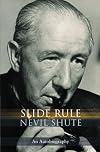
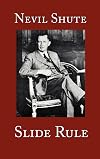
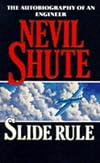
Slide Rule
by Nevil Shute
On This Page
Description
Nevil Shute was a power and a pioneer in the world of flying long before he began to write the stories that made him a bestselling novelist. This autobiography charts Shute's path from childhood to his career as a gifted aeronautical engineer working at the forefront of the technological experimentation of the 1920s and 30s. The inspiration for many of the themes and concerns of Shute's novels can be identified in this enjoyable and enlightening memoir.Tags
Recommendations







































Member Reviews
http://nhw.livejournal.com/978094.html
It's a book in three parts: the first couple of chapters describe Shute's boyhood and youth, where the most exciting part is his close observation of the Easter Rising of 1916 - his father, as it happens, was the Secretary of the Irish Post Office, so there is a certain immediacy to Shute's account, from an angle one doesn't often get - that of a middle-class English teenager pressed into service as a stretcher-bearer.
Then a bit over half the book is devoted to a fascinating account of Shute's involvement with the R100, the private sector counterpart to the doomed state-funded R101 British airship. This was at the cutting edge of technology, a prestige engineering project every bit as important in show more its way as the moon landings, which was to open up mass travel between the continents at a time when it was thought that aeroplanes would never be able to be big enough or fast enough to satisfy the commercial demand. Shute clearly loved his own creation (he was deputy to Barnes Wallis but ended up de facto in charge) and goes into fascinating detail about the problems they faced, both technical and political; and looming over the narrative, of course, is the eventual R101 disaster, which he blames on the failings of senior civil servants as technical managers and on the general policy of having any state-run industry (and specifically the ego of Lord Thomson, the Air Minister, who paid for it with his life and the lives of dozens of others).
The final chunk of the book, a bit over a third of it, is Shute's account of setting up his own aircraft company, and the difficulties of running a hi-tech startup in the context of the Great Depression. Again, an interesting human tale of innovation, struggle against the odds, the difficulties of balancing the books and the personalities, the intimate involvement of people and capital; I think it ought to be required reading for anyone thinking of setting up their own business. On top of that, the looming clouds of war - in Spain, China and Ethiopia, and coming up close to home - were crucial in making the company break even by the time he was eased out with a golden handshake in 1938.
Shute isn't shy about his politics, which are certainly to the right: I guess that being caught on the wrong side of a revolution at 17, and then seeing your professional colleagues killed by the hubris of a Labour government minister, may well be formative experiences, but he also argues for the retention of the moneyed aristocracy as a source of start-up finance for innovation. I'm not in huge sympathy with him on these points, but I like his clear and occasionally self-deprecating prose; the two books of his that I have read, Pied Piper and Trustee from the Toolroom, are both rather enchanting tales of older men who accidentally go on long journeys to do good deeds, and it's interesting to see where this comes from. show less
It's a book in three parts: the first couple of chapters describe Shute's boyhood and youth, where the most exciting part is his close observation of the Easter Rising of 1916 - his father, as it happens, was the Secretary of the Irish Post Office, so there is a certain immediacy to Shute's account, from an angle one doesn't often get - that of a middle-class English teenager pressed into service as a stretcher-bearer.
Then a bit over half the book is devoted to a fascinating account of Shute's involvement with the R100, the private sector counterpart to the doomed state-funded R101 British airship. This was at the cutting edge of technology, a prestige engineering project every bit as important in show more its way as the moon landings, which was to open up mass travel between the continents at a time when it was thought that aeroplanes would never be able to be big enough or fast enough to satisfy the commercial demand. Shute clearly loved his own creation (he was deputy to Barnes Wallis but ended up de facto in charge) and goes into fascinating detail about the problems they faced, both technical and political; and looming over the narrative, of course, is the eventual R101 disaster, which he blames on the failings of senior civil servants as technical managers and on the general policy of having any state-run industry (and specifically the ego of Lord Thomson, the Air Minister, who paid for it with his life and the lives of dozens of others).
The final chunk of the book, a bit over a third of it, is Shute's account of setting up his own aircraft company, and the difficulties of running a hi-tech startup in the context of the Great Depression. Again, an interesting human tale of innovation, struggle against the odds, the difficulties of balancing the books and the personalities, the intimate involvement of people and capital; I think it ought to be required reading for anyone thinking of setting up their own business. On top of that, the looming clouds of war - in Spain, China and Ethiopia, and coming up close to home - were crucial in making the company break even by the time he was eased out with a golden handshake in 1938.
Shute isn't shy about his politics, which are certainly to the right: I guess that being caught on the wrong side of a revolution at 17, and then seeing your professional colleagues killed by the hubris of a Labour government minister, may well be formative experiences, but he also argues for the retention of the moneyed aristocracy as a source of start-up finance for innovation. I'm not in huge sympathy with him on these points, but I like his clear and occasionally self-deprecating prose; the two books of his that I have read, Pied Piper and Trustee from the Toolroom, are both rather enchanting tales of older men who accidentally go on long journeys to do good deeds, and it's interesting to see where this comes from. show less
This book looks at Nevil Shute's role in starting up an aviation business in the early days of that industry. While the book is very dated in terms of language and its treatment of women, it remains relevant in some ways. It shows the challenges of operating a start-up in an emerging industry; the issues caused by political imperatives and a reluctance to speak truth to power. I found the discussion of the ethics involved in writing a prospectus interesting. It's easy to see from this book how Mr. Shute gained success as a novelist -- clear, crisp writing.
This is supposed to be Nevil Shute's autobiography but I would say it is more a memoir about his career in aviation. He doesn't delve into his personal life too deeply. There is nothing about his childhood, his marriage, becoming a father, or much of his writing career, for example. You don't know much about his family life/childhood, how he met his wife, when he had children, or even how he became a writer in the first place. Slide Rule is more about Shute's life in aviation; how he became a calculator for the firm of DeHavilland when they were designing rigid airships. What's fascinating is his company was in competition with the government to build airbuses. After an airbus disaster Shute founded the company Airspeed, Ltd and had show more lukewarm success being profitable building private planes. At the start of World War II the nature of the business changed and Shute slowly started to withdraw emotionally from Airspeed. The memoir ends with him leaving Airspeed after being voted out by the board. Meanwhile, his career as an author was just starting to take flight. show less
Nevil Shute Norway was happy to work in Aeronautics following WWI. Unfortunately, He worked with the Airships, not the monoplanes, and his future got blighted by the 1930's airship disasters. He found, however that writing worked out better for him. This is a "how I came to be a full time writer biography," and, it seems to have been reprinted in this millennium. I recall it was clearly written and mildly diverting.
Very good personal account of engineering careers in the early 20C and of development of dirigibles.
Of major interest to people curious about the interwar history of Airplane design in England, it also has some interesting points about growing up in Britain and Ireland before and during world war I, including an adventure during his easter holidays in 1916 where he became a volunteer stretcher-bearer during the 1916 rising in Dublin.
Interesting book. the author Nevil Shute was an engineer involved in the building of the R100/R101 and the establishment of the Airspeed aircraft building company. Concentrates on the interval between the two world wars, when he was a young man, working his way in aircraft design. Was recomended to me as good reading for how a small company grows and the growing pains it has to endure. It was actually quite illuminating in that regard.
Members
- Recently Added By
Published Reviews
Truth is often stranger than fiction, and this autobiography takes on almost heroic dimensions as various threatening events take place which make success seem like a miracle. There is no doubt that the novelist Shute is at work here! No wonder Warren goes to jail for an overly zealous prospectus in Kindling!
In 1935 when the Company had grown to very complex and expensive proportions, Shute show more was faced with the first necessity to "downsize". Some employees were original investors but could not handle the pace of production and stress of responsibility. This feeling of indebtedness to loyal employees and respect for their contribution, is traced thru his novels with the theme of the "little man" hero he wrote about. Their work ethic is praised with novels like Trustee and Round the Bend. He describes the obstinant behavior, in 1936 and 1937, of civil servants who would not bend their regulations to allow use of the new and more efficient Wolsely engine, thus hampering Britain's effort to re-tool for the coming threat of war. His "Balkan" experience trying to sell aircraft abroad, is mirrored in the experience of Henry Warren in Kindling. show less
In 1935 when the Company had grown to very complex and expensive proportions, Shute show more was faced with the first necessity to "downsize". Some employees were original investors but could not handle the pace of production and stress of responsibility. This feeling of indebtedness to loyal employees and respect for their contribution, is traced thru his novels with the theme of the "little man" hero he wrote about. Their work ethic is praised with novels like Trustee and Round the Bend. He describes the obstinant behavior, in 1936 and 1937, of civil servants who would not bend their regulations to allow use of the new and more efficient Wolsely engine, thus hampering Britain's effort to re-tool for the coming threat of war. His "Balkan" experience trying to sell aircraft abroad, is mirrored in the experience of Henry Warren in Kindling. show less
added by John_Vaughan
Author Information

56+ Works 20,288 Members
Nevil Shute Norway was born in Ealing, London, England, on January, 17 1899. At the age of 11, Norway played truant from his first preparatory school in Hammersmith. After he was discovered, he was sent to the Dragon School, Oxford, and from there to Shrewsbury. He was on holiday in Dublin at the time of the Easter rising of 1916 and acted as an show more ambulance driver, winning a commendation for gallant conduct. He then entered the Royal Military Academy, intending to be commissioned into the Royal Flying Corps, but a bad stammer led to his being failed at his final medical examination and returned to civil life. The last few months of the war were spent on home service as a private in the Suffolk Regiment. In 1919, Norway went to Balliol College, Oxford, where he took a third class honors course in engineering science in 1922. During the vacations he worked, unpaid, as an aeronautical engineer, for the Aircraft Manufacturing Company at Hendon, and then for Geoffrey de Havilland's own firm, which he joined as an employee upon finishing at Oxford. He learned to fly and gained experience as a test observer. During the evenings he diligently wrote novels and short stories unperturbed by rejection slips from publishers. In 1924 Norway took the post of Chief Calculator to the Airship Guarantee Company, to work on the construction of the R100. In 1929 he became Deputy Chief Engineer under Barnes Wallis, and in the following year he flew to and from Canada in the R100. After the end of the airship project, jobs were hard to come by due to the depression so Shute started an aircraft manufacturing company, Airspeed Limited. This company was ultimately successful and built a large number of aircraft during the war. Shute remained joint managing director until 1938. When the business became too routine, he decided to get out of the rut and live by writing. The de Havillands, the first aviation job Shute had ever had, wound up buying Airspeed Ltd. He had by then enjoyed some success as a novelist and had sold the film rights of Lonely Road and Ruined City. At the outbreak of war in 1939, Norway joined the Royal Naval Volunteer Reserve as a Sub-Lieutenant in the Miscellaneous Weapons Department. Rising to Lieutenant Commander, he found experimenting with secret weapons a job after his own heart. But he found that his growing celebrity as a writer caused him to be in the Normandy landings on 6th June 1944, for the Ministry of Information, and to be sent to Burma as a correspondent in 1945. He entered Rangoon with the 15th Corps from Arakan. Soon after demobilisation in 1945 he emigrated to Australia and made his home in Langwarrin, Victoria. His output of novels, which began with Marazan (1926) continued to the end. Shute was one of the leading aeronautical engineers in Britain during the 30's and a fellow of the Royal Aeronautical Society. When he began writing in the 20's, he feared that a reputation as a writer of fiction might harm his engineering career. For this reason he published under his two Christian names, Nevil Shute and engineered under his "real" name, Nevil S. Norway. Nevil Shute Norway died in Melbourne on January, 12 1960. (Bowker Author Biography) show less
Series
Belongs to Publisher Series
New Windmill Series (98)
Common Knowledge
- Canonical title
- Slide Rule
- Original publication date
- 1954
- People/Characters
- Nevil Shute
- Important places
- Dragon School, Oxford, Oxfordshire, England, UK; Balliol College, University of Oxford, Oxford, Oxfordshire, England, UK; University of Oxford, Oxford, Oxfordshire, England, UK; Oxford, Oxfordshire, England, UK; York, North Yorkshire, England, UK; Yorkshire, England, UK (show all 12); Howden, East Riding of Yorkshire, England, UK; Bedfordshire, England, UK; Cardington, Bedfordshire, England, UK; Hampshire, England, UK; Portsmouth, Hampshire, England, UK; Dublin, Ireland
- Important events
- Easter Rising (1916); R100 Airship project
- Epigraph
- To travel hopefully is a better thing than to arrive, and the true success is to labour. R. L. Stevenson
- First words
- A year or so ago I was driving on the coast road near Mornington, forty miles south of Melbourne in Australia.
- Last words
- (Click to show. Warning: May contain spoilers.)My gladness is tempered with regret, for once a man has spent his time in messing about with aeroplanes he can never forget their heartaches and their joys, nor is he likely to find another occupation that will satisfy him so well, even writing novels.
- Original language
- English
Classifications
- Genre
- Biography & Memoir
- DDC/MDS
- 809 — Literature & rhetoric Literature, rhetoric & criticism History, description, critical appraisal of more than two literatures
- LCC
- TL540 .N6 .A3 — Technology Motor vehicles. Aeronautics. Astronautics Motor vehicles. Aeronautics. Astronautics Aeronautics. Aeronautical engineering
- BISAC
Statistics
- Members
- 407
- Popularity
- 76,131
- Reviews
- 9
- Rating
- (3.84)
- Languages
- Danish, English, Swedish
- Media
- Paper, Audiobook, Ebook
- ISBNs
- 17
- ASINs
- 12