On This Page
Description
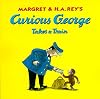
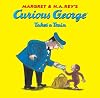
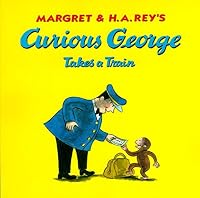
While waiting for the man with the yellow hat to buy train tickets, Curious George causes trouble by mixing up numbers on the schedule, but he makes up for it when a little boy's toy rolls toward the tracks.Tags
Recommendations





Member Reviews
Curious George, the Man in the Yellow Hat, and Mrs. Needleman decide to go on a trip and thus head to the train station. George is soon distracted by the trainmaster posting the train schedules by hand on the board and tries to do the same, but of course his slapdash entries make for thorough confusion. However, George more than redeems himself by later rescuing a small child from falling on to the tracks.
I absolutely love Curious George, and this book did not fail, even though some of it is rather dated. (For instance, most train stations now have electronic boards, so children might not 100% get why/how the trainmaster is moving the arriving and departing times by hand.) As usual, George creates some mischief by trying to do something show more without thinking through the consequences, but he then gains forgiveness by making up for it with a good action. George seems like a very relatable character for children (and honestly for adults as well) in that he means well but sometimes makes mistakes. Rather than being berated for his errors, he learns from them.
The illustrations, billed as "in the style of the H.A. Rey," are quite comparable to the original ones by the series' co-creator. They do a fine job of complementing the story so that children can use them to help them decode the words or to simply follow along as an adult reads aloud to them. show less
I absolutely love Curious George, and this book did not fail, even though some of it is rather dated. (For instance, most train stations now have electronic boards, so children might not 100% get why/how the trainmaster is moving the arriving and departing times by hand.) As usual, George creates some mischief by trying to do something show more without thinking through the consequences, but he then gains forgiveness by making up for it with a good action. George seems like a very relatable character for children (and honestly for adults as well) in that he means well but sometimes makes mistakes. Rather than being berated for his errors, he learns from them.
The illustrations, billed as "in the style of the H.A. Rey," are quite comparable to the original ones by the series' co-creator. They do a fine job of complementing the story so that children can use them to help them decode the words or to simply follow along as an adult reads aloud to them. show less
Curious George and The Man with the Yellow Hat visit the train depot to take a trip to the country. While the man heads off to buy tickets, George notices a man working on a big sign, rearranging numbers and letters. Of course, George is curious. Of course, George gets in trouble. He tries to help by moving more numbers and letters around. Unfortunately, the sign is announcing departures and arrivals. Now everyone is mad at George! After he saves a little boy from falling in a train's path, he's a hero and everyone forgives him for changing the sign. Also, George has a new friend.
The books in the Curious George series tend to fall in a pattern: George is curious, George accidentally causes problems, George redeems himself. The writing show more isn't spectacular, but I can see why kids like them so much. George is like a child - he is curious about the world around him, and his inexperience and youth lead him into accidental mistakes. He always means well, though, and his acts of bravery prove that. Plus, the pictures are endearing. On a personal note, my little girl is mad about this monkey, so I foresee many more Curious George titles in my future. show less
The books in the Curious George series tend to fall in a pattern: George is curious, George accidentally causes problems, George redeems himself. The writing show more isn't spectacular, but I can see why kids like them so much. George is like a child - he is curious about the world around him, and his inexperience and youth lead him into accidental mistakes. He always means well, though, and his acts of bravery prove that. Plus, the pictures are endearing. On a personal note, my little girl is mad about this monkey, so I foresee many more Curious George titles in my future. show less
Curious George heads to the train station to take a trip with the Man with the Yellow Hat, but when he tries to help out the station master, he gets himself into trouble. George finds himself a hiding place--only to discover that his help is really needed when a little boy's toy train is about to fall onto the tracks.
Hans Augusto Rey was born in Hamburg, Germany in 1898. As a child, he spent much of his free time in that city's famous Hagenbeck Zoo drawing animals. After serving in the army during World War I, he studied philology and natural science at the University of Hamburg. He then married Margret Rey and they moved to Montmartre for four years. The manuscript for the first Curious George books was one of the few items the Reys show more carried with them on their bicycles when they escaped from Paris in 1940. Eventually, they made their way to the United States, and Curious George was published in 1941. Curious George has been published in many languages, including French, German, Japanese, Afrikaans, and Norwegian. show less
Hans Augusto Rey was born in Hamburg, Germany in 1898. As a child, he spent much of his free time in that city's famous Hagenbeck Zoo drawing animals. After serving in the army during World War I, he studied philology and natural science at the University of Hamburg. He then married Margret Rey and they moved to Montmartre for four years. The manuscript for the first Curious George books was one of the few items the Reys show more carried with them on their bicycles when they escaped from Paris in 1940. Eventually, they made their way to the United States, and Curious George was published in 1941. Curious George has been published in many languages, including French, German, Japanese, Afrikaans, and Norwegian. show less
More adventures with George who seems to always get into trouble.
Ratings
Members
- Recently Added By
Author Information

130+ Works 52,713 Members
Margarete Elisabeth Waldstein was born in Hamburg on May 16, 1906. She briefly met her future husband, H. A. Rey, when she was a young girl, but then left for Hamburg to study art. They were reunited in 1935 in Rio de Janeiro, where Rey had gone to escape the political climate in Germany. Margret convinced Hans to leave the family business, and show more soon they were working together on a variety of projects. Hans and Margret were married in Brazil on August 16, 1935, but they soon moved to Paris. It was there that Hans published his first children's book, after a French publisher saw his newspaper cartoons of a giraffe and asked him to expand upon them. Raffy and the Nine Monkeys was the result, and the debuted the mischievous monkey named Curious George. After Raffy and the Nine Monkeys was published, the Reys began a book of Curious George's own. Before the new manuscript could be published, the Reys, both German Jews, found themselves being forced to flee the Nazi occupation. From Lisbon, they made their way to Brazil and on to New York City, where they began a whole new life as children's book authors. Curious George was published by Houghton Mifflin in 1941. All the Curious George books, including the seven original stories by Margret and Hans, have sold over 25 million copies and are so popular that the original story has never been out of print. Margret Rey passed away in 1996, but not before establishing the Curious George Foundation in 1989, which gives money to children and animals. (Bowker Author Biography) show less

294+ Works 69,772 Members
Hans Augusto Rey was born on September 16, 1898 in Hamburg, Germany. He escaped to Paris with his wife after the Nazi's invaded. While in Paris, Hans's animal drawings came to the attention of French publisher, who commissioned him to write a children's book. The result, Rafi and the Nine Monkeys, is little remembered today, but one of its show more characters, an adorably impish monkey named Curious George, was such a success that the couple considered writing a book just about him. Their work was interrupted with the outbreak of World War II. As Jews, the Reys decided to flee Paris before the Nazis seized the city. Hans built two bicycles, and they fled Paris just a few hours before it fell. Among the meager possessions they brought with them was the illustrated manuscript of Curious George. The books were published by Houghton Mifflin in 1941. Curious George was an instant success, and the Reys were commissioned to write more adventures of the mischievous monkey and his friend, the Man in the Yellow Hat. They wrote seven stories in all. Their title Happy Halloween made The New York Times Best Seller List in 2013. At first, Margret's name was left off the cover because there was a glut of women already writing children's fiction. In later editions, this was corrected, and Margret now receives full credit for her role in developing the stories. H. A. Rey died in 1977 and in 1989 Margaret Rey established the Curious George Foundation to help creative children and prevent cruelty to animals. (Bowker Author Biography) show less
All Editions
Series

Work Relationships
Is contained in
Common Knowledge
- Original title
- Curious George Takes a Train
- Alternate titles
- Curious George Catches a Train
Classifications
Statistics
- Members
- 758
- Popularity
- 36,874
- Reviews
- 4
- Rating
- (3.39)
- Languages
- English
- Media
- Paper, Ebook
- ISBNs
- 16
- UPCs
- 2
- ASINs
- 8