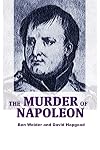
The Murder of Napoleon
by Ben Weider, David Hapgood
On This Page
Description
A narrative of Napoleon's final years in exile on the island of St. Helena and of a 20th century toxicologistdetective's efforts to prove that his death was caused by arsenic poisoning.Tags
Recommendations







































Member Reviews
I know that some do not agree with the facts stated in this book, but to me it shows complete proof that Napoleon was poisoned on orders from the French government. There is just too much evidence showing the murder. The facts have been suppressed by the French because it would be an embarrassment, especially because it was done by someone who was one of the staff of Napoleon who was there with him. The English, too, do not wants the facts known - he was their prisoner. Many years ago, before this book came out (along with "The Assassination of Napoleon"), I wondered how Napoleon, who was still young and healthy, would suddenly become ill and die. His symptoms were not those of cancer, the official cause of death. This is a very show more interesting book, a must for history buffs. It goes back and forth between the discovery by Sten Forshufvud of the poisoning in the late 20th century and the life of Napoleon on St Helena. The end of Napoleon is very sad, sick and dying with only a few followers.... show less
Napoleon's death was not without controversy and there is evidence that he may have been poisoned. As a fascinating sidelight to the story of Napoleon, it appears that Count Charles-Tristan de Montholon, an aide to Napoleon and a member of the "pre-Revolutionary aristocracy" poisoned him slowly with arsenic (a poison) on St. Helena (Weider, p. 33).
Napoleon, although it was widely known that he had suffered from physical ailments his entire life (it appears to be the scratching disease, scabies, Napoleon's Glands, Arno Karlen, p. 7), had nonetheless a legendary reputation for work; yet, he succumbed at the relatively young age of 51 thus at the very least his death should raise questions.
At the time of Napoleon's death, the arsenic show more poisoning went unnoticed and it was not until a Swedish researcher in 1955, Sten Forshufvud, reconstructed the accounts and medical evidence of Napoleon's death that a modern, forensic connection could be established determining that Napoleon was murdered. Montholon had a motive, he was attached to the pre-Revolutionary aristocracy, and he appeared to be an agent of Count d'Artois, brother of King Louis XVIII, and later Charles X in the restored French monarchy who hated the Revolutionary Napoleon (Weider, pp. 144, 254).
Napoleon himself may have sensed something was amiss in his last days. Six days before his death he directed:
"After my death, which cannot be far off. I want you to open my body. . . . I want you to remove my heart, which you will put in spirits of wine and take to Parma, to my dear Marie-Louise [Napoleon's second wife]. . . . I recommend that you examine my stomach particularly carefully; make a precise, detailed report on it, and give it to my son. . . . I charge you to overlook nothing in this examination. . . . I bequeath to all the ruling families the horror and shame of my last moments."
(Wieder, preface). show less
Napoleon, although it was widely known that he had suffered from physical ailments his entire life (it appears to be the scratching disease, scabies, Napoleon's Glands, Arno Karlen, p. 7), had nonetheless a legendary reputation for work; yet, he succumbed at the relatively young age of 51 thus at the very least his death should raise questions.
At the time of Napoleon's death, the arsenic show more poisoning went unnoticed and it was not until a Swedish researcher in 1955, Sten Forshufvud, reconstructed the accounts and medical evidence of Napoleon's death that a modern, forensic connection could be established determining that Napoleon was murdered. Montholon had a motive, he was attached to the pre-Revolutionary aristocracy, and he appeared to be an agent of Count d'Artois, brother of King Louis XVIII, and later Charles X in the restored French monarchy who hated the Revolutionary Napoleon (Weider, pp. 144, 254).
Napoleon himself may have sensed something was amiss in his last days. Six days before his death he directed:
"After my death, which cannot be far off. I want you to open my body. . . . I want you to remove my heart, which you will put in spirits of wine and take to Parma, to my dear Marie-Louise [Napoleon's second wife]. . . . I recommend that you examine my stomach particularly carefully; make a precise, detailed report on it, and give it to my son. . . . I charge you to overlook nothing in this examination. . . . I bequeath to all the ruling families the horror and shame of my last moments."
(Wieder, preface). show less
Considering the fact that Ben Weider was a contributor to this & Assassination at St. Helena Revisited, this [earlier] work has a completely different writing style than his later works making it a lot easier to read. I find it surprising, however, that Forshfvud had not written his account until much later as he had done the preliminary work that was to bring about the conclusions of the Emperor’s death.
All of the people Forshfvud had met while researching his work were enthralled with Napoleon. (Where are these people & where can I meet them??? Mon Dieu, it must be nice to meet & know people that have similar interests as one’s own!)
Overall, the book is a nice prelude to Forshufvud’s Who Killed Napoleon? & Sokoloff’s show more Napoleon: A Doctor’s Biography, which are always included in the bibliography of the most respectable works of one of the most remarkable people to have lived in the past three hundred years. show less
All of the people Forshfvud had met while researching his work were enthralled with Napoleon. (Where are these people & where can I meet them??? Mon Dieu, it must be nice to meet & know people that have similar interests as one’s own!)
Overall, the book is a nice prelude to Forshufvud’s Who Killed Napoleon? & Sokoloff’s show more Napoleon: A Doctor’s Biography, which are always included in the bibliography of the most respectable works of one of the most remarkable people to have lived in the past three hundred years. show less
Considering the fact that Ben Weider was a contributor to this & Assassination at St. Helena Revisited, this [earlier] work has a completely different writing style than his later works making it a lot easier to read. I find it surprising, however, that Forshfvud had not written his account until much later as he had done the preliminary work that was to bring about the conclusions of the Emperor’s death.
All of the people Forshfvud had met while researching his work were enthralled with Napoleon. (Where are these people & where can I meet them??? Mon Dieu, it must be nice to meet & know people that have similar interests as one’s own!)
Overall, the book is a nice prelude to Forshufvud’s Who Killed Napoleon? & Sokoloff’s show more Napoleon: A Doctor’s Biography, which are always included in the bibliography of the most respectable works of one of the most remarkable people to have lived in the past three hundred years. show less
All of the people Forshfvud had met while researching his work were enthralled with Napoleon. (Where are these people & where can I meet them??? Mon Dieu, it must be nice to meet & know people that have similar interests as one’s own!)
Overall, the book is a nice prelude to Forshufvud’s Who Killed Napoleon? & Sokoloff’s show more Napoleon: A Doctor’s Biography, which are always included in the bibliography of the most respectable works of one of the most remarkable people to have lived in the past three hundred years. show less
Ratings
Members
- Recently Added By
Author Information

14+ Works 412 Members
Ben Weider is currently President of the International Napoleonic Society which has affiliated organisations in 30 countries.
14+ Works 388 Members
Common Knowledge
- Canonical title
- The Murder of Napoleon
- Original publication date
- 1982
- People/Characters
- Napoleon Bonaparte
- Important places
- St Helena
- Epigraph
- After my death, which cannot be far off, I want you to open my body . . . I want you to remove my heart, which you will put in spirits of wine and take to Parma, to my dear Marie-Louise . . . I recommend that you examine my s... (show all)tomach particularly carefully; make a precise detailed report on it, and give it to my son. . . . I cahrge you to overlook nothing in this examination. ... I bequeath to all the ruling families the horror and shame of my last moments. - Napoleon to his doctor six days before his death
- First words
- At dusk, they heard the cannon of the British garrison sound retreat, and the sun vanished in a burst of light.
- Last words
- (Click to show. Warning: May contain spoilers.)With a last look at the concrete slab behind its metal fence, Forshufvud turned and strode rapidly of toward the road to Jamestown and home to Göteborg.
- Blurbers
- Ross, Steven; Chandler, David; Barthel, Joan; Baden, Michael M. M.D.; Barkham, John
- Original language
- English
Classifications
- Genres
- History, Nonfiction, General Nonfiction, Biography & Memoir
- DDC/MDS
- 944.05 — History & geography History of Europe France and Monaco France First empire 1804-1815
- LCC
- DC212 .W44 — History of Europe, Asia, Africa and Oceania France – Andorra – Monaco History of France Modern, 1515- Revolutionary and Napoleonic period, 1789-1815
- BISAC
Statistics
- Members
- 186
- Popularity
- 176,685
- Reviews
- 4
- Rating
- (4.08)
- Languages
- 5 — Dutch, English, Hungarian, Italian, Swedish
- Media
- Paper
- ISBNs
- 14
- ASINs
- 2