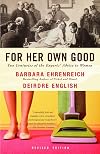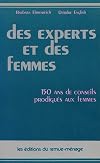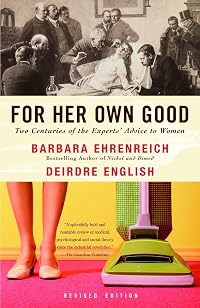
For Her Own Good: Two Centuries of the Experts Advice to Women
by Barbara Ehrenreich, Deirdre English
On This Page
Description
From the Publisher: A provocative new perspective on female history, the history of American medicine and psychology, and the history of child-rearing unlike any other.Tags
Recommendations










Member Recommendations
Member Reviews
Igrew up in a conservative home in a conservative state with a religion that enshrined conservatism more than Christianity. Fortunately, I was allowed to read, and reading has become a salvation of sorts. As I’ve aged and expanded my horizons, I’ve nonetheless grown concerned that I might have picked up some bad habits along the way. I’m recognized as an expert in my field, but I strive not to be one that oppresses others. Instead, I seek to empower others, and that includes women. Thus, I picked up this book, now in a revised edition supplanting its classic in the late 1970s.
Throughout history, women have been told who to be much more than they’ve been empowered to do the telling. When they’ve held leadership roles, their show more audiences are often limited to other women and children. Sometimes, the “children” part is even limited just to girls. The role of an “expert” has often functioned to put women in a box, not of their own making. Experts, however, changed their advice over time. This confusion often obscured rather than helped.
Things were not always so. Before the industrial revolution, women used to play a recognized, necessary role in an agrarian society. After industrial workplaces took root, it became hard to put women into a society organized around male work. Women were always put in a place, though this place tended to change with time. In this book, Barbara Ehrenreich and Deirdre English document how experts came to rule the roost, so to speak, of womankind and how women eventually rebelled to find their own perspectives after the twentieth century’s feminism.
It’s been almost two decades since this revised edition has been published. Personally, I’ve grown more awake to the contributions of women around me. American culture seems even more entrenched in culture wars, to the point of empowering anti-feminists, seemingly just for effect. This book remains important to remind us of where we’ve come from. Humanity need not suffer endless wars over how much to restrict people from choosing, and people can have real choices without destroying society. Centralized experts do not know everything. This book contributes a reasoned explanation for these feminist views and empowers readers to choose for themselves. show less
Throughout history, women have been told who to be much more than they’ve been empowered to do the telling. When they’ve held leadership roles, their show more audiences are often limited to other women and children. Sometimes, the “children” part is even limited just to girls. The role of an “expert” has often functioned to put women in a box, not of their own making. Experts, however, changed their advice over time. This confusion often obscured rather than helped.
Things were not always so. Before the industrial revolution, women used to play a recognized, necessary role in an agrarian society. After industrial workplaces took root, it became hard to put women into a society organized around male work. Women were always put in a place, though this place tended to change with time. In this book, Barbara Ehrenreich and Deirdre English document how experts came to rule the roost, so to speak, of womankind and how women eventually rebelled to find their own perspectives after the twentieth century’s feminism.
It’s been almost two decades since this revised edition has been published. Personally, I’ve grown more awake to the contributions of women around me. American culture seems even more entrenched in culture wars, to the point of empowering anti-feminists, seemingly just for effect. This book remains important to remind us of where we’ve come from. Humanity need not suffer endless wars over how much to restrict people from choosing, and people can have real choices without destroying society. Centralized experts do not know everything. This book contributes a reasoned explanation for these feminist views and empowers readers to choose for themselves. show less
Ehrenreich and English look at what kind of advice we've been given for the last two hundred years. Although they provide a good deal of social, political, economic, and general background to the development and evolution of experts, the part I found most fascinating was on the creation of what we consider medical doctors. I hadn't realized how culturally specific, oft-changing, and purposefully created our modern conception of medicine is.
For instance, the cultural ancestors of modern doctors were just dudes who had enough money and class status to go to university and learn classical languages. They never learned anatomy or how to treat illnesses in any evidence-based manner. In fact, to maintain their status as "gentlemen," they show more didn't touch their patients (instead leaving the dispensing of medicines, bone-setting, childbirth, etc to others) or receive payment for their services (they were instead given "gifts"). But given that their medical knowledge was entirely based in classical literature, they were not particularly helpful. Instead, most people used what we now term folk-medicine (practiced by a healer in their area), which *was* mostly evidence-based and very much in line with modern conceptions of medicine (understandings of anatomy, palpating the lymph nodes, knowing what the patient ate, what their stools looked like, etc). But "regular" doctors had the rich on their side, so when science and the scientific method began to gain credence, they were able to lay claim to science first, while simultaneously suing to have all doctors who didn't go to their specific universities be considered criminals if they practiced medicine. It worked! Oh classism. And thus, for the next hundred years or so, the UK and US were left with doctors who had a very narrow understanding of what to look for to judge health. Mental state, nutrition, environment...all of this fell by the way-side.
Ehrenreich and English also talk a bit about how various credentials came to be and the double-binds created by psychologists for women. And don't think women were martyred saints, either--white, middle and upper class women were instrumental in all sorts of bs movements to "improve" the poor and minority groups. Overall, a good read, with nuggets of biting sarcasm to match the facts and anecdotes. show less
For instance, the cultural ancestors of modern doctors were just dudes who had enough money and class status to go to university and learn classical languages. They never learned anatomy or how to treat illnesses in any evidence-based manner. In fact, to maintain their status as "gentlemen," they show more didn't touch their patients (instead leaving the dispensing of medicines, bone-setting, childbirth, etc to others) or receive payment for their services (they were instead given "gifts"). But given that their medical knowledge was entirely based in classical literature, they were not particularly helpful. Instead, most people used what we now term folk-medicine (practiced by a healer in their area), which *was* mostly evidence-based and very much in line with modern conceptions of medicine (understandings of anatomy, palpating the lymph nodes, knowing what the patient ate, what their stools looked like, etc). But "regular" doctors had the rich on their side, so when science and the scientific method began to gain credence, they were able to lay claim to science first, while simultaneously suing to have all doctors who didn't go to their specific universities be considered criminals if they practiced medicine. It worked! Oh classism. And thus, for the next hundred years or so, the UK and US were left with doctors who had a very narrow understanding of what to look for to judge health. Mental state, nutrition, environment...all of this fell by the way-side.
Ehrenreich and English also talk a bit about how various credentials came to be and the double-binds created by psychologists for women. And don't think women were martyred saints, either--white, middle and upper class women were instrumental in all sorts of bs movements to "improve" the poor and minority groups. Overall, a good read, with nuggets of biting sarcasm to match the facts and anecdotes. show less
An interesting work of deconstruction, Ehrenreich and English sketch the rise of the "scientific" expert in American society and trace the history of the advice these experts have given women on how to be women. The authors find the problem is the unwilligness people to question the structure of society and relying on a false binary between the choices of assimilating to the norms of the culture or adjusting to life in the margins. Of course, being a theology geek, I immediately thought: well, here's a place a hearty dose of the Jesus Movement (and I'm thinking of holy vagrants, not the pseudo-Paul) could be useful.
I feel that the authors passed over the role religion and the religious "experts" have played in doling out advice to women show more that has trapped them in a false dichotomy between sacrificing themselves to create an oasis or giving up on morals and ethics to assimilate to the outside world. In the epilogue they touched briefly on how the neo-romantics (Phyllis Schafly, Focus on the Family, and company) have relied upon religion rather than science to justify a binary division of the genders into private women and public men. This is different from the romanticism of the previous eras which used science to add legitimacy to demand that women stay barefoot and pregnant in their kitchens. They also touch briefly on the model for God adopted by the neo-romantics, "a God who has made his peace with the consumer society" (320). Religion is a powerful force in any society, either for good or ill. Unfortunately, in America at the moment, it appears that Christianity's public image has been hijacked by people who are using it for ill.
Reconstruction is where this book, as do many in the area, falls short. Ehrenreich and English fail to offer up much in the way of a plan of action. The authors offer little in the way of suggestions as to exactly how society should begin to address the problems created by a marketplace mentality in which human beings are reduced to cogs in an assembly line. There's a clear and convincing argument that humans much change the system, but not a plan of how to change the system or even a particularly detailed vision of what the institutional structures should look like. (There's a newer edition out as of 2005, they may have added something to this effect.) show less
I feel that the authors passed over the role religion and the religious "experts" have played in doling out advice to women show more that has trapped them in a false dichotomy between sacrificing themselves to create an oasis or giving up on morals and ethics to assimilate to the outside world. In the epilogue they touched briefly on how the neo-romantics (Phyllis Schafly, Focus on the Family, and company) have relied upon religion rather than science to justify a binary division of the genders into private women and public men. This is different from the romanticism of the previous eras which used science to add legitimacy to demand that women stay barefoot and pregnant in their kitchens. They also touch briefly on the model for God adopted by the neo-romantics, "a God who has made his peace with the consumer society" (320). Religion is a powerful force in any society, either for good or ill. Unfortunately, in America at the moment, it appears that Christianity's public image has been hijacked by people who are using it for ill.
Reconstruction is where this book, as do many in the area, falls short. Ehrenreich and English fail to offer up much in the way of a plan of action. The authors offer little in the way of suggestions as to exactly how society should begin to address the problems created by a marketplace mentality in which human beings are reduced to cogs in an assembly line. There's a clear and convincing argument that humans much change the system, but not a plan of how to change the system or even a particularly detailed vision of what the institutional structures should look like. (There's a newer edition out as of 2005, they may have added something to this effect.) show less
Ehrenreich put together a very comprehensive, well-researched book on the effect of "expert" advice on women over a two-hundred-year span. The chronicle is both hilarious and frightening. We see women being celebrated as frail, delicate creatures whose reproductive organs are the source of every illness... then later women are descended upon by psychologists and deemed too dangerous to run a family, having penis envy and ambition compelling them to kill their children. Mothers were considered the heart of the home for their childrearing powers, then considered too weak to raise their own sons. It's enough to make a woman never buy a self-help book again.
It's amazing to see how much the woman's role has changed in two centuries. Before show more machines became a way of life, women had a lot of work to do. Surprisingly, we learn that housecleaning was low on the list. It wasn't until the the 20th century where women's boredom and advertisers met to compel a frenzy for housecleaning. Early women were too busy making all their home's supplies. When all of women's traditional work was being taken over by factories, and their healing knowledge taken away by men, the Woman Question arrived. With so little to do, what was a woman's role in society? What was her contribution to her household? Early feminists argued that women were reduced to glorified prostitutes, with their skills and knowledge taken away. The Woman Question is one that was debated until the feminists exploded into the 1960s and '70s.
At this point, after the women's rights movement of the '70s, Ehrenreich falters a bit when describing the "Let's think about me, now" attitude of women who eschewed a husband and kids for a childfree life. She paints these as selfish people obsessed with money and free time. True, many women feeling stifled under the confines of traditional society would start thinking of their own needs in a manner considered "selfish" after centuries of thinking solely of their family's comfort. Ehrenreich seems to think that the advice of earlier "experts" who encouraged permissiveness went too far and made child-haters of these women. On the contrary, the childfree movement that stemmed from modern feminism is all about the choice to have children. Since Ehrenreich clearly approves of abortion in her writing, it is strange that she gets a little touchy over the choice to be a mother or not. Since the author is pro-choice, she may not have thought out the connection to those who abstain from childrearing entirely, and how they must fight charges of selfishness just as those who get an abortion fight charges of being a "murderer." I wonder if Ehrenreich, being a mother, is aghast at how feminism inspired future generations of women to live a childfree life.
Other than that criticism, I found the book a valuable source of information. I want to wave it under the nose of every person who thinks the feminist movement was a mistake. I want to yell at them, "Do you know where these doctors would put leeches on a woman because her husband could drag her in to a doctors office for an attitude adjustment? Think of a place only her gynecologist would see - that's where they put those leeches!" But, as Ehrenreich points out, there are many people who buy into the romance of the woman invalid, the lobotomized housewife, and sheltered female who never has to make an important decision. Some may find this a blissful life, but as history proves, it's not necessarily a healthy one for women. show less
It's amazing to see how much the woman's role has changed in two centuries. Before show more machines became a way of life, women had a lot of work to do. Surprisingly, we learn that housecleaning was low on the list. It wasn't until the the 20th century where women's boredom and advertisers met to compel a frenzy for housecleaning. Early women were too busy making all their home's supplies. When all of women's traditional work was being taken over by factories, and their healing knowledge taken away by men, the Woman Question arrived. With so little to do, what was a woman's role in society? What was her contribution to her household? Early feminists argued that women were reduced to glorified prostitutes, with their skills and knowledge taken away. The Woman Question is one that was debated until the feminists exploded into the 1960s and '70s.
At this point, after the women's rights movement of the '70s, Ehrenreich falters a bit when describing the "Let's think about me, now" attitude of women who eschewed a husband and kids for a childfree life. She paints these as selfish people obsessed with money and free time. True, many women feeling stifled under the confines of traditional society would start thinking of their own needs in a manner considered "selfish" after centuries of thinking solely of their family's comfort. Ehrenreich seems to think that the advice of earlier "experts" who encouraged permissiveness went too far and made child-haters of these women. On the contrary, the childfree movement that stemmed from modern feminism is all about the choice to have children. Since Ehrenreich clearly approves of abortion in her writing, it is strange that she gets a little touchy over the choice to be a mother or not. Since the author is pro-choice, she may not have thought out the connection to those who abstain from childrearing entirely, and how they must fight charges of selfishness just as those who get an abortion fight charges of being a "murderer." I wonder if Ehrenreich, being a mother, is aghast at how feminism inspired future generations of women to live a childfree life.
Other than that criticism, I found the book a valuable source of information. I want to wave it under the nose of every person who thinks the feminist movement was a mistake. I want to yell at them, "Do you know where these doctors would put leeches on a woman because her husband could drag her in to a doctors office for an attitude adjustment? Think of a place only her gynecologist would see - that's where they put those leeches!" But, as Ehrenreich points out, there are many people who buy into the romance of the woman invalid, the lobotomized housewife, and sheltered female who never has to make an important decision. Some may find this a blissful life, but as history proves, it's not necessarily a healthy one for women. show less
While I found Ehrenreich and English's thesis to be fascinating (the Industrial Revolution led to the division of work and home into separate spheres that created the rigid gender roles which ruled 19th- and 20th-century medical discourse until the feminist movement in the late '60s/early '70s), their tone is sometimes churlish and judgmental. The best parts of the book deal with the 19th and early 20th centuries, but when it gets closer to the authors' own era, some of their personal beliefs start to color their interpretation of historical events. For instance, I was really puzzled by the fact that while they are obviously pro-contraception and pro-choice (although they give little information about these topics in the book; show more admittedly, these are so weighty and complex that they would probably require a separate book), Ehrenreich and English launch into a condescending dismissal of women who choose not to have children as "selfish", i.e., not fulfilling their role as women (very odd considering that the book is concerned with liberating women to redefine social roles in the face of alleged expert advice). Ironically, their liberal, socialist tendencies often come across as just as proscriptive as the experts' advice that they rail against.
They do proffer much valid criticism of the way that the medical profession has too often veiled its own misogynistic views as "science-based", and I did find that aspect of the book provocative. So while this is definitely worth reading, I would take some of Ehrenreich and English's interpretations with a grain of salt. I also agree with the reviewer who remarks on the lack of suggestions for how human beings (both men and women) can better incorporate, modify, or reject expert advice to live productive, creative lives in a capitalist society. The book spends so much time highlighting what is wrong with capitalism and American individualism that it virtually ignores the fact that, for better of worse, life in a democratic society has made such critiques possible.
Despite the afterword that covers events up to the early 2000s, the book often has an aggressively utopian quality that betrays its origins in the rather humorless world of late '70s sociopolitical discourse (it was originally published in 1978). For Her Own Good would make a good introductory text for both women' studies and health care courses not only for the solid historical evidence that it often provides (the excerpts from Freudian tomes are especially chilling) but also as an examination of biases that occasionally undermine the authors' arguments. show less
They do proffer much valid criticism of the way that the medical profession has too often veiled its own misogynistic views as "science-based", and I did find that aspect of the book provocative. So while this is definitely worth reading, I would take some of Ehrenreich and English's interpretations with a grain of salt. I also agree with the reviewer who remarks on the lack of suggestions for how human beings (both men and women) can better incorporate, modify, or reject expert advice to live productive, creative lives in a capitalist society. The book spends so much time highlighting what is wrong with capitalism and American individualism that it virtually ignores the fact that, for better of worse, life in a democratic society has made such critiques possible.
Despite the afterword that covers events up to the early 2000s, the book often has an aggressively utopian quality that betrays its origins in the rather humorless world of late '70s sociopolitical discourse (it was originally published in 1978). For Her Own Good would make a good introductory text for both women' studies and health care courses not only for the solid historical evidence that it often provides (the excerpts from Freudian tomes are especially chilling) but also as an examination of biases that occasionally undermine the authors' arguments. show less
Co-authors Ehrenreich and English trace two centuries of women’s history from the industrial revolution into the 1970s. A 2004 epilogue extends the history into the early 21st century. Ehrenreich and English are critical of the growth and influence of scientific experts who proffered advice to women (mostly middle-class) on how to live. The goal posts continually moved so that each succeeding generation of “experts” corrected the “advice” of the preceding generation. The Secret History of Home Economics covers some of the same ground in a much more engaging manner.
A history of how the status of women has changed since the Industrial Revolution, when the modern gender roles were delineated based on the new divisions of labor. Very well researched, and well written, it suffers quite a bit, especially in early chapters, from a suspension of skepticism in the face of "woman's" medicine - the various herbals and potions that were used before the birth of modern medicine. There is a great deal of accuracy in the description of the failure of medicine at that time, but the presentation of these other methods as effective is perhaps a bit credulous. Otherwise, a very solid work by a writer with a sense of irony.
Members
- Recently Added By
Lists

Best Medical Nonfiction
79 works; 29 members

Penguin Random House
458 works; 4 members

Books Read in 2015
3,299 works; 126 members
Author Information

35+ Works 22,915 Members
Barbara Ehrenreich is the author of "Blood Rites"; "The Worst Years of Our Lives"; "Fear of Falling", which was nominated for a National Book Critics Circle Award, & eight other books. A frequent contributor to Time, Harper's, Esquire, The New Republic, Mirabella, The Nation, The New York Magazine, she lives near Key West, Florida. (Publisher Fact show more Sheets) Political activist and writer Barbara Ehrenreich was born in Butte, Montana on August 26, 1941. She studied physics at Reed College and graduated in 1963. She received a Ph.D. in Cell Biology from Rockefeller University in 1968. Rather than pursuing a career in science, however, she decided to focus on social change. Ehrenreich has written columns and contributed articles to publications including Time Magazine, The Progressive, The New York Times, Mother Jones, The Atlantic Monthly, Ms, The New Republic, Harper's Magazine, and The Nation. She taught essay writing at the Graduate School of Journalism at the University of California, Berkeley in 1998 and 2000. Ehrenreich has written many books, with 2001's Nickel and Dimed: On (Not) Getting by in America and 2005's Bait and Switch, The (Futile) Pursuit of the American Dream both becoming New York Times bestsellers. Nickel and Dimed examines working-class poverty, while Bait and Switch discusses white-collar unemployment. Her next bestseller was in 2014 with Living With a Wild God: A Nonbeliever's Search for the Truth about Everything. In 1998 Ehrenreich was named Humanist of the Year by the American Humanist Association, and she received the Nation Institute/Puffin Foundation Prize for Creative Citizenship in 2004. (Bowker Author Biography) show less

4+ Works 2,132 Members
Common Knowledge
- Canonical title
- For Her Own Good: Two Centuries of the Experts Advice to Women
- Canonical LCC
- HQ1426 .E38
Classifications
- Genres
- Nonfiction, Sexuality and Gender Studies, General Nonfiction, History, Sociology
- DDC/MDS
- 305.420973 — Society, government, & culture Social sciences, sociology & anthropology Social group - Age, Gender, Ethnicity Women Social role and status of women Standard subdivisions History, geographic treatment, biography North America
- LCC
- HQ1426 .E38 — Social sciences The family. Marriage, Women and Sexuality The Family. Marriage. Women Women. Feminism
- BISAC
Statistics
- Members
- 917
- Popularity
- 29,309
- Reviews
- 21
- Rating
- (3.79)
- Languages
- Dutch, English, French, Spanish
- Media
- Paper, Ebook
- ISBNs
- 9
- ASINs
- 3