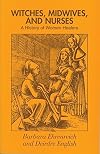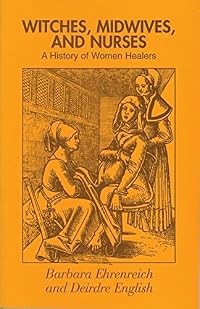
Witches, Midwives, and Nurses: A History of Women Healers
by Barbara Ehrenreich, Deirdre English
On This Page
Description
Witches, Midwives, and Nurses examines how women-led healing was delegitimized to make way for patriarchy, capitalism, and the emerging medical industry. As we watch another agonizing attempt to shift the future of healthcare in the United States, we are reminded of the longevity of this crisis, and how firmly entrenched we are in a system that doesn't work. First published by the Feminist Press in 1973, Witches, Midwives, and Nurses is an essential book about the corruption of the medical show more establishment and its historic roots in witch hunters. In this new and updated edition, Barbara Ehrenreich and Deirdre English delve into the current fascination with and controversies about witches, exposing our fears and fantasies. They build on their classic expose on the demonization of women healers and the political and economic monopolization of medicine. This quick history brings us up-to-date, exploring today's changing attitudes toward childbirth, alternative medicine, and modern-day witches. show lessTags
Recommendations











































Member Recommendations

Member Reviews
Another recommendation from Book Riot's Tailored Book Recommendation service. As this one was from Feminist Press, who I love, I went ahead and ordered a copy.
When it came it was such a tiny volume and I already knew it was a bit dated, that I really worried I wouldn't get much of of it, as this is a subject I have already done some reading about. But I LOVED this. I am sure it helped having the second edition, with the introduction that really places this work within its historical context. As usual, context is nearly everything, and I think I wouldn't have liked this book nearly as much without that introduction. This IS a "blaze of anger and indignation," but part of why the world has changed since this book came out is BECAUSE of show more this book -- and scholarship and activism in this vein.
Absolutely glad that I sought this out. show less
When it came it was such a tiny volume and I already knew it was a bit dated, that I really worried I wouldn't get much of of it, as this is a subject I have already done some reading about. But I LOVED this. I am sure it helped having the second edition, with the introduction that really places this work within its historical context. As usual, context is nearly everything, and I think I wouldn't have liked this book nearly as much without that introduction. This IS a "blaze of anger and indignation," but part of why the world has changed since this book came out is BECAUSE of show more this book -- and scholarship and activism in this vein.
Absolutely glad that I sought this out. show less
Is Witches, Midwives and Nurses: A History of Women Healers, first published in 1970, a bit dated? Yes. Does it contain an excellent history of how healing women (who once acted as midwives, yes, but as general healers as well) were first diminished by being deemed witches and then shunted into the supporting role of nurse? Yes, as well. This slim volume still makes for excellent reading, particularly to see how the Church and the emerging physicians’ associations made common cause in keeping women in their place.
If you're going to read this book, do yourself a favor and get the second edition. The introduction to this edition does a wonderful job of putting the book in context, as well as admitting where the authors were proven to be wrong with history... as well as right.
We take the subject of women's health for granted now. Not too long ago, however, it was a completely taboo subject. And women were perceived to be incapable of understanding and actively contributing to their own health. Where now breast cancer options are part and parcel of treatment, at the time of this book it was normal for a woman to go under for a biopsy and wake with a mastectomy. Ehrenreich and English chronicle some of the history of Western health care, both from show more the standpoint of what women received as well as what people received depending on social class. Medicine is not merely a matter of making a person well. It's tied in with power, money, social structures, and encouraging the status quo.
Because of this book, many women took an active interest in their health and actually learning about their bodies. A worthwhile read on a lot of fronts. show less
We take the subject of women's health for granted now. Not too long ago, however, it was a completely taboo subject. And women were perceived to be incapable of understanding and actively contributing to their own health. Where now breast cancer options are part and parcel of treatment, at the time of this book it was normal for a woman to go under for a biopsy and wake with a mastectomy. Ehrenreich and English chronicle some of the history of Western health care, both from show more the standpoint of what women received as well as what people received depending on social class. Medicine is not merely a matter of making a person well. It's tied in with power, money, social structures, and encouraging the status quo.
Because of this book, many women took an active interest in their health and actually learning about their bodies. A worthwhile read on a lot of fronts. show less
Engagées dans le Mouvement pour la santé des femmes dans les années 1970, Barbara Ehrenreich et Deirdre English enquêtent sur les racines historiques de la professionnalisation du corps médical. Portant un regard féministe sur les chasses aux sorcières en Europe et la suppression de la profession de sage-femme aux États-Unis, elles s’interrogent : et si, derrière ces événements, se cachait une véritable monopolisation poli-tique et économique de la médecine par les hommes de la classe dominante, reléguant peu à peu les femmes à la fonction subalterne d’infirmière docile et maternelle ?
Depuis sa parution aux États-Unis en 1973, cet essai concis et incisif a ouvert la voie à de nombreux travaux de recherche et show more prises de conscience. Cette traduction s’ouvre sur une préface inédite des deux auteures. show less
Depuis sa parution aux États-Unis en 1973, cet essai concis et incisif a ouvert la voie à de nombreux travaux de recherche et show more prises de conscience. Cette traduction s’ouvre sur une préface inédite des deux auteures. show less
The co-writers trace the history of the roles of woman from the distant past to the present. There are times they come across as a little too polemical, but overall it's an interesting and engaging history: as a scholar of the nineteenth century, I found the discussion of the emergence of nursing the most interesting part.
Profoundly informative. Published in the same year as [Our Bodies, Ourselves], this is a pungent critique of the treatment of women in the medical system, resulting from when the experience and training of midwives and other women healers was discredited with the formation of the male medical establishment.
Very short book (it was originally a pamphlet).
Good overview/introduction of women's status in healthcare, from witches to nurses.
Good overview/introduction of women's status in healthcare, from witches to nurses.
Members
- Recently Added By
Lists

Witch Hunts
30 works; 7 members

Feminist Press
26 works; 1 member
Author Information

35+ Works 22,837 Members
Barbara Ehrenreich is the author of "Blood Rites"; "The Worst Years of Our Lives"; "Fear of Falling", which was nominated for a National Book Critics Circle Award, & eight other books. A frequent contributor to Time, Harper's, Esquire, The New Republic, Mirabella, The Nation, The New York Magazine, she lives near Key West, Florida. (Publisher Fact show more Sheets) Political activist and writer Barbara Ehrenreich was born in Butte, Montana on August 26, 1941. She studied physics at Reed College and graduated in 1963. She received a Ph.D. in Cell Biology from Rockefeller University in 1968. Rather than pursuing a career in science, however, she decided to focus on social change. Ehrenreich has written columns and contributed articles to publications including Time Magazine, The Progressive, The New York Times, Mother Jones, The Atlantic Monthly, Ms, The New Republic, Harper's Magazine, and The Nation. She taught essay writing at the Graduate School of Journalism at the University of California, Berkeley in 1998 and 2000. Ehrenreich has written many books, with 2001's Nickel and Dimed: On (Not) Getting by in America and 2005's Bait and Switch, The (Futile) Pursuit of the American Dream both becoming New York Times bestsellers. Nickel and Dimed examines working-class poverty, while Bait and Switch discusses white-collar unemployment. Her next bestseller was in 2014 with Living With a Wild God: A Nonbeliever's Search for the Truth about Everything. In 1998 Ehrenreich was named Humanist of the Year by the American Humanist Association, and she received the Nation Institute/Puffin Foundation Prize for Creative Citizenship in 2004. (Bowker Author Biography) show less

4+ Works 2,110 Members
Some Editions
Series
Belongs to Publisher Series
Common Knowledge
- Canonical title
- Witches, Midwives, and Nurses: A History of Women Healers
- Original publication date
- 1973
Classifications
Statistics
- Members
- 923
- Popularity
- 28,878
- Reviews
- 8
- Rating
- (4.08)
- Languages
- Danish, English, French, German
- Media
- Paper, Ebook
- ISBNs
- 16
- ASINs
- 6